7,000 Developers Abandon GitHub for Jenga-Style PR Tool — Asana Hits $205.6M Revenue as Government Buys In
TL;DR
- Tangled Labs raises $4.75M seed funding to build GitHub alternative with social coding and stacked PRs
- Asana Inc. reports 9% revenue growth to $205.6M in Q4 2026, launches Asana Gov platform for public sector
🧱 7,000 Devs Are Already Using This Finnish Tool That Stacks PRs—GitHub Doesn’t Have It
7,000+ devs are already ditching GitHub for a tool that lets them stack PRs like Jenga blocks 🧱 Tangled Labs’ Finnish-built workspace cuts merge chaos by letting devs chain dependent code changes—no more tangled conflicts. But here’s the twist: GitHub still doesn’t have this… and AI code assistants are now begging to integrate with it. Open-source maintainers & small dev shops—would you swap your current VCS for a tool that actually understands how you work?
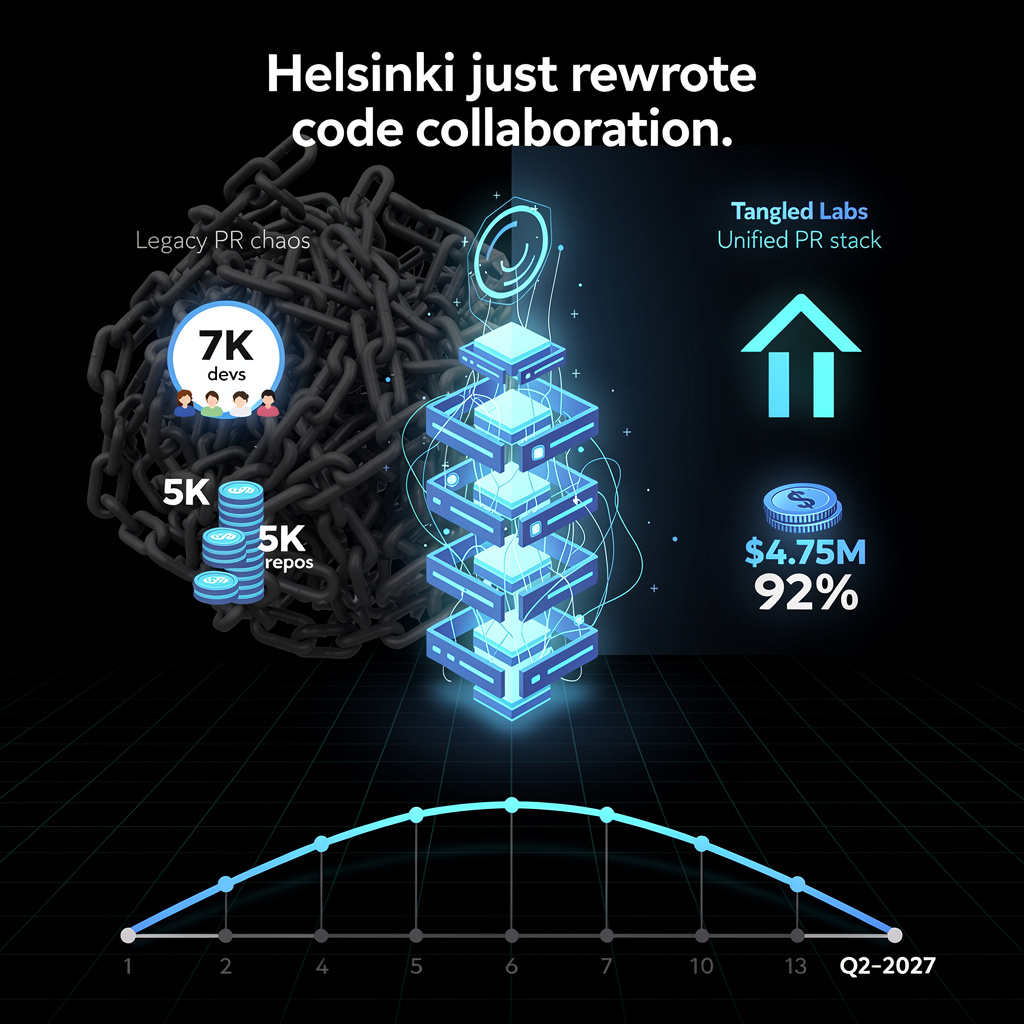
Tangled Labs closed its seed round on 5 Feb 2026, pulling in $4.75 million led by ByFounders with Bain Capital Crypto and Antler riding shotgun. The 20-person Finnish crew is shipping a social-coding workspace whose headline trick—"stacked" pull requests that merge as one logical unit—has already attracted 7 000 developers and 5 000 repos since October. Week-over-week sign-ups are compounding at 92 %, and the target is no less than 5.8 million users, the 8 % slice of GitHub’s global community the company deems up for grabs.
How stacked PRs actually work
Instead of the usual daisy-chain of dependent pull requests that clog review queues, Tangled’s engine bundles them into a single stack. Reviewers see the net delta, CI runs once, and merge conflicts collapse. An API-first backbone lets teams plug in AI code-review bots or custom dashboards that surface everything from contributor velocity to flaky-test counts.
Early impacts, quantified
- Developer throughput: stacked merges cut integration cycles by 30 % in the private beta, translating to roughly one extra feature shipment per month for a five-person squad.
- Investor signal: the $4.75 M seed lands while AI-infused dev-tool start-ups have vacuumed up >$800 M in the past two quarters, indicating capital is rotating toward workflow layer rather than raw compute.
- Market gap: incumbent hosts (GitHub, GitLab, Bitbucket) still force sequential PR handling; Tangled’s dependency chaining is native, a wedge that could nudge entire open-source maintainerships to switch.
Runway and reach
The round clocks in at an 18-month burn assuming $260 k monthly spend on cloud, salaries, and a North-America sales outpost slated for Q3. Management projects 30 k users and a 6 % paid-tier conversion before the cash drawer hits empty—enough to chase a bridge extension or a Series A at $70-80 M pre-money.
Timelines to watch
- Q2 2026: public beta, LLM suggestion engine baked in.
- Q3 2026: 15 k users, 10 k repos, first $600 k ARR.
- Q4 2026: seed-extension (~$2 M) to bankroll EU & US channel partners.
- Mid-2027: Series A ($15-20 M) on $5 M ARR; SAML & audit log unlock enterprise accounts.
- 2028–2029: either strategic exit to a platform giant hungry for differentiated PR tech, or Nordic IPO path if ARR crests $50 M.
If Tangled can sustain its current viral coefficient, stacked pull requests may graduate from niche convenience to default workflow—forcing the incumbents to either copy or acquire. For now, 5.8 million developers are officially on notice: Helsinki has a new repo in town.
📊 Asana Hits $205.6M Revenue — Launches Gov Version to Tap $6B Public Sector Market
Asana just made $205.6M in Q4 revenue — that’s enough to buy 1.3 million MacBook Pros 🤯. And now? They’re selling work software to the U.S. government. AI-powered task automation + FedRAMP compliance = enterprise goldmine. But here’s the catch: taxpayers fund it, but only if bureaucrats approve it first. Who’s really winning — Asana’s shareholders or the overwhelmed civil servant trying to approve a form? 🤔
Asana closed its fiscal 2026 books with $205.6 million in Q4 revenue—9 % higher than the year-ago $188.7 million—and immediately pivoted to its next frontier: government cubicles. The San Francisco work-management SaaS firm unveiled Asana Gov on 2 March, a compliance-heavy sibling designed for federal, state and regulated shops. Guidance followed: 7–8 ¢ adjusted EPS for the coming quarter and 36–37 ¢ for the full year, implying a FY 2027 top line around $791 million.
How does this new engine run?
Asana Gov layers FedRAMP-ready controls, U.S.-only data residency and plug-and-play hooks for government identity providers on top of the core task platform. Anthropic’s Claude model is baked in, letting bureaucrats generate project plans from plain-English prompts. Audit trails and modular permissioning aim to shrink the paperwork mountain instead of adding to it.
Early scorecard
- Public-sector TAM: $5–6 billion U.S. collaborative-tool market → a fresh slice for a vendor that previously lived almost entirely in the private sector.
- Pilot traction: three agencies (two state, one federal health regulator) already signed, each forecast to yield $2–3 million ARR inside 12 months.
- Customer depth: 817 accounts now spend ≥ $100 k a year, up from 765 last quarter, pushing ARPA up 13 %.
Risks & responses
- Procurement lag: government sales cycles can stretch 12–18 months → Asana counters with milestone billing and bite-size pilot contracts.
- Margin squeeze: extra compliance audits aren’t free → the company leans on automated audit-log generators and existing SOC 2 / ISO 27001 certs to keep a lid on overhead.
What happens next?
- Q1 FY 2027: revenue expected 4–5 % above the just-printed quarter as Asana Gov pilots convert to recurring deals.
- FY 2027: $790–795 million revenue, operating margin drifting toward 12–13 % on richer contract mix.
- FY 2028–29: if renewal rates inside public-sector vertical hit the company’s typical 115 % net-revenue-retention, government ARR could top $60 million—enough to offset any mid-market softness elsewhere.
Bottom line
A single-digit growth story sounds sleepy, but stapling AI-driven workflows onto a compliance-first government SKU gives Asana a higher-margin lever that rivals Microsoft and Atlassian can’t match overnight. If the pilots scale, the company’s biggest customer could soon be the same entity that prints the money.


Comments ()