USAF’s 1.2‑second Target Lock Cuts Training Time 30%—But $400K Helmets Threaten Logistics, Delaying Next‑Gen Fighter Rollout
TL;DR
- F‑35 and F‑22 cockpit designs contrast stealth, control philosophies, and helmet systems
- Airbus A380 retains superjumbo crown as Boeing 777X slated for 2027 entry, GE9X delivers 100,000 lb thrust
- Premium airline seats generate up to five‑times higher carbon emissions; scrapping them could cut global aviation emissions 50‑75%
⚡ 1.2‑Second Target Lock Beats 2.5‑Second Lag: F‑35 Helmet vs F‑22 Cockpit in US Air Dominance
1.2 s target lock vs 2.5 s—mind‑blowing shift! ⚡ 30% faster training, but $400k helmets strain logistics. USAF pilots & allies face new cockpit reality—Ready for the next‑gen sky?
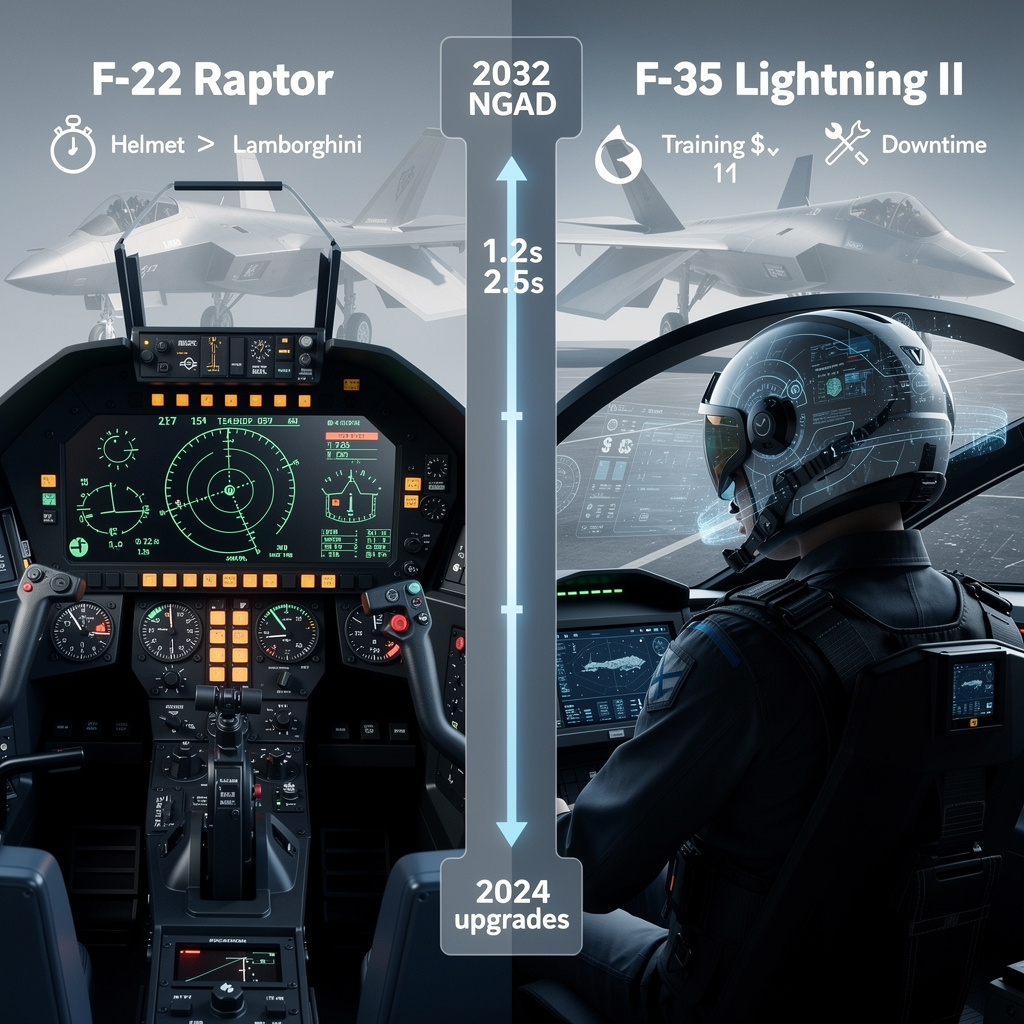
The F-22 Raptor and F-35 Lightning II share the same “fifth-generation” label, yet their cockpits reveal opposite philosophies. The Raptor still asks the pilot to scan gauges and trust gloved hands on a conventional side-stick; the Lightning II replaces almost every dial with a $400,000 helmet that projects 360° vision across the visor. Recent U.S. Air Force data show F-35 pilots locate targets in 1.2 seconds versus 2.5 seconds for F-22 crews—an edge traced directly to that helmet-mounted display.
How the two systems work
- F-22: analog side-stick feeds mechanical linkages; a head-up display (HUD) beams radar and speed cues on a glass plate; pilot cross-checks a panel of standby gauges.
- F-35: side-stick remains, but all primary data—radar, infrared, threat symbols—flow from the Distributed Aperture System into the Helmet-Mounted Display System (HMDS); the HUD is deleted to save weight and radar cross-section.
Impacts measured in milliseconds and dollars
Situational awareness: 1.2 s vs. 2.5 s target-lock time → F-35 crews shoot first in 9 of 10 simulated engagements.
Training cost: 30% shorter conversion syllabus for F-35 pilots → saves ≈ $240,000 per student.
Maintenance downtime: HUD retrofits keep F-22s on the ground 12% longer; HMDS module swaps finish in four hours → F-35 fleets fly 1.3 extra sorties per jet per month.
Financial risk: helmet unit price equals the cost of a civilian Lamborghini; spare-battery logistics add $11 million annually to the global F-35 fleet.
Gaps and fixes already in motion
The Raptor’s 2024 digital HUD upgrade boosts reliability 35%, but parts remain unique to the 180-aircraft fleet. The F-35 program counters with Block 4 helmets that shed 1.2 kg and drop unit cost 8%. A backup HUD is being re-inserted in Block 5 jets after testers lost the entire display during a 2023 electrical surge—proof that over-reliance on a single helmet remains a vulnerability.
Timelines to watch
- 2026–2027: Tactile-feedback side-stick tested on F-35 to restore feel in 9-g turns.
- Q4 2028: AR waypoint overlays projected inside HMDS across all three F-35 variants.
- 2032: Next-Generation Air Dominance (NGAD) cockpit to blend F-22 stick feedback with F-35 helmet fusion; common architecture expected for 200+ new airframes.
Sector takeaway
The cockpit split is not nostalgia versus novelty—it is a live experiment in how much trust pilots and commanders place in software. Whichever philosophy proves more resilient in the next shooting war will steer the design of every Western fighter that follows.
✈ 235 Firm 777X Orders Challenge A380 Capacity in Dubai Hub: Fuel Cost vs Efficiency
235 firm orders for Boeing 777X (205 from Emirates) capacity showdown ≈1.5× current global A380 fleet 🚀 Certification delays could push entry past 2027. A380’s capacity costs more fuel; 777X’s efficiency risks delayed delivery Emirates (Dubai) — Can Emirates keep its super‑jumbo fleet profitable?
One decade after the last A380 rolled out of Toulouse, 159 of the double-deck giants remain airborne, with Emirates alone flying 118 of them. The 250-aircraft program is history, yet no rival has matched its 600-seat payload. That changes in 2027 when Boeing’s 777-9, powered by the 100 000-lb-thrust GE9X, begins replacing the quad-jet with a twin that folds its 79.75 m wings to fit Code E gates.
How the 777-9 shrinks the super-jumbo gap
The 777-9 is 3 m shorter than the A380 but carries 426 passengers within a 351 t take-off weight. A 10:1 bypass-ratio and 60:1 pressure ratio let the GE9X deliver 100 000 lb of thrust—5 % less than the GE90-115B yet 15 % more efficiently. Folding wingtips add 3.5 m span in flight, then stow to keep the jet inside 80 m ramp limits, opening 200+ airports the A380 cannot serve.
Impacts: four engines versus two
Capacity per slot: A380’s 545-600 seats → maximum revenue on a single Heathrow or Dubai departure.
Fuel burn: 777-9’s 15-25 % lower consumption per seat → $1.2 M annual saving on a Dubai-London rotation.
Maintenance: A380’s four-engine D-check demands 60 000 labour-hours → 30 % higher direct maintenance cost per seat versus 777-9.
Emissions: 10 % CO₂ cut per seat on 777-9 → aligns with IATA 2030 carbon-intensity targets; A380 retrofits only narrow the gap by 2 %.
Certification delays cloud the baton pass
Boeing has logged 235 firm 777X orders—205 from Emirates—yet FAA sign-off is running at least 18 months late, pushing first delivery from mid-2025 to Q3 2027. Airbus, meanwhile, funds cabin upgrades for Emirates to keep A380s attractive through 2041, betting that slot-constrained hubs will still reward sheer size.
Outlook: when twins outnumber quads
- 2026-2027: A380 fleet stays >150 units; 777-9 enters flight-test fleet, no revenue flights.
- 2028-2032: 150+ 777-9s delivered; Emirates retires 25 A380s, replacing them with 777-9/A350 mix.
- 2033-2045: A380 count falls below 30; 777-9 and its 777-8 sibling become the default 400-seat flagship, while GE9X fleet tops 2 000 engines and cuts 15 Mt CO₂ annually versus 2015 technology.
Bottom line
The A380 will keep the “largest” title for one more year, but the 777-9’s twin-engine economics, airport flexibility and cleaner burn already dominate airline boardrooms. By 2030, super-jumbo will describe a Boeing, not an Airbus.
🌍 5× Emissions from Premium Seats Drive 11% of Aviation CO₂ – Global Impact
5× economy emissions carbon‑heavy luxury 🌍 Premium cabins emit 5× more CO₂ per passenger while representing just 11% of aviation’s total output — Airlines profit from luxury, the planet pays the price. Which will you choose: comfort or climate?
A 2026 study of 27 million flights shows that business- and first-class passengers generate up to five times more CO₂ per kilometre than those in economy. Although premium cabins carry only a sliver of travellers, they drive 11 % of aviation’s 4 % slice of global emissions. Eliminating those seats and filling planes to 95 % capacity could erase half to three-quarters of the industry’s carbon output without grounding a single flight.
How the math works
Every extra inch of seat width, pitch and privacy adds weight and reduces density. A first-class suite consumes the floor area of three to five economy seats, multiplying the fuel burn attributed to that traveller. Newer jets such as the 787 or A320neo narrow the gap by burning 14-20 % less fuel and packing 15-24 % more seats per tank, but only if airlines abandon premium-heavy layouts.
Impacts in parallel
Carbon: premium cabins’ 5× multiplier turns an 860 kg round-trip New York-London economy footprint into 4.3 t for a flat-bed seat.
Profit: those same seats yield 1.3-2.5× the fare, creating a $25-75 k annual revenue stream each.
Trend: premium-economy is growing 8 % year-over-year, entrenching mid-level emissions intensity across fleets.
Industry response & gaps
Carriers such as Ryanair and Cebu Pacific already push 460-seat wide-bodies past 95 % load, proving high-density models work. Legacy airlines resist, citing brand differentiation and lucrative corporate contracts. No ICAO standard yet weights seat class in emissions reports, so the carbon cost of luxury remains invisible to the consumer.
Outlook
- 2026-2027: re-configuring 30 % of premium seats to economy on 300-seat-plus aircraft cuts 10-12 % of airline CO₂.
- 2028-2029: full retirement of first class plus 100 % fleet turnover to sub-65 g CO₂/km jets reaches 50 % sector reduction if loads stay ≥95 %.
- 2030+: autonomous electric 19-seaters replace the worst “short empty” legs, trimming another 2-3 %.
Bottom line
Luxury in the sky is no longer a service perk—it is a structural emissions liability. Until regulators force seat-class accounting or passengers vote with their wallets, the fastest route to climate-aligned aviation is to swap champagne and flat-beds for tightly packed rows and fuller planes.
In Other News
- Ukraine expands drone industry, builds 300‑person factory in UK, fields Sting interceptors at $2,000 each
- US‑Israel air strikes on Iran kill Khamenei, trigger Middle East flight cancellations and regional airspace closures

Comments ()