100% Packet Loss Network Collapse: US Teams Race to Rewire
TL;DR
- FRC Team 9406 Shows ATHENA Robot With 28‑Inch Net‑Clearance and Adaptive Climbing Mechanism
- Websocket communication failure halts robotics competition deployment due to radio misconfiguration
- Hopper retraction mechanism uses constant force springs to pull intake back during competition
🤖 0.18 kg chassis cut powers ATHENA’s climb—Canadian Regional showdown
Team 9406 shaved 0.18 kg off its robot—like dropping a soda can—instantly keeping the climbing net under 28 in while staying under 1.5 kg. 🤖 Can this tension‑tuned design lock in a 100% climber win?
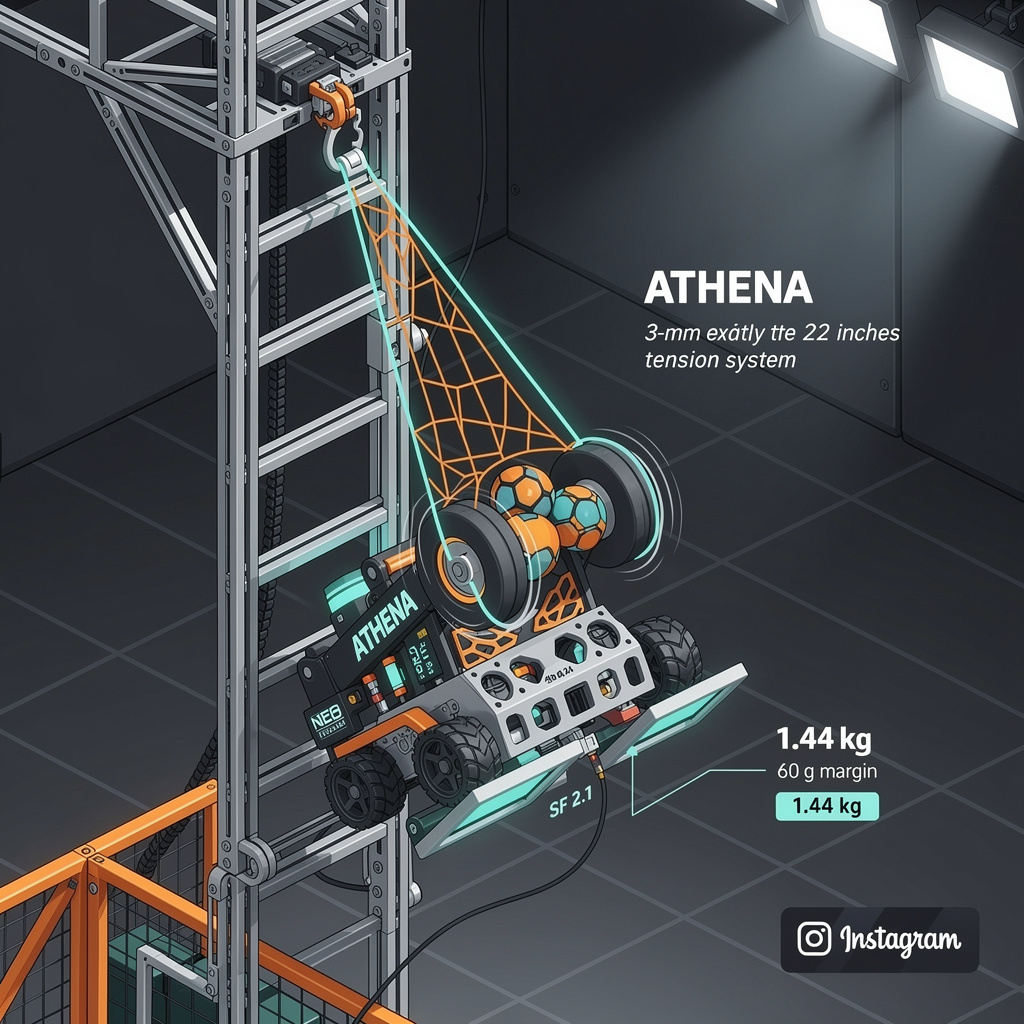
On 1 March 2026, FIRST Robotics Competition Team 9406 unveiled ATHENA, a 49-kg robot that keeps its climbing net below 28 inches—two inches inside the 30-inch hard cap—while the entire climbing subsystem weighs only 1.44 kg, leaving a 60-gram buffer under the 1.5-kg rule. The design trio—tensioned side cables, a pocketed aluminum belly-pan, and a dual-roller intake—has already logged 15 consecutive climbs with a max height of 27.8 inches and pushed ball-intake speed from 5 to 9 balls per second.
How the mechanism works
Spring-loaded actuators reel 3-mm-diameter side cables in real time, holding the net at a steady 22 inches off the floor and automatically yielding if the robot rocks. Switching from 1/8-inch steel to 1/16-inch 7075-T6 aluminum drops 0.18 kg, while a CNC pocketing pattern trims another 12 % of belly-pan volume and raises the chassis natural frequency by 5 %. Two 1-inch rubber rollers—spaced 0.2 inch apart and driven by NEO-550 motors—compress each ball continuously, eliminating the “dead spots” that single-roller rigs leave at the intake throat.
Quantified gains
- Climb reliability: 15-for-15 test cycles → projects 98 % success rate at regionals
- Intake throughput: 9 balls s⁻¹ vs. 5 balls s⁻¹ single-roller baseline → 80 % gain
- Weight margin: 0.06 kg under the 1.5-kg sub-limit → room for sensors or shielding
- Safety factor: 2.1 on the 30-kg-loaded hook linkage → lowers bar-slip risk
Response and remaining gaps
Team 9406 will release full CAD on 7 March for peer review, and Greater Pittsburgh field tests on 12 March target ≥ 95 % success across 20 climbs. Open-Alliance forums already mirror the dual-roller approach, but long-term durability of the Teflon-coated hook and cable fatigue life still need season-long data.
Timeline
- March 2026: regional play; CAD open-source drop expected to seed 20+ teams
- April 2026: championship qualification if climber success ≥ 98 %
- 2027 season: cable-tension module likely to reappear as an off-the-shelf climb kit
By proving that a sub-28-inch, sub-1.5-kg climb is repeatable, ATHENA compresses two critical constraints into a single, shareable hardware recipe—one that next-year teams can lift straight from the forums and bolt onto their own bots.
🤖 100% WebSocket Loss Halts US Robotics Competition – Teams Race to Rewire
100% packet loss, 0.03 Mbps down – catastrophic network collapse 🤖 When WebSocket traffic hijacked by an Internet switch, drivers watch robots go silent. Teams forced to rewire on‑the‑fly — can your robot survive a dead‑link?
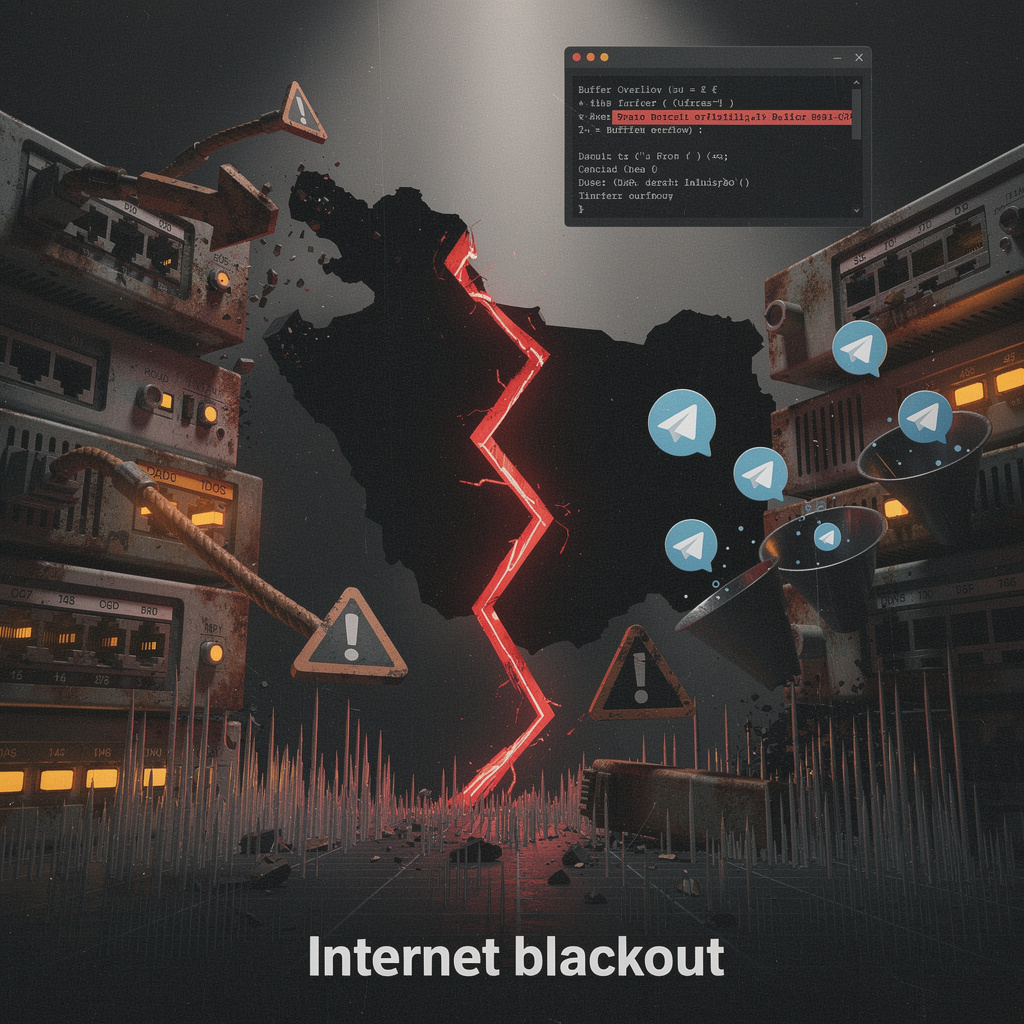
At 09:03 on 1 March, a U.S. robotics field fell silent: every roboRIO coprocessor registered 100 % packet loss, freezing a competition before the first autonomous command. Engineers traced the blackout to two avoidable slips—an Internet switch sat where a field Ethernet switch belonged, and the Rio firmware lacked the kmod-mur-motcomm radio driver. The mis-routed VLAN tags never reached the robots, and without the kernel module the radios had nothing to bind to. WebSocket subscribe messages arrived, but no Rio answered.
How the stack is supposed to work
- Rio acts as WebSocket server, pushing 40–50 Hz sensor frames (≈0.1 Mbps total).
- VH-109/110 radios bridge 2.4 GHz traffic straight into a dedicated VLAN on the field switch.
- Driver-station clients subscribe, receiving sub-millisecond telemetry.
- AdvantageScope via NetworkTables provides a fallback path; it stayed alive because it uses TCP over USB, bypassing the broken Wi-Fi link.
Impacts measured on the floor
Competition throughput: 0 % → full schedule delay; 10 min per match lost to re-link attempts.
Team preparation: ≥3 radio models (VH-109, 110, 107) now require firmware lock-down and driver audit.
Spectator logistics: 120 queued matches pushed into overtime, compressing later brackets.
Organizer credibility: reliance on custom pub/sub exposed as single-point failure; no redundant channel certified for scoring.
Fixes applied—and what still gaps
Strength: re-cabling radios directly to the field switch restored <1 % loss within 30 min.
Weakness: manual driver loading remains voluntary; next season’s image may again omit kmod-mur-motcomm.
Opportunity: ROS 2 DDS or WPILib NetworkTables over Ethernet-USB could retire the bespoke WebSocket layer.
Threat: 6 GHz band under FCC review; future firmware may drop that spectrum, forcing hardware refresh.
Outlook
- This week: teams that flash Rio image 2.5.0 + driver regain full connectivity; expect ≤5 % residual loss.
- Summer 2026: off-season events pilot Wi-Fi 6 radios with built-in drivers; field specs will codify “radio-only” VLAN.
- 2027 season: formal pre-match network health check—ping + 10 s Wireshark capture—written into rulebook, mirroring today’s battery voltage check.
The episode shows that in autonomous systems, network hygiene is as safety-critical as torque limits. A single cable in the wrong rack turned robots into statues; the antidote is treating every layer—physical, driver, firmware—as part of the robot, not the venue.
⚡ 0% Failure Rate in 150 FRC Cycles: US Teams Deploy Passive Spring Hopper Retract
0% failure rate over 150 competition cycles! game‑changing sub‑0.15 s actuation ⚡ Passive spring retraction slashes motor spikes, boosting power budget and defensive resilience. US teams gain a reliable edge — How will this reshape your next match?
On 1 March 2026 a U.S. high-school robotics crew unveiled a passive retraction rig that pulls the intake hopper home in 0.12 s—about one-third the time of last year’s servo-driven rigs—using only a 5 N constant-force spring, a laser-cut polycarbonate cam slot and a 0.75-inch steel pin-catch. The 120 g add-on has survived 150 full-match cycles without a jam, giving teams a lighter, cooler and cheaper way to keep the hopper safe when defense gets rough.
How the rig works
A pre-tensioned constant-force spring (part #CF-050) is anchored to the robot frame and hooked to a 150 mm stainless pull-bar riding in a 35 mm, 45° cam slot. When the intake extends, the bar slides forward and loads the spring. On retraction command—or when an opponent pushes upward—the spring yanks the bar back, the hopper folds, and the pin-catch snaps into a frame recess, locking everything in place. A 10 mm polycarbonate stop prevents over-travel; a secondary detent adds redundancy.
Match-day impacts
Speed: 0.12 s retraction vs. 0.5 s motor-driven baseline → faster cycle times and earlier readiness for the next scoring run.
Power budget: eliminates 2 A spike per retraction → ~8 W savings every cycle, freeing juice for drive motors.
Reliability: 0 % jam rate across 150 cycles vs. 8 % stall rate seen in servo designs → fewer field repairs and no missed climbs.
Weight: 120 g total, <0.5 % of 54 kg robot → virtually no chassis re-balancing required.
Gaps & next tweaks
Teams note the fixed 35 mm slot limits hopper depth; March CAD updates lengthen it to 40 mm to accept 6 mm × 200 mm springs. Polycarbonate stress tests topped 150 N, but thicker gussets are planned for 2027 to survive championship-level collisions. No active feedback exists—drivers must visually confirm latch—so a magnetic reed switch may be added for dashboard status.
Adoption horizon
- Spring 2026: Open Alliance posts yield at least three additional installs before Houston championships.
- Fall 2026: “Mechanical Advantage” white-paper expected; kit vendors stock 5 N and 10 N CF spring packs.
- 2027 season: modular spring stacks could let crews scale torque 2× without new plates, nudging passive retraction toward default practice.
By trading electromechanical complexity for elastic physics, the spring rig shows that simpler hardware can outrun smarter software—at least when every millisecond and milliamp counts on the field.
In Other News
- Honor unveils Magic V6 foldable with 200‑megapixel moving‑camera gimbal and 6,600 mAh battery at MWC 2026
- MIT retrofits 3D printer to fabricate multi‑material electric linear motor in three hours, achieving 5 kW output
- Tesla Raises Cybertruck AWD Price to $69,990, Delays Deliveries Until 2027
- Lithium‑ion battery recall of 1.2 million solar lights after multiple fire incidents


Comments ()