$31/Month Cloud Desktops Hit 58 Nations: Azure-First Hardware Cuts Rack Space 40% But Tethers Users to Latency
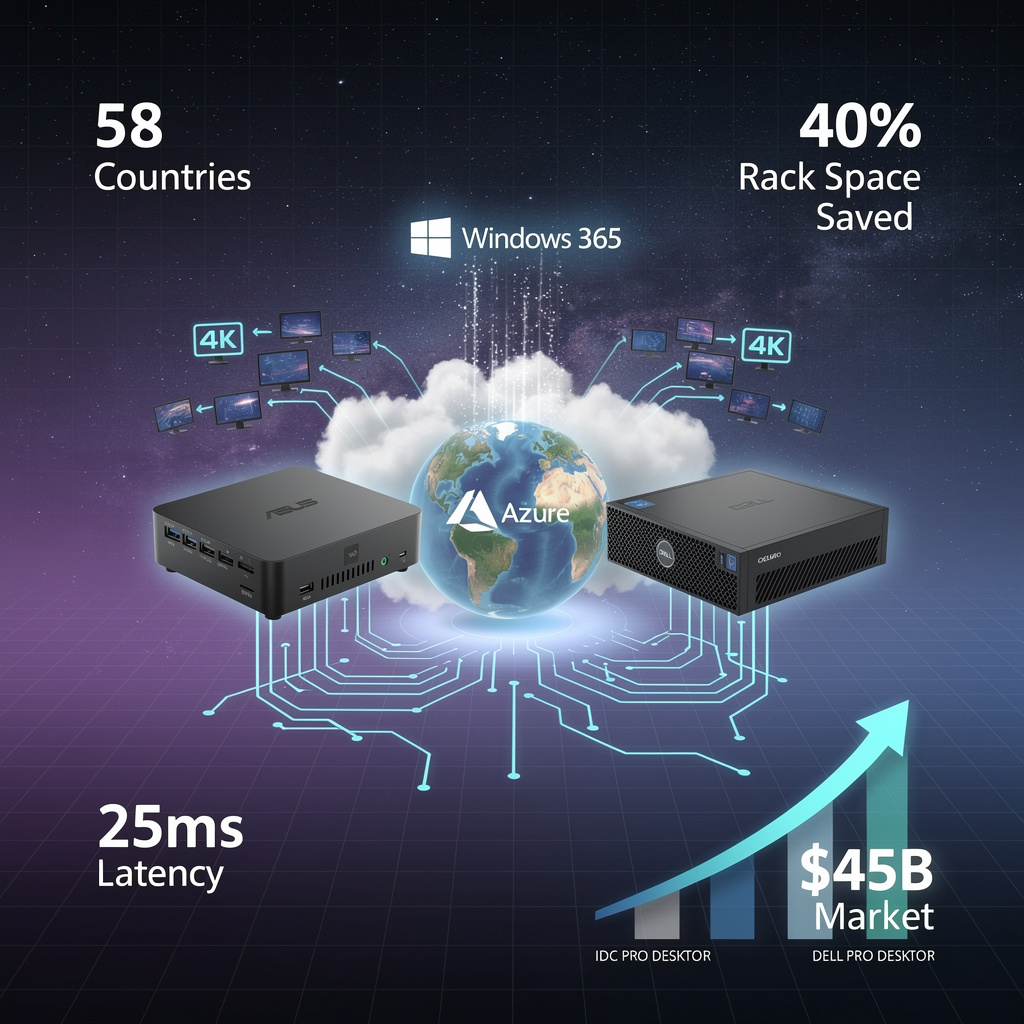
58 countries. $31/user/month. Zero on-premise servers. Microsoft's new ASUS NUC 16 & Dell Pro Desktop boot straight to Azure—no local OS, no IT headaches. 40% less rack space, 3×4K displays, yet you're now 100% dependent on internet latency. Is your region's broadband ready for cloud-native desktops?
Microsoft is expanding its Windows 365 Cloud PC footprint from 20 to 58 countries by Q3 2026, launching purpose-built hardware with ASUS and Dell that transforms how enterprises deploy and manage desktop computing.
How these devices bridge local and cloud
The ASUS NUC 16 (0.7L mini-PC, 65W) and Dell Pro Desktop (2U rack-mount, 200W) boot directly into Windows 365 sessions via pre-installed firmware. Both support three 4K displays and run client software across Android, iOS, macOS, and ChromeOS. The NUC 16 ships with Intel 12th-gen Core processors and 8 GB DDR5; the Dell Pro Desktop offers Intel Xeon W-Series, 16 GB ECC memory, and optional NVIDIA RTX A5000 discrete graphics. Zero-touch provisioning pulls Azure AD credentials and Cloud PC images automatically, presenting a managed Windows 10/11 desktop within seconds.
What organizations gain and sacrifice
Operational efficiency: Offloading OS, applications, and data to Azure enables retiring legacy thin-clients and reduces on-premise rack space by approximately 40% per endpoint.
Security posture: Endpoints cache only 64 GB locally; compute resides entirely in Azure with uniform zero-trust enforcement via Conditional Access and Intune.
Cost structure: Per-user pricing ($31–$66/month) replaces capital expenditure with predictable operational spend, allowing geographic workforce scaling without hardware procurement cycles.
Network dependency: Performance hinges on round-trip latency to Azure regions; graphics-intensive workloads require sub-25 ms RTT and minimum 25 Mbps symmetric bandwidth. Three concurrent 4K streams can consume 12–15 Gbps downstream per user during sustained sessions.
Where infrastructure gaps persist
| Risk | Mitigation |
|---|---|
| Latency: UI lag for demanding applications | Azure Edge Zones and local peering sites in each target country |
| Bandwidth: ISP cost escalation and congestion | Adaptive bitrate streaming; MPLS links with QoS tagging |
| Hardware failure: Limited local storage disrupts sessions | 5-minute Azure Site Recovery snapshots; 5-minute replacement SLA for Dell units |
| Compliance: Data residency restrictions in regulated sectors | Region-locked Azure subscriptions (EU-West, Asia-Pacific) via Azure Policy |
Timeline and adoption trajectory
- Q3 2026: 58-country launch; 200,000-unit initial shipment; 15% projected conversion from legacy thin-clients within six months
- Q4 2026: Full geographic coverage; enterprise pilots expanding to production deployments
- 2027–2028: Hybrid-Cloud PC market projected to reach $45 billion (IDC); next-generation devices integrate NPUs for local LLM inference offload
Sectoral shift
The transition from one-time hardware purchases to subscription-based endpoints signals a broader restructuring of enterprise IT: desktop management consolidates into Azure, while specialized workloads—CAD, data science, eventually HPC front-ends—gain viable cloud delivery paths as edge infrastructure matures.
In Other News
- Microsoft introduces Windows 365 Link mini PC at $349, enabling cloud-only endpoint computing with Intel chip and dual 4K support



Comments ()