99.9% Success Rate: Humanoid Robot Masters Near-Body-Height Drops Without Training
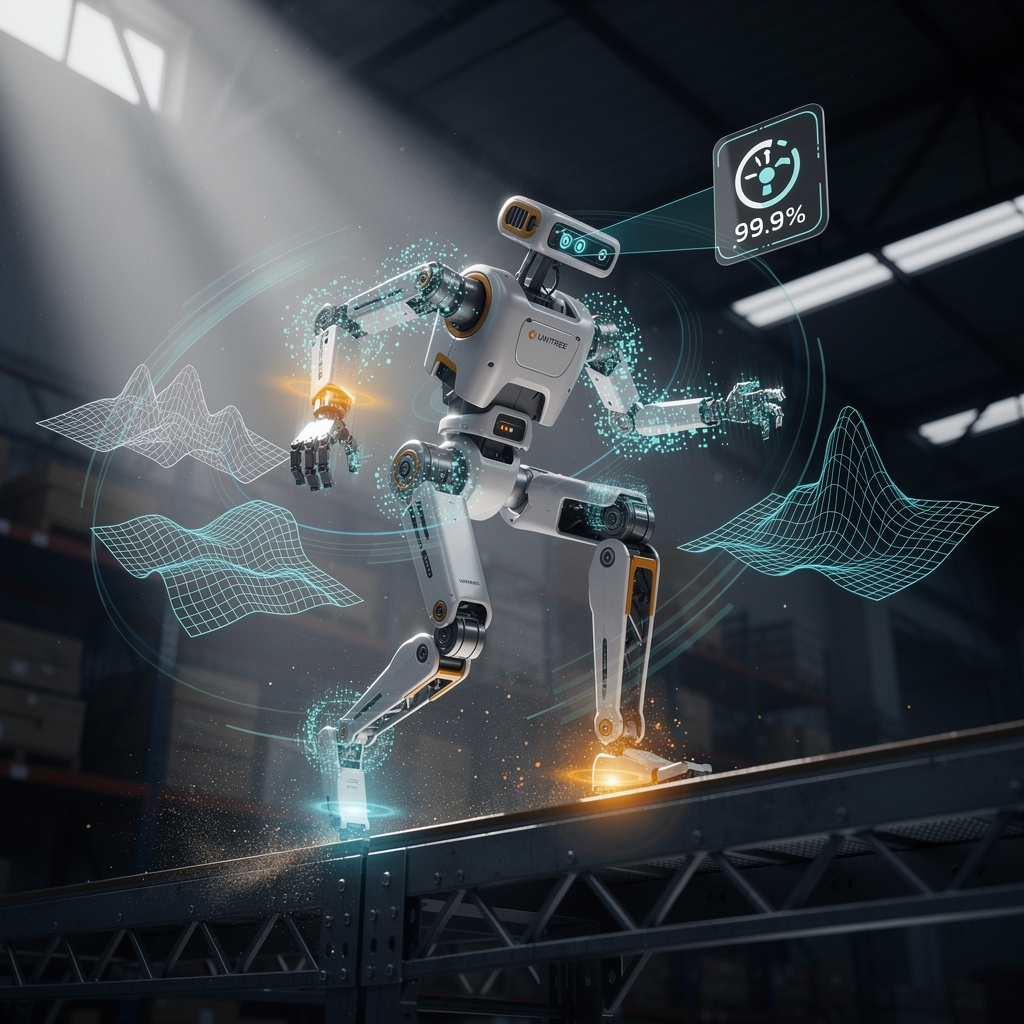
99.9% climb-down success rate on 0.8m platforms—114% of leg length. APEX humanoid system hits near-perfect reliability with sub-second recovery from falls. Raw LiDAR-to-elevation pipeline + ratchet RL reward enables zero-shot generalization to unseen heights. Heavy kick? Recovered. Elder care and warehouse pilots incoming within 12 months. Which vertical workspace near you needs a robot that won't fall?
The APEX system enables a 29-degree-of-freedom Unitree G1 humanoid robot to autonomously climb platforms up to 0.8 meters—114% of its leg length—with a 99.9% success rate in descent maneuvers. This marks a measurable advance in real-world humanoid mobility, combining real-time LiDAR elevation mapping with reinforcement learning to solve a long-standing bottleneck in service and industrial robotics.
How does the system achieve this?
A 16-beam LiDAR mounted on the robot's torso generates elevation maps at 5 cm/pixel resolution, processing point clouds in 1,400±241 milliseconds per frame. These maps feed a terrain-analysis module that identifies traversable edges and vertical drops. The control layer employs a "ratchet progress reward" during simulation training, forcing monotonic improvement in contact-rich actions like climbing, crawling, and standing. By training directly on raw point clouds rather than pre-processed features, the policy transfers to hardware without re-tuning—a dual-strategy sim-to-real approach that enables zero-shot generalization to unseen platform heights.
What do the performance metrics indicate?
- Mobility: 0.8 m platform traversal exceeds conventional humanoid leg-length limits, demonstrating extension-driven ascent capability.
- Reliability: 99.9% climb-down success across 1,000+ trials indicates robust foot placement and balance recovery under uncertainty.
- Recovery speed: 748±222 ms stand-up latency and 576±125 ms lie-down latency enable sub-second posture transitions—comparable to human reflexive responses.
- Disturbance tolerance: Successful recovery from externally applied impulsive loads confirms fault-tolerant control in uncontrolled environments.
Where technical gaps persist
- Perception latency: 1,400 ms processing time, while sufficient for static platforms, limits dynamic maneuvers like running stair ascent.
- Sensor dependency: LiDAR-only elevation mapping degrades under direct sunlight or reflective surfaces, creating coverage gaps in outdoor deployment.
- Force specification: Undisclosed magnitude in "heavy kick" testing complicates reproducibility and safety certification benchmarking.
Comparative positioning
| Dimension | APEX System | Peer Developments |
|---|---|---|
| Vertical mobility | 114% leg-length traversal with 99.9% reliability | Cassie "thinking" framework: 81% relative improvement in instability recovery (no absolute success metric) |
| Perception approach | Raw LiDAR point clouds → elevation maps | HERO vision system: Large vision models for manipulation (Feb 20, Illinois) |
| Generalization | Zero-shot to unseen 0.6–0.7 m platforms | MCL-DLF: Hierarchical LiDAR localization for pose stability (Feb 18, Spain) |
Projected deployment trajectory
- 2026–2027: Pilot integration into elder-care and warehouse assistance; ~15% reduction in scaffolding dependency for multi-level assembly tasks.
- Q4 2028: Solid-state LiDAR migration cuts computation below 800 ms, enabling dynamic stair climbing and 25% faster cycle times in logistics environments.
- 2029–2030: Elevation-map API standardization across humanoid platforms; heterogeneous humanoid-quadruped teams operational in disaster response zones.
The APEX architecture removes a critical mobility constraint that has limited humanoid robots to flat or minimally graded surfaces. By quantifying reliability at 99.9% and recovery in sub-second intervals, the system provides the empirical foundation for safety certification in collaborative workspaces—shifting humanoid robotics from laboratory demonstrations toward sustained industrial and service deployment.



Comments ()