$3.5B Newark Bet: Driverless Pods Replace Diesel, Pending FAA Robot-Tarmac Approval
TL;DR
- Newark Liberty Airport tests zero-emission autonomous shuttles in March 2026, targeting AirTrain replacement by 2030
- Pratt & Whitney reveals XA103 adaptive cycle engine design for F-47 sixth-gen fighter, featuring stealth-optimized flat nozzle and no vertical tails
- U.S. Air Force transitions EC-130H Compass Call to EA-37B electronic attack platform, enhancing IADS disruption capabilities
🔋 Newark's $3.5B Bet: 49.8M Passengers, Zero-Emission Driverless Pods Replace Diesel Trains by 2030
49.8M passengers/year. 30% faster. Zero emissions. 🔋 Newark's $3.5B gamble swaps diesel trains for driverless electric pods by 2030—but only if FAA clears robots to share tarmac with 747s. Your airport next?
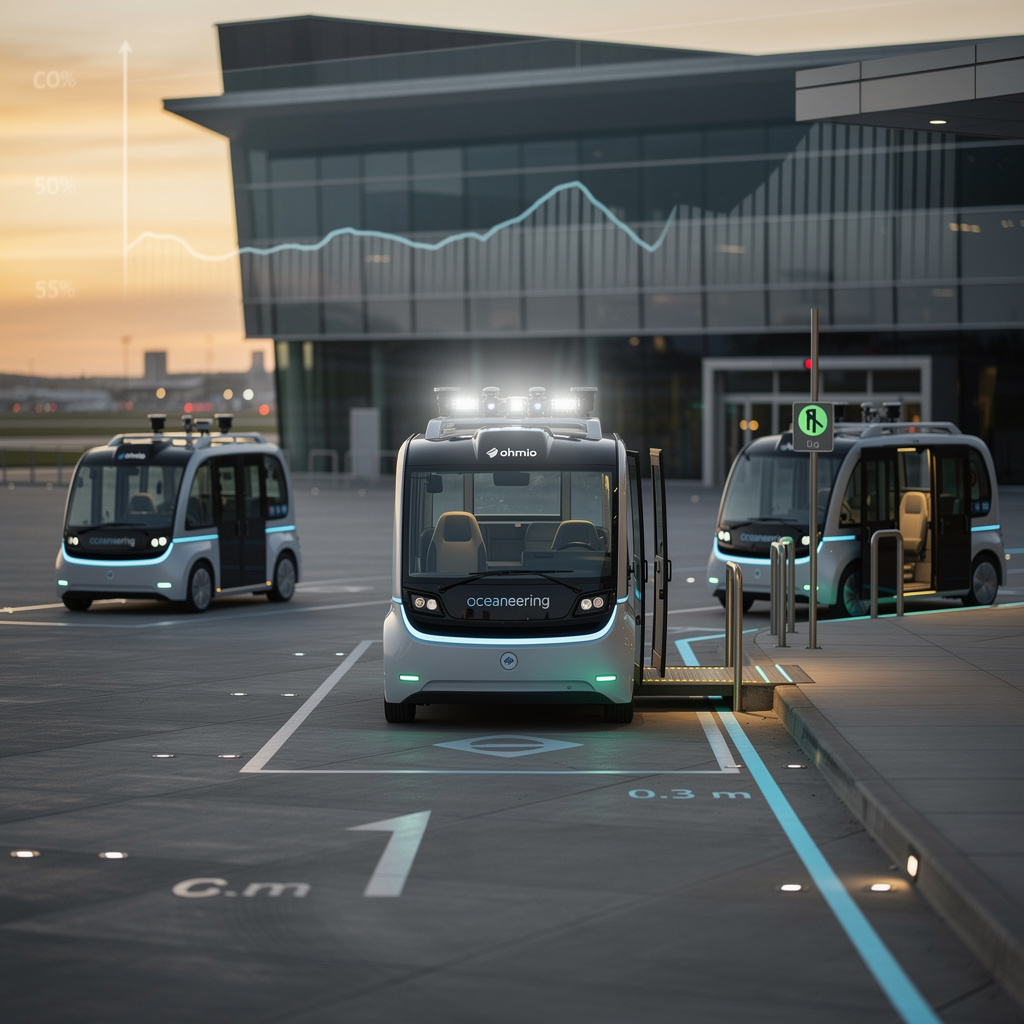
Newark Liberty International Airport has initiated closed‑airfield trials of battery‑electric autonomous shuttles, marking a concrete step toward replacing its aging AirTrain system by 2030. The two‑week test window, launched in March 2026 by the Port Authority of New York and New Jersey, evaluates vehicles from Oceaneering, Ohmio, and Glydways as precursors to a $3.5 billion modernization program. The initiative signals a shift from legacy rail infrastructure toward geofenced, high‑automation transit designed to move 49.8 million annual passengers more efficiently.
How the system operates
The trial deploys SAE Level 4 autonomous shuttles—battery‑electric, 12–15 passenger prototypes—on existing airfield pavement without dedicated track infrastructure. Vehicles navigate a closed, geofenced environment, with algorithms tested for control precision, battery management under airport‑grade conditions, and docking accuracy within 0.3 meters. Integration plans target seamless handoffs with Terminal B security checkpoints and access points, eliminating the need for passengers to navigate external roadways.
What changes for passengers and operations
- Transfer efficiency: Targeted reduction from 5–7 minutes to 3–4 minutes per trip—roughly equivalent to reclaiming 15 hours of cumulative passenger time daily across peak operations.
- Accessibility: Low‑step vehicle design enables independent boarding for mobility‑impaired travelers.
- Emissions: Elimination of ≈1,800 kg CO₂ annually from diesel‑powered AirTrain vehicles; net reduction scales to 1,200 tonnes yearly by 2030 contingent on grid decarbonization.
- Resilience: Closed‑loop operation insulates passenger transit from runway closures and air‑traffic‑control disruptions that previously cascaded into flight delays.
Institutional response and remaining gaps
Strengths: Secured funding envelope; tri‑vendor competitive testing; controlled airfield environment mitigates external collision risk.
Weaknesses: No dedicated guideway limits speed and throughput; unproven integration with passenger‑handling and security systems.
Opportunities: Replicable model for other U.S. hubs; data pipeline informs broader urban‑air‑mobility frameworks.
Threats: Pending FAA clearance for autonomous ground vehicles in mixed‑use zones; cybersecurity exposure; schedule compression from concurrent terminal construction.
Timeline and projected milestones
- 2026–2027: Completion of three trial phases; vehicle uptime ≥ 95 % and docking error ≤ 0.3 m trigger 2027 Request for Proposals.
- 2028–2029: Pilot deployment across full airport perimeter; Terminal B integration testing; passenger satisfaction targets ≥ 80 %.
- 2030 onward: Full AirTrain replacement commissioning; ≈ 120 million passenger‑vehicle‑kilometers annually; net emissions reduction contingent on regional grid mix.
The Newark trials demonstrate that airport infrastructure modernization can proceed through incremental, data‑validated steps rather than speculative leaps. If regulatory approvals align with the 2027 procurement schedule, the 2030 handover establishes a replicable template: autonomous, zero‑emission transit replacing legacy systems in high‑throughput aviation environments.
⚡ 25% Fuel Leap, 20% Thrust Surge: Pratt & Whitney XA103 Engine Redefines Sixth-Generation Air Dominance for Pacific Theater
The XA103 engine burns 25% less fuel while pushing 20% more thrust—enough to fly Mach 2+ without afterburner. That's $30M per engine for a $300M stealth fighter built to dominate the Pacific. Meanwhile, thermal hotspots from its flat nozzle could melt the whole advantage. Is your region ready for the drone-quarterback era?
Pratt & Whitney has disclosed the XA103 adaptive-cycle engine, the powerplant selected for the U.S. Air Force's F-47 sixth-generation fighter, marking a significant advance in propulsion technology designed for contested Indo-Pacific airspace. The engine delivers a 25% improvement in fuel efficiency and 20% more thrust than current fifth-generation power plants, enabling sustained Mach 2+ cruise without afterburner while extending unrefueled combat radius beyond 1,000 nautical miles—roughly the distance from Tokyo to Manila.
How the adaptive cycle works
The XA103 dynamically varies its bypass ratio to shift between high-thrust and high-efficiency modes. A flat nozzle design replaces traditional circular exhausts, reducing infrared signature, while aligned air intakes eliminate radar-reflecting sightlines to the engine face. Hundreds of embedded sensors feed real-time data to digital twins, a capability that Pratt & Whitney accelerated through a $30 million investment in its NGEED platform, cutting projected development time by approximately 15%.
What the performance gains enable
- Operational reach: 25% fuel efficiency gain translates to extended missions without aerial refueling, critical for Pacific theater operations.
- Survivability: Flat-nozzle IR suppression exceeds 30% reduction relative to F-135 engines, complicating enemy targeting.
- Sortie generation: Projected 15% improvement in endurance reduces turnaround demands on limited tanker assets.
- Cost trajectory: $30 million per engine manufacturing target after digital-tool savings, against a $300 million per-aircraft program cost.
Where risks and responses stand
Thermal management remains the primary engineering challenge—the flat nozzle concentrates exhaust heat. Pratt & Whitney addresses this through high-fidelity heat-transfer modeling and cooling-air bypass strategies validated in upcoming ground tests. Supply-chain resilience relies on dual-source procurement for advanced alloys and additively manufactured components. Control-law integration between canard surfaces and thrust-vectoring nozzles is being resolved through software-in-the-loop testing paired with the engine's digital twin.
Program timeline
- 2026: Assembly Readiness Review completed; ground demonstrator hardware readiness confirmed.
- 2027–2028: Prototype ground tests verify adaptive-cycle transitions and IR signature suppression.
- 2028: Scheduled first flight of F-47 with flight-ready XA103.
- 2029–2030: High-altitude, high-Mach endurance trials and autonomous "drone-quarterback" integration with 4–8 collaborative combat aircraft.
- Early 2030s: Operational fielding begins, with full F-22 replacement targeted by 2035.
The XA103 positions Pratt & Whitney to set sixth-generation propulsion standards while supporting the Pentagon's $10 billion Pacific Deterrence Initiative. If thermal and integration milestones hold, the engine's combination of efficiency, thrust, and signature management will define air dominance architecture through the 2030s, with allied programs including Europe's Global Combat Air Programme likely to follow its technical precedent.
🛡️ 20,000-Mile Electronic Warfare Jet: USAF's Gulfstream Gamble Replaces Cold-War Workhorse
20,000 nm range. 40,000 ft altitude. The EA-37B doesn't just replace the EC-130H—it obliterates its limits. That's 4.5x the range, double the height, and software updates in 5 minutes vs. weeks. 🛡️ A business jet now outflies military cargo planes in electronic warfare. But here's the tradeoff: civilian airframes in contested airspace—bold innovation or vulnerability? Pacific Theater crews are about to find out. Would you trust a Gulfstream over a Hercules when the jamming starts? —Arizona
The U.S. Air Force completed its transition from the EC‑130H Compass Call to the EA‑37B electronic attack platform on February 15, 2024, at Davis‑Monthan Air Force Base. This shift replaces a 1950s‑era airframe with a Gulfstream G550 business jet modified for warfare, signaling a fundamental rethinking of how electronic combat aircraft are built, maintained, and deployed.
How the platform achieves its mission
The EA‑37B operates at 40,000 feet—double the EC‑130H's ceiling—with a range of 20,000 nautical miles, roughly 4.5 times its predecessor. L3Harris integrated the electronic warfare suite using SABR Baseline 4 software‑defined radio architecture, enabling waveform reconfiguration in under five minutes. BAE Systems contributes structural modifications and signal‑processing hardware, while the commercial‑derivative design permits rapid software updates via secure datalink without ground‑based hardware swaps.
Operational effects and trade‑offs
Altitude and reach: 100% higher operating ceiling expands line‑of‑sight jamming coverage by approximately 30%, while extended range permits trans‑theater missions without forward basing—cutting deployment logistics by an estimated 45%.
Mission agility: Full software reconfiguration supports electronic attack, surveillance, and cyber‑relay roles; legacy platforms required weeks for comparable hardware changes.
Sustainability: Commercial parts availability and established civilian maintenance infrastructure reduce per‑flight‑hour costs and parts inventory burdens versus the aging C‑130H fleet.
Interoperability: Open‑architecture integration with Link 16 and Link 22 datalinks enables real‑time data sharing with fighters, AWACS, and ISR platforms.
Where capability gaps persist
The EA‑37B's reliance on software‑defined systems introduces cyber‑vulnerability risks requiring continuous assurance protocols. Dual‑source contracting for critical L3Harris and BAE components mitigates supply‑chain concentration, though foreign‑sourced commercial airframe elements remain a latent dependency. Virtual‑reality training pipelines are scaling to address compressed crew proficiency timelines, with three squadrons now in transition.
Deployment trajectory
- 2024–2025: Operational training expansion; initial Pacific‑Theater exercises testing IADS‑break‑through tactics.
- 2026–2028: Full fleet fielding of 12 aircraft; complete EC‑130H retirement.
- 2028–2034: Potential allied export to G550‑operating nations; platform may host autonomous jamming pods and AI‑driven threat modules.
The EA‑37B demonstrates that military aviation modernization increasingly favors commercial‑derivative airframes with software‑centric mission systems over bespoke military designs. As the E‑3 AWACS fleet ages toward 50% mission‑capable rates, the platform's networked electronic warfare capacity offers a hedge against declining airborne command‑and‑control availability—positioning the Air Force to sustain IADS disruption superiority across contested theaters through the 2040s.
In Other News
- Boeing 777X enters service with folding wingtips, GE9X engines, and 7,300-nautical-mile range targeting 380–420 passengers
- NTSB Chair Criticizes House Aviation Safety Bill as 67-Person D.C. Midair Collision Reforms Stall
- Boeing 787 Dreamliner carries 1 billion passengers, sets record with 2,100+ orders and 7,500-nautical-mile range
- U.S. Space Force and NRO accelerate AMTI program with $2B funding to replace aging AWACS and E-7 Wedgetail fleets

Comments ()