🎯 96% AI Misclassification: Laser Trap Hijacks U.S. Border Drones — Critical Vision Vulnerability Exposed
TL;DR
- UC Irvine researchers demonstrate FlyTrap attack exploiting AI camera systems on commercial drones
- U.S. Air Force accelerates A-10 retirement amid Indo-Pacific shift, reallocating funds to F-35, NGAD, and B-21 stealth platforms
- U.S. military deploys 11 Skydio drones in Orlando’s Drone as First Responder program, targeting sub-3-minute response times
🎯 96% AI Misclassification: Laser Trap Hijacks U.S. Border Drones — Critical Vision Vulnerability Exposed
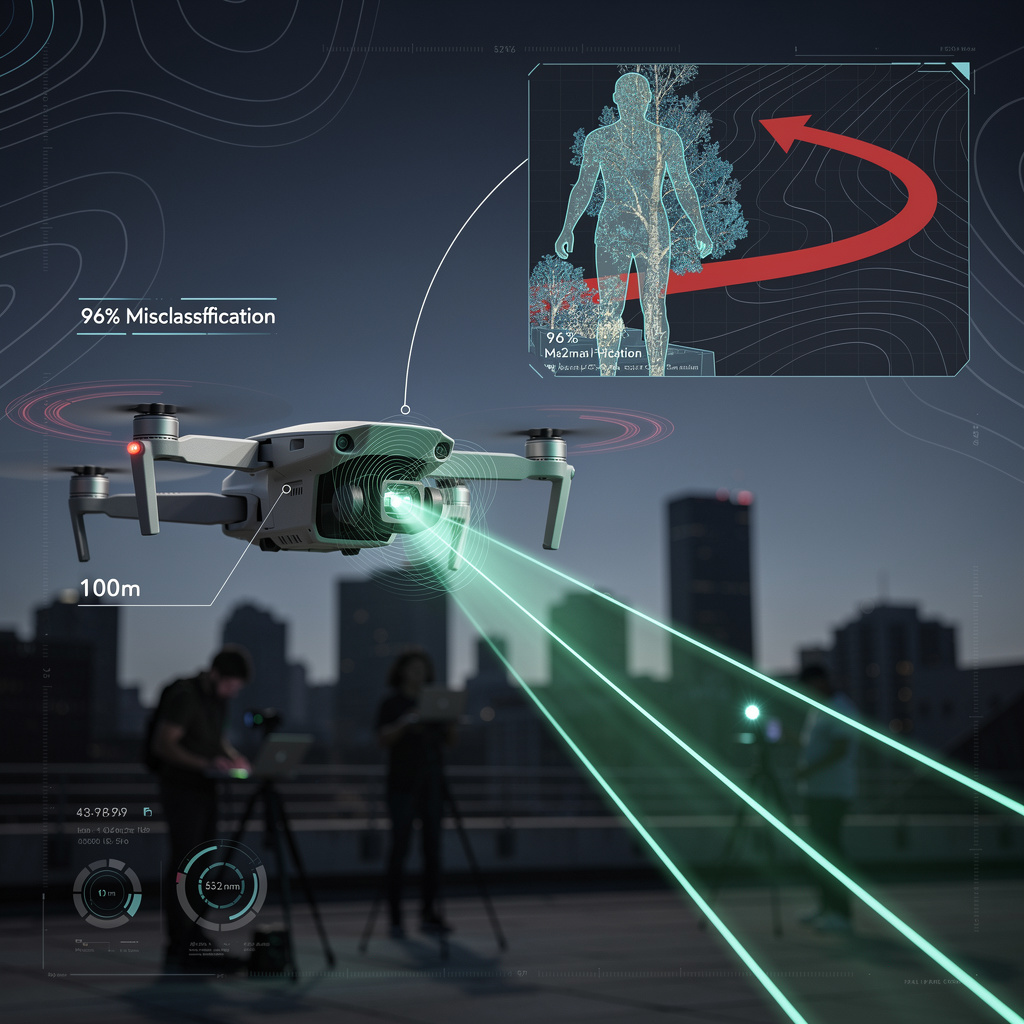
96% misclassification in 3 seconds: DJI & HoverAir drones hijacked by laser-projected optical traps 🎯 A $60 attack can fool border-patrol AI into chasing ghosts. Sensor fusion exists—so why are agencies still flying blind? — Would you trust AI drones over your neighborhood?
UC Irvine researchers have exposed a critical vulnerability in AI-driven commercial drones, demonstrating that engineered light patterns can hijack autonomous tracking systems with near-total success. The FlyTrap attack—tested on DJI Mini 4 Pro, DJI Neo, and HoverAir X1 units deployed by U.S. border patrol and law enforcement—reveals how adversarial optical manipulation threatens the operational integrity of vision-dependent unmanned aircraft.
How the exploit functions
The attack projects precisely calibrated 2-D sinusoidal gratings onto a drone's camera sensor. These patterns exploit gradient vulnerabilities in lightweight convolutional neural networks—specifically YOLO-v5-tiny variants running on embedded GPUs. Within three seconds of exposure, the drone's perception stack misclassifies benign objects as high-priority targets, triggering automated flight-path alterations, loiter commands, or emergency returns. The 532 nm laser projection remains effective at 120 meters under daylight conditions, requiring only 10 milliwatts of power—roughly equivalent to a standard laser pointer.
Operational consequences
Surveillance integrity: 96% misclassification rate enables hostile actors to spoof target acquisition without radio-frequency interception, potentially directing law enforcement drones toward false locations.
Safety liability: Erroneous waypoint commands in urban environments elevate collision risk with infrastructure and bystanders.
Data security: False triggers may initiate unauthorized recording cycles, capturing footage outside legal boundaries.
Institutional trust: Reliance on unshielded visual AI undermines confidence in autonomous systems for sensitive operations.
Current defenses and gaps
| Mitigation | Status | Limitation |
|---|---|---|
| Adversarial training | Moderate feasibility | Requires physics-based optical simulation datasets not yet standardized |
| Sensor fusion | High feasibility | Adds cost and weight; cross-modal validation logic remains immature |
| Real-time detection | Low feasibility | Fourier-analysis filters exceed embedded GPU power budgets |
| Optical shielding | Moderate feasibility | Degrades low-light performance; trade-offs unresolved |
Development trajectory
- 0–6 months: Firmware patches incorporating basic high-frequency filtering; open-source adversarial pattern datasets released for researcher collaboration.
- 6–18 months: Federal procurement mandates multi-sensor validation (visual + RF + thermal); dual-camera rigs with cross-modal consistency checks enter production.
- 18+ months: ASTM F3309 standard establishes quantitative resilience thresholds; autonomous fleets deploy sub-second anomaly abort protocols.
The FlyTrap findings signal that visual-only AI pipelines now constitute a primary attack surface for autonomous aerial systems. As border security and urban policing increasingly depend on uncrewed platforms, the gap between adversarial capability and defensive readiness demands accelerated coordination among manufacturers, agencies, and standards bodies—before low-cost optical exploitation scales from laboratory demonstration to operational threat.
🛩️ 55% CAS Fleet Cut: A-10 Retirement Accelerates as USAF Pivots $58M to F-35, NGAD, B-21 for Indo-Pacific
55% of America's close-air-support fleet just vanished. The A-10 Warthog—famous for its tank-killing cannon and titanium "bathtub" armor—is being retired 2 years early, with $15-58M redirected to F-35, NGAD, and B-21 programs. The F-35 costs 4x more per hour and can't loiter like the Hawg, but USAF says it's needed for Pacific threats. Ground troops lose their favorite flying tank—pilots gain stealth. Is your state losing its A-10 unit, and do you trust the F-35 to fill the gap?
The U.S. Air Force has formally accelerated the retirement of its A-10 Thunderbolt II fleet, completing the phase-out two years ahead of schedule with the deactivation of the final unit at Hill Air Force Base on February 12, 2026. The move redirects an estimated $15–58 million annually from A-10 sustainment toward next-generation platforms—F-35 Lightning II, the classified Next Generation Air Dominance (NGAD) program, and the B-21 Raider stealth bomber—reflecting a strategic pivot toward high-end conflict in the Indo-Pacific region.
How the A-10's role disappears
The A-10's retirement removes 162 aircraft from active service, representing a 55% reduction in dedicated close-air-support inventory. These airframes previously delivered 1,500–3,000 flight hours annually at approximately $7,000 per hour—the lowest operational cost among combat aircraft. The platform's signature capabilities—six-hour loiter time, titanium-armored cockpit, and GAU-8/A 30mm cannon firing 1,350 rounds per minute—have no direct replacement in the current force structure. The F-35A, now numbering roughly 400 in USAF inventory, offers sensor-fusion targeting and stealth penetration but carries only a 25mm internal cannon, sustains roughly two hours on internal fuel, and costs $25,000–$30,000 per flight hour with a projected $2.1 trillion lifecycle cost through 2070.
What capability gaps emerge
- Close-air-support: Loss of low-speed, high-loiter attack against armored formations → reduced effectiveness in ground-intensive theaters where visual identification and prolonged engagement are decisive.
- Survivability: Absence of dedicated armor (30% of A-10 airframe weight) → increased vulnerability to ground fire during low-altitude operations.
- Operational economics: Higher per-hour costs across replacement platforms → constrained sortie generation under fixed budgets.
Responses and remaining gaps
The USAF is mitigating through accelerated F-35 "Quick-Strike" software integration and cross-training maintenance crews at Hill AFB and Ogden Air Logistics Complex. However, the F-35 lacks the A-10's kinetic firepower and armor protection, while NGAD and B-21 programs—projected above $20 billion each with per-airframe costs approaching $300 million—carry substantial budget overrun risk. No dedicated light-attack replacement has entered procurement, leaving a persistent niche uncovered.
Timeline of transition
- 2026–2027: Full A-10 retirement completed; F-35A forward basing expanded at Moody AFB for rapid Indo-Pacific deployment; initial $50 million annual savings realized.
- 2028–2029: NGAD prototyping enters flight test; B-21 production rate increases to 10–12 units annually; F-35 Block 4 upgrades deliver enhanced precision-engagement software.
- 2030–2032: NGAD initial operational capability targeted; assessment of CAS gap determines whether supplemental light-attack acquisition proceeds.
The accelerated A-10 phase-out demonstrates how threat assessment reshapes force structure: integrated air-defense densities around Taiwan and the South China Sea have rendered low-speed platforms operationally prohibitive, while stealth and network-centric capabilities enable penetration of contested environments. Yet the transition trades proven tactical utility for strategic reach, leaving ground commanders to adapt to reduced loiter time and lighter kinetic options until technological or doctrinal solutions mature.
🚁 Orlando Deploys $6.83M Autonomous Drone Fleet: 33% Faster Emergency Response Raises Privacy, Cost Questions
11 drones. $6.83M. 33% faster than patrol cars. 🚁 Orlando's Skydio X10 fleet arrives before officers on 1-in-3 emergency calls—sub-3-min response now the new standard. Privacy audits + BVLOS waivers make it possible, but at $69K/year per drone, is your city next? — Would you want autonomous drones responding to 911 calls in your neighborhood?
Orlando's $6.83 million bet on airborne emergency response cleared its final hurdle this week, positioning the Florida metropolis to become one of the largest U.S. cities deploying autonomous drones as frontline first responders. The eight-year program, approved February 25, will station 11 Skydio X10 drones across nine rooftop docking sites—an infrastructure play designed to compress emergency response times below three minutes while reducing officer exposure to volatile scenes.
How the system operates
The technical architecture centers on fully autonomous flight. Skydio's AI-powered quadcopters navigate dense urban corridors without human piloting, launching within 30 seconds of dispatch from elevated "hives" 30–45 meters above street level. Axon Air and DroneSense software manage secure telemetry and live video feeds, with FAA Beyond Visual Line of Sight waivers enabling legal operation out of operator sight. Each unit carries integrated speakers, spotlights, and optional thermal imaging—tools that let dispatchers assess threats, communicate with crowds, and locate missing persons before ground units arrive.
Operational impacts
- Response velocity: Drones reached scenes before officers on 33% of pilot-phase calls, cutting average arrival times by roughly one-third (≈2.5 minutes versus 4 minutes for patrol vehicles).
- Cost structure: Annual outlay of $759,322 yields a per-drone cost of approximately $69,000 yearly—comparable to traditional aerial contracts with greater deployment flexibility.
- Safety calculus: Remote situational awareness enables threat assessment without officer exposure; projections indicate ≥20% reduction in officer-injury incidents where drones provide initial scene evaluation.
- Accountability: Real-time streams feed into Axon Evidence with audit-log retention, paired with a public transparency dashboard.
Peer benchmarks and competitive positioning
Orlando enters a maturing field. Los Angeles Police Department's 23-station Skydio deployment logged 1,779 flights averaging 23 daily, with drones first on scene in 30% of incidents—slightly below Orlando's pilot results. Dearborn, Michigan achieved 80% first-on-scene rates with 2.5-minute response times, correlating with measurable crime reductions. Meridian, Idaho targets sub-4-minute responses with a smaller three-unit footprint. Orlando's sub-3-minute mandate and mandatory 2.5-year hardware refresh distinguish it through aggressive performance targets and built-in obsolescence mitigation.
Deployment trajectory
- Q4 2026: Full fleet operational across nine sites; ≤2.9-minute average arrival targeted for ≥40% of priority calls; 5,000+ dispatches logged for algorithm refinement.
- 2028–2029: Expansion to adjacent municipalities via shared-services model; projected 15% cost reduction per participating agency through economies of scale.
- 2030–2034: Federal adoption potential for standardized "air-layer" disaster response; integration with city-wide emergency management platforms including fire GIS and EMS triage systems.
The program's eight-year horizon and technology-refresh clause address a chronic pain point in public-safety procurement: hardware obsolescence. By mandating replacement before performance degradation, Orlando avoids the stranded-asset problem plaguing earlier drone deployments. The financial model—municipal funding supplemented by private donation streams for expansion—creates replicable scaffolding for peer cities weighing similar investments.
Autonomous systems in emergency response are shifting from pilot novelty to operational baseline. Orlando's deployment demonstrates that FAA regulatory streamlining, combined with integrated software ecosystems and rigorous refresh cycles, enables response-time compression that traditional ground-based patrol structures cannot match. The question now is whether municipal budgets nationwide can absorb the upfront capital commitment before federal cost-sharing mechanisms emerge.
In Other News
- U.S. Air Force Veteran Arrested for Training Chinese Military Pilots on Nuclear Systems
- Boeing 777X freighter enters production, with first deliveries expected in 2028 and Qatar Airways as launch customer for next-gen cargo fleet
- NSF-DOE Vera C. Rubin Observatory issues 800,000 alerts in single night, launching 10-year survey of Southern Hemisphere sky
- Boulder Municipal Airport to Offer Unleaded Avgas by Late 2026 Amid State Mandate


Comments ()