Profound Hits $1B Valuation Selling 'Meme Insurance' to Fortune 500—But Its API Dependency Is a Ticking Time Bomb
TL;DR
- Profound raises $96M Series C to build AI-powered brand representation monitoring platform
- Cadence completes acquisition of Hexagon AB’s Design and Engineering business for $160M incremental 2026 revenue
- Constellation Energy reports $2.32B net income post-Calpine acquisition, stock surges 6%
🛡️ Profound Hits $1B Valuation: $96M Bet on AI Brand Safety as Pharma, CPG Race for Compliance Shield
$96M to fix AI's brand problem: Profound just hit $1B catching logo disasters before they go viral. That's like buying 3,000+ Super Bowl ads... to stop your brand from becoming a meme. Pharma & CPG are paying $1.2M/year each for this insurance policy. But here's the tension: they built the fire extinguisher for a house they don't own (OpenAI's API). What happens when the landlord changes the locks? — Would you trust AI with your brand's reputation, or is human oversight still non-negotiable where you operate?
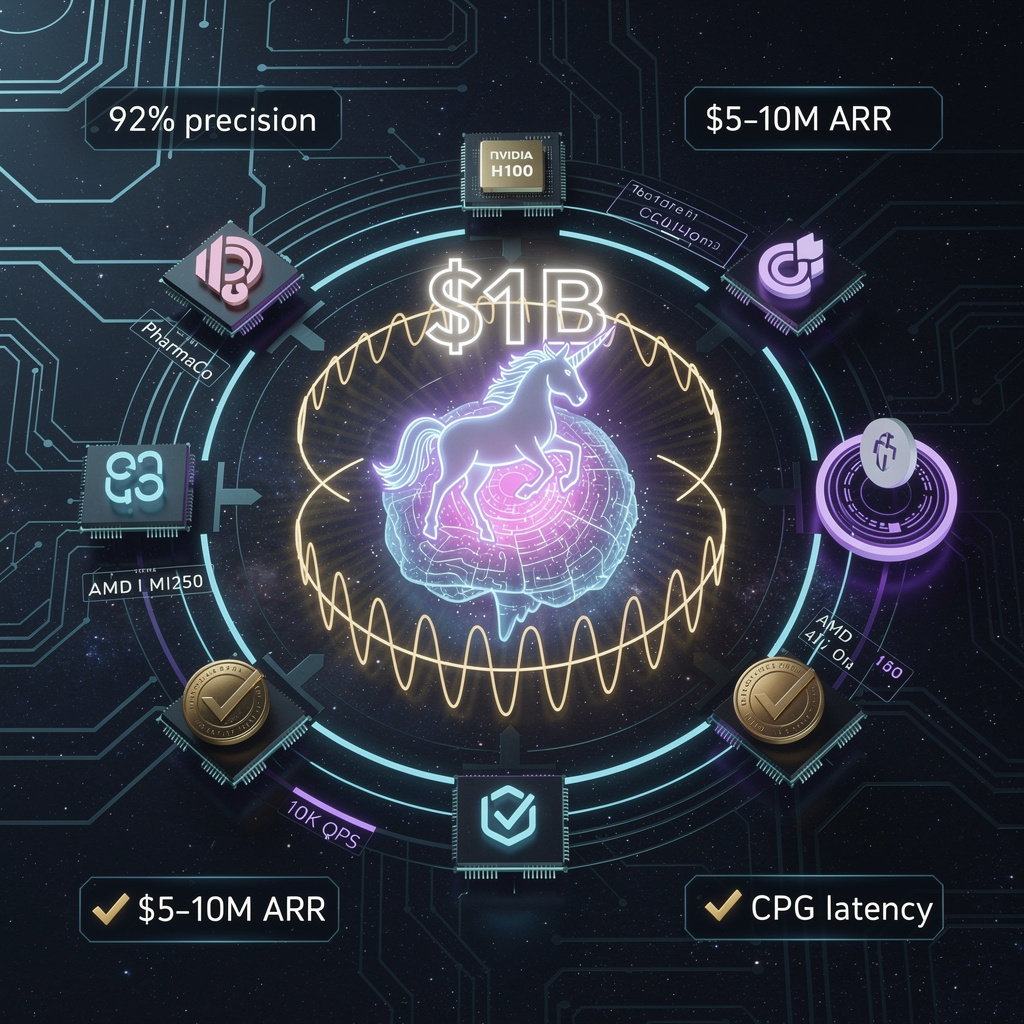
Profound's $96 million Series C, led by Lightspeed Venture Partners, vaults the 2024-founded startup to a $1 billion valuation—less than two years after inception. The capital fuels an AI-powered platform that monitors and corrects how brands appear in generative AI outputs, targeting consumer goods and pharmaceutical companies where regulatory and reputational stakes run highest.
How does the platform work?
Profound's architecture centers on a multi-modal detection engine. Transformer models exceeding 2 billion parameters per modality scan text, image, and video outputs for brand drift—achieving 92% precision and 88% recall on internal benchmarks. When discrepancies surface, an API middleware injects compliant tokens or overlays before content reaches audiences. The system integrates with 15 major generative AI providers including OpenAI and Anthropic, processing over 10,000 queries per second on cloud-native infrastructure powered by NVIDIA H100 and AMD MI250 chips.
What risks and advantages shape this bet?
Revenue potential: Compliance-as-a-service contracts with major CPG clients yield estimated $5–10 million ARR each, with enterprise deals averaging $1.2 million annually.
Regulatory shield: Automated brand fidelity reduces legal exposure for pharma firms navigating FDA labeling requirements—comparable to deploying 50–100 human compliance reviewers per client.
Dependency exposure: Third-party API policy shifts could disrupt integrations; latency demands for real-time ad serving may require substantial hardware expansion.
Technical obsolescence: Emerging AI content attribution standards could invalidate current detection heuristics.
Where does this fit in the funding landscape?
Profound's raise arrives amid a concentrated surge in AI infrastructure investment. WitnessAI secured $58 million for enterprise AI security governance in February; Runway closed $30 million for creative generation tools. While SambaNova and Axeler pursue massive hardware plays, Profound occupies a narrower but defensible niche: brand-specific observability rather than general-purpose AI governance.
What happens next?
- Q3 2026: Full SaaS launch following current beta with two pharma pilots; target 15–20 enterprise contracts within 12 months.
- 2027: Edge inference deployment across North America and Europe to maintain sub-150 millisecond latency SLAs.
- 2028–2029: Pursuit of 30% market share in AI brand-safety, projected as a $1.4 billion segment; potential strategic integration with OpenAI or Anthropic at the model-output layer.
The trajectory points toward either acquisition by a martech conglomerate or IPO once annual recurring revenue exceeds $150 million.
Profound's rapid unicorn status signals a maturation in AI funding—from model development toward application-layer safeguards. For an ecosystem flush with capital but hungry for defensible moats, brand-specific observability offers a concrete path: proprietary lexicon datasets, recurring compliance revenue, and regulatory tailwinds that compound with each generative AI deployment.
🧩 Cadence Absorbs Hexagon's $160M CAE Arm, Betting Physical AI Will Redefine Chip Design
$160M revenue boost. $0.28 EPS hit. That's the price of buying tomorrow's chip design tools today. 🧩 Cadence just swallowed Hexagon's CAE empire—MSC Nastran, Adams, the works—betting that 'Physical AI' (physics sim training AI models) becomes the new battleground. Short-term pain, long-term silicon dominance. Founders: would you trade 12 months of dilution for a category-defining moat?
Cadence Design Systems has closed its acquisition of Hexagon AB's Design and Engineering business, folding MSC Software's mechanical simulation tools into its System Design and Analysis portfolio. The deal adds $160 million in projected 2026 revenue—roughly 2.7% of Cadence's upper-end guidance—and signals a calculated bet on "Physical AI," where physics-based simulation trains AI models for semiconductor and systems design.
How the integration works
MSC Software brings finite-element analysis, multibody dynamics, and optimization capabilities that complement Cadence's existing Spectre, Virtuoso, and Allegro tools for analog and mixed-signal design. The combination creates a single-source workflow for system-level verification, eliminating data translation steps between mechanical and electrical domains. Cadence's SDA platform already accommodates third-party plug-ins, which reduces typical integration complexity for CAE software mergers.
What changes for customers and competitors
Revenue mix: $160 million incremental in 2026, with full cross-sell potential realized by 2027. Earnings trajectory: $0.28 per share dilutive in 2026 → accretive in 2027, following standard one-year integration lag. Competitive positioning: Synopsys pursues parallel AI-driven chip initiatives; Siemens exits direct semiconductor design simulation post-sale. Customer base: System companies—hyperscalers and silicon designers—gain unified mechanical-electronic simulation for AI-embedded hardware.
Risk factors and mitigations
| Integration | 12+ month code base and licensing alignment typical for CAE mergers → mitigated by existing SDA plug-in architecture. | | Earnings pressure | 2026 dilution explicit → offset by $7 billion backlog and communicated 2027 accretion. | | Demand cyclicality | AI chip design spend fluctuates → diversified portfolio (automotive, aerospace) spreads exposure. | | Competitive response | Rivals may accelerate AI-simulation offerings → early Physical AI entry and unique tool combination create differentiation. |
Outlook and milestones
- FY 2026: $160 million revenue contribution; EPS dilution observed; integration of sales channels and licensing models.
- FY 2027: Earnings accretion begins; MSC tools fully cross-sold to Cadence's installed base.
- 2028–2030: Physical AI services expansion for ≤3 nm semiconductor nodes and advanced system designs (automotive ADAS, aerospace structures).
The acquisition leverages Cadence's record $1.73 billion operating cash flow and 45.8% operating margin to fund integration without straining balance sheet capacity. For a sector where design-cycle compression determines competitive advantage, consolidating mechanical and electronic simulation under one vendor addresses a genuine friction point—while the $160 million headline, modest against a $6 billion revenue base, understates the strategic value of owning the full physics-to-silicon workflow.
⚡ Constellation Energy Posts $2.32B Profit, Controls 55 GW U.S. Grid: Nuclear Bet Meets AI Power Surge
Constellation Energy just posted $2.32B net income after swallowing Calpine whole for $26.6B—now commanding 55 GW of U.S. power, the largest carbon-free fleet on the grid. C&I revenue up 135% YoY, fueled by AI data-center hunger. But here's the twist: they're shutting Three Mile Island while betting billions on nuclear restarts. 32× P/E says markets love the monopoly, but what happens when AI demand cools? Your electric bill—and your 401k—are now hostage to one company's atom-splitting ambition. Does your state even have a backup plan?
Constellation Energy's $26.6 billion acquisition of Calpine has delivered immediate financial returns, with the combined entity reporting $2.32 billion in net income for 2025 and a 6% stock surge following its February earnings release. The merger creates a 55-gigawatt generation powerhouse—roughly equivalent to the total electricity consumption of 40 million U.S. households—positioning Constellation as the nation's largest carbon-free power producer.
How the deal reshapes power markets
The transaction combines Constellation's nuclear expertise with Calpine's natural-gas and geothermal assets, yielding operational synergies projected to boost capacity factors by 2-3% through integrated dispatch algorithms. The merged fleet now spans approximately 30 GW of nuclear capacity and 25 GW of gas-fired generation, with commercial and industrial revenue surging 135% year-over-year in Q4 2025, driven largely by AI data-center demand.
What the numbers indicate
- Profitability: Adjusted EPS rose 8.3% despite a 38% GAAP earnings decline, reflecting acquisition-related accounting adjustments
- Cash generation: Approximately $2 billion in annual free cash flow contribution, with targets exceeding $3 billion annually by 2028-2029
- Contract backlog: $6 billion in power purchase agreements, including a 380 MW deal with CyrusOne and 20-year contracts with Microsoft and Meta
- Market valuation: Forward P/E of 25.5×, trading at roughly $100 billion market capitalization
Where operational priorities converge
- Regulatory: NRC license renewals secured for Clinton (through 2047) and Dresden (through 2049-2051) nuclear stations; federal loan guarantee obtained for Unit 1 restart
- Infrastructure: Three Mile Island refurbishment underway, targeting mid-2027 operational restart
- Service segment: Eight consecutive quarters of positive contribution, with 20% gross margins on $14 billion revenue base
Short- and long-term trajectory
- 2026: CyrusOne PPA commissioning (Q3); adjusted EPS guidance of +5% year-over-year; Calpine fleet integration completion
- 2027: Three Mile Island restart; incremental 5-7 GW low-emission capacity advancement under "Powered Land Capabilities" model
- 2028-2030: Net carbon-free generation exceeding 70% of total output; $3 billion+ annual free cash flow realization
The acquisition demonstrates viable large-scale M&A financing in energy transition markets, combining cash, debt and equity structures that may encourage similar consolidation among mid-size independent power producers. While analyst targets range from $356 (Barclays) to $460 (Wells Fargo), the sustained EPS trajectory and robust contract pipeline indicate Constellation has converted scale into measurable shareholder returns—setting a benchmark for vertically integrated operators navigating the intersection of nuclear reliability and gas-fired flexibility.
In Other News
- Wells Fargo raises Google stock target to $387, citing 15GW to 35GW compute capacity growth and $240B cloud backlog
- Rivian expands service network with 50+ new centers ahead of R2 launch, hiring 1,000+ technicians
- Workday reports 14.5% YoY revenue growth but shares plunge 39% after CEO stepping down
- Danaher acquires Masimo for $9.9B to expand medical monitoring portfolio, deal to close in H2 2026


Comments ()