$236B AI Agent Economy: Machines Now Hold Crypto, Pay Salaries—But Compute Costs Threaten Revolution
TL;DR
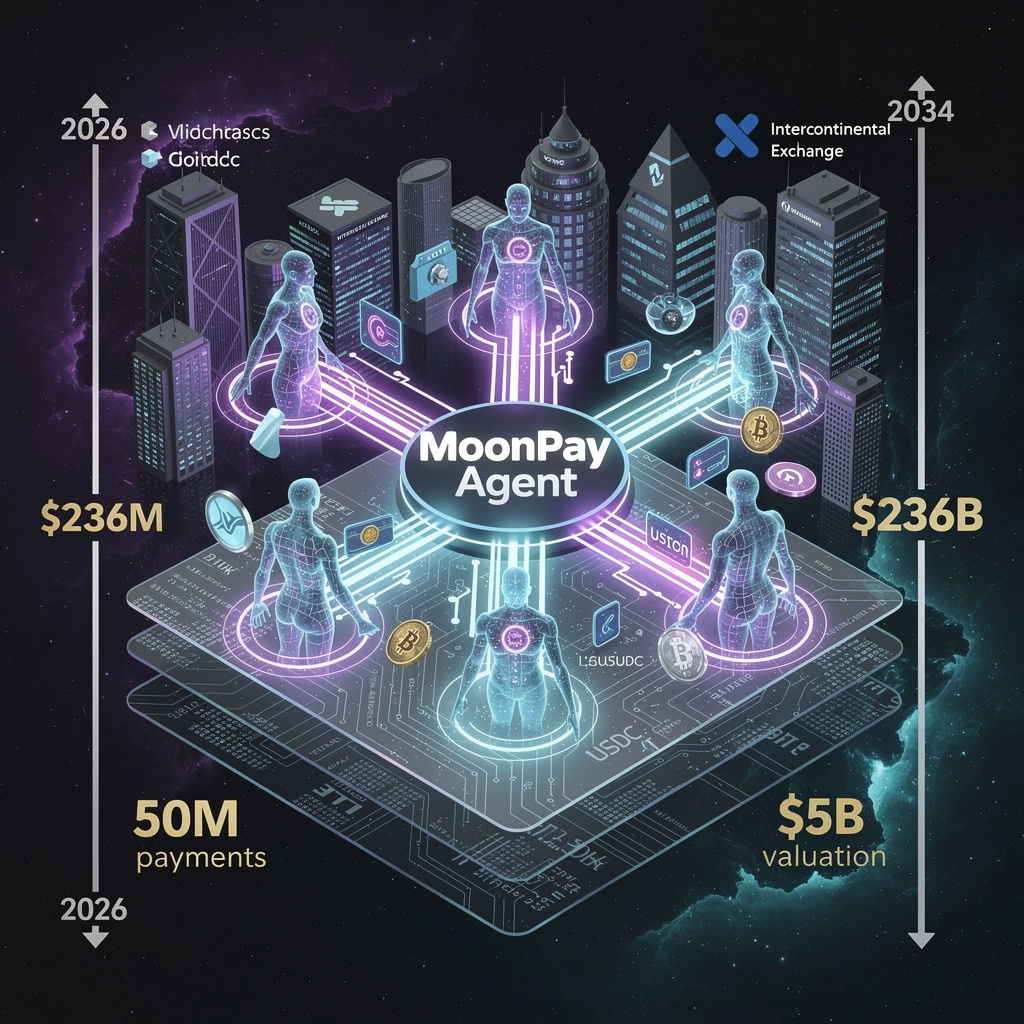
- AI agent payment sector projected to reach $236B by 2034 as MoonPay launches non-custodial AI agent tool for crypto asset movement
- SambaNova Systems raises $350M Series E to scale AI inference chips for enterprise automation
- IBM and Deepgram integrate voice AI into watsonx Orchestrate to power enterprise digital agents
🤖 $236B AI-Agent Economy: MoonPay's $5B Bet on Machines That Own Money
236 BILLION by 2034. AI agents now own crypto, pay salaries, and trade without humans. MoonPay's $5B valuation isn't hype—it's the first stack letting machines truly hold assets. Meanwhile Claude agents burn $300/day just to think. The math is brutal: 25% of Fortune 500 deploying, but compute costs could eat the revolution. Who profits when the bots pay themselves—Silicon Valley or the infrastructure layer?
MoonPay's launch of MoonPay Agents marks a pivotal shift in autonomous finance: AI agents can now hold and transact crypto assets without human intermediaries, transforming software from tool to economic actor. The non-custodial layer enables deterministic transaction signing via smart-contract wallets, with enterprise pilots already underway in UK/EU payroll corridors.
How autonomous ownership works
The architecture separates custody from execution. MoonPay Agents deploy ERC-4337 account abstraction, allowing AI systems to derive signing keys from deterministic seeds while policy contracts enforce risk limits—capping daily transfers at $100,000 and triggering escrow reversal on anomalous patterns. Agents settle in USDC, leveraging sub-second Lightning channels for Bitcoin-native operations, and pay for compute via the x402 micro-payment protocol at roughly $0.001 per API call. Coinbase's competing Agentic Wallet adds meta-transaction support, letting agents relay operations without holding gas-token balances.
What this unlocks
- Operational: 25% of Fortune 500 firms now expanding AI-agent deployments, per McKinsey—translating to an estimated $12–15 billion annual infrastructure spend by 2028
- Financial: World Economic Forum projects the AI-agent payment sector grows from $236 million (2026) to $236 billion by 2034—a 71% compound annual growth rate
- Transactional: Coinbase's x402 has processed 50 million agent-driven payments; cumulative fee revenue already exceeds $150,000 at $0.003 average per transaction
- Capital: MoonPay's $5 billion valuation target and Intercontinental Exchange's investment talks signal institutional confidence; Sapiom's $15 million raise builds agent-centric credit infrastructure
Where barriers persist
Compute costs: High-performance LLM inference runs $300 per day per instance at 10–20% utilization, creating a baseline friction point for continuous agent operation.
Credit access: Sapiom's emerging financing stack addresses upfront capital requirements, though risk algorithms for autonomous entities remain nascent.
Security exposure: Smart-contract vulnerabilities impose potential losses of roughly 0.5% of on-chain value annually without mitigation; multi-signature policies and on-chain monitoring bots flagging transfers exceeding $500,000 in five minutes are now standard.
Regulatory alignment: Non-custodial agents must satisfy AML/KYC through "beneficial owner" on-chain attestations—MoonPay's payroll pilots demonstrate early engagement with FinCEN and EU directives.
Timeline: From pilot to predominant
- 2026–2027: 5–7% of global AI-agent deployments integrate payment capabilities; combined x402 and MoonPay transactions exceed 100 million, generating $300,000+ in protocol fees
- 2028–2030: Enterprise compliance layers standardize agent identity; L2 rollups drive transaction costs below $0.001
- 2031–2034: Autonomous agents execute 50%+ of cross-border B2B payments; settlement latency drops to sub-second, displacing correspondent banking infrastructure
The sector's trajectory hinges on bridging compute costs with financing mechanisms and hardening security as volumes scale from millions to billions of autonomous transactions.
⚡ SambaNova Raises $350M, Unveils SN50 Chip: 10 Trillion Parameters, 5× Efficiency—Intel Partnership Signals Challenge to Nvidia's Inference Dominance
$350M fuels SambaNova's SN50: 10 trillion parameters, 10M token context, 5× efficiency vs prior gen. Intel partnership + $1.6B acquisition rumor. Real-time inference at ≤50ms hitting finance & logistics. Is your data center ready for the post-Nvidia shakeup? — Which latency threshold matters most for your AI workloads?
SambaNova Systems has closed a $350 million Series E funding round led by Vista Equity Partners, Cambium Capital, Intel Capital, and General Atlantic, with Intel simultaneously announcing a partnership to integrate SambaNova's chips into its cloud platforms and a potential $1.6 billion acquisition option. This capital injection signals a decisive pivot in AI infrastructure investment: away from generative model pre-training and toward enterprise-grade inference efficiency, where real-time intelligence workloads are becoming the primary growth driver.
How the hardware achieves its efficiency gains
The SN50 chip, built on a refined TSMC 5 nm process, introduces several architectural innovations that directly address enterprise constraints. Multimodel memory enables simultaneous loading of multiple AI models without context-switching overhead. Agentic caching and kernel exchange reduce redundant computation across inference sessions. Operator fusion and optical-network-assisted data paths cut per-token costs and latency. The chip supports 10 trillion parameters with 10 million token context lengths—roughly equivalent to processing the complete works of Shakespeare in a single inference pass—while delivering 5× compute per kilowatt-hour versus its SN40L predecessor. A 256-accelerator mesh with fast fabric interconnect allows horizontal scaling for thousands of concurrent enterprise sessions.
What this means for data-center economics and competition
- Power efficiency: 5× compute per kWh translates to measurable reductions in total cost of ownership for data-center operators, directly addressing the 40% of AI infrastructure costs typically consumed by energy and cooling.
- Latency performance: Sub-50 millisecond inference enables real-time fraud detection and dynamic logistics routing—workloads previously bottlenecked by GPU-based architectures.
- Market structure: 12% targeted inference-chip market share by 2029 would erode Nvidia's current ~40% data-center dominance, creating viable silicon diversity for enterprise procurement.
- Supply-chain exposure: TSMC 5 nm dependency creates concentration risk, though multi-foundry agreements and Intel's procurement leverage provide partial mitigation.
Where technical and commercial risks persist
Thermal scaling: The 256-accelerator mesh generates substantial power density; SambaNova counters with dynamic voltage/frequency scaling and liquid-cooling modules, yet sustained operation at peak throughput remains unproven at volume.
Acquisition uncertainty: Intel's $1.6 billion option introduces governance risk during the critical SN50 production ramp; SambaNova's stand-alone commercialization roadmap and existing customer contracts provide defensive stability.
Ecosystem maturity: Kernel exchange and operator fusion require software stack adaptations; enterprise adoption depends on framework integration timelines that lag hardware availability by 6–12 months.
The deployment trajectory ahead
- Q3 2026: SN50 silicon qualification completed; 10,000-unit initial shipment to Intel, Azure, and AWS cloud partners.
- Q4 2026: Financial services and logistics pilots operational; $150 million annual recurring revenue increase projected.
- 2027–2028: 12% market share penetration; heterogeneous CPU-GPU-FPGA-ASIC pipelines standard in U.S. hyperscale deployments.
- 2029: 20 trillion-parameter support and 20 million token contexts; sustained 5× efficiency advantage through sparsity and quantization advances.
The SN50's technical specifications—particularly its power efficiency and parameter scale—directly map to enterprise automation requirements that generative training chips were never optimized to meet. If SambaNova executes its production ramp without Intel acquisition disruption, the company establishes a durable position in the inference silicon layer that underpins real-time enterprise intelligence. The broader implication extends beyond one vendor: successful diversification of AI infrastructure supply signals maturation in a market long dominated by single-source dependencies, with measurable consequences for data-center design, energy consumption, and enterprise procurement flexibility through decade's end.
🎙️ IBM-Deepgram Voice AI: Sub-300ms Latency Targets $53.7B Market by 2030
IBM + Deepgram just dropped a voice AI integration with <300ms latency—faster than human reaction time. That's 35 languages, 90%+ accuracy, processing 1 trillion words. But here's the kicker: open-source Mistral Voxtral already hits 200ms with Apache 2.5 licensing. Are enterprises paying premium for orchestration polish, or is the open-source latency gap closing too fast? Which matters more for your deployment—speed or sovereignty? 🎙️
IBM and Deepgram have integrated real-time voice AI into the watsonx Orchestrate platform, delivering speech-to-text and text-to-speech capabilities that exceed 90% accuracy with end-to-end latency below 300 milliseconds across 35 languages. This technical stack addresses a critical bottleneck in enterprise automation: the 80% of customer interactions that still occur via voice have historically required fragmented, multi-component systems that degrade performance. The partnership positions IBM to capture share of a voice recognition market projected to expand from $20.2 billion in 2023 to $53.7 billion by 2030.
How the architecture achieves sub-300ms performance
Deepgram's end-to-end neural architecture replaces traditional five-model ASR pipelines that suffer accuracy decay to roughly 50% when latency exceeds 500 milliseconds. The integrated system processes over one trillion words of training data, enabling robust acoustic modeling without the cascading latency penalties of modular designs. Watsonx Orchestrate provides the workflow automation layer, closing the infrastructure gap between telephony inputs and enterprise business-process-management pipelines. The 200,000 registered API developers in Deepgram's ecosystem gain modular SDK nodes for plug-and-play deployment.
What this enables—and where risks concentrate
- Operational: >90% transcription accuracy with <300ms latency → elimination of the latency-accuracy trade-off that plagued layered ASR systems
- Geographic: 35-language baseline with 2026 European endpoint expansion → accelerated non-English market penetration
- Competitive: Positioning against Mistral's Voxtral (200ms, Apache 2.5 license) and ElevenLabs commercial platforms → pressure on pricing and licensing clarity
- Regulatory: Cloud-dependent architecture with potential licensing complexity in healthcare and finance → elevated compliance scrutiny versus on-premise alternatives
Where infrastructure gaps persist
The integration still operates above the 100-millisecond "ideal" benchmark for ultra-low-delay use cases, leaving headroom for edge-compute optimization. Regional VoIP restrictions in the UAE and Saudi Arabia may limit real-time deployment in some markets. Open-source alternatives threaten cost disruption, though they currently lack the orchestration depth of IBM's enterprise stack.
Adoption trajectory and market implications
- Q3 2026–Q2 2027: Enterprise pilots in North America and Europe transition to production within 3–6 months, leveraging IBM's existing contract base and Deepgram's developer traction
- 2028–2030: 5% market capture of the projected $53.7 billion sector generates approximately $2.7 billion revenue; model compression (quantization, sparsity) drives latency toward the 100-millisecond target while preserving accuracy
The partnership establishes a benchmark for real-time, multilingual voice AI in enterprise settings. Success depends on maintaining technical performance advantages while resolving licensing transparency and regional deployment constraints that favor privacy-first competitors.
In Other News
- LUMI-lab AI system synthesizes 1,700+ lipid nanoparticles using active learning, boosting mRNA transfection efficiency
- Google acquires ProducerAI, integrating generative music tool into Labs suite with Gemini and DeepMind
- Ferret-UI Lite, a 3B-parameter AI model, achieves 91.6% accuracy on GUI tasks using on-device reasoning and reinforcement learning
- AWS Elemental Inference launches real-time vertical video optimization for TikTok, Instagram Reels, and YouTube Shorts with 6–10s latency


Comments ()