$175B Tariff Revenue Voided: Trump's SOTU Nightmare as Supreme Court Strikes Economic Pillar
TL;DR
- Trump's 2026 State of the Union speech draws Democratic boycott amid tariffs, Epstein file controversies, and election integrity disputes
- Trump administration scrubs LGBTQ+ data from federal websites, sparking lawsuits and protests over loss of vital health disparity metrics
- House Republicans face mounting pressure to resign over ethics scandal involving Tony Gonzales and deceased aide Regina Santos-Aviles
⚖️ $175 Billion Tariff Plan Voided: Supreme Court Ruling Collides With Historic Democratic Boycott of Trump's Record-Breaking SOTU
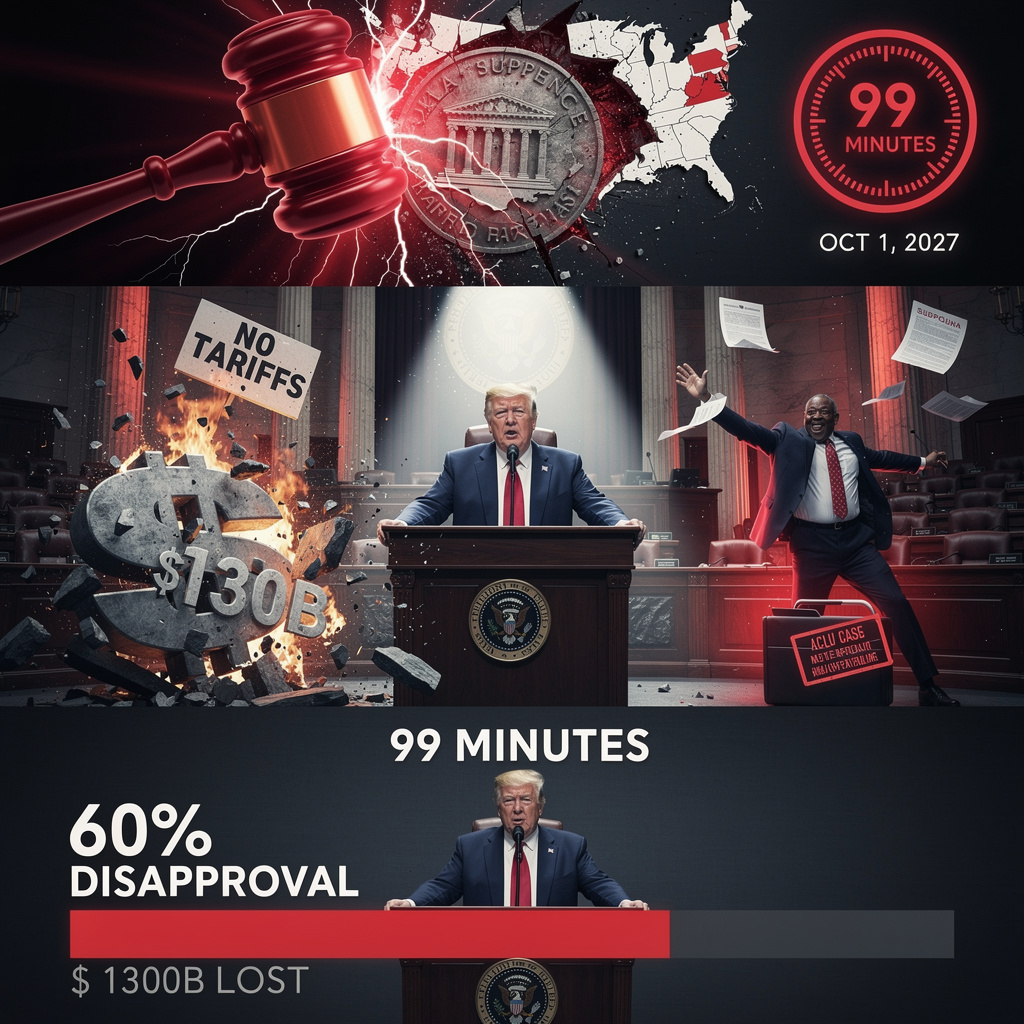
99 minutes. That's how long Trump spoke while 90% of House Democrats boycotted his SOTU. The Supreme Court just voided $130–175B in tariff revenue the same night. 🔥 A record-long speech met by a record walkout—and now his economic plan is in ruins. Will your state be the next battleground for Trump's federal election takeover? — Are you ready for federal agents running your local polling place?
President Donald Trump’s 2026 State of the Union address—delivered February 24 in a record‑long 99 minutes—has accelerated three simultaneous crises: a Supreme Court‑invalidated tariff regime, a Democratic boycott exceeding 90% of the House caucus, and a contested federal push to nationalize election infrastructure. The speech, which claimed “defeated inflation” and “vanishing crime,” drew immediate procedural disruptions, including the ejection of Representative Al Green for displaying a protest placard and repeated interjections by Representative Ilhan Omar.
How the tariff ruling reshapes fiscal planning
The Supreme Court’s 6‑3 decision, issued the same day, voided Section 122 emergency‑tariff authority under the International Emergency Economic Powers Act. The ruling eliminates $130 billion to $175 billion in projected revenue—roughly equivalent to the annual GDP of Kansas—forcing Republican leadership to identify replacement funding before the October 1, 2027 budget deadline. Senate Finance Committee staff indicate a bipartisan “tariff replacement” bill targeting $90 billion will surface by early May 2026.
What institutional pressures are mounting
Parallel developments intensify the administration’s exposure:
Judicial: The Supreme Court’s statutory overreach finding establishes precedent limiting unilateral trade action, constraining future “America First” economic maneuvers.
Legislative: House Oversight Democrats subpoenaed the Department of Justice for unreleased Jeffrey Epstein documents on February 24, with compliance due March 15; contempt hearings are scheduled for June 2026 if unmet.
Federal‑state: Senator Maria Cantwell’s February 24 condemnation of federal election‑overreach proposals—citing Article I, Section 4’s Elections Clause—previews constitutional litigation; the ACLU filed suit February 27 (docket #22‑2026‑TR).
Floor conduct: Enforcement of House Rules 37 and 46 against Green and Omar signals elevated disruption protocols, with Capitol Police reviewing rapid‑removal procedures for future addresses.
Where political capital stands
A Reuters/Ipsos poll conducted February 24 registers 60% disapproval of Trump’s overall performance and 54% viewing immigration enforcement as “excessive.” Internal GOP metrics place congressional hostility at 8.3/10 post‑boycott. Yet base mobilization shows traction: GOP donor contributions rose 12% following the address, and conservative media coverage averages 15 minutes daily.
Short‑ and long‑term trajectories
- March–May 2026: Partial DOJ compliance with Epstein subpoena; bipartisan revenue bill introduction.
- June 2026: Contempt hearing if subpoena unfulfilled; primary campaigning accelerates with tariff and election‑integrity as top issues.
- November 2026: Midterm elections test whether Democratic protest tactics solidify a “culture‑war” voting bloc or alienate moderate voters.
- 2027–2028: Anticipated district‑court rulings on federal election mandates; potential shift to sector‑specific duties (steel, automotive) capped at $30 billion annually if replacement legislation fails.
The 2026 State of the Union has crystallized an inflection point: the administration must navigate judicial constraints, legislative gridlock, and escalating opposition while preserving operational latitude ahead of November’s electoral test.
🏳️🌈 CDC Data Scrub: 23% HIV Gap Erased as Federal SOGI Fields Deleted
23% higher HIV prevalence among gay/bisexual men now invisible to CDC. 1.3M LGBTQ+ youth crisis calls lose tracking tags. $58M in NIH grants at risk. The federal government just erased an entire population from public health data—while Stonewall's Pride flag came down. Your community's health data: gone overnight. What happens when your state can't prove you need care?
The Trump administration's February 24 purge of sexual orientation and gender identity data from federal health systems has severed a critical artery of public health surveillance, stripping researchers and policymakers of the metrics needed to track HIV prevalence, youth suicide risk, and housing instability among LGBTQ+ populations. The deletion, executed under Executive Order 14,168's mandate for "political neutrality," eliminates fields from CDC surveillance systems, Census Bureau instruments, and employee records—rendering invisible disparities that the Williams Institute quantified at 23% higher HIV rates among gay and bisexual men.
How the scrub was executed
The White House Office of Management and Budget directed 27 agencies to delete SOGI variables from core datasets. The CDC's National Health Interview Survey and WONDER query tool dropped "sexual_orientation" and "gender_identity" columns entirely. The Office of Personnel Management restricted federal employee gender entries to binary male/female options. At the Stonewall National Monument, the National Park Service removed the rainbow Pride flag—triggering same-day protests that forced its re-raising under legal pressure.
What disappears from the record
HIV surveillance: Disaggregation by sexual orientation becomes impossible; prevention programs lose targeting data for populations bearing disproportionate disease burden.
Mental health outcomes: The 988 Suicide & Crisis Lifeline's 1.3 million annual LGBTQ+ youth contacts can no longer be evaluated for intervention effectiveness.
Research funding: $58 million in NIH grants requiring SOGI reporting face suspension due to non-compliance with revised federal data standards.
Perinatal care: CDC maternal mortality tracking—already strained by April 2025 reporting suspensions—loses visibility into transgender patient mental health trends.
Legal and institutional response
- Williams Institute v. United States: Federal suit alleging Administrative Procedure Act and Health Equity Act violations; preliminary hearing March 15, 2026.
- New York state action: Attorney General Letitia James pursuing parallel anti-discrimination claims.
- Congressional scrutiny: House Oversight Committee hearing scheduled March 30, 2026 on federal data integrity.
Agencies are reportedly maintaining isolated "legacy datasets" pending court rulings, though operational disruption has already delayed HIV prevention grant allocations by 4-6 weeks.
Projected trajectory
- 2026: Data blind spot institutionalized; epidemiological baselines degrade; $12-18 million estimated cost for pipeline restoration if courts intervene.
- 2027: Three-year trend gap (2025-2027) solidifies, crippling evidence-based policy revision for LGBTQ+ health services.
- 2028-2029: Precedent binds future executive data alterations; international reporting obligations to WHO Global Health Estimates face compliance gaps.
The outcome will determine whether demographic surveillance infrastructure remains a stable public utility or becomes subject to cyclical erasure with each administration change.
House Republicans face mounting pressure to resign over ethics scandal involving Tony Gonzales and deceased aide Regina Santos-Aviles
Following the suicide of former congressional aide Regina Santos-Aviles in September 2025, multiple Republican lawmakers are calling for Rep. Tony Gonzales (R-TX) to resign after text messages surfaced showing he pressured her for explicit photos in 2024. The House Ethics Committee is investigating the case, with Gonzales denying an affair but admitting the texts were real. His district, which voted for Trump in 2024, has seen growing public outcry. Six GOP colleagues have demanded his resignation, while Speaker Mike Johnson has urged transparency. The scandal has intensified scrutiny of GOP conduct and sparked debate over whether disciplinary action could jeopardize Republican control of the House.
The suicide of former congressional aide Regina Santos‑Aviles has ignited a firestorm that now endangers Representative Tony Gonzales's career and his party's razor‑thin majority. Text messages sent in May 2024 show Gonzales requesting explicit photos from Santos‑Aviles, who died by self‑immolation last September. Six Republican colleagues have demanded his resignation; Speaker Mike Johnson has urged transparency while stopping short of joining them. The House Ethics Committee awaits a fact‑finding report from the Office of Congressional Conduct, due within 60 days of the March 3 primary.
How does this work procedurally?
The OCC completed preliminary investigation on February 24 and must forward its dossier to the Ethics Committee ahead of any disciplinary vote. Under House Rule X‑2, the committee can issue reprimand, censure, or recommend expulsion—the last requiring a two‑thirds House vote. Gonzales denies an affair but concedes the texts are authentic. His district, which delivered Trump a 60‑plus percent margin in 2024, now shows 54 percent unfavorable views of the incumbent and 61 percent of primary voters less likely to support him.
What are the measured impacts?
- Political stability: Intra‑party resignation calls surged 30 percent within 48 hours of message release, straining GOP cohesion as Johnson calculates risks to the 218‑seat majority.
- Electoral risk: A 12‑point projected loss of GOP vote share could flip Texas‑23; one resignation narrows the majority to 217, jeopardizing procedural leverage.
- Legislative agenda: Border security and water infrastructure bills face stall if the Freedom Caucus bloc gains veto power over contentious votes.
- Reputational damage: Withdrawn media endorsements and $300,000 unverified settlement demand compound fundraising and legal exposure.
Where institutional responses fall short
Gonzales retains Donald Trump's December 2025 endorsement, creating a split‑screen dynamic: presidential backing versus mounting caucus defections. Challenger Brandon Herrera, who lost the 2024 runoff by roughly 350 votes, now polls at 45 percent against Gonzales's 21 percent. The Ethics Committee's procedural timeline—constrained by the 60‑day pre‑primary window—effectively delays substantive action until after voters decide.
What happens next
- March 3, 2026: Primary election proceeds with Gonzales on ballot; OCC report transmitted to Ethics Committee.
- Spring–Summer 2026: Formal hearing likely; censure probable if Gonzales wins primary, with sub‑15 percent expulsion risk absent new evidence.
- Late 2026–2027: Special election probable if expulsion or resignation occurs; GOP win probability drops from historical 55 percent to approximately 40 percent given scandal‑driven disapproval, threatening Democratic pickup.
The scandal demonstrates how verified digital evidence, combined with tragic human consequence, can compress political timelines and force institutional actors into reactive posture. For House Republicans, the calculation is stark: immediate accountability risks majority collapse, while delay risks voter punishment and permanent reputational damage in a district that should remain safe.
In Other News
- U.S. and Mexico intensify joint operations after death of Jalisco Cartel leader El Mencho, triggering 'Code Red' violence across 20 states
- Democrats appoint Virginia Gov. Abigail Spanberger to deliver official rebuttal to Trump’s State of the Union, citing affordability crisis

Comments ()