Air India: 82.5% Defect Rate, 260 Dead, Delhi-Dubai Route Bleeds Fuel
TL;DR
- Air India reports 82.5% of fleet has recurring technical defects, incident rate spikes to 1.09 per 1,000 flights
- U.S. Air Force integrates munitions onto Anduril’s Collaborative Combat Aircraft prototype in live flight tests
- AOG Technics fraud scheme sold £7 million in fake aircraft parts, exposing global aviation supply chain vulnerabilities
✈️ 82.5% Defect Rate: Air India's Fleet Crisis Sparks Global Aviation Safety Alert
82.5% of Air India's fleet—138 of 166 planes—now carry recurring technical defects. That's 4x the defect rate in just 13 months 📉 One fatal crash, 260 lives lost, and still flying. Delhi-Dubai route hit hardest: 60% of fuel leaks cluster there. Passengers boarding planes with known hydraulic trips, engine stalls, and corrupted flight computers. $2.3M lost to cancellations, but what's the cost of trust? — Would you knowingly board a flight with documented defects if it saved you $50?
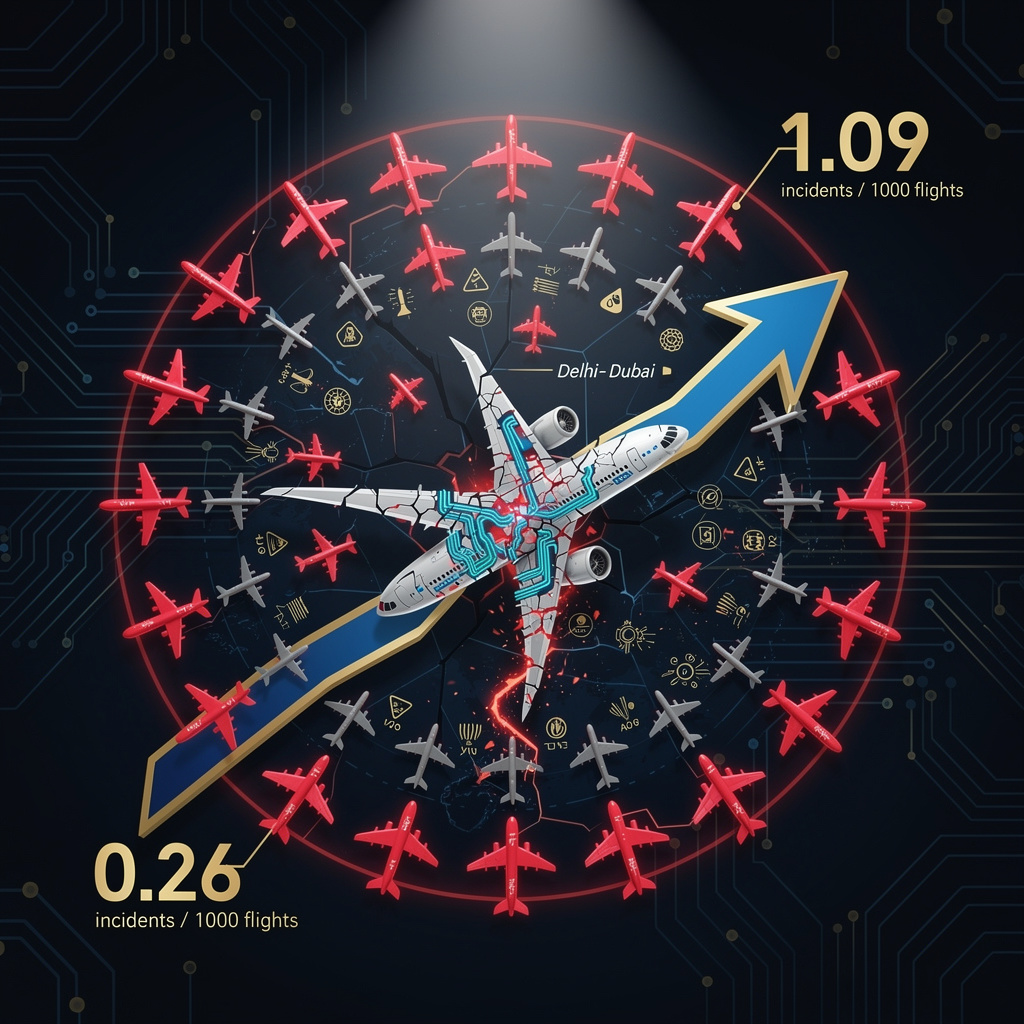
Air India's disclosure that 82.5% of its 166-aircraft fleet carries recurring technical defects marks a critical inflection point for India's flag carrier. The incident rate's fourfold surge—from 0.26 to 1.09 per 1,000 flights between December 2024 and January 2026—signals systemic maintenance failure rather than isolated malfunction, with 138 aircraft exhibiting patterns of engine stalls, hydraulic failures, and fluid leaks that now demand structural intervention.
How defects propagate across systems
The technical profile reveals interconnected vulnerabilities. Boeing 787-8 Dreamliners show fuel-control switch anomalies ("RUN → CUT-OFF" transitions) and FADEC data corruption, while hydraulic actuator trips and uncommanded altitude restrictions indicate Integrated Avionics Bus arbitration failures. Five fuel/oil leaks concentrated on the Delhi-Dubai corridor—accounting for roughly 60% of such incidents—suggest route-specific stress from high-altitude, long-haul cycles. The January 12 lavatory water failure forcing a diversion exemplifies how auxiliary systems degrade when maintenance bandwidth contracts under fleet expansion pressure: 33 Dreamliners added in 2025 strained existing protocols.
Operational and safety impacts
- Safety: 260 fatalities from Flight 171 (May 2025); 23 technical incidents in January 2026 generated 12 cancellations, 8 diversions, 5 altitude restrictions
- Financial: ~$2.3 million revenue loss from January disruptions; $110,000 regulatory fine imposed
- Regulatory: DGCA confirmed 191 recurring defects across 267 inspected aircraft; ministry-mandated fleet-wide re-inspections completed February 3, 2026
Response gaps and structural constraints
Current measures demonstrate activity without assurance. The 30% critical spares inventory increase reduces ground time but does not address root causes. Predictive maintenance analytics and non-destructive testing equipment investments remain nascent. Revised Minimum Equipment List thresholds and crew-maintenance communication protocols treat symptoms; centralized control computer software updates—critical to eliminating cascade failure pathways—lack certification timelines. The 82.5% defect prevalence exceeds any comparable full-service carrier disclosure in the past decade, indicating maintenance infrastructure scaled inadequately to fleet growth.
Projected trajectory
- Q2–Q3 2026: Target incident rate ≤0.6 per 1,000 flights following completed re-inspections; Delhi-Dubai leak frequency stabilization after May hydraulic line replacements
- 2027: Full recurring defect remediation contingent on predictive maintenance integration and narrow-body retrofit completion
- Post-2028: Residual 0.3 per 1,000 flight incident probability persists until CCC software certification
The data indicates Air India's crisis stems from expansion velocity exceeding maintenance modernization capacity. Without accelerated avionics software certification and predictive maintenance deployment, temporary fixes will yield to renewed defect accumulation.
🎯 1,000 AI Combat Drones: U.S. Air Force's YFQ-44A Proves Missile-Haul Capability, Production Decision Due FY 2026
1,000 AI drones will fly as 'loyal wingmen' by 2030—each carrying live AMRAAM missiles 🎯 The YFQ-44A just proved it can haul weapons without breaking aerodynamics, with 99.8% waypoint precision. Human pilots still pull the trigger... for now. Would you trust an algorithm with your wingman in contested airspace? — What's your take: Colorado test range or your hometown skies?
The U.S. Air Force has cleared a critical hurdle in autonomous warfare, demonstrating that Anduril's YFQ-44A "Fury" drone can carry air-to-air missiles in live flight without sacrificing aerodynamic stability. February's captive-carry tests over Colorado validated what program architects promised: a loyal-wingman platform that extends manned fighter reach while keeping pilots out of the most lethal airspace.
How the system operates
The YFQ-44A functions as a remotely commanded extension of a pilot's intent. During the February sorties, an F-22 pilot issued mission-level commands through Collins Aerospace's Sidekick and Shield AI's Hivemind software, which translated human direction into autonomous flight and weapons-hold maneuvers. Latency remained below 150 milliseconds—roughly the blink of an eye—with waypoint navigation succeeding 99.8% of the time. Structural strain gauges recorded peak loads within 5% of design margins, confirming the airframe tolerates missile carriage under combat-equivalent stresses.
Operational implications
Force multiplication: Each CCA effectively doubles a fighter pilot's sensor-shooter capacity without doubling crew or risk exposure.
Cost asymmetry: At roughly one-third the lifecycle cost of an F-35, attritable CCAs absorb losses that would ground manned fleets.
Kill-chain compression: Autonomous release authority—retained under human confirmation—shortens engagement timelines against hypersonic and stealth threats.
Interoperability demands: Software must synchronize across Air Force, Navy, and Marine Corps platforms, complicating updates and vulnerability patching.
Capability gaps and responses
Structural fatigue from repeated captive-carry cycles poses the most immediate technical risk. The program counters with real-time health monitoring and preemptive airframe rotation. Software-weapon interaction undergoes formal verification against the Autonomous Mission Reference Architecture, with human-in-the-loop release authority maintained as a fail-safe. Raytheon's expanded AMRAAM production—now exceeding 1,000 units annually—addresses missile availability constraints that previously delayed similar programs.
Program trajectory
- Q3–Q4 2026: Live-weapon flight tests of AMRAAM-armed YFQ-44A; production decision for Increment 1 (~1,000 units).
- 2027–2029: Initial squadron fielding as "loyal wingmen" for F-22 and F-35 formations; projected 30% increase in sortie generation in contested airspace.
- 2030–2035: Full fleet integration of ~1,000 CCAs across services; autonomous self-protection layer for tankers and AWACS in high-threat environments.
The February tests do not guarantee program success, but they eliminate the most fundamental uncertainty: whether an autonomous airframe can carry lethal payload without compromising the manned aircraft it supports. With Raytheon embedding live AMRAAMs and Increment 2 contracts already awarded, the Air Force has compressed a decade of traditional development into roughly 24 months. The result, if sustained, redefines the cost-exchange calculus of aerial warfare—trading silicon for blood in contested skies.
✈️ 60,000 Fake Jet Parts, £40M Fraud: Music Exec's Counterfeit Scheme Grounds 90 Aircraft Across US, Europe
60,000+ counterfeit jet engine parts with forged certificates. £40M+ damage. A former music exec orchestrated the largest aviation parts fraud in history—supplying fake CFM56 components to American Airlines, Ryanair & others. Paper certificates = broken security. When your next flight's engine traceability depends on a signature that could be fake, does your ticket price still feel like the real bargain?
Between 2019 and 2023, AOG Technics sold over 60,000 counterfeit aircraft components worth £7 million to airlines across Europe and the United States, exposing critical vulnerabilities in the aviation supply chain. The UK-registered firm forged airworthiness certificates for CFM56 engine parts used in Boeing 737NG and Airbus A320ceo fleets—aircraft carrying millions of passengers annually. Former music executive Jose Alejandro Zamora Yrala orchestrated the scheme, admitting to forging more than 60,000 certificates before receiving a 56-month prison sentence in February 2026. The fraud's total financial damage exceeds £40 million, with American Airlines alone reporting £21 million in direct losses from approximately 28 affected engines.
How falsified documentation bypassed safety systems
The scheme exploited the "cannibalisation economy" for used CFM56 spares—components from retired aircraft resold to active fleets. Zamora's operation reproduced signatures of authorized release engineers on paper certificates, submitting them to airline maintenance and audit departments as legitimate. A parallel shell entity, "AOG Technic," extended the fraud to $53 million, including €17 million in missing military components. Parts reached Los Angeles, Chicago, San Francisco, São Paulo, and multiple European maintenance facilities without unified digital verification, demonstrating how fragmented traceability enables systemic deception.
Immediate impacts on safety and operations
- Operational: ~90 aircraft temporarily grounded pending verification; mandatory inspections ordered for all CFM56 engines with post-2018 sourced parts
- Financial: £40 million+ total damage; £21 million direct loss to American Airlines; civil recovery actions ongoing
- Regulatory: EASA, FAA, and UK CAA issued safety alerts; criminal investigations launched in Italy, UK, and South America
- Industry: Major OEMs (Safran, GE Aviation) circulated enhanced documentation checks to approved maintenance facilities
Where verification gaps persist
| Vulnerability | Current State | Consequence |
|---|---|---|
| Certificate integrity | Paper-based airworthiness releases | Signature replication enables undetected fraud |
| Part provenance | Fragmented, non-digital records | 60,000+ components entered supply chain without unified audit trail |
| Cross-border oversight | Inconsistent national acceptance standards | Regulatory arbitrage exploited across UK, US, Brazil, Mexico, Europe |
| Market transparency | Unregulated surplus component resale | "Cannibalisation" market operates without mandatory registration |
Projected reforms and adoption timeline
- 2026–2027: Surplus-part transactions projected to drop 30% as airlines implement stricter acceptance criteria; compliance audits surge across CFM56-operating fleets
- 2028–2029: Blockchain-based Part-Traceability Ledger adoption by three major OEMs (CFM, Pratt & Whitney, Rolls-Royce); counterfeit-part incidence forecast to decline >70%
- 2030–2031: ICAO-mandated global standards for used-part certification; harmonized digital certificate exchange protocol operational
The AOG Technics case demonstrates that aviation's reliance on paper documentation and fragmented oversight creates measurable systemic risk. The £7 million fraud caused immediate safety disruptions and £40 million in verified losses, while highlighting potential industry-wide exposure measured in billions. Digital traceability infrastructure and multilateral regulatory coordination now determine whether the surplus-parts market can restore operational confidence or remains vulnerable to replication.
In Other News
- BRINC Drones unveils next-gen night-capable DFR drone on March 24, 2026, with 500+ law enforcement contracts and $400M valuation
- Ford recalls 412,774 Explorer SUVs over rear suspension toe link fractures risk
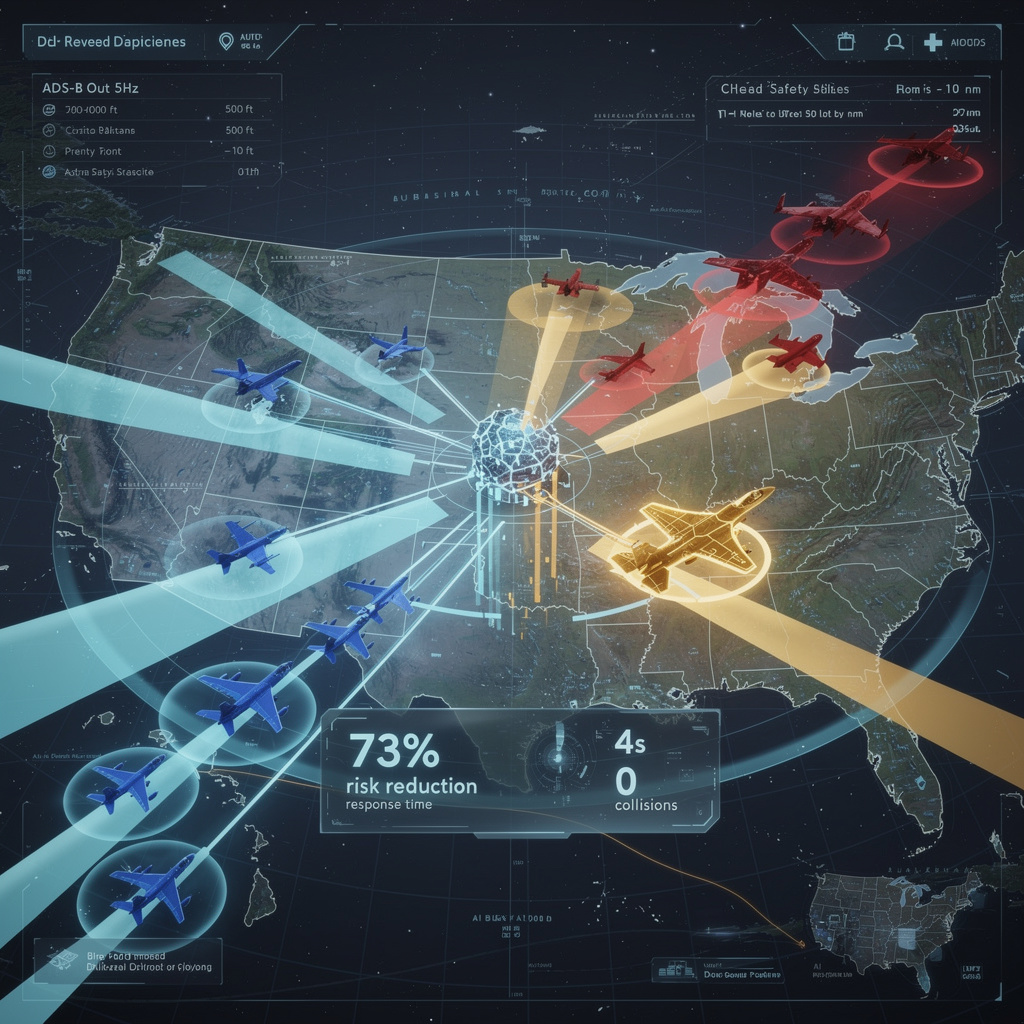
- House rejects ROTOR Act, blocking mandatory ADS-B collision avoidance tech after 67-dead midair crash near Washington D.C.
- Boeing 787 Dreamliner’s bleedless cabin air system improves fuel efficiency by 20%, now in service with 86 airlines
Comments ()