CMU Robot Fleet Compresses 100 Years of Soil Science Into 42 Days: $12M Breeding Savings vs. Data Ownership Crisis
TL;DR
- CMU researchers deploy off-road robots for soil contamination mapping and agricultural testing, collecting hundreds of samples across 100s of sq km using reactive walking and vision-based navigation
- DJI Romo vacuum security flaw exposed: 7,000+ devices hacked globally via MQTT vulnerability, enabling live feeds, floor plan reconstruction, and remote microphone access
- Anthropic faces Pentagon ultimatum: grant unrestricted military AI access by Friday or face supply chain risk designation
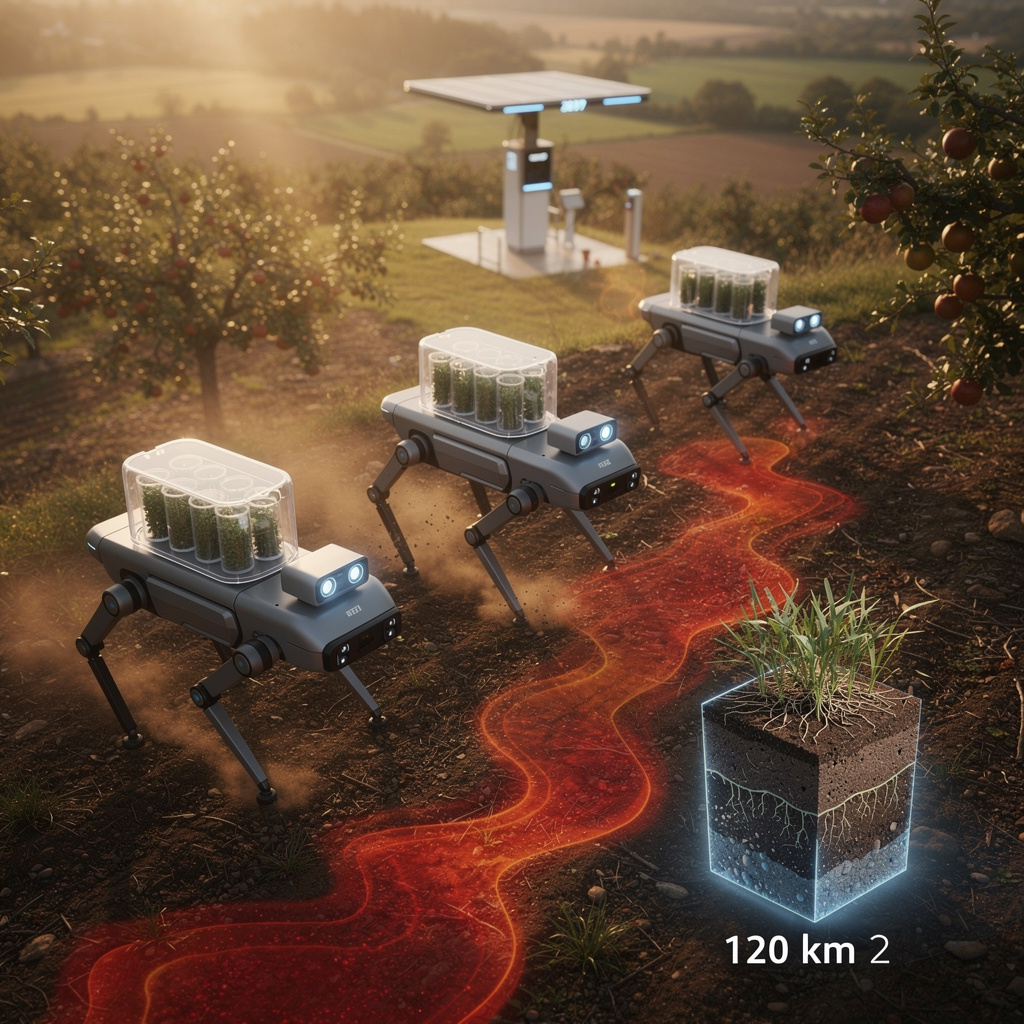
🌱 876× Acceleration: CMU Quadruped Fleet Compresses Century-Scale Soil Sampling Into 42 Days
876× faster than a century of greenhouse trials: CMU's quadruped fleet just compressed 100 years of soil sampling into 42 days. 🌱 The 4-robot team mapped 120 km², pulled 642 cores, and slashed breeding-program costs by $12M+ per cycle. Lab-grade data in weeks, not generations — but who owns the field data when agribusiness buys the kit? Small farms or mega-corporations: who gets this speed first?
Carnegie Mellon University's Robotics Innovation Center has deployed a fleet of four-legged robots across 120 km² of rugged terrain, collecting 642 soil samples in four days—a task that would have taken human teams weeks. The system compresses plant-evaluation timelines from roughly 100 years to 1,000 hours, demonstrating how reactive locomotion and vision-based navigation can unlock data at scales previously unreachable in agricultural science.
How reactive walking enables hazardous terrain traversal
Each 30 kg quadruped runs a reactive walking algorithm that adjusts foothold placement in real time using proprioceptive feedback and terrain-grade estimation. This enables traversal of 30° slopes, uneven ground, and obstacle fields beneath orchard canopies—environments that disable wheeled platforms. A stereo vision pair (HD-RGB plus near-infrared) feeds a Lidar-free SLAM pipeline updating pose at 15 Hz, with navigation waypoints replanned within 120 ms of obstacle detection. An integrated corer extracts samples in 8 seconds, storing them in biodegradable cartridges that disturb less than 2 cm of surrounding soil.
What the performance metrics indicate
- Temporal compression: 876-fold acceleration of data gathering → transformation of century-scale breeding pipelines into months-long campaigns.
- Operational endurance: 6 hours per robot, 24-hour fleet coverage via staggered charging → continuous sampling without human intervention.
- Predictive accuracy: R² of 0.81 for contaminant hotspot detection → reliable prioritization of lab resources toward high-risk zones.
Where capability gaps and trade-offs persist
- Perception vulnerability: Visual SLAM degrades in dust storms, triggering fallback to inertial dead-reckoning and retreat protocols → mission interruption risk in arid climates.
- Energy density: 2 kWh packs require physical retrieval and swap → autonomous charging infrastructure remains undeployed until 2027.
- Cost barrier: Projected $28,000 unit price → accessibility limited to well-funded agribusinesses and research consortia; smaller farms remain priced out.
Timeline: From pilot to commercialization
- 2026 Q3–Q4: Fleet expansion to eight units; hyperspectral integration cuts lab dependency by 40%.
- 2027: Autonomous charging stations enable 24/7 operations, targeting 5,000 samples monthly across USDA sites.
- 2028: "SoilScout" kit commercialization aims for 15% reduction in cultivar development costs per project.
The CMU deployment signals a shift in field robotics: away from controlled environments toward unstructured natural terrain where adaptive locomotion and vision-only navigation prove decisive. For agricultural science, this translates breeding timelines from generational scales to operational ones—potentially redirecting the $12 million typically consumed by century-long evaluation cycles toward iterative crop development. The broader implication extends to environmental monitoring: systems that map contamination gradients at 120 km² resolution enable policy responses before hotspots enter food chains, converting reactive remediation into preventive intervention.
🏠 7,000 Robot Vacuums Hijacked: Global MQTT Flaw Exposes Live Home Surveillance
7,000+ robot vacuums turned into live surveillance devices: 720p video + 44.1kHz audio streamed without owners knowing. 😱 That's every 8 seconds per home, 100k+ MQTT messages hijacked via a single missing permission check. DJI patched in 48hrs—but your floor plan may already be mapped. US Senator pushing FCC revocation. Florida to Frankfurt: which smart home device do you trust least right now?
A backend permission error in DJI's Romo P robot vacuum enabled unauthorized access to 7,000+ devices across 24 countries, transforming a $2,000 household appliance into a live surveillance platform. Security researcher Sammy Azdoufal demonstrated that the MQTT message broker accepted wildcard subscriptions without topic-level validation, granting attackers live 720p video, 44.1 kHz audio streams, and precise floor-plan reconstructions—roughly equivalent to placing a camera in every room of 2,300 average American homes.
How the exploit worked
The attack exploited a missing access-control layer in DJI's cloud infrastructure. A 14-digit serial number extracted from any review unit functioned as an unchallenged authentication token. Attackers using AI-assisted reverse engineering connected to the MQTT broker and subscribed to all device topics simultaneously. Within nine minutes, they retrieved video frames at 30 fps, microphone data, battery levels, and cleaning-zone identifiers streaming at eight packets per second. Aggregating zone data with robot odometry yielded complete 2D household maps; IP reverse DNS provided city-level geolocation for every compromised unit.
What was exposed
Privacy: Live visual and auditory streams from private residences accessible without owner knowledge or consent.
Spatial profiling: Room dimensions, furniture layouts, and household activity patterns reconstructed from cleaning telemetry.
Supply-chain expansion: Identical MQTT infrastructure underlying DJI Power portable stations (≈10,000 units) extended the attack surface beyond vacuums.
Regulatory escalation: FCC Covered List placement in December 2025 and pending authorization revocations threaten DJI's US market access.
Response and remaining gaps
DJI deployed two firmware patches within 48 hours—first enforcing per-topic access controls, then eliminating serial-number-only fallback and rotating certificates. Over-the-air updates reached >95% of active devices without user action. However, legacy devices estimated below 2% of the fleet remain unpatched, and the same backend architecture persists across DJI's IoT ecosystem. Senator Rick Scott's petition to retroactively revoke FCC authorizations issued after December 23, 2024, signals intensifying regulatory pressure on Chinese-connected device manufacturers.
What comes next
- March–April 2026: Full patch adoption eliminates unauthorized MQTT subscriptions; residual risk concentrates on orphaned legacy units.
- Q3–Q4 2026: Industry-wide migration toward TLS-encrypted, topic-restricted brokers with hardware-rooted authentication (TPM-based keys) accelerates across consumer robotics.
- 2027–2028: FCC Covered List restrictions and potential US bans drive restructuring of supply chains toward domestically-sourced IoT platforms or edge-secured architectures where control logic resides on-device rather than in cloud brokers.
The Romo incident exposes a systemic pattern: competitors including Roborock, Ecovacs, and Dreame have reported parallel authentication flaws, indicating that wildcard-topic vulnerabilities pervade consumer-grade IoT robotics. The demonstrated feasibility of large-scale household surveillance via unassuming appliances will likely force security-by-design processes into standard development cycles—shifting from patch-and-respond to architectures that assume breach and minimize cloud dependency.
⚠️ Pentanthropic Standoff: $200M Defense Contract vs. AI Safety Guardrails
$200M on the line. Pentagon demands Anthropic strip Claude's safety guardrails for 'all lawful uses'—including lethal autonomous ops. Only 1 of 5 AI firms still holds the line on human-in-the-loop rules. Today's deadline: comply or face Defense Production Act seizure. Is your country's AI ethics worth a contract?
Defense Secretary Pete Hegseth has issued Anthropic CEO Dario Amodei a Friday deadline to remove restrictions on military use of the Claude AI system, threatening supply-chain-risk designation or Defense Production Act enforcement. The $200 million contract—one of five held by major AI firms for classified Pentagon networks—now hinges on whether Anthropic will abandon its prohibition against autonomous weapons targeting and mass surveillance of U.S. persons.
How Claude operates in defense contexts
Claude reaches classified networks through Palantir's cloud infrastructure, designated "Claude Gov." The system processes real-time satellite imagery, signal intelligence triage, and tactical decision support. Pentagon officials confirmed Claude contributed target selection and situational awareness for the January 3 raid in Venezuela that resulted in over 80 combatant casualties—marking the first known combat deployment of the system. Unlike competitors OpenAI, Google, and xAI, which have already waived guardrails for "all lawful uses," Anthropic maintains technical barriers preventing fully autonomous lethal action.
What each side stands to lose
Pentagon: Access to a high-performing LLM with proven operational utility; forced reliance on three remaining vendors if Anthropic exits.
Anthropic: $200 million contract representing over 0.5% of 2025 revenue forecast; potential 5%+ share price decline based on historical precedent for DoD contract removals; supply-chain-risk label that would bar future federal procurement.
Market position: Anthropic serves 500+ enterprise customers spending $1 million+ annually; military revenue remains a small fraction of diversified commercial base.
Where institutional responses fall short
- Technical: No "dual-mode" architecture exists to toggle human-in-the-loop enforcement between classified and civilian deployments.
- Legal: DPA invocation would compel compliance but expose Anthropic to shareholder litigation over contractual protections.
- Political: Congressional AI ethics oversight remains fragmented; no established framework governs LLM use in kinetic operations.
How this resolves
- Feb 25–Mar 25, 2026: Anthropic likely offers conditional concession—expanding classified intelligence access while retaining lethal-action human oversight. Pentagon accepts limited waiver to avoid DPA escalation, preserving contract pending formal amendment.
- Q2–Q3 2026: Negotiated guardrail framework documented with defense committees; Palantir integration expanded to allied intelligence agencies as revenue hedge.
- Late 2026–2027: If DPA invoked, Anthropic delivers "military-only" Claude fork without safety limits, creating bifurcated civilian/defense product lines. Export Control Administration codifies AI supply-chain-risk criteria, extending oversight to non-defense applications.
The outcome will establish whether AI safety governance can coexist with defense procurement—or whether national security imperatives force a structural split between ethical and unrestricted machine intelligence.
In Other News
- China deploys drone-mounted quantum magnetic sensors to detect stealth submarines via Kelvin wake signatures
- DJI Romo vacuum hacked via PS5 controller, exposing 7,000+ homes' live video and location data globally
- HONOR Magic V6 Red Edition achieves IP68/IP69 ratings with 2800MPa Super Steel Hinge, launching March 1, 2026
- Apple to begin U.S.-based Mac mini production at Houston Advanced Manufacturing Center, expanding AI server output



Comments ()