Invisible Killers: How One NASA Pilot's Death Rewrote Air Safety Rules
TL;DR
- NASA's T-37B aircraft completed decade-long wake turbulence study, confirming aircraft-specific vortex behavior with Boeing 727 and L-1011 TriStar tests
- Murtala Muhammed International Airport Terminal 1 fire disrupts flights; 6 injured, British Airways, Lufthansa, Emirates diverted to Abuja
- 237+ flights canceled across Mexico as military operation kills cartel leader El Mencho, U.S. and Canadian carriers suspend routes
🌪️ NASA Pilot's Fatal Chase Mapped Invisible Killers: 35% Stronger Vortices Rewrite Air Rules
A NASA pilot died chasing invisible killers. The T-37B program proved L-1011 vortices were 35% deadlier than 727s—coherent for 70+ seconds, spiraling down faster. 200+ encounters mapped the danger we now separate by class. Richard Gray's 1982 crash ended the flights but birthed the 'Heavy-Medium-Light' rules still guarding your flight today. Ever wonder if AI could shrink those gaps safely? — What's your closest brush with turbulence?
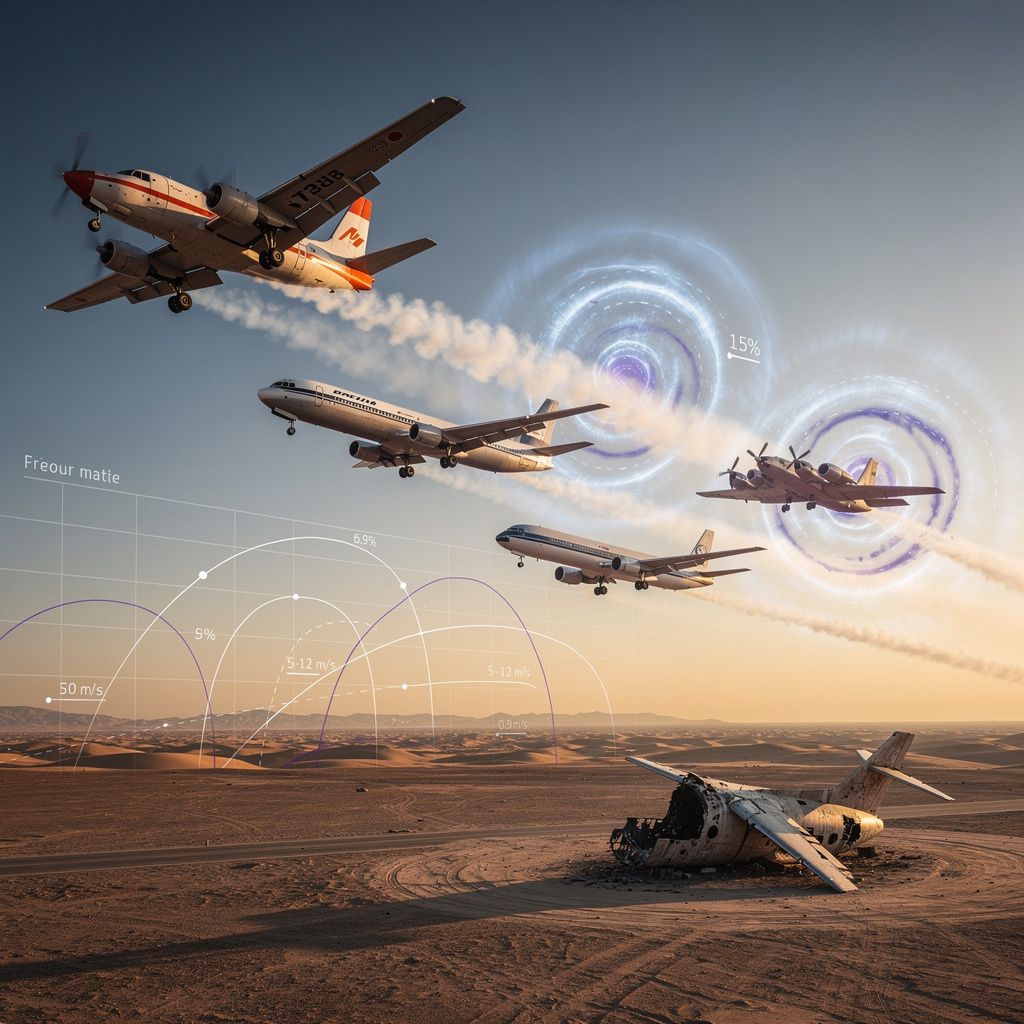
NASA's decade-long pursuit of invisible killers in the sky ended with a crash that ironically proved the danger it sought to measure. From 1973 to 1982, a Cessna T-37B chase aircraft tailed Boeing 727s, DC-8s, and Lockheed L-1011 TriStars over California's Mojave Desert, smoke-marking their wake vortices to decode how these turbulent spirals threaten trailing planes. The findings reshaped air traffic control worldwide.
How the chase worked
The T-37B maintained a fixed six-nautical-mile offset behind target airliners, using pressure transducers, high-speed cine-photography at 200 frames per second, and early lidar sampling to capture vortex structure. Smoke generators installed on the larger aircraft made invisible turbulence visible, revealing cores spanning 0.9 to 1.5 nautical miles with circulation strengths of 5–12 square meters per second.
What the data revealed
Scale: The L-1011 TriStar produced vortices roughly 35% stronger than the Boeing 727 at comparable thrust—equivalent to the difference between a Category 3 hurricane and a Category 4 in atmospheric energy density.
Persistence: Larger aircraft vortices remained coherent for over 70 seconds; 727 vortices dissipated in roughly half that time.
Descent: The TriStar's vortex descended approximately 15% faster, accelerating the hazard window for following traffic.
Regulatory consequence: These measurements directly enabled the "Heavy-Medium-Light" aircraft classification system still governing separation minima today.
Program termination and legacy
The research ended November 8, 1982, when the chase T-37B suffered structural failure during a high-bank maneuver near Edwards Air Force Base, killing pilot Richard E. Gray. Post-crash analysis identified wing spar root fatigue compounded by cumulative high-g loads from vortex-avoidance maneuvers—essentially, the research method itself created the structural stress that downed the aircraft.
- Immediate response: All chase flights suspended; raw data transferred to NASA's Aeronautics Research Mission Directorate
- Structural mitigation: Legacy chase aircraft stress limits reduced 15%
- Regulatory integration: Findings informed FAA Rule 25 FR 121.337, establishing aircraft-specific spacing envelopes
From 1982 datasets to 2026 algorithms
- 2026–2027: Integration of 1973–1982 data into NASA's High-Fidelity Wake-Vortex Model, refining the "Vortex Decay Coefficient" for ATC decision-support tools
- 2028–2030: AI-assisted wake-vortex forecasting enters operational testing for next-generation "Free-Flight" air traffic management
- 2031–2035: Projected 20% reduction in required separation for Light aircraft while preserving safety margins, enabled by real-time vortex prediction
The T-37B program's empirical foundation now underpins computational fluid dynamics validation for autonomous air-traffic systems and unmanned aerial vehicle operations near airports. What began with smoke trails and chase planes has calcified into the mathematical models that will govern increasingly automated skies—proof that rigorous, aircraft-specific measurement outlasts even the most tragic program endings.
🔥 Lagos Airport Fire: $3.2M Diversion Cost, 45-Minute Airspace Closure Exposes Terminal Vulnerability
🔥 12 ATC staff evacuated, 14 rescued by crane after Terminal 1 fire at Lagos airport. A server room electrical fault spread through cable trays in 3–5 minutes—no early warning. $3.2M in diversion costs, Abuja traffic surged 22%. Nigeria's busiest hub still running on mobile control towers. Is your regional airport ready for a 45-minute airspace blackout?
A fire originating in the ground-floor server room of Murtala Muhammed International Airport's Terminal 1 on February 23 forced the evacuation of 12 air traffic controllers, injured six people, and diverted three major international carriers to Abuja. The incident—triggered by an electrical fault that overcame inadequate fire-stop barriers—exposes how aging IT infrastructure can cascade into systemic operational failure at one of West Africa's busiest aviation gateways.
How the fire propagated
Initial alarms sounded 3–5 minutes after ignition, suggesting delayed smoke detection in the server zone. The fire ascended cable trays to the roof, breaching fire-stop barriers and igniting adjacent insulation. Fourteen personnel required crane extraction from the control-tower vicinity; mobile ATC consoles deployed to Terminal 2 within 30 minutes of containment, enabling remote tower operations that limited airspace closure to approximately 45 minutes.
Immediate operational impacts
- Airline finances: Diversion costs for British Airways, Lufthansa, and Emirates reach an estimated $3.2 million in fuel, crew duty-time, and passenger accommodation.
- Regional strain: Abuja absorbed a 22% temporary surge in inbound traffic; secondary fields including Malabo reported capacity pressure.
- Passenger displacement: Roughly 180 travelers across three diverted flights faced rebooking delays and ground-handling backlogs.
Response effectiveness and gaps
Strengths: FAAN's emergency protocols activated mutual-aid agreements with NEMA and LSEMA; police helicopters provided aerial oversight; a 25-tonne mobile crane extracted trapped personnel without fatalities.
Weaknesses: Fire-stop integrity failed in vertical shafts; server-room detection latency exceeded optimal thresholds; ATC evacuation routes required ad-hoc revision under emergency conditions.
Recovery trajectory
- 0–48 hours: Portable fire-suppression units deployed; remote ATC operations sustain normal traffic flow from Terminal 2.
- 1–4 weeks: Fire-rated cabling replaces compromised conduit; addressable multi-sensor detection systems installed with <10-second alarm latency.
- 12–24 months: N712 billion terminal-modernisation programme delivers fire-resistant structural materials, a purpose-built ATC tower with redundant systems, and AI-assisted fire-monitoring integrated with central command.
The incident maintains FAAN's zero-fatality record for 2026 but underscores that Lagos's position as West Africa's primary aviation hub depends on accelerating infrastructure investment already approved—rather than deferred—before the next fault line sparks.
✈️ 237 Flights Canceled: Cartel Violence Grounds Mexico's Pacific Coast Aviation
237+ flights vaporized in 72 hours: Mexico's Pacific coast went 'empty sky' after cartel kingpin takedown. That's 35,600 seats gone—enough to fill 5 Rose Bowls. Air Canada, WestJet, Aeroméxico all grounded while CJNG torched roads outside terminals. Airlines lost $15-20M instantly; tourism bled $30-40M more. Your spring break to Puerto Vallarta: still worth the risk? — Where would you reroute if your destination suddenly became a conflict zone?
The death of Nemesio "El Mencho" Oseguera Cervantes in a February 22 military raid near Tapalpa, Jalisco, triggered one of the most severe security-driven aviation disruptions in recent Mexican history. Within hours, cartel retaliation produced road blockades, vehicle arson, and armed confrontations at airport perimeters, forcing the cancellation of 237+ flights across Guadalajara, Puerto Vallarta, and Manzanillo. Major North American carriers—Air Canada, WestJet, Southwest, Delta, and Aeroméxico among them—suspended operations entirely, while flight-tracking services recorded an "empty-sky" phenomenon over the Mexican Pacific coast on February 23. The episode exposes how quickly organized-crime violence can collapse regional air connectivity, stranding thousands and exposing systemic fragility in airline risk models.
How the disruption cascaded
The raid's immediate aftermath generated kinetic threats to aviation infrastructure. Mexican federal forces deployed National Guard units to secure terminal access at Guadalajara and Puerto Vallarta, yet blockades severed ground transportation links. Airlines faced a binary choice: operate into uncertain security conditions or preserve crew and aircraft safety through suspension. Most chose the latter. WestJet diverted 7 en-route flights and canceled 37 additional services; Air Canada deployed a Boeing 787-9 Dreamliner for 258-seat repatriation operations. The operational calculus prioritized asset protection over schedule integrity, reflecting standard aviation risk protocols when ground security cannot be verified.
Quantified impacts
- Network disruption: 237+ cancellations—approximately 90 at Guadalajara, 137 at Puerto Vallarta, 6 at Manzanillo—removing roughly 35,600 seat-capacity hours from the market.
- Financial exposure: Immediate airline revenue losses of $15–20 million (assuming $250 average fare), with ancillary tourism losses of $30–40 million across the 48-hour window.
- Operational strain: Ground-handling crews redeployed to security screening; air traffic control delays at Guadalajara spiked 45% during peak hours.
- Passenger volume: U.S. and Canadian government advisories affected approximately 350 travelers under shelter-in-place protocols.
Institutional responses and capability gaps
Airline mitigation: Travel waivers, fee-free rebooking, and partial refunds limited passenger liability. Repatriation flights addressed immediate stranding but required dedicated wide-body allocation.
Regulatory coordination: U.S. State Department Level 3 alerts and Canadian "extreme caution" advisories formalized risk perception, yet provided limited operational guidance for real-time fleet repositioning.
Security measures: National Guard terminal presence and "Code Red" public alerts restored partial confidence, though intelligence-sharing between Mexican defense agencies and airline operations centers remained ad hoc.
Persistent vulnerabilities: Limited alternate runway capacity in Jalisco forced diversion rather than rerouting; no pre-established security clearance protocols existed for high-risk zone entries.
Recovery trajectory
- February 26–28: Staggered service resumption contingent on verified terminal perimeter security; majority rebooking onto restored schedules.
- March 2026: Crew standby pool expansion and alternative hub capacity securing at Mexico City and Monterrey to absorb overflow.
- Q2 2026: Projected 8–12% tourism demand decline to Pacific coast destinations; insurance premiums for Mexican operations anticipated to rise 12–18%.
- Q4 2026: Potential frequency downgrades on Jalisco routes—daily services reduced to twice-weekly pending sustained security stabilization.
The El Mencho operation demonstrates that cartel-related violence now functions as a systemic aviation risk requiring integrated geopolitical modeling in network planning. Airlines operating in high-threat regions must institutionalize real-time intelligence feeds, rapid-response insurance frameworks, and cross-border security coordination as core operational requirements—not peripheral contingencies. The 237 canceled flights represent more than temporary schedule disruption; they signal a structural inflection point where organized-crime dynamics demand fundamental recalibration of route resilience strategies.
In Other News
- U.S. Navy refuels Gerald R. Ford-class carriers every 25 years; RCOH process takes 6 years, costs $300B total, uses 3D-printed parts for electronics
- FBI Director Kash Patel faces bipartisan backlash over use of government jet to celebrate with U.S. Olympic hockey team in Italy
- Boeing 747-8F freighters average 33.2 years in service, with 42 active globally as airlines shift to A350-1000 and 777-9 for cargo efficiency
- Apollo-era Artemis 2 mission delayed to April 2026 due to helium flow issue, rocket rolled back to VAB for repairs

Comments ()