0.02% Incident Rate vs. 'Full Self-Driving': California DMV Cracks Down on Tesla's $8B Marketing Machine
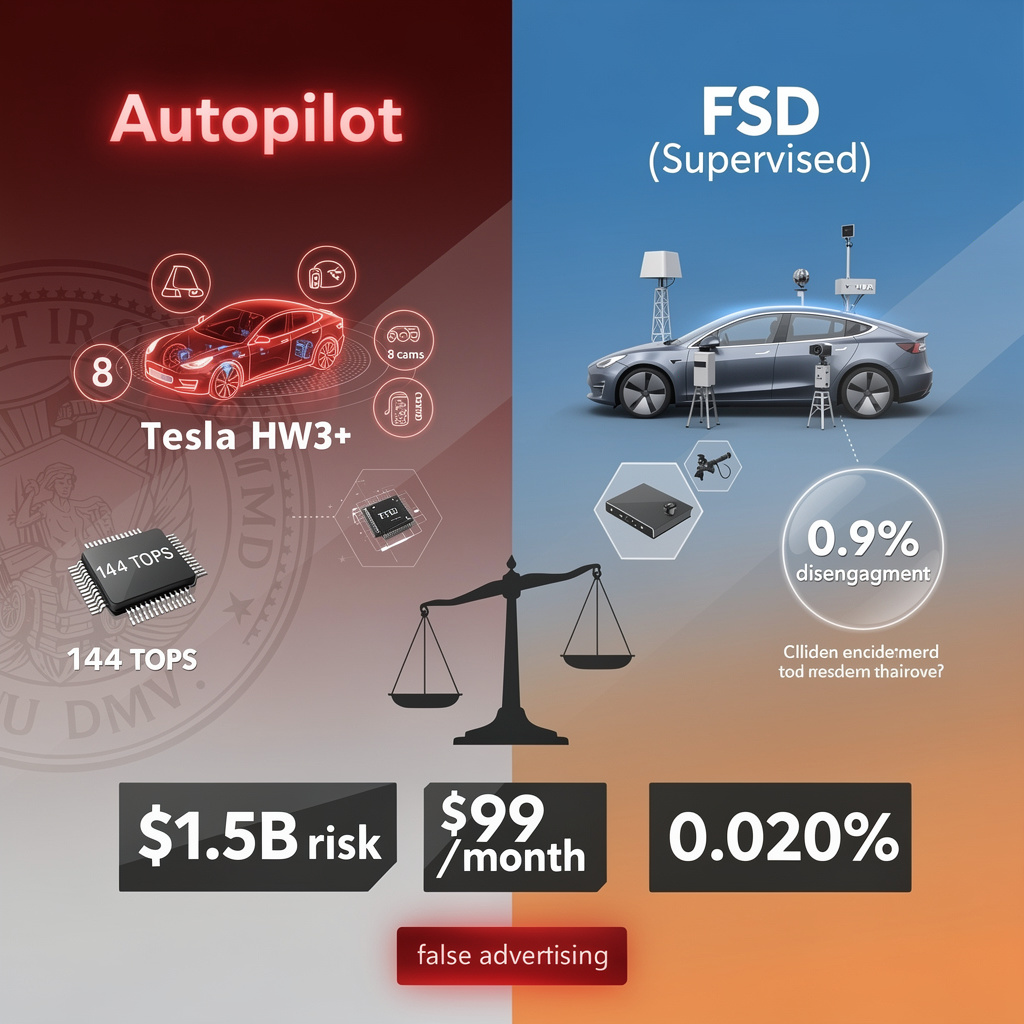
58 FSD incidents across 2.88M Teslas—just 0.02% incident rate, yet California DMV calls it false advertising. That's like one bad apple per 5,000 cars, but the label 'Full Self-Driving' sold $8K dreams while drivers kept hands on wheel. Now it's $99/month 'Supervised' mode, with 30-day license suspension looming over 33% of US sales. When does marketing language become public safety liability? — Would you pay monthly for 'supervised' autonomy in your commute?
Tesla has sued the California DMV to overturn a December 2025 ruling that deemed its "Autopilot" and "Full Self-Driving" branding false advertising, exposing a fundamental tension between marketing language and verified autonomous capabilities. The case centers on whether Tesla's vision-centric driver-assist system—capable of lane-keeping and traffic-light recognition but requiring constant human supervision—warrants terminology implying Level 3-4 autonomy.
How the technology actually performs
Tesla's HW3+ stack relies on eight cameras, a single forward radar, and ultrasonic sensors—no LiDAR—processed by a 144-TOPS custom ASIC. The system operates in "shadow mode," collecting data for over-the-air updates, yet NHTSA data reveals 58 incidents across 2.88 million vehicles: a 0.020% incident rate translating to roughly two events per 10,000 vehicles. While Tesla cites a 0.28% disengagement rate per million miles—below the industry average of 0.9%—the 14 crashes and 23 injuries under federal investigation indicate the gap between marketing promise and operational reality.
Regulatory and financial pressures
The DMV's corrective-action framework carries substantial weight:
- Legal exposure: 60-day deadline to remove "Autopilot" from California marketing and rebrand FSD as "Full Self-Driving (Supervised)"; 30-day license suspension for non-compliance
- Revenue at risk: California represents ~33% of U.S. Tesla deliveries; a one-month sales halt threatens ~$1.5 billion based on 2025 monthly averages
- Pricing restructuring: $8,000 one-time purchase eliminated in favor of $99/month subscription, generating ~$108 million annual recurring revenue from 1.1 million active subscribers
Competitive positioning: strengths and vulnerabilities
| Capability | Tesla approach | Competitor standard (Waymo, Cruise) | |:---|:---|:---| | Sensing: Vision-primary, no LiDAR | Multimodal redundancy with LiDAR/radar fusion | | Data scale: >30 billion real-world miles | Smaller mapped geofenced zones | | Update velocity: Mature OTA pipeline | Slower certification cycles | | Regulatory exposure: State-level consumer protection vulnerability | Cleaner compliance record, higher capital costs |
Timeline: near-term decisions and structural shifts
- March–April 2026: Tesla likely files California Court of Appeal petition while rolling out "(Supervised)" qualifiers across all channels; expect 5–7% temporary California sales dip during marketing collateral transition
- Q2 2026: NHTSA investigation continues; no additional crash penalties anticipated before quarterly safety report
- 2027: HW4 hardware refresh may add short-range LiDAR or solid-state radar to address sensor-redundancy gaps; Austin "Cybercab" pilot (~200 units) targets $300 million 2027 revenue if regulatory path clears
- 2028: Subscription revenue projected to reach $250 million annually; DMV precedent may trigger similar consumer-protection statutes in additional states
The California case signals a broader regulatory reckoning for autonomous-vehicle marketing. Tesla's integrated hardware-software stack and vast data corpus remain competitive advantages, yet the absence of sensor redundancy and dependence on human supervision constitute technical vulnerabilities that regulators are now systematically exposing. For the sector, the ruling establishes that autonomy claims require demonstrable capability alignment—a standard that may reshape how driver-assistance systems are branded, priced, and deployed across the United States.
Comments ()