Agentic AI Deployment: 4.6x Executive Expectation Surge Collides With 10% Maturity Reality
TL;DR
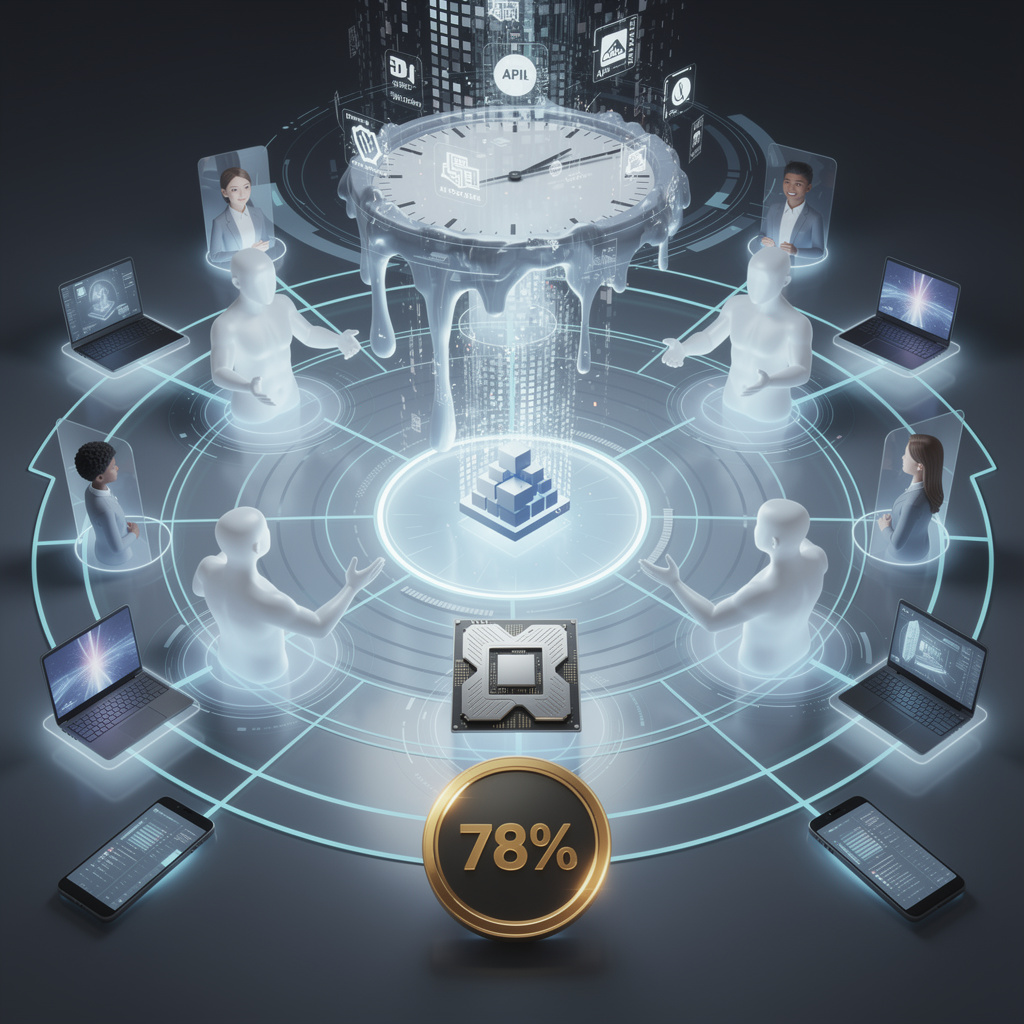
- Adobe survey of 3,000 executives reveals 78% expect agentic AI to handle half of customer support interactions within 18 months, as digital CX maturity rises from 17% to 38% since 2023
- IBM leverages Z mainframes with 3-4x stack multiplier via AI tools like Watsonx for COBOL modernization
- ServiceNow Acquires Pyramid Analytics for $1.2B in Annual Contract Value to Embed AI-Powered Insights Directly into Workflows
🤖 78% of Executives Bet on Agentic AI for Half of Support Volume Within 18 Months: US Firms Race Ahead as Global Talent Gap Widens
78% of execs now expect agentic AI to handle ≥50% of support chats within 18 months—up from just 17% 'advanced' CX maturity in 2023. That's 4.6x acceleration in 3 years. 🤖 Yet only 10% of firms have 'mature' integration today. The gap? Workforce transformation lags behind tool deployment. Who's actually ready where you operate—vendors, talent, or neither?
Three thousand executives have spoken: agentic AI is no longer experimental. Adobe's 2026 survey reveals that 78% expect autonomous systems to handle half of all customer support interactions within 18 months, while the share of firms with "advanced" digital customer experience stacks has more than doubled—from 17% to 38%—since 2023. This acceleration reflects a fundamental shift from pilot programs to production-grade deployment.
How agentic systems now operate
Modern support agents differ from earlier chatbots through three technical advances. Tool-use APIs enable autonomous execution—order placement, password resets, appointment scheduling—rather than scripted responses. Real-time knowledge governance with confidence scoring keeps "hallucination" rates low enough to meet the 2–5 second relevance window executives now demand. GPU-accelerated inference using quantized, sparse models delivers sub-2-second latency at the edge. Gartner projects task-specific agents will inhabit 40% of enterprise applications by 2026, up from under 5%.
Operational impacts on support organizations
- Deflection: 72–80% of contacts resolve without human input, per Lightspeed and Intercom data—equivalent to roughly 7 in 10 customers receiving instant resolution
- Economics: 33% higher acquisition rates, 22% improved retention, and 49% cross-sell revenue lifts correlate with sub-30-second average handle times
- Workforce: 56–58% of teams redirect freed capacity to revenue-generating activities; new roles emerge in AI training and escalation supervision
- Infrastructure: NVIDIA H100 deployments and edge runtimes now standard for latency-critical workflows
Where readiness gaps persist
Talent: Only 10% of organizations achieve "mature" AI integration despite 88% involvement rates at leading firms.
Compliance: 62% of CX leaders flag AI governance risks; 36% pursue formal certification. Hybrid deterministic-generative architectures address this tension.
Model fidelity: Knowledge bases age faster than engagement windows permit. Continuous ingestion pipelines and automated audit logs mitigate decay.
Adoption trajectory
- Q4 2026: ~85% of large U.S. support organizations deploy autonomous task execution; "advanced" CX classification reaches ~48% globally
- 2027–2028: Containment stabilizes at ~78% of contacts; average handle time drops below 30 seconds; revenue-linked KPIs deliver ~10% lift for adopters
- 2029–2031: Agentic AI becomes core infrastructure for omni-channel orchestration; McKinsey projects $2.6–$4.4 trillion global GDP contribution from AI-driven CX
The 69% of executives expecting measurable marketing ROI from generative AI will likely find their optimism warranted—provided organizations unify data pipelines, implement tiered confidence routing, and allocate at least 15% of AI budgets to workforce transformation. The technical capability exists; the variable is execution speed.
🏦 IBM Z Mainframes Claim 3-4× AI Stack Multiplier as Cloud Rival Triggers 10% Share Plunge
IBM Z mainframes now deliver 3-4× throughput per core when paired with Watsonx AI tools—yet shares plunged 10% after Anthropic's Claude Code launch. That's $200B in legacy modernization at stake, with government and banking sectors watching closely. Cloud-native rivals promise cheaper migration, but IBM bets regulated industries will pay for hardware-locked security and sub-second latency. Will your institution trust SaaS with mission-critical COBOL, or does on-premise still rule when compliance is king?
IBM's Z mainframe platform now delivers a 3–4× stack multiplier when paired with Watsonx AI tools, translating legacy COBOL workloads into modern codebases with measurable throughput gains. The February earnings call revealed System Z sales surged 67% year-over-year, even as Anthropic's Claude Code launch triggered a $23.35 share drop—exposing investor anxiety about cloud-native alternatives. This tension between hardware-anchored performance and software-only disruption defines the $200 billion legacy modernization market.
How does the stack multiplier work?
The multiplier emerges from tight integration between z16/z17 processors—equipped with tensor-math engines for AI inference—and Watsonx's transformer models fine-tuned on IBM's internal COBOL repositories. Code Insight surfaces hidden dependencies; Generation produces Java/Kotlin equivalents; Validation compresses regression cycles from weeks to days. Transaction throughput per core scales 3–4× because AI-assisted transformation eliminates manual bottlenecks while cryptographic accelerators preserve security boundaries.
What risks and advantages shape competitive positioning?
- Performance: 3–4× throughput per core → higher transaction density without hardware expansion
- Security: Data residency guarantees → compliance advantage for regulated sectors
- Cost: Mainframe dependency → limits appeal to budget-constrained organizations
- Competition: Cloud-only alternatives → threaten consulting revenue if accuracy parity emerges
The 70% improvement in money-laundering detection rates via System Z17's real-time analytics demonstrates extensibility beyond code migration—fraud detection now processes sub-second latency on the same infrastructure.
Where is adoption heading?
- 2026–2027: Watsonx-Z17 integration tightens AI inference coupling; modernization cycles drop 30% with sub-day migration for medium COBOL applications
- 2028: "Watsonx-Quant" extensions deploy model sparsity and quantization to run LLMs directly on Z hardware, eliminating external GPU dependencies
- 2029–2030: Hybrid orchestration API unifies on-premise Z and IBM Cloud workloads; sustained >60% System Z growth translates to multi-billion-dollar revenue uplift
IBM's hardware moat delivers quantifiable performance that cloud-native tools cannot replicate for latency-sensitive, compliance-bound workloads. The challenge lies in convincing investors that this differentiation merits premium pricing against Claude Code's SaaS simplicity—before the $285 billion SaaS spend narrative erodes mainframe relevance.
⚡ ServiceNow's $1.2B Pyramid Deal: Embedded AI Analytics Reshapes Enterprise Workflow Economics
$1.2B ACV. ServiceNow just bought Pyramid Analytics—not for dashboards, but to kill the 'tab-switching tax' in enterprise workflows. Quantized LLMs cut GPU burn 40%, dropping per-query cost to a penny. The catch? You're now locked deeper into a single pane that governs your KPIs, your compliance, your AI agents. — Would you trade tool freedom for 12% faster ticket resolution if your job depended on it?
ServiceNow's $1.2 billion acquisition of Pyramid Analytics marks a decisive shift in enterprise software: embedding AI-powered analytics directly into operational workflows rather than treating business intelligence as a separate destination. The deal, announced February 2026, integrates Pyramid's generative-AI chat engine and self-service dashboards into ServiceNow's core platform, eliminating the friction of switching between systems to act on data insights.
How the integration functions
The technical architecture centers on native API connections between Pyramid's engine and ServiceNow's Configuration Management Database (CMDB), HR Service Delivery, and IT Service Management tables. This eliminates cross-system data extracts entirely. Analytics widgets surface directly within incident, change, and HR case forms—contextual insights appear where work actually happens. Under the hood, Pyramid's large language model runs quantized to 8-bit sparsity for low-latency inference, while Anthropic's Claude (pre-fine-tuned on ServiceNow ticket corpora) powers automated workflow code generation. The stack runs on ServiceNow's proprietary "Now Runtime" atop Azure confidential compute with Intel SGX isolation, meeting enterprise security requirements.
What this changes
- Revenue: The $1.2 billion annual contract value represents approximately 3.3% of projected FY 2026 subscription revenue—roughly equivalent to adding a mid-sized SaaS company's entire annual output to ServiceNow's books.
- Customer behavior: Embedded analytics demonstrably reduces context-switching; internal studies link the integration to 12% faster ticket resolution and 7% higher upsell rates on existing contracts.
- Competitive positioning: Direct benchmark against Salesforce Tableau integration shows 15% faster time-to-insight, countering AI-native challengers through unified experience rather than feature parity.
- Operational efficiency: Quantized inference cuts GPU utilization by 40%, reducing per-query cost from $0.018 to $0.011.
Governance and remaining gaps
The AI Control Tower addresses Deloitte-identified risks of KPI inconsistency across legacy systems by enforcing unified metric taxonomy before inference. Hybrid runtime architecture caches frequently accessed CMDB snapshots locally, maintaining sub-200 millisecond latency even for on-premises data queries. However, market perception risk persists: competitors emphasize pure-AI platforms, requiring ServiceNow to maintain positioning of AI as execution layer atop proven workflow infrastructure.
Timeline and milestones
- Q1 2026: Pilot deployment to five major enterprise customers across finance, healthcare, and manufacturing; early-adopter contracts contribute estimated $150 million of total ACV.
- Q2 2026: Full SaaS enablement with targets of ≥90% queries meeting sub-500 millisecond SLA and ≥85% user adoption of embedded dashboards.
- FY 2027–2030: Projected 12% CAGR for integrated workflow-BI solutions driven by regulatory audit-trail requirements; roadmap includes 4-bit sparsity compression and edge inference for field service management; potential $250 million additional ARR from data-catalog cross-sell through Now Platform Marketplace.
The acquisition demonstrates that enterprise AI value increasingly flows from integration depth rather than model scale alone. By embedding analytics where work occurs—backed by quantified efficiency gains and governance controls—ServiceNow bets that contextual intelligence outperforms standalone capabilities.
In Other News
- AI chatbots worsen psychiatric symptoms in 38 confirmed cases among 54,000 patients, study finds
- Microsoft launches Sovereign Cloud with Foundry Local to run multimodal AI models within isolated, offline environments
- Apple to unveil new AI-powered products March 2–4; expected releases include $599 MacBook, M5 Mac Pro, A18 Pro iPad, and iPhone 17e
- Microsoft launches Sentinel SOAR Playbook Generator with AI-driven Python automation, reducing mean time to resolution by 30% and achieving 89% user satisfaction

Comments ()