US GDP Craters to 1.44%: Shutdown Masked 2.5% Economy, AI Drove Third of Growth
TL;DR
- U.S. Q4 GDP Growth Slows to 1.4% Annualized Amid Federal Spending Drop of 16.6%, Consumer Spending and Tech Investment Drive Underlying Momentum
- DoorDash Q4 2025 Revenue Grows 37.7% to $3.96B, Misses Expectations by $31M; EPS Down $1.27
📉 1.44% GDP Collapse: Shutdown Wiped 1.1 Points, AI Saved the Quarter
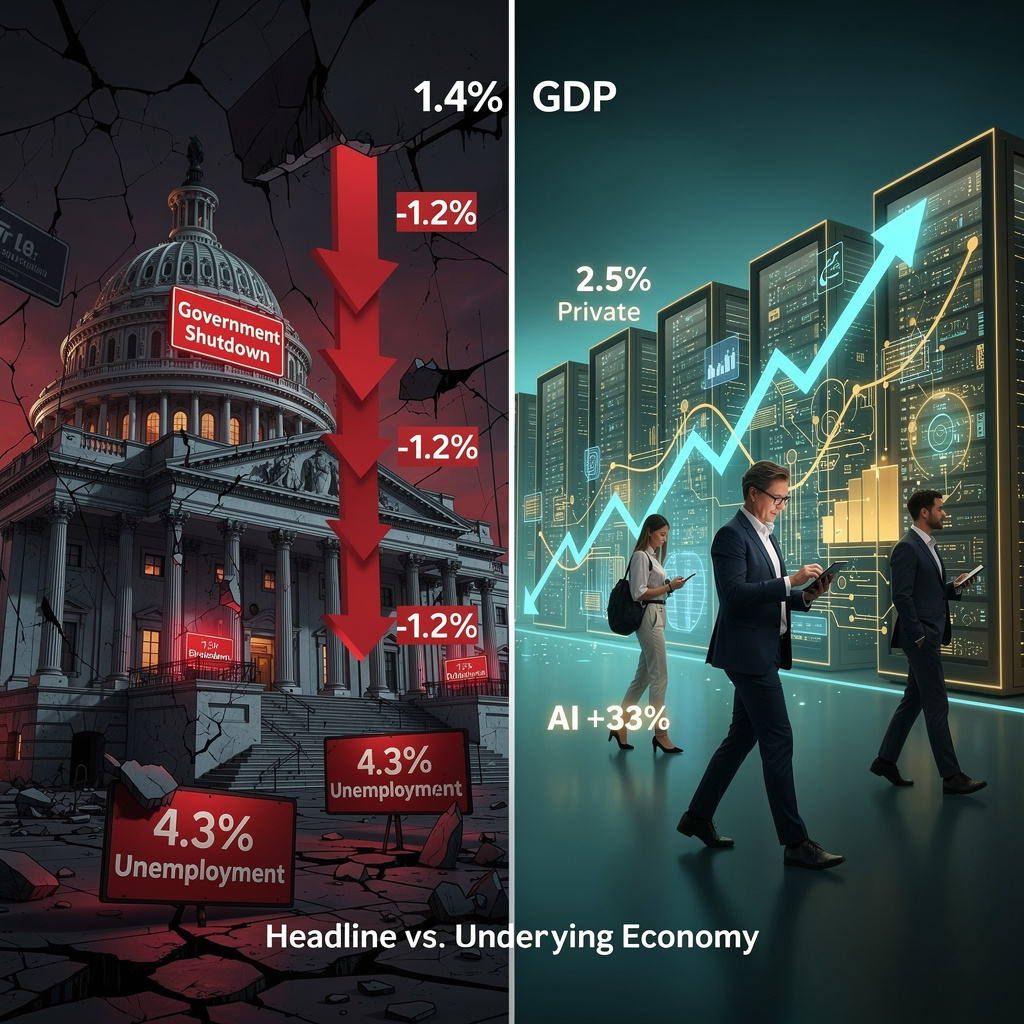
US Q4 GDP collapsed to 1.44%—the worst since 2009 except for one thing: government shutdown erased 1.1 points. Strip that out? Economy's running 2.5%. AI investment carried 33% of growth. So was this a slowdown or just politics eating the numbers? 📉 Your paycheck feel the shutdown or the resilience?
U.S. economic growth decelerated to 1.4% annualized in Q4 2025, a sharp drop from Q3's 4.0% and well below consensus forecasts of 3%. The primary culprit: a 43-day federal government shutdown that slashed public outlays by 16.6%, dragging headline GDP down by approximately 1.1 to 1.2 percentage points. Strip away that fiscal shock, and the private economy expanded at roughly 2.5%—a figure that reveals more resilience than the surface number suggests.
How did the shutdown transmit through the economy?
The fiscal contraction operated through multiple channels. Federal payroll and procurement froze, producing a 5.1% quarterly collapse in government spending. Secondary effects rippled through reduced SNAP benefits and transfer payments, marginally dampening consumer demand during the October-November window. Yet real final sales to domestic purchasers still rose 2.4%, indicating that private demand absorbed much of the blow.
What sustained momentum despite fiscal drag?
Three forces buffered the economy:
- Consumer spending: Wealth effects from elevated asset prices sustained demand among higher-income households, though the pace cooled from Q3's 3.5% growth.
- AI-driven investment: Technology capital expenditures supplied roughly one-third of growth in the first three quarters of 2025; Q4 saw continued 0.3% quarterly expansion in private investment, concentrated in data-center infrastructure.
- Inflation moderation: Core PCE held near 2.0%, preserving Federal Reserve flexibility without forcing restrictive policy.
Where vulnerabilities persist
- Labor market: Net job creation fell to approximately 181,000 for 2025—the lowest annual addition since 2009—pushing unemployment to 4.3%.
- External balance: The trade deficit widened to a five-month high in December, with export deceleration partially offsetting domestic demand strength.
- Fiscal reliability: The shutdown demonstrated how operational dysfunction in Washington can instantly erase over one percentage point of growth.
Near-term trajectory
- Q1 2026: Analysts project 3% annualized growth assuming fiscal operations normalize and private investment holds steady.
- Policy stance: The Federal Reserve maintains its 2.9% policy rate with core inflation at target, retaining optionality for future moderation.
Long-term structural factors
Sustained 2.0–2.5% growth through 2026–2027 hinges on three pillars: affluent consumer spending, AI capital deployment, and asset-price appreciation. Any erosion—whether through renewed fiscal impasse, persistent trade deficits, or labor market deterioration—threatens to push growth below 2% and resurrect recession probabilities.
The Q4 data ultimately demonstrates a bifurcated economy: headline figures capture Washington's dysfunction, while underlying indicators reveal private-sector adaptability. The policy challenge lies in preventing the former from overwhelming the latter.
🌨️ DoorDash Revenue Soars 38% but Profits Stumble: $20M Storm Hit, 41% R&D Surge Test 'Scale-First' Model
DoorDash revenue hit $3.96B (+38% YoY) yet EPS missed by $0.02—spending $20M on winter storms alone 🌨️ R&D surged 41% chasing robots while Dasher costs keep climbing. 'Scale-first, profit-later' playbook wearing thin? Your delivery app fees: worth the convenience or breaking the bank? — How much extra would you pay before deleting every food app?
DoorDash's Q4 2025 results expose the tension between rapid platform expansion and near-term profitability that defines modern gig-economy investing. Revenue surged 37.7% to $3.96 billion—yet a $31 million miss against consensus and a $1.27 EPS figure ($0.02 below expectations) triggered a 10% after-hours sell-off before partial recovery. The numbers tell a familiar story: growth commands premium valuation, but execution precision determines whether that premium endures.
How does the platform actually generate returns?
DoorDash operates a three-sided marketplace connecting consumers, merchants, and "Dashers" (independent contractors). Revenue scales through order volume, commission rates, and emerging verticals like grocery and retail. The model's leverage depends on minimizing per-order delivery costs while maximizing transaction frequency. Q4 delivered 903 million orders (+32% YoY) and $29.7 billion in Gross Order Value (+39% YoY), suggesting healthy demand elasticity. Yet cost pressures—particularly a 41% R&D surge and 31% sales/marketing increase—absorbed these gains before reaching the bottom line.
What dragged on unit economics?
Labor intensity: Higher Dasher costs per order, driven by seasonal demand spikes and regulatory adjustments, compressed margins.
Weather disruption: U.S. winter storms added $20 million in incremental expense—equivalent to roughly 0.5% of quarterly revenue—through delivery delays and vehicle maintenance.
Investment loading: Autonomous-vehicle pilots, drone-delivery development, and the Symbiosys ad-tech platform consumed capital without immediate revenue recognition.
Where do strategic bets stand?
The Deliveroo acquisition contributed approximately $200 million in EBITA for FY 2025, with integration targeting $250 million incremental contribution by FY 2027. This European expansion diversifies geographic concentration but requires operational alignment to DoorDash's cost structure. Meanwhile, the mixed-fleet autonomous model—combining human Dashers with piloted self-driving vehicles—aims to reduce long-term per-order labor expense if scaled successfully.
Forward trajectory
- Q1 2026: GOV guidance of $31.0–$31.8 billion implies moderating growth; adjusted EBITDA of $675–$775 million suggests margin discipline efforts. Consensus EPS may reset lower if cost pressures persist.
- 2026–2027: Autonomous-fleet validation could yield 10% per-order labor cost reduction, translating to 150–200 basis points of adjusted EBITDA margin improvement. Symbiosys ad platform scaling toward 5% of marketplace GOV as ad revenue would add material high-margin contribution.
- FY 2027: Deliveroo integration and ad-tech monetization project $1.5 billion incremental GOV potential, contingent on execution velocity.
DoorDash's path illustrates a sector-wide challenge: platform scale enables defensive moats, but the transition from growth-at-all-costs to sustainable free cash flow demands precise timing of technology deployment and expense rationalization. Investors weighing the 14% post-earnings volatility should focus less on quarterly beats or misses and more on whether autonomous delivery pilots and ad-tech traction convert operational investment into structural margin expansion.
In Other News
- Sandisk Corporation Shares Surge 136% YTD After Earnings Beat, Bank of America Raises Price Target to $850 from $390, Revenue Forecast Raised to $15.7B
- S&P 500 rallies 0.7% weekly despite institutional net sales of $8.3B; Shiller P/E at 17.3 signals elevated valuations
- Consumer sentiment hits 12-month low at 56.4 as Core PCE rises to 2.22%, savings rate drops to 3.6%, and healthcare costs surge 7.7%
- U.S. inflation drops to 3% in January, lowest in 10 months, as Bank of England targets 2% by April


Comments ()