99.67% Success Rate: AI Firefighting Robots Beat Humans by 42%—But One Hardware Failure Risks $50K Unit
TL;DR
- Cyborg Dynamics’ Firefighting Robots Achieve 99.67% Success Rate Using Multi-Agent Reinforcement Learning in Real-World Trials
- Tesla unveils AI4 chip with 20 Cortex-A72 cores and 100–150 TOPS AI performance, targeting Optimus robot and FSD; AI5 planned for late 2026
- Waymo’s Remote Assistance System Faces Scrutiny as 70 Agents Globally Support 400,000 Daily Robotaxi Rides with 150–250ms Latency
🤖 AI Firefighting Robots Achieve 99.67% Success Rate in Queensland: Autonomous Squads Extinguish Flames 42% Faster Than Human Operators
99.67% success rate: AI firefighting robots now extinguish flames in 7.2 seconds—42% faster than human operators. That's less time than it takes to read this sentence. 🔥 Queensland trials prove multi-agent reinforcement learning can coordinate robotic squads without a single human in the danger zone. But here's the tension: zero collisions in 300 trials, yet one hardware failure could trap a $50K unit in a burning building. Firefighters—would you trust an algorithm with your life, or is human judgment still irreplaceable when smoke fills the lungs?
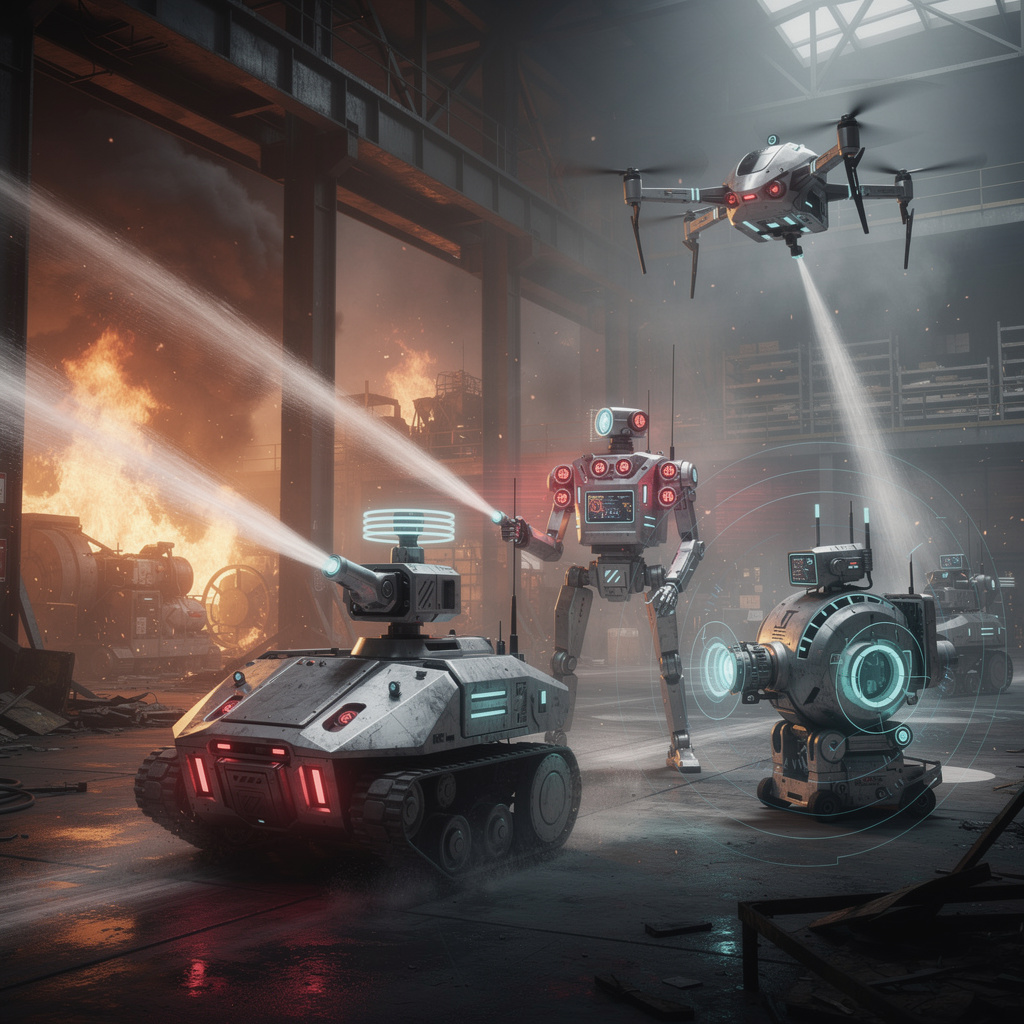
Cyborg Dynamics Engineering has demonstrated that autonomous firefighting robots can outperform human operators in controlled trials, achieving a 99.67% success rate across 300 randomized scenarios involving simultaneous fires. The Queensland-based collaboration with Griffith University and the Queensland Defence Science Alliance deployed unmanned ground vehicles using multi-agent reinforcement learning to self-organize extinguishment tasks without human intervention—reducing mean time-to-extinguish to 7.2 seconds, 42% faster than screen-based human control.
How does the system coordinate without centralized command?
Each robot runs decentralized actor-critic networks on edge computers, processing fused sensor data at approximately 30 frames per second. A three-stage training curriculum progressively built cooperative behavior: solo navigation for basic fire localization, paired coordination via peer-to-peer map sharing, and full squad collaboration with up to four agents self-assigning approach, spray, and monitor roles. A feasibility-guided exploration wrapper filters unsafe state transitions, enabling zero hard collisions across all trials.
What do the performance metrics indicate?
- Operational reliability: 99.67% complete extinguishment rate with no safety violations logged
- Speed advantage: 7.2-second average response versus 12.4 seconds for human operators
- Sensor dependency: Thermal imaging contributed 68% of fire-localization confidence; LiDAR provided 32% for obstacle avoidance
- Robustness: Greater than 95% detection reliability maintained through 200 smoke-dense scenarios using redundant sensing
Where do scalability constraints and hardware risks persist?
- Coordination ceiling: Multi-agent performance scales linearly to four units; beyond this, communication bandwidth saturates
- Mechanical stress: High-degree-of-freedom actuation risks breakage during aggressive maneuvers—mitigated through torque limiting and real-time stress monitoring
- Partial observability: Smoke occlusion remains a threat addressed through thermal-LiDAR redundancy, not eliminated
What does the deployment timeline project?
- 2026–2027: Expansion to multi-fire scenarios and aerial drone integration for fire-source triangulation
- 2028–2029: Municipal fire service trials contingent on Australian autonomous robot certification alignment
- 2030–2031: Export deployment to high wildfire-incidence regions, pending international regulatory compliance
The results validate multi-agent reinforcement learning as a pathway for hazardous-environment robotics beyond firefighting—mining, chemical spill response, and other scenarios where human exposure carries unacceptable risk. For emergency services worldwide, the technology offers a template for reducing responder casualties while maintaining operational effectiveness, provided regulatory frameworks evolve to certify autonomous systems in life-safety applications.
🤖 Tesla AI-4: 150 TOPS, 90% Cheaper Than Nvidia, Powers 1M Robot Army
150 TOPS on a chip that costs 90% less than Nvidia's $30K H100 🤯 Tesla's AI-4 packs supercomputer power into a $3K brain for your car—and factory robot. Dual-chip redundancy means if one dies, the other takes over instantly. By 2028, AI-6 hits 1 PFLOPS, making robotaxis cheaper than Uber rides. But here's the kicker: Tesla's building 1M Optimus humanoids/year with the same silicon. Would you trust a $500 computer to drive your kids to school? — What's your robotaxi red line: price, safety, or brand?
Tesla's AI4 chip, unveiled February 22, delivers 100–150 TOPS of neural performance through 20 ARM Cortex-A72 cores clocked at 2.35GHz—enough raw compute to power both Full Self-Driving and the Optimus humanoid robot from a single silicon platform. The dual-SoC architecture with automatic fail-over eliminates single points of failure, a design choice that directly addresses emerging U.S. safety standards for autonomous vehicles while slashing estimated chip costs by 90% compared to Nvidia's Blackwell GPUs.
How does the architecture enable dual-use deployment?
AI4's 384 GB/s GDDR6 memory bandwidth ingests high-resolution streams from eight-plus cameras and LiDAR simultaneously, processing perception and motion planning within 30-millisecond latency budgets. This throughput supports end-to-end autonomous pipelines in vehicles while leaving sufficient headroom for real-time manipulation, vision-guided grasping, and multimodal language interaction in humanoid robots. The same HW-4.5 computer (part 2261336-02-A) now shipping in 2026 Model Y units serves as the compute backbone for early Optimus 3 production at Fremont.
What performance gains and risks shape the roadmap?
Compute: 100–150 TOPS → enables Level-5 autonomy targets and factory robot deployment. Cost: ~$500 per-vehicle compute reduction vs. prior Nvidia-dependent designs. Energy: ~30% lower power draw than comparable data-center GPUs. Supply security: TeraFab's 100 GW annual wafer target by 2030 reduces external foundry dependence. Validation gap: Continuous OTA updates required to maintain inference accuracy against ImageNet-V2 and KITTI benchmarks.
Where does the silicon roadmap lead?
- Q4 2026: AI5 enters limited production with 3–5× AI4 TOPS and 5× memory bandwidth; HW-5 computers reach 2027 model year vehicles.
- Late 2027: Optimus 4 units on AI5 scale to 2 million annually, expanding beyond factory floors into service roles.
- 2028: AI6 production delivers >1 PFLOPS throughput, enabling full-scene 3D reconstruction for complex urban robotaxi navigation.
- 2030: Per-vehicle autonomous compute costs drop below $300; Tesla projects >30% U.S. robotaxi market capture.
The vertical integration from chip design through TeraFab fabrication creates a cost structure that external competitors cannot easily match. By the decade's end, Tesla's silicon cadence—AI4 deployed today, AI5 within months, AI6 following nine months later—positions the company to define compute standards across both automotive autonomy and general-purpose humanoid robotics.
🚕 250-Millisecond Gap: Waymo's Offshore Remote Assistance Under Federal Scrutiny
400K robotaxi rides/day. 70 humans watching from Manila to Michigan. 250ms lag = 0.5m blind spot at 30mph. Waymo's crash rate beats humans by 80%—but offshore agents now face Senate scrutiny. When your 'self-driving' car needs a human in the loop, should that loop cross an ocean? — Would you trust a remote operator 8,000 miles away with your commute?
Waymo's remote assistance network—70 agents split between Arizona, Michigan, and Manila—now underpins 400,000 daily robotaxi rides across ten U.S. metros. The Senate Commerce Committee's February hearings exposed a tension: autonomous vehicles marketed as self-driving still rely on human judgment at critical moments, with latency varying from 150ms domestically to 250ms offshore.
How does the system actually work?
Waymo's fleet of 3,000 vehicles transmits encrypted sensor data over private LTE/5G backhaul. When the autonomous driving stack encounters ambiguity—construction zones, emergency vehicles, occupancy disputes—it requests guidance. Agents review snapshots, suggest "nudge" maneuvers capped at 2 mph, or confirm situational details. Direct control remains impossible; the ADS retains 300ms to incorporate advice before each 50ms control cycle. This architecture delivered 4 million weekly miles with a crash rate 80% below human-driver averages, though 1,429 NHTSA-logged incidents included 117 injuries and 2 fatalities.
What risks emerge from the human layer?
Latency: 250ms links introduce ~0.5m positional error at 30 mph, absorbed by predictive buffers but not eliminated.
Security: Offshore agents expand credential-compromise surfaces; Waymo responds with hardware-rooted enclaves and continuous attestation.
Oversight: Philippine agents hold verified U.S.-equivalent licenses, yet lack domestic regulatory accountability—fueling Senator Markey's scrutiny.
Transparency: RA sessions occur in <2% of vehicle-miles, but exact frequency remains undisclosed, obscuring true human-dependence metrics.
How are competitors and regulators responding?
May Mobility mirrors Waymo's advisory-only model. Tesla diverges sharply: its Texas center exercises direct throttle, brake, and steering control during fallback conditions. Pending DOT rulemaking may impose <200ms latency ceilings and on-shore residency requirements for safety-critical assistance—standards that would force Waymo's restructuring.
What comes next?
- Q4 2026: Guam and Hawaii edge centers reduce overseas latency to ≤180ms; quarterly public dashboards launch.
- 2027–2028: Federal "Remote Assistance Safety Standard" likely mandates on-shore agents for dynamic-driving advice; Waymo faces 35-position workforce relocation or foreign-agent U.S. certification.
- 2029: On-board edge AI targets 30% reduction in human advisory volume through automated occupancy checks and route-deviation handling.
- 2030: Projected 6,000-vehicle fleet scales to ~110 agents (1:55 ratio), assuming linear growth and partial automation of low-complexity queries.
The 70-agent support layer reveals a broader industry pattern: "full autonomy" remains operationally contingent on human judgment, just with thinner staffing and higher stakes per intervention. Waymo's safety record suggests the model functions; congressional pressure questions whether functioning suffices when milliseconds and miles separate suggestion from consequence.
In Other News
- Nvidia’s DreamDojo AI Model Learns Robotics from 44,000 Hours of Human Video, Enables Real-Time Simulation at 10 FPS
- Xos launches 2026 electric medium-duty truck at $99,000 with LFP battery, 200-mile range, and enhanced OTA updates targeting fleet electrification


Comments ()