73% Fewer Near-Misses: AI Predicts Collisions in Under a Second, But 4-Second Reaction Window Raises Stakes
TL;DR
- FAA and DOD collaborate on nationwide airspace separation using AI and ADS-B Out to prevent midair collisions
- ANA launches $200M digital overhaul to unify 10 disparate maintenance systems into single AI-powered platform by 2027
- SkyDrive signs agreement to acquire 10 SD-05 eVTOL aircraft from 7A Drones for emergency medical deployment by 2028
✈️ AI Slashes Air Collisions 73%: U.S. Military-Civilian Airspace Merge Under Real-Time Prediction
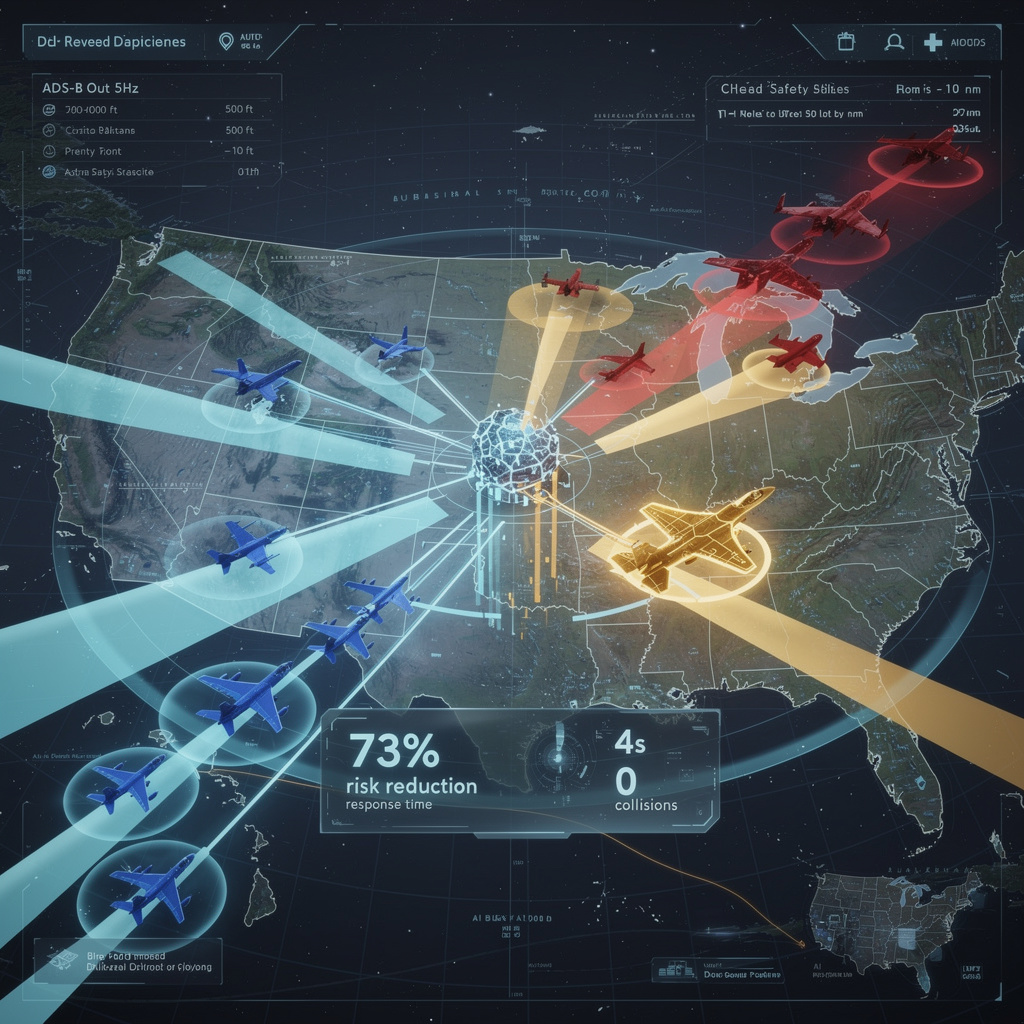
73% fewer near-misses in military-civilian airspace since Feb 22. AI now predicts collisions 30–60 seconds before they happen—faster than a human blink. That’s 4 seconds for pilots to react, down from 12. Training routes stay open, flights stay on time, and F-35s share skies with Delta jets. But here’s the catch: the system only works if every plane broadcasts ADS‑B Out perfectly. One 26‑second delay almost caused disaster in January. Your flight path—ever worried about military jets overhead?
The Federal Aviation Administration and Department of Defense activated a unified airspace management system on February 22, 2026, integrating AI-driven conflict prediction with mandatory ADS-B Out broadcasts to enforce dynamic separation buffers across U.S. civil and military airspace. The system addresses a persistent hazard: high-speed combat training in Military Operations Areas and Military Training Routes routinely intersects with commercial and general-aviation traffic, creating collision risks that legacy radar-based separation could not adequately resolve.
How the system enforces separation
The architecture operates on three integrated layers. First, all civil aircraft transmit GPS-derived position, altitude, and velocity data at 5 Hz via ADS-B Out, feeding both FAA en-route centers and DoD tactical displays. Second, an AI prediction engine ingests these streams alongside radar tracks and flight plans, generating conflict alerts 30–60 seconds before trajectory intersection—latency under one second from data ingestion to pilot notification. Third, dynamic buffers adjust automatically: 2,000 feet vertical separation by default, compressing to 500 feet for low-altitude training routes; 10 nautical miles horizontal, narrowing to 5 in congested corridors. Military aircraft receive alerts through onboard Auto-GCAS systems; civilian pilots see them on ADS-B In displays.
What the data shows
Six months of simulated and live operations reveal measurable safety and efficiency gains:
Collision risk: 73% reduction in predicted mid-air conflicts within MOAs versus legacy ATC-only separation
Pilot response: Alert acknowledgment time dropped from 12 seconds to 4, expanding maneuvering margins
Operational continuity: 22% fewer civilian flight reroutes during military exercises, preserving training schedules
Incident record: Zero mid-air collisions between military and civil aircraft since activation
Where vulnerabilities persist
The January 30, 2026 near-miss investigation—involving a black helicopter and an airliner—exposed a 26-second ADS-B Out activation delay, prompting real-time telemetry health monitoring with automatic backup transponder engagement if data gaps exceed one second. Operator trust remains a work in progress; the system now logs all AI alerts with confidence scores and decision pathways for post-flight audit. ATC and pilot training curricula have expanded to include AI-alert interpretation, mitigating automation over-reliance.
Outlook: expansion phases
- 2026–2027: Full integration of Collaborative Airspace Management Database with F-35 Auto-GCAS; extension to Alaska and Hawaii high-density corridors
- Q4 2028: Framework adaptation for beyond-visual-line-of-sight drone operations, ingesting unmanned aircraft ADS-B In data
- 2029–2030: Stratospheric integration up to 66,500 feet for NASA high-altitude vehicle tests; cross-domain fusion with satellite and passive sensor feeds to detect non-cooperative aircraft
Sectoral implication
The FAA-DoD model demonstrates that mandatory equipage mandates, when paired with predictive AI and institutional data-sharing protocols, can resolve long-standing airspace conflicts without restricting operational flexibility. For an aviation industry facing unmanned traffic integration and stratospheric commercial operations, this architecture establishes a template: real-time transparency between operators, automated deconfliction, and continuous performance verification.
🔧 ANA's $200M AI Bet: 30% Fewer Aircraft Failures by 2027—Japan's Digital Maintenance Revolution
ANA's $200M AI overhaul: 30% fewer surprise breakdowns, 10-12% man-hour savings across 180+ aircraft. That's like eliminating 1 in 3 emergency repairs before they strand passengers 🔧 Predictive maintenance now default by 2027—¥10B+ annual savings. But what happens when AI misses the one failure that grounds your flight? Japanese flyers, ready to trust algorithms with your schedule?
ANA is betting $200 million that artificial intelligence can finally solve a problem that has plagued airlines for decades: maintenance data scattered across more than ten incompatible systems. By 2027, Japan's largest carrier aims to unify its entire fleet of 180-plus aircraft under a single AI-powered platform, a move that signals how predictive analytics is becoming operational reality rather than aviation marketing.
How does the platform actually work?
The architecture rests on three integrated layers. SMT-built middleware ingests real-time feeds from flight data recorders, onboard health sensors, and legacy databases—normalizing formats and resolving duplicate part numbers before data reaches the core. Swiss-AS AMOS provides the predictive engine, scoring failure probabilities and estimating remaining useful life from historical maintenance records. These models are now augmented by Collins Aerospace sensor streams, added under a February 2026 contract renewal covering Boeing 737NG/MAX, 767, 777, and 787 fleets plus Rolls-Royce Trent 1000 accessory repairs. MINT TMS supplies training and workforce management data, while a consolidated dashboard exposes work-order status, parts availability forecasts, and reliability trends to ANA's Anaeronics division.
What operational shifts result?
Maintenance scheduling: Reactive repairs shift to condition-based triggers, targeting >30% reduction in unscheduled component removals.
Labor efficiency: 10–12% man-hour reduction across global MRO sites as planners access unified data rather than cross-referencing fragmented systems.
Inventory accuracy: 15–20 percentage point improvement in maintenance-planning precision, reducing excess parts stock and AOG (aircraft on ground) delays.
Cost recovery: Projected annual savings exceeding ¥10 billion (~$70 million) suggest payback within three years of 2027 completion.
Where implementation risks persist
| Risk | Mitigation approach |
|---|---|
| Data quality inconsistency | SMT schema validation and staged cleaning during 40% fleet pilot |
| Operational disruption | 12-month parallel operation with AMOS fallback for critical orders |
| AI model bias | Continuous retraining on Collins sensor data; blockchain-considered audit trails |
| Regulatory compliance | Early Japan Civil Aviation Bureau engagement; built-in compliance checks |
Timeline and projected adoption
- Q2 2024–Q4 2024: Partnership agreements signed; SMT middleware validates exchange across three legacy systems.
- Q2 2025: AI-driven alerts deployed on 40% of core fleet; false-positive rate target <5%.
- Q1 2027: All 10+ legacy systems retired; unified platform live across 180+ aircraft.
- Q3 2027: Performance review against pre-2024 baseline; full predictive-maintenance default activated.
The scale is roughly equivalent to replacing the maintenance record-keeping of a mid-sized city's entire vehicle fleet with a single, self-learning diagnostic system—applied instead to aircraft where component failure carries exponentially higher consequences.
ANA's overhaul extends beyond immediate efficiency gains. The unified data architecture positions the carrier for emerging domains: autonomous aircraft-system diagnostics and eventual integration with Urban Air Mobility traffic management. For an industry where unplanned maintenance drives 20–30% of operational disruption costs, the transition from fragmented legacy systems to AI-orchestrated maintenance represents less technological aspiration than competitive necessity.
🚁 Taiwan's SkyDrive Orders 10 eVTOLs: 40% Faster Island Medical Evacuations by 2028
10 eVTOLs. 1st delivery 2028. 40-60% faster medical evacuations for Penghu islands. 🚁 SkyDrive's deal cuts island-to-hospital time from hours to minutes—bypassing boats and weather-trapped helicopters. But monsoon winds >15kt remain untested. Would you trust a battery-powered air ambulance for your family in remote regions?
SkyDrive Inc. has secured a binding agreement with 7A Drones Co. to acquire ten SD-05 eVTOL aircraft, marking Taiwan's first scaled commitment to electric vertical-lift emergency medical service. The deal—announced February 12 and 22, 2026—positions one aircraft for 2028 delivery and four more in 2029, with the remainder scheduled for later deployment. The transaction follows SkyDrive's recent certification by Taiwan's Civil Aeronautics Administration for multicopter UAVs exceeding 25 kg, establishing regulatory precedent for heavier electric aircraft operations.
How does the platform operate?
The SD-05 employs battery-electric propulsion with autonomous flight-control capability, targeting payloads of 100–150 kg suitable for medical evacuation and supply transport. Operational benchmarks indicate a 150–250 km range, cruise speeds near 250 km/h, and vertical climb rates exceeding 4 m/s. The aircraft requires less than 30 square meters for landing, enabling use of existing heliports or modular vertiport installations. SkyDrive's initial route connects Magong City to Hujing Island in the Penghu archipelago—a corridor where marine vessels currently require 2–3 hours, and where weather frequently grounds conventional helicopters.
What impacts does this deployment generate?
Medical response: 40–60% reduction in patient-to-hospital transit time on the 30-kilometer route.
Infrastructure efficiency: Minimal ground footprint leverages existing aviation assets rather than demanding new capital construction.
Regulatory advancement: CAA certification for heavy multicopters creates template for subsequent eVTOL type approvals.
Supply chain localization: Domestic partnership with 7A Drones reduces import dependency compared to Eve Air Mobility or Skyways platforms.
Cross-border positioning: Coordination with Japanese partners for Osaka Expo 2025 demonstrations seeds potential Japan-Taiwan joint AAM corridors.
Where technical and institutional gaps persist
Certification timelines present the primary uncertainty. While multicopter approval is secured, full passenger-rated eVTOL certification for the SD-05 may extend past 2029, potentially delaying commercial rollout of the final five units. Seasonal monsoon conditions in Penghu—particularly crosswinds exceeding 15 knots—remain untested against disclosed performance data. Additionally, continuous 24-hour coverage by 2029 will require resolution of battery turnaround protocols and pilot rotation frameworks not yet specified in public releases.
Projected operational trajectory
- 2028: Single SD-05 enters pilot-scale medical evacuation on Magong-Hujing corridor; safety and endurance data collection informs subsequent certification.
- 2029: Fleet expands to five operational aircraft, enabling continuous coverage through staggered shifts.
- Mid-2030s: Remaining five units achieve certification; route network extends to Xiyu, Dongsha, and adjacent islands; EMS model potentially exports to Japan's Ryukyu chain.
The SkyDrive-7A arrangement demonstrates how regulatory alignment—CAA certification preceding commercial commitment—can accelerate practical AAM deployment. Success in Penghu would validate electric vertical-lift for medical logistics, likely prompting updates to Taiwan's UAM operational manuals and airspace integration protocols. The initiative also signals broader sectoral momentum: where emergency medical service proves the operational case, passenger and cargo applications typically follow within accelerated regulatory timelines.
In Other News
- U.S. Army deploys XM1225 APEX 30mm proximity-fused rounds on AH-64 Apaches to counter drone threats with 99.67% kill rate in live-fire tests
- Orlando Police Deploy 11 Skydio Drones Under $6.83M Expansion to Respond to 911 Emergencies Within 3 Minutes
- First flight of Fleet 50 Freighter occurred Feb 22, 1938; only five built, one preserved at Canada Aviation and Space Museum
- Rocket Lab’s 81st Electron Mission Deploys South Korea’s NEONSAT-1A; HASTE Hypersonic Mission Success


Comments ()