AI Cuts Month-End Close 71%: $23M Bet on Replacing Spreadsheet Janitors
TL;DR
- Stacks Launches $23M Series A Led by Lightspeed to Automate Accounting and Financial Close Processes
- Crusoe Energy secures $300 million Goldman Sachs loan using AMD Instinct MI450 chips as collateral, advancing clean data center model
- Freeform Secures $67M to Deploy AI-Controlled Laser Factories for 3D Metal Printing
📉 $23M AI Bet: Enterprise Accounting Close Crushed From 7 Days to 2
$23M to cut month-end close from 7 days to 2. Stacks' AI just made 40% of accounting grunt work obsolete 📉 Legacy ERPs = $200K-$500K/yr burned on manual reconciliations. Lightspeed's bet: finance teams become strategic, not spreadsheet janitors. But can your CFO trust an LLM with the ledger? — Would you let AI sign off on your books?
Stacks Lands $23M to Halve Financial Close Times—What AI Automation Means for Enterprise Finance
Enterprise accounting is entering a new phase. On February 19, 2026, Stacks closed a $23 million Series A led by Lightspeed Venture Partners to deploy AI-driven automation that compresses month-end financial close cycles by up to 50%. The funding signals intensifying investor conviction in vertical SaaS solutions that replace manual finance workflows with machine-precision orchestration.
How does the platform actually work?
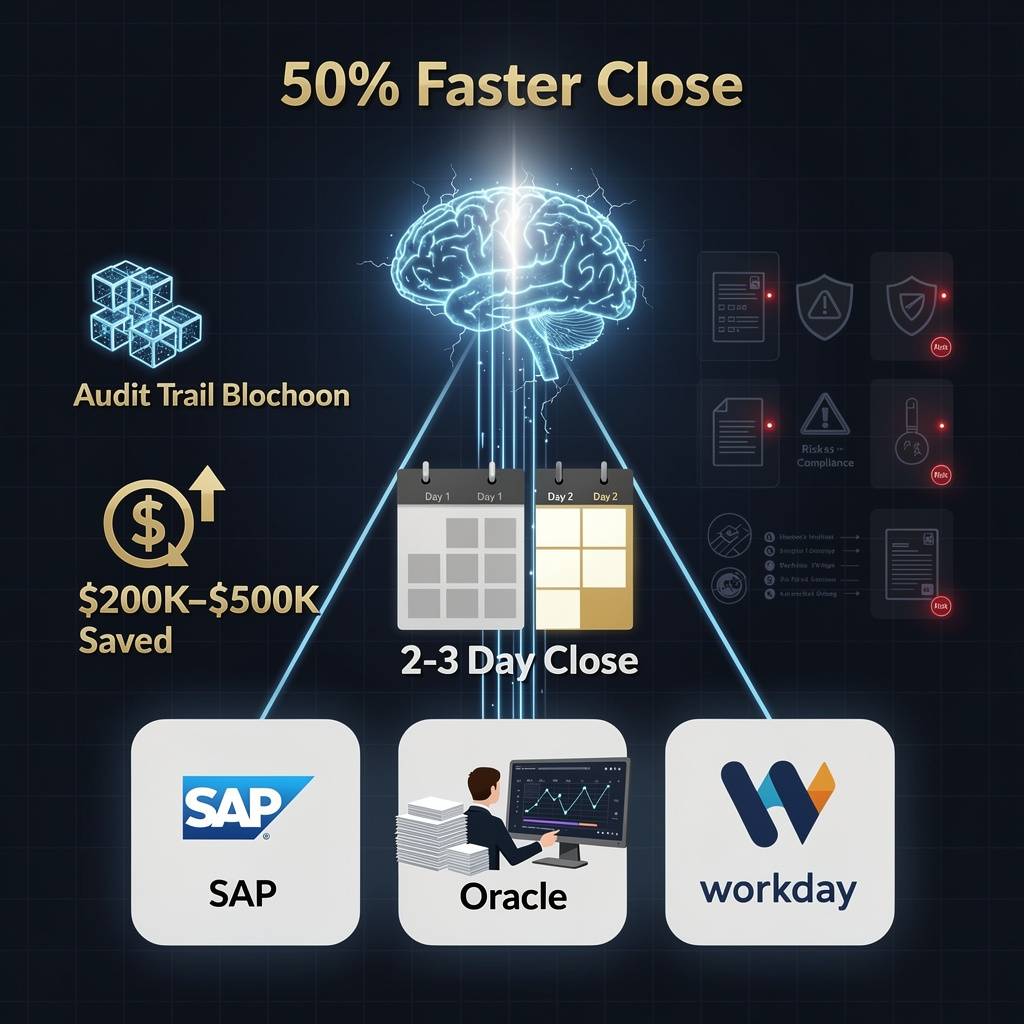
Stacks deploys a three-layer technical architecture. AI models ingest ledger data to auto-match transaction streams with confidence-scored flagging, cutting manual reconciliation effort by approximately 40% in pilot deployments. Large language models translate rule-based accounting policies directly into general ledger entries. A workflow engine integrates with SAP S/4HANA, Oracle Cloud ERP, and Workday to consolidate close timelines from 5–7 days to 2–3 days for midsize enterprises. Immutable audit trails of AI decisions support SOX and IFRS compliance requirements with zero-loss findings in early beta trials.
What impacts does this create across stakeholders?
- Finance Operations: 50% faster close cycles enable real-time decision-making and reduce quarter-end crunch
- Cost Structure: $200K–$500K annual savings per $10M revenue segment through reduced headcount dependency
- Compliance Risk: Tamper-evident decision logs reduce regulatory penalty exposure and audit preparation overhead
- Talent Allocation: Frees senior accountants from reconciliation tasks toward strategic analysis and forecasting
- Integration Burden: Heterogeneous ERP ecosystems may delay ROI realization by 6–12 months in complex environments
Where do institutional responses and gaps stand?
| Strength | Weakness |
|---|---|
| Quantified productivity benchmarks with pilot validation | Model drift risk as accounting standards evolve |
| Lightspeed enterprise network enables co-selling | GDPR/CCPA compliance complexity at full ledger scale |
| Modular API architecture reduces deployment friction | Requires continuous LLM retraining pipelines |
| Opportunity | Threat |
|---|---|
| Series B positioning if ARR exceeds $10M within 36 months | ERP-native AI modules from SAP/Oracle competitive pressure |
| Expansion into adjacent treasury and FP&A automation | Data security breaches in high-sensitivity financial data |
What does the adoption trajectory look like?
- 2026–2027: Pilot conversions drive 2× ARR growth; net revenue retention exceeds 120% as existing teams expand module usage
- Q4 2028: Positioning for Series B (~$80M) led by growth-stage firms; enterprise contracts approach $10M ARR threshold
- 2029–2031: Market consolidation phase; ERP vendors likely acquire or deeply integrate AI-close automation, establishing $500M–$1B valuation tier for category leaders
The Stacks funding validates a broader sectoral shift: AI-powered back-office automation is becoming a competitive imperative in regulated, high-transaction environments. For enterprise finance leaders, the benchmark has moved—50% cycle reduction is now the performance yardstick against which automation investments will be measured.
⚡ $300M GPU-Backed Loan: Crusoe Energy Secures Clean-Power Data Center Expansion Without Equity Dilution
$300M backed by chips, not equity. Crusoe just mortgaged AMD MI450 GPUs to build 200MW of clean AI infrastructure—founders keep control, lenders get collateral. This is how infrastructure scales now: hardware as credit, not dilution. Your region betting on AI jobs or watching them flow to Ohio? 🌱⚡
Crusoe Energy's $300 million loan from Goldman Sachs, collateralized by AMD Instinct MI450 chips, marks a structural inflection in how AI infrastructure startups access capital. The February 19, 2026 transaction—backed by AMD's guarantee—demonstrates that compute hardware now functions as bankable collateral, enabling clean-power data center expansion without equity dilution.
How Does GPU-Backed Financing Work?
The mechanism treats high-performance AI accelerators as secured assets. AMD's MI450 delivers 1 TFLOP FP16 performance per unit, with Crusoe deploying these in HPE Helios racks capable of 3 exaflops per rack. AMD's guarantee insulates Goldman Sachs against collateral volatility, while Crusoe retains operational control. This mirrors Nvidia-backed lending structures that have already funded cloud-scale deployments, including CoreWeave's $2.3 billion facility and OpenAI's 6 GW procurement pipeline.
What Are the Immediate Operational Impacts?
- Capacity expansion: Crusoe targets 200 MW additional renewable-sourced capacity by Q4 2027
- Cost structure: Asset-backed financing reduces weighted-average cost of capital versus equity rounds
- Supply chain integration: Vertical alignment across AMD chips, HPE Helios racks, and enterprise support services streamlines deployment
Where Does This Fit in Broader Market Trends?
The transaction signals accelerating institutional acceptance of compute-asset credit. AMD's 111% year-over-year share price appreciation—outpacing Nvidia's 28%—reflects investor confidence in collateral-grade hardware. The MI450's 20-30% cost advantage over Nvidia's MI300X strengthens its loan security suitability.
2026: ~5 MW MI450 deployment begins; 30% baseline renewable footprint achieved 2027: 200 MW target capacity operational; latency benchmarking versus H100 nodes shows 15-20% edge-workload improvements 2028–2030: Projected $10–15 billion additional GPU-backed loan volume in AI infrastructure; Crusoe scales toward ~1 GW compute capacity
What Risks Remain?
- Collateral volatility: Semiconductor fab constraints and rare-earth dependencies affect GPU resale values
- Regulatory exposure: State-level renewable-energy certification shifts could impact revenue servicing loan repayments
- Market standardization: Loan-to-GPU ratios must reach ~$0.8 million per MI450 unit to signal mature market structure
The deal establishes a replicable template: hardware-backed credit enables rapid scaling, preserves founder ownership, and ties capital access to sustainability metrics. As AMD projects $14–15 billion FY2026 AI revenue and the MI500 series promises 1,000× performance gains over MI300X, compute-asset financing appears poised to become a dominant capital formation mechanism for AI infrastructure—particularly for operators linking expansion to clean-energy deployment.
🎯 $67M Laser Bet: AI Factories Slash Metal Waste 70% in Silicon Valley Race
Freeform Future just raised $67M to build AI-controlled laser factories that cut metal waste by 70%—that's $800K saved per $5M spent. Their 18-laser GoldenEye system runs on Nvidia H200s and predicts defects with 95% accuracy. But can they outrun VulcanForms' $220M war chest? Bay Area engineers, would you bet on laser AI over CNC tradition? 🎯
Freeform's $67M Series A signals a structural shift in metal manufacturing, deploying AI-controlled laser arrays to displace conventional CNC production. The round, announced February 19, 2026, pairs Nvidia's NVentures with Boeing's AE Ventures—positioning the startup at the intersection of semiconductor intelligence and aerospace-grade fabrication.
How does the GoldenEye platform transform production?
The second-generation system operates 18 ytterbium-doped fiber lasers at ~1 kW per channel, melting metal powder layers through rapid rastering. Photodiode and high-speed vision sensors capture melt-pool dynamics at >10 kHz, feeding an on-prem AI controller that adjusts laser power, scan speed, and hatch spacing in closed-loop. Nvidia H200 GPUs—backed by H300-class redundancy—run TensorRT-optimized inference, predicting defects with >95% accuracy. This architecture enables simultaneous multi-material builds and 99.9% production uptime, contrasting with cloud-dependent competitors.
What measurable impacts does this unlock?
- Material efficiency: 70% waste reduction versus CNC machining, yielding ~$0.8M annual savings per $5M metal spend (equivalent to eliminating scrap from 6,600 kg of titanium powder)
- Throughput: 25% capacity lift per line via parallel laser operation
- Quality: Post-process inspection time drops 40% (6 hours to 3.6 hours); rework rates fall from 12% to 3%
- Scalability: Each H200 node supports two additional laser arrays without hardware redesign
Where does execution risk concentrate?
| Dimension | Observed strength | Critical gap |
|---|---|---|
| Talent | 100 hires planned (70% engineering) by year-end | Bay Area retention pressure; culture dilution risk |
| Supply chain | On-prem GPU stack reduces latency | Nvidia H200 availability constraints |
| Certification | Aerospace partnerships provide pathway | DoD qualification timelines uncertain |
| Competition | 18-laser density exceeds typical 1-4 laser peers | VulcanForms' $220M raise creates capital asymmetry |
What does the deployment timeline indicate?
- Q2 2026: Series A close, first production GPU cluster operational
- Q3 2026: Pilot commercial lines at aerospace and medical device customers
- Q4 2026: 25% capacity expansion complete, hiring target met
- H1 2027: Second-generation GoldenEye launch (22 lasers)
The global metal additive manufacturing market projects $15B by 2027 (14% CAGR). Freeform's AI-closed-loop approach captures a specific vector within this expansion—industrial-grade production rather than prototyping. The 70% waste reduction claim, if validated across customer environments, restructures unit economics for metal parts: material costs dominate at scale, and $0.8M annual recovery per mid-size deployment compounds across fleet expansion.
Strategic investor alignment matters here. Nvidia gains a production-scale AI inference case study; Boeing secures de-risked capacity for titanium aerospace components. Both incentives align toward certification acceleration and downstream offtake—critical given that AI defect prediction, however precise in pilot runs, requires aerospace-grade validation to convert capacity into contracted revenue.
The $67M positions Freeform to commercialize before better-capitalized peers consolidate distribution channels. Execution hinges on Q3 pilot performance and H200 supply continuity—variables that will determine whether the 25% throughput uplift translates to sustainable market share in industrial metal manufacturing.
In Other News
- Altesa BioSciences Closes $75M Series B to Advance Inhaled Antiviral Lung Therapy for Respiratory Diseases
- Microsoft Azure completes independent GxP audit to streamline life sciences cloud compliance
- Redwood Materials raises $425M in Series E led by Google and Nvidia to expand AI data center recycling R&D lab to 55,000 sq ft
- Johnson & Johnson invests $1 billion in next-gen cell therapy facilities in Montgomery County, PA, targeting cancer and neurological diseases

Comments ()