Starliner 286-Day Stranding: NASA Type A Mishap Ranks With Challenger, Columbia Disasters
TL;DR
- NASA declares Starliner's 2024 crewed test flight a Type A mishap due to thruster failures and leadership failures
- Boeing 777-9 simulator qualification approved by EASA and FAA, accelerating airline training and operational readiness
🚨 Starliner Stranded 286 Days: NASA's Type A Mishap Ranks Boeing Failure Alongside Challenger, Columbia
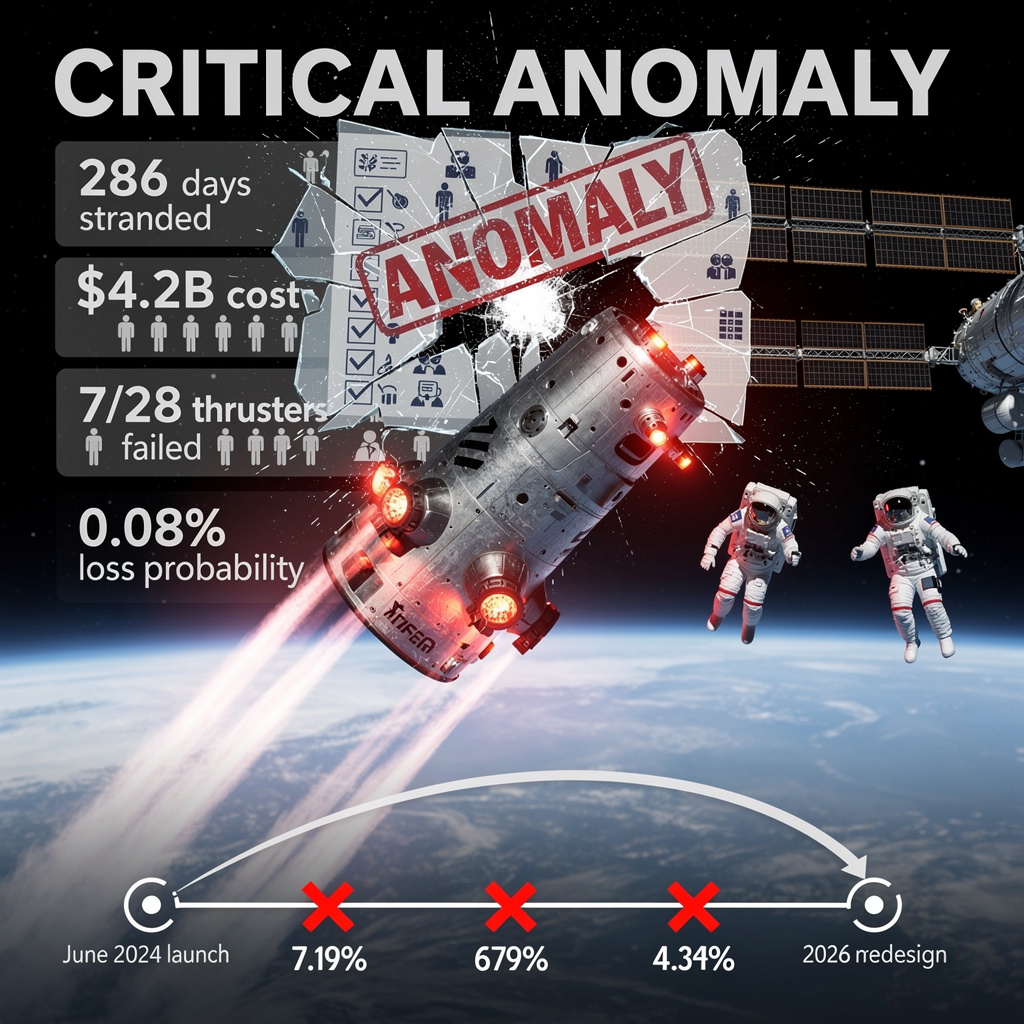
286 days stranded. NASA just classified the 2024 Starliner mission as a Type A mishap—same severity as Challenger & Columbia. 7 of 28 thrusters failed, helium leaks exceeded limits by 150%, and astronauts tumbled at 0.45 rad/s. Boeing spent $4.2B but only fixed 4 of 17 pre-flight warnings. 🚨 The crew survived by luck, not design. Now SpaceX is the ONLY U.S. ride to orbit. Should your tax dollars still fund Boeing's second chance, or is it time to bet everything on commercial space? — Would you fly Starliner if it relaunches this fall?
NASA's Type A Mishap Classification Exposes Systemic Failures in Boeing's Starliner Program
NASA's final investigation has classified Boeing's 2024 Starliner Crew Flight Test as a Type A mishap—the agency's most severe designation, previously applied only to the Challenger and Columbia disasters—after thruster failures stranded two astronauts on the International Space Station for 286 days. The 311-page report released February 19, 2026, identifies not merely hardware malfunction but a cascade of leadership failures that permitted an unsafe mission to proceed.
How Did Thruster Failures Escalate to Catastrophic Risk?
The CST-100 Starliner launched June 5, 2024, from Cape Canaveral with astronauts Barry Wilmore and Suni Williams aboard. Within minutes of orbital insertion, 7 of 28 reaction control system thrusters exhibited valve-seal leakage; 3 failed completely, eliminating pitch-yaw control. Helium leak rates measured approximately 2 × 10⁻⁴ kg/s—exceeding design limits by over 150 percent. The spacecraft tumbled at roughly 0.45 rad/s, breaching six-degree-of-freedom tolerance by 220 percent. Program investigators calculated an 0.08 percent probability of total vehicle loss, a risk level incompatible with crewed operations.
What Were the Human and Program Impacts?
- Crew safety: Two astronauts diverted to 9.5-month unplanned ISS residency; return required SpaceX Crew-9 Dragon
- Financial: >$2 million direct mission overruns; $4.2 billion cumulative Boeing program cost
- Operational: Sole-source dependency on SpaceX Dragon for U.S. crew transport
- Institutional: Congressional hearings scheduled; Boeing contract frozen at $4 billion versus SpaceX's $2.6 billion
Where Did Decision-Making Break Down?
The flight-readiness review approved launch despite a "critical-level" thruster anomaly logged May 12, 2024—three weeks prior. NASA engineers submitted 17 corrective recommendations after the 2022 uncrewed test flight; Boeing incorporated only 4. Interviews with 22 program staff revealed "mission-pressure" language and an "accept-risk-as-normal" mindset, with no formal stop-go authority vested at the flight-director level.
What Corrective Measures Are Now Required?
NASA has mandated full 508-compliance for all future Starliner hardware. Boeing must complete thruster-valve redesign with nitrogen-tetroxide-resistant seals, validated through hot-fire testing at White Sands Test Facility. The next uncrewed flight shifts to April 2026; crewed flight moves to fall 2026 at earliest.
What Does the Timeline Look Like?
- April 2026: Uncrewed test flight with redesigned thruster system
- Fall 2026: Potential crewed certification flight, contingent on zero unresolved 508 findings
- 2027–2028: Possible re-entry to crew-transport market as low-cost alternative
- 2–5 years: Potential expansion to third Commercial Crew vendor driven by redundancy concerns
The Starliner mishap demonstrates that technical validation cannot compensate for eroded safety culture. NASA's classification signals that crewed spaceflight demands not merely functional hardware but organizational structures that empower dissent, integrate feedback, and halt operations when data warrants—regardless of schedule pressure or sunk costs.
✈️ 777‑9 Simulators Cleared: EASA/FAA Unlock Year‑Early Pilot Training at Gatwick
777‑9 simulators cleared for Level D training 12‑18 months before first jet delivers. Gatwick facility can run 30 concurrent courses—enough to prep 3 major carriers' pilot pipelines while planes still roll off the line. Boeing cuts 9 months off fleet rollout vs. waiting for live aircraft. United, Lufthansa, BA start 50‑pilot cohorts this year. Simulator‑first certification could become the new wide‑body standard. Does your home airport see 777‑9 service by 2028?
The Boeing 777‑9 cleared its final regulatory hurdle to operational readiness on February 19, 2026, when EASA and the FAA jointly qualified full‑flight simulators at Boeing's Gatwick campus. This dual approval removes the last barrier separating airlines from pilot training, enabling crew certification to begin 12–18 months before the first aircraft deliveries—an acceleration that compresses fleet rollout timelines and strengthens Boeing's competitive position against Airbus's A350‑1000.
How Do the Simulators Enable Earlier Training?
The approved Level D simulators replicate the 777‑9 flight deck, GE9X propulsion dynamics, and flight‑control laws with sufficient fidelity to satisfy both EASA Part‑21 and FAA Part‑21 standards. High‑resolution visual rendering and six‑degree‑of‑freedom motion cueing eliminate the need for live‑aircraft training until physical delivery. This technical validation means airlines can run complete type‑rating courses—including emergency‑scenario rehearsal for compressor stalls and loss‑of‑thrust events—entirely in synthetic environments.
What Are the Immediate Operational Effects?
- Training capacity: Gatwick supports 30 concurrent 12‑week pilot courses, accommodating three major carriers simultaneously.
- Schedule compression: Airlines achieve roughly nine months of schedule reduction by decoupling crew qualification from aircraft availability.
- Safety assurance: Validated emergency‑procedure rehearsal enhances crew competence before first‑flight operations.
- Market positioning: Early readiness supports Boeing's 500‑plus order backlog and counters program delays that eroded market share.
Where Do Gaps and Responses Remain?
| Strength | Weakness | Opportunity | Threat |
|---|---|---|---|
| Dual regulatory approval accelerates global deployment | Single UK location creates geographic concentration risk | Secondary U.S. simulator site (Eglin AFB) planned for redundancy | Pilot supply constraints may lag accelerated training demand |
| Level D fidelity meets highest certification tier | Hardware expansion budget remains contingent on airline commitment | 12% projected revenue growth for simulator manufacturers in FY 2027 | FAA Operations Specification A134 hiring mandates require timeline alignment |
What Does the Timeline Project?
2026–2027: Deployment of two additional Gatwick simulators and one U.S. unit; United Airlines, Lufthansa, and British Airways commence 50‑pilot cohorts each; Q4 joint FAA/EASA audit verifies training outcomes.
2027–2028: First commercial 777‑9 entry‑into‑service with 70% of order book operational by 2028; simulator‑first pathways standardize for 787‑10 and future wide‑body programs.
2028–2030: Gatwick framework potentially repurposed for autonomous‑flight certification, leveraging validated high‑fidelity modeling.
Why Does This Matter for Fleet Modernization?
The approval transforms a logistical constraint into a strategic accelerant. Airlines replacing aging 777‑200/300 fleets can now align crew readiness with delivery schedules, minimizing revenue‑idle aircraft. For Boeing, this closes a vulnerability window against Airbus and validates the $400 million per‑unit investment that customers have deferred since 2019. The sectoral implication is clear: regulatory synchronization now drives competitive advantage as directly as airframe engineering.
In Other News
- Embraer and Northrop Grumman partner to pitch KC-390 Millennium with autonomous boom refueling to US Air Force
- Mercedes-Benz recalls 12,236 EQB EVs after battery short-circuit fires; 80% charge limit imposed until replacement
- Virginia launches world's first FAA-certified IFR network for Ultra Short and AAM aircraft, projected to generate $16B in economic activity
- Nissan recalls 318,781 Rogue SUVs due to electronic throttle body gear fractures from ECM software flaws

Comments ()