Silica Storage & Nuclear AI: 10,000‑Year Archives Meet $7B Reactor Restart
TL;DR
- Microsoft Announces Silica Glass Storage Technology for 10,000-Year Data Preservation
- New Quantum ISA Enables Deterministic Control of NV-Center Qubits for Scalable Quantum Networks
- Centrus Energy to Reopen Three Mile Island Reactor with Microsoft as 20-Year Power Buyer
🔥 Microsoft's 10,000-Year Glass Storage: A New Era for Archival Data
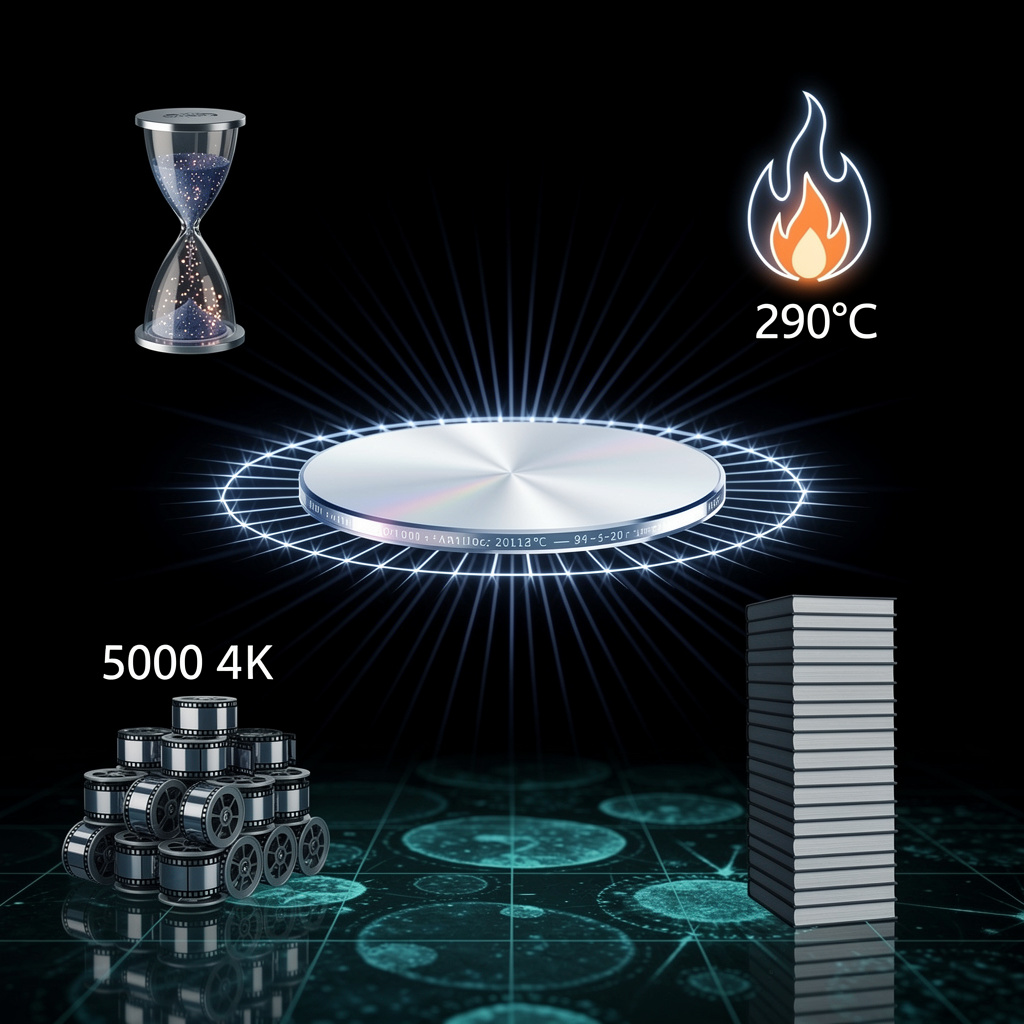
Microsoft's Project Silica glass storage can preserve data for >10,000 YEARS—outlasting HDDs/SSDs by orders of magnitude. That's like storing 5,000 4K movies on a single disc that survives 290°C heat. A game-changer for cultural heritage and scientific archives. What's the first thing you'd preserve for millennia? 🔥
Microsoft Research has unveiled a commercial‑ready silica‑glass storage platform that encodes data in nanostructures etched by ultrashort laser pulses—a medium proven stable beyond 10 000 years and resilient up to 290 °C. Announced on 18 February 2026 and detailed in Nature, the technology stores the equivalent of 5 000 4K films or 2 million printed books on a single disc, offering a durable, passive archival solution just as global data production soars.
How It Works
The system writes “phase voxels” onto 2‑mm‑thick borosilicate glass using femtosecond‑laser pulses, achieving a data density exceeding 1 Gigabit mm⁻³. Each disc layer holds 4.8 TB, written at 3.13 MB s⁻¹ and read via confocal microscopy at about 3 MB s⁻¹. While slower than today’s HDDs (≈160 MB s⁻¹) or SSDs (≈7 000 MB s⁻¹), the glass medium requires no power, has no moving parts, and withstands heat, moisture, and oxidation that would degrade magnetic or semiconductor storage in a decade.
Impacts
- Longevity: >10 000‑year projected lifespan versus ≈10‑15 years for HDD/SSD → eliminates periodic migration and media‑refresh cycles.
- Thermal Resilience: stable up to 290 °C → enables archival storage in environments unsuitable for conventional media.
- Capacity: 4.8 TB per layer, scalable through stacking → one disc stores data equivalent to 2 million books.
- Energy Efficiency: passive storage draws zero power → >90 % reduction in energy use versus active cold‑storage tiers.
- Supply Chain: uses standard borosilicate glass → leverages existing glass‑fab infrastructure, lowering production barriers.
Microsoft, with Shandong University, has secured dual‑source glass vendors and open‑sourced the read‑software stack to guard against hardware obsolescence. Pilot deployments are planned for Norway’s Global Music Vault and European cultural archives. Yet the technology remains tailored for write‑once, read‑rarely archival workloads; it does not replace high‑performance primary storage. The slower write speed and current lack of petabyte‑scale production lines mean adoption will be gradual, focused on niches where longevity outweighs access speed.
Outlook
2026‑2028: limited‑volume pilots in cultural‑heritage and government‑record repositories.
2029‑2035: scale‑up to multi‑petabyte archival clusters; integration with cloud‑storage tiers (e.g., Azure Blob “Glacier‑Glass”).
2040+: potential standardization for millennial‑scale data preservation, influencing data‑retention regulations.
Project Silica delivers a physically immutable, ultra‑dense archival medium that could secure humanity’s scientific, cultural, and legal records against the data‑loss risks of conventional storage. By turning glass into a millennia‑spanning digital ledger, Microsoft provides a strategic, energy‑efficient complement to high‑performance computing pipelines—ensuring that today’s most valuable datasets remain readable for generations far beyond the lifespan of any chip or disk drive.
🚀 Deterministic Quantum ISA Boosts NV‑Center Repeaters: 30% Faster Purification, 15% Lower Latency
🚀 Quantum ISA unlocks 2ⁿ operations per coherence window—doubling control space with each nuclear spin! 30% fewer purification rounds, 15% faster network latency. Deterministic NV‑center repeaters could reshape quantum internet within 3 years. Who’s ready for a 10 kHz entanglement rate? 🤯
A novel instruction-set architecture (ISA) for quantum hardware, designed specifically for nitrogen-vacancy (NV) center nodes, has been proposed, promising to transform probabilistic quantum networks into deterministic, scalable systems. By using a programmable nuclear-spin register to control an electron-spin qubit, this architecture enables 2ⁿ distinct operations within a single, synchronized time slot. This deterministic control is the missing piece for building high-fidelity, practical quantum repeater networks, moving the quantum internet from theoretical blueprint toward physical reality.
The Mechanics of Deterministic Control
The ISA’s three-field instruction format (OPCODE, PARAMS, MODE) is executed by a local decoder that configures microwave and radio-frequency pulses. The core innovation is the use of n nuclear spins as a memory register. By deterministically preparing these nuclear registers into known basis states, the system can map each unique state to a specific electron-spin operation. This happens within a fixed 100 µs time slot, carefully aligned to the electron-spin’s coherence window, ensuring an entire entanglement-purification protocol can complete before quantum information decays.
Measurable Impacts
- Protocol Fidelity: Eliminating stochastic gate selection reduces the number of required entanglement-purification rounds by an estimated 30%, directly improving success rates for building long-distance quantum links.
- Operation Density: Achieving 2ⁿ operations per 100 µs represents a 4x improvement in operations per coherence window compared to traditional pulse-programming, maximizing the use of scarce quantum coherence time.
- Network Latency: Simulations incorporating the ISA show deterministic control simplifies network scheduling, reducing average end-to-end entanglement distribution latency by ≈15%.
- Scalability: Each added nuclear spin doubles the operation space without increasing cycle time. A six-spin register can address 64 distinct gates per cycle, sufficient for complex multi-node protocols.
The Roadmap to Integration
Current experimental work in Munich, Tokyo, and Chicago provides a clear, evidence-backed trajectory for this technology.
- 2026–2027: Deployment of ISA firmware on existing NV-center testbeds. Validation of multi-node protocols with ≤2% error accumulation.
- 2028–2029: Integration with photonic interfaces for deterministic spin-photon entanglement. Scaling registers to n=5–6 spins.
- 2030–2031: Inclusion of ISA-controlled repeaters in continental-scale testbeds (e.g., European Quantum Internet Alliance). Target: entanglement distribution rates >10 kHz over 10 km, surpassing current stochastic repeaters by an order of magnitude.
The proposed quantum ISA directly attacks the core bottlenecks of fidelity and throughput in quantum networking. By providing deterministic, synchronized control from the hardware level up, it lays the essential groundwork for NV-center technology to form the backbone of a future, functional quantum internet.
⚡ Nuclear Revival: $7 Billion TMI‑1 Restart to Fuel Microsoft’s AI Expansion
🚨 $7 BILLION nuclear restart! TMI‑1’s 1 GW reactor to power Microsoft’s AI data centers for 20 years—avoiding $200 M in volatile power costs. 🔥 Refurbished in just 2‑3 years vs. 5‑7 yr for new SMRs. Zero‑carbon baseload meets 24/7 AI demand. ⚡ How will this reshape the race for clean, reliable compute power in your region?
The once‑dormant Three Mile Island Unit 1 nuclear reactor is poised for a historic restart, powered by a 20‑year commitment from Microsoft. This $7 billion+ project, targeting operation by late 2026, is more than a corporate power purchase agreement; it’s a strategic pivot. It leverages existing nuclear infrastructure to deliver the massive, stable, and carbon‑free electricity that the explosive growth of artificial intelligence demands.
The Mechanics of a Reactor Restart
The plan involves a comprehensive refurbishment of the 1,018‑megawatt pressurized‑water reactor. Key upgrades include replacing steam generators and control‑rod drives and installing a modern digital instrumentation and control system to meet 2025 regulatory standards. The reactor will use conventional, commercially available 4.5% enriched uranium fuel, avoiding the supply‑chain complexities of newer advanced fuels. On the grid side, a reinforced 345‑kV transmission line, equipped with advanced power‑flow controllers, will ensure the electricity reliably reaches Microsoft’s data centers with a contractual uptime exceeding 99.995%—translating to less than 30 minutes of downtime per year.
Impacts: A Parallel Analysis
The project’s implications span technical, economic, and environmental domains:
- Power Stability: 1 GW of continuous baseload power → enables Microsoft to deploy AI compute clusters requiring 3.3 kW per rack, 24/7.
- Carbon Accounting: 0 gCO₂/kWh nuclear generation → reduces Microsoft’s AI‑related annual carbon footprint by approximately 0.6 million metric tons.
- Financial Hedge: Fixed‑price power purchase agreement → shields Microsoft from volatile energy markets, projecting roughly $200 million in cost avoidance over two decades versus peak pricing.
- Infrastructure Strategy: 2‑3‑year refurbishment timeline → offers a faster, lower‑risk path to gigawatt‑scale clean power compared to 5‑7‑year timelines for new small modular reactor (SMR) constructions.
The Institutional Response and Remaining Gaps
Regulatory pathways have been streamlined. A “fast‑track” NRC review process and a 2023 policy exemption have significantly shortened the environmental and safety re‑licensing timeline. Pennsylvania’s clean‑energy tax credit improves the project’s financial return for operator Constellation Energy. However, gaps persist. The long‑term plan for on‑site nuclear waste storage remains an unresolved national issue, and the project’s success hinges on flawless execution of the digital control‑system upgrade—a potential cybersecurity focal point that requires continuous, hardened monitoring.
Outlook: A Phased Trajectory
The restart is expected to set a precedent for corporate energy procurement.
- 2026‑2028: Commercial operation begins; Microsoft integrates the power into its Mid‑Atlantic AI cluster, delivering 250 MW of AI‑optimized compute capacity by 2027.
- 2029‑2035: Successful operation validates the nuclear PPA model, likely triggering similar tech‑utility partnerships and bolstering policy support for additional reactor refurbishments.
- 2036‑2046: The secured 20‑year baseload underpins Microsoft’s long‑term AI roadmap while demonstrating a viable, capital‑efficient model to support over 100 GW of future low‑carbon capacity for the U.S. grid.
This project signals a maturation in the energy strategy of big tech. Faced with the insatiable power demands of AI, companies are moving beyond renewable credits to directly fund and secure fundamental, firm generation. The Three Mile Island restart is not a nostalgic revival but a hard‑nosed calculation: that America’s existing nuclear fleet offers the most immediate, scalable answer to the industry’s most critical constraint.

Comments ()