Naval Robotics Shift & Autonomous Miles: U.S. Navy's AI Swarms vs. Tesla's Safety Record
TL;DR
- U.S. Navy Proposes Robotic Autonomous Systems Commander to Integrate Unmanned Capabilities
- Tesla Exceeds 8 Billion Miles on Full Self-Driving Supervised System
- Aurora Innovation Targets 200 Driverless Trucks by End of 2026
🤖 U.S. Navy Establishes Robotic Autonomous Systems Commander to Unify Drone Fleets, Cut Personnel by 50%
🚨 The U.S. Navy is creating a new commander just for robots & drones. Billions in funding, 350+ unmanned assets in the pipeline, targeting a 50% cut in shore personnel. This is a massive shift from legacy fleets to AI-driven swarms. Early tests show 30% faster decisions. How will this reshape naval power and global security?
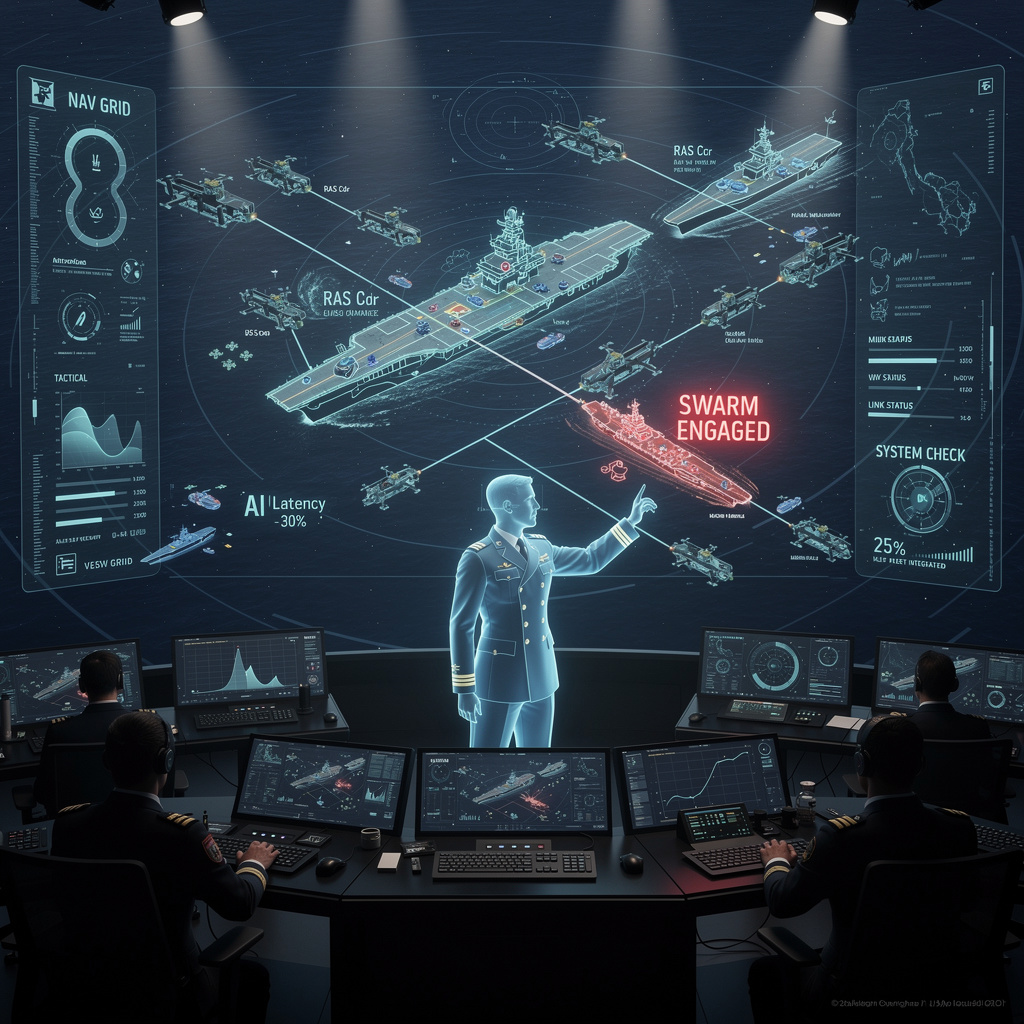
SAN DIEGO — The U.S. Navy’s fleet is undergoing a quiet but profound transformation, shifting from a force centered on massive, manned platforms to one increasingly defined by swarms of unmanned systems. At the WEST 2026 conference, Chief of Naval Operations Adm. Daryl Caudle unveiled a structural solution to manage this complexity: the creation of a dedicated Robotic Autonomous Systems Commander (RAS Cdr). This proposal is not merely an organizational tweak; it is a decisive move to centralize oversight and standardize the integration of robotic assets across the fleet, directly aligning unmanned capabilities with strategic priorities like force dispersal and joint operations.
The Unmanned Dilemma Demands a Solution
The strategic rationale is clear. The Navy’s inventory of unmanned surface vessels (USVs), underwater vehicles (UUVs), and aerial drones is expanding rapidly, creating an integration challenge that outgrows legacy command structures designed for anti-submarine warfare. This “unmanned dilemma” creates gaps in coordination, doctrine, and safety. The new RAS Commander, reporting to the Sea Combat Commander, is designed to eliminate those gaps by providing a single authority to synchronize these assets. This commander will enforce standardized “Fighting Instructions,” embed fail-safe and redundancy designs into mission planning, and ensure robotic systems are seamlessly woven into the Navy’s global force management.
The Technical Backbone of a Hybrid Fleet
The initiative is backed by billions in funding and a concrete technical architecture. The initial pilot phase involves integrating approximately 120 USVs with carrier strike groups, 80 UUVs with submarine forces, and 150 aerial swarm drones with carrier air wings. Key enabling technologies include:
- Sensor-fusion suites on autonomous swarms for enhanced perception.
- Containerized Autonomous Drone Delivery Systems (CADDS) for rapid, mass deployment from forward bases.
- AI-driven mission-planning modules embedded directly into command software, with early tests showing a 30% reduction in command-to-action latency.
This technical foundation supports the Navy’s vision of a “hybrid hedge” force—modular combinations of manned ships and unmanned swarms that can be tailored for specific regions and threats.
Operational Impact and a Phased Rollout
The operational impacts are already taking shape. Distributed operations using smaller warships equipped with RAS assets are reducing the single-point vulnerability of traditional carrier groups across the North Atlantic and Indo-Pacific. The formal rollout will follow a deliberate timeline:
- Late 2026: Formal appointment of the first RAS Commander; initial USV swarm integration with the USS Theodore Roosevelt.
- Early 2027: Commencement of containerized drone pod trials in forward-deployed regions.
- FY 2028-30: Full-scale fielding of AI-driven RAS across all ten fleet Maritime Operations Centers.
A Three-Phase Outlook for Autonomous Combat Power
The initiative sets a clear trajectory for the next decade, fundamentally altering the Navy’s composition and strategic posture.
- Short-term (12 months): The RAS Commander becomes operational, pilot programs validate integration on two carrier groups, and baseline AI decision-aid software is deployed. This demonstration phase is critical for securing continued budget support.
- Mid-term (3–5 years): A standardized RAS tasking architecture is implemented across all fleet domains. Approximately 25% of total combat vessels will be equipped with autonomous modules, enabling “plug-and-play” force composition and significantly boosting interoperability with NATO allies.
- Long-term (7–10 years): Autonomous swarms are projected to constitute at least 30% of the Navy’s expeditionary combat power. These AI-controlled systems will execute independent intelligence, surveillance, reconnaissance (ISR), mine-countermeasure, and surface-strike missions with minimal human oversight, pressuring adversary sensor networks and reshaping the defense industrial base toward mass-produced, containerized unmanned systems.
Centralizing the Robotic Frontier
Adm. Caudle’s proposal directly confronts the core challenge of modern naval warfare: effectively harnessing proliferating robotic systems. By instituting a unified command pathway, the Navy is moving to translate technological potential into reliable, scalable combat power. This shift promises to reduce manpower burdens, enhance distributed lethality, and ensure the United States maintains maritime dominance in an era defined by autonomous systems. The new commander won’t be a robot, but their sole charge will be to lead them.
🚗 Tesla Hits 8B Miles: The Data Race to Unsupervised Autonomy
🚨 Tesla's FSD just hit 8 BILLION real-world miles—closing in on the 10B threshold for unsupervised autonomy. That's like circling Earth 320,000 times. Yet, its supervised robotaxis in Austin crash 9x more often than human drivers. Who would you trust in the driver's seat?
Tesla confirmed this week that its Full Self‑Driving (Supervised) suite has logged over 8 billion real‑world miles, edging toward the 10‑billion‑mile threshold Elon Musk has called essential for unsupervised autonomy. This milestone underscores Tesla’s massive lead in collecting driving data—especially rare, complex “long‑tail” events that simulations cannot replicate—but it also reveals persistent gaps in safety and readiness that must be closed before driverless cars become a widespread reality.
How the System Works—and Where It Stumbles
The FSD Supervised system runs on about 1.1 million Tesla vehicles globally, each mile feeding neural‑network training. The latest software (version 14.2.2) adds visual prompts to keep drivers engaged and uses optical‑character recognition to read speed signs. Yet under low‑visibility conditions, the OCR system still misinterprets signs at a rate of 60–80 incidents per 100,000 miles—a flaw that has drawn scrutiny from U.S. safety regulators.
Impacts: A Mixed Picture of Progress and Risk
- Safety: In Austin’s supervised robotaxi pilot, crash incidence is 1 per 55,000 miles, roughly 9 times higher than the human‑driver baseline of 1 per 500,000 miles.
- Fleet Availability: Only 19 % of Austin’s 42 robotaxis are operational at any given time; 81 % are sidelined for maintenance or safety checks.
- Competitive Position: Tesla’s 8 billion supervised miles dwarf Waymo’s 100 million driverless miles, but Waymo operates over 2,500 unsupervised vehicles and has completed 14 million paid rides—a more mature commercial service.
- Regulatory Hurdle: European and Chinese approvals for unsupervised operation remain pending, with compliance reviews cited as the main delay.
Institutional Response & Gaps
Tesla has opened dedicated AI‑training centers (e.g., in Shanghai) and hired specialized test engineers to refine its perception models. However, the National Highway Traffic Safety Administration continues to query the company about low‑visibility performance, and no formal suspension of the robotaxi pilot has been announced despite the elevated crash rate. The gap between data volume and operational safety suggests that more robust validation—particularly in sensor fusion and redundancy design—is needed before regulatory green lights will flash.
The Road Ahead: A Timeline to Autonomy
- Next 6 months: Mileage is projected to grow by 0.9–1.2 billion miles; software patches aim to cut OCR errors by ≥ 30 %; Austin’s robotaxi fleet may expand to 60 units, limited by hardware and safety‑monitor staffing.
- 12–24 months: The 10‑billion‑mile threshold is within reach, satisfying Musk’s data prerequisite. Supervised robotaxi service could expand to ≥ 7 more U.S. cities, contingent on local regulatory clearances.
- Long‑term: If crash rates can be reduced to ≤ 2 times the human‑driver baseline, Tesla’s data advantage may accelerate unsupervised feature deployment—but that remains a big “if.”
Tesla’s 8‑billion‑mile achievement is a testament to the scale of real‑world data collection possible with a consumer‑fleet model. Yet the numbers also lay bare the challenges: higher crash rates, limited vehicle availability, and regulatory headwinds. Reaching 10 billion miles will be a psychological milestone, but turning that data into safe, reliable, unsupervised autonomy will require engineering rigor that matches Tesla’s ambition.
🚚 Aurora's 200 Driverless Truck Target: Zero-Collision Record Over 250K Miles Fuels Sun Belt Expansion
Aurora just hit 250,000 driverless miles with ZERO collisions 🤯 That's like 10 laps around Earth! Their trucks now run 14+ hours, exceeding human limits. Can autonomous semis solve the driver shortage?
Aurora Innovation has set a clear and aggressive benchmark for autonomous trucking: deploy 200 fully driverless trucks across ten U.S. corridors by December 2026. This target, anchored by a 1,000‑mile Phoenix–Fort Worth route that already exceeds federal hours‑of‑service limits, is backed by over 250,000 driverless miles with zero collisions. While the company’s $816 million net loss in 2025 underscores the steep financial climb ahead, its technical milestones and strategic partnerships point toward a scalable model for long‑haul freight autonomy.
The Technical Foundation: Redundancy and Reliability
The company’s fourth‑generation Aurora OS enables a 14‑hour autonomous duty cycle, a capability that directly challenges the 14‑hour cap imposed on human drivers. This software runs on a new, simplified hardware kit retrofitted to International LT Series trucks. The system integrates LiDAR, radar, and a 13‑camera perception suite—a 42% sensor reduction from prior designs—and relies on redundant actuators and fail‑safe braking. The first monitor‑free truck launched in Q1 2026, marking a critical step toward removing the human safety net entirely.
Impacts: Efficiency Gains and Inherent Risks
The push for 200 driverless trucks carries multifaceted consequences for the freight sector.
- Operational Efficiency: A 15‑hour, non‑stop Phoenix–Fort Worth run demonstrates a direct path to higher asset utilization and faster delivery times, potentially reshaping logistics networks.
- Financial Pressure: Despite a strengthened $1.6 billion cash position, Aurora’s $816 million 2025 loss and a burn rate of roughly $180 million per quarter highlight the immense capital required to scale autonomy before unit economics turn positive.
- Safety and Regulatory Scrutiny: A flawless 250,000‑mile safety record is a powerful credential, but the first major incident would trigger an automatic fleet‑wide software rollback and invite intensified regulatory examination.
- Competitive Positioning: Aurora’s focus on 1,000‑mile corridors distinguishes it from middle‑mile specialists like Gatik and passenger‑focused systems like Waymo, carving a niche in the most demanding segment of trucking.
The Road to Profitability: A Narrowing Path
Aurora’s path to sustainability hinges on rapid scaling and cost discipline. Analyst firm Cantor Fitzgerald reaffirmed an Overweight rating with a $12 price target, citing the company’s partnership with Continental for sensor development and its scalable technology.
The financial projections follow a clear, staged timeline:
- Q3–Q4 2026: Deployment of ≈200 driverless trucks across ten routes, aiming for $5‑6 million in incremental revenue and a ~5% reduction in loss margins.
- 2027–2028: Expansion to 15 Sun Belt corridors. Economies of scale in hardware production are projected to lower per‑truck capital costs by ≈12%, pushing operating costs below the $2.25‑per‑mile human‑driver benchmark. Positive free cash flow is targeted for 2028, contingent on a 30% year‑over‑year increase in freight volume.
- 2029–2030: Establishment as the standard long‑haul autonomy platform in North America, with potential for software licensing to other OEMs. Regulatory approval for continuous (24‑hour) autonomous duty could unlock further cost reductions.
A High‑Stakes Bet on Scale
Aurora Innovation’s end‑2026 target is more than a fleet number; it is a test of whether the technical promise of driverless trucks—proven in 250,000 miles of safe operation—can be translated into a financially viable service. Success depends on maintaining an impeccable safety record, leveraging partnerships to control costs, and navigating an evolving regulatory landscape. If executed, this scaling effort could redefine the economics of continental freight hauling.
In Other News
- Clarios to Launch Supercapacitors for Drive-by-Wire Systems in 2027, Ford as Early Adopter
- Tesla Reverses California Sales Ban After Court Overturns Autopilot Misrepresentation Ruling


Comments ()