Biopharma's $149B Surge: Deal Size Doubles as IPO Window Reopens
TL;DR
- Foresite Capital Celebrates 15th Anniversary Amid Biopharma Funding Surge
- Fiverr Reports 10.1% YoY Revenue Growth Amid AI-Driven Workforce Shift
- Digital Realty Trust Expands Data Center Capacity with $3.2B Private Fund
🚀 Biopharma's $149B Surge: Foresite Capital's 15-Year Milestone Ignites IPO & M&A Avalanche
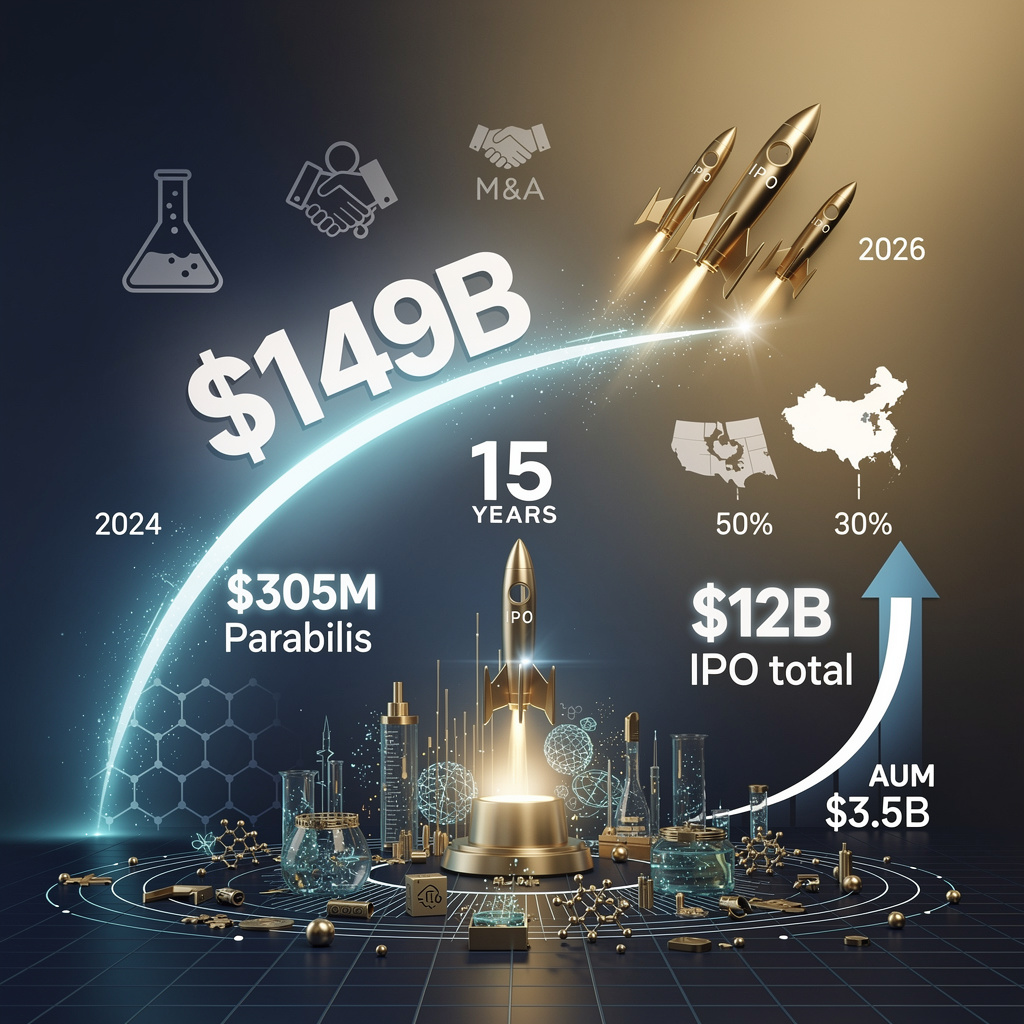
🚀 $149B surged into biopharma in 2025—a 65% YoY jump—as average deal size doubled to $1.96B. That's more than the GDP of some small nations! Six IPOs just cracked open the market after a year-long freeze, sparking a $116B M&A frenzy. Who's positioned to win: U.S. innovators or China's 50%+ margin plays?
Foresite Capital’s 15th anniversary arrives amid a decisive inflection point for biopharma finance. The venture firm deployed $149 billion across 76 deals in 2025—a 65% year-over-year surge from $90 billion—and celebrated six portfolio IPOs as the sector’s M&A value more than doubled. With assets under management now exceeding $3.5 billion, Foresite’s milestone underscores a broader capital renaissance driving consolidation and liquidity back into life sciences.
The Mechanics of a Capital Upswing
The 2025 investment figures reveal a strategic pivot toward larger, later-stage bets. The average deal size ballooned to $1.96 billion, more than double the 2024 average of $960 million, even as the total number of deals declined from 94 to 76. This concentration of capital fueled a series of landmark financings in early 2026, including a $305 million Series F for Parabilis Medicines and a completed Series D1 for Corxel Pharmaceuticals. Concurrently, six companies—including Generate: Biomedicines and Eikon Therapeutics—priced first-time public offerings, collectively commanding post-IPO market caps above $12 billion and ending a prolonged IPO drought.
Parallel Impacts of the Funding Wave
- Market Liquidity: Six IPOs in early 2026 reopened the public-equity channel, reducing the cost of capital for late-stage firms and enabling accelerated R&D timelines.
- Sector Consolidation: Biopharma M&A deal value doubled to $116.3 billion in 2025, intensifying competitive pressure and encouraging smaller innovators to pursue strategic exits.
- Geographic Arbitrage: Investments in China yield gross margins above 50%, compared to 30% or less for similar U.S. patient-centric assets, creating a powerful incentive for geographic portfolio diversification.
- Capital Scale: Foresite’s AUM growth to over $3.5 billion represents a 290% increase since its 2024 fundraise, positioning the firm to anchor mega-deals and influence valuation trajectories.
Institutional Response and Observable Gaps
The funding environment is being reinforced by tangible infrastructure expansion. Lab and R&D vacancy rates have tightened, dropping 30 basis points to 23.0%, while industry giants like Genentech and Gilead are committing billions to new research campuses. However, this bullish activity surfaces two critical gaps: a persistent concentration risk for firms overly exposed to biopharma cycles, and looming regulatory uncertainties in China that could swiftly erode its current margin advantage.
Forecast: A Sustained Capital Cycle
2026–2027: Venture capital funding in biopharma is projected to rise 12–15% year-over-year, propelled by the revived IPO pipeline and sustained M&A momentum exceeding $110 billion annually.
2028–2030: If China’s margin differential holds, investment allocations may shift 20% or more toward China-centric assets. Sector consolidation is likely to culminate in a “top-five” dominance structure, with mid-size firms forced into niche specialization or acquisition.
The Bottom Line for Biopharma
Foresite Capital’s anniversary is less a retrospective and more a bellwether. The firm’s $149 billion deployment, coupled with a doubling of sector M&A and a resurgent IPO window, signals a mature capital cycle ready to fund the next wave of therapeutic innovation. The strategic playbook now demands balancing high-margin international opportunities against regulatory volatility, while leveraging unprecedented liquidity to shape the future of global health markets.
🚀 Fiverr's AI-Driven Pivot: 10.1% Revenue Surge as Premium Freelance Work Soars 23%
📈 Fiverr's Q1 revenue surges 10.1% YoY—driven by a 23% explosion in premium projects over $1,000! That's like adding a full extra quarter of growth in just one year. AI is compressing project timelines by 20%, letting freelancers stack more high-value gigs. But with premium work still under 15% of total volume, can Fiverr scale its high-margin engine without alienating its core gig workforce? Freelancers, are you seeing more AI-augmented, high-paying opportunities on your dashboards?
Fiverr’s first-quarter revenue climbed 10.1% year-over-year, a figure that underscores a fundamental restructuring of the freelance marketplace. The growth is not a simple volume play but a strategic shift, powered by artificial intelligence and a deliberate corporate focus on premium projects exceeding $1,000, which are now growing at a 23% annual clip. This comes alongside a 2025 restructuring that cut 250 roles, signaling a move from a broad gig platform to a curated, high-value talent ecosystem.
The Mechanics of an AI-Augmented Marketplace
The company’s growth engine is now dual-fueled: AI-driven efficiency and human specialization. AI agents are compressing project lifecycles by an estimated 15-20% through automated matching and task assistance, enabling freelancers to handle more engagements. Simultaneously, enterprise demand is surging for complex, AI-augmented work in areas like advanced design and niche consulting—tasks where human expertise remains irreplaceable. The 250-employee reduction was a tactical reallocation, freeing resources to build the very algorithms that now drive this premium segment.
Assessing the Impacts of the Shift
The strategic pivot yields a clear set of parallel outcomes:
- Revenue & Margins: 10.1% YoY top-line growth amid a 23% surge in high-value projects points to improving margin potential, though these premium gigs still constitute less than 15% of total platform volume.
- Workforce Dynamics: AI accelerates hiring and project completion but also necessitated a 4% headcount reduction; the remaining talent pool is increasingly focused on high-skill, oversight, and development roles.
- Market Position: Growth in specialized work differentiates Fiverr from low-cost gig platforms, but over-reliance on AI risks alienating mid-tier freelancers and invites intensified competition from rivals like Upwork developing similar tools.
Institutional Response and Observed Gaps
Fiverr’s restructuring is a direct response to AI’s compression of low-value work. The company is betting its future on AI-curated, premium talent matching. However, a gap exists in ensuring service quality and freelancer retention as human oversight scales down. The observed opportunity lies in using AI not just for matching, but for identifying skill gaps and offering targeted upskilling—turning the platform’s data advantage into a talent-development engine.
The Outlook: A Premium, AI-Curated Future
The trajectory suggests Fiverr is evolving from a marketplace to a managed talent network.
- Short-Term (Next 12 Months): Revenue growth is projected to hold at 8-10% YoY, with premium projects likely rising to 18% of total platform value. Hiring will focus modestly on AI engineering to refine algorithms.
- Mid-to-Long-Term (24-36 Months): High-value work could surpass 25% of all platform activity. Successful execution of an “AI-augmented talent marketplace” model could boost operating margins by 1.5 to 2.0 percentage points and attract larger enterprise contracts.
Fiverr’s report is less an earnings story and more a blueprint for the future of work platforms. The 10.1% revenue increase validates a painful but precise transition: leveraging AI to handle efficiency while doubling down on the irreplaceable value of specialized human creativity. The company’s challenge is no longer connecting freelancers with clients, but curating and enhancing the talent that AI alone cannot replace.
⚡ Digital Realty's $3.2B Fund Ignites 769MW AI Data Center Race Amid Power Crunch
🚨 $3.2B private fund fuels 769MW AI data center surge! DLR's massive build-out targets >70% of AI workloads by 2030. That's like powering 5 million homes. Hyperscale demand is exploding, but power constraints loom. Who's ready for the AI infrastructure boom?
Digital Realty Trust (DLR) has solidified its position as a linchpin of the digital economy, announcing a $3.2 billion private capital fund and 769 megawatts of new, AI-ready data center capacity under construction. This aggressive expansion, coupled with a quarterly revenue beat of $1.63 billion, underscores a strategic pivot: to become the indispensable physical backbone for the coming wave of artificial intelligence. The launch of its Private AI Exchange (AIPx) further signals a move beyond mere real estate into high-margin, platform-driven services.
The Mechanics of Scale
The newly closed $3.2 billion HIsScale Development Capital fund is earmarked for next-generation infrastructure. This capital injection supports a construction pipeline that will add 769 MW to DLR’s existing 3 GW live capacity, with a total future pipeline exceeding 5 GW. The company’s financial heft is notable—a year-end cash balance of $7 billion provides liquidity to fund over $15 billion in projects without external financing, insulating it from volatile capital markets. This scale enables bulk procurement, targeting a 12% reduction in Power Usage Effectiveness (PUE) across new sites.
The Strategic Impacts
The expansion is a direct response to structural shifts in demand and risk within the industry.
- AI Demand Surge: Industry analysts forecast AI will consume over 70% of data-center workload by 2030. DLR’s 769 MW pipeline, expected to unlock ~$300 million in incremental annual revenue by 2027, positions it to capture this growth.
- Power Risk Mitigation: 74% of 2025’s global data-center deal value flowed through private equity demanding secured power. DLR mitigates this via long-term power purchase agreements (e.g., 6.6 GW nuclear procurement) and geographic diversification into regions like Texas and Southeast Asia.
- Revenue Diversification: The launch of AIPx creates a SaaS-style recurring revenue stream, projected to reach $120 million in annual recurring revenue by FY2027. This complements traditional colocation leases and leverages DLR’s carrier-neutral interconnect ecosystem.
- Competitive Posture: While rivals like Equinix and QTS expand aggressively, DLR’s private-fund structure allows rapid deployment without dilutive equity raises, providing a distinct advantage in the race for power-secure sites.
Navigating the Road Ahead
The path forward is marked by both significant opportunity and acknowledged headwinds. Analyst sentiment reflects this duality: while Citi recently trimmed its price target over power-supply concerns, TD Cowen raised its target, crediting the fund and AIPx rollout. DLR’s strategy to navigate this landscape involves a clear, phased approach.
- Short-Term (12–24 months): Completion of the 769 MW pipeline by Q4 2026, driving booking growth of 12–15% YoY from AI and hyperscale clients. Core Funds From Operations (FFO) is expected to rise 5–6% as newer, more efficient assets come online.
- Long-Term (3–5 years): With total IT capacity surpassing 5 GW, DLR aims to capture over 30% of projected AI-compute demand in carrier-neutral markets. This could support a Core FFO compound annual growth rate of ~10% and a potential 15–20% market-cap re-rating.
A New Capital Blueprint
Beyond the raw megawatts, DLR’s move signals a broader evolution. Its private-fund approach illustrates a new capital model for infrastructure REITs, leveraging non-public capital to accelerate growth while preserving shareholder equity. This decouples digital infrastructure investment from traditional public market cycles and is likely to prompt peer adoption, intensifying competition for strategic assets. For institutional investors, it underscores that data-center exposure is increasingly a specialized play on compute power, not just real estate.
Digital Realty Trust is not just building more data centers; it is architecting the physical and financial framework for the AI era. Its success will hinge on executing its colossal construction schedule, converting power agreements into reliable capacity, and convincing the market that its foray into AI platform services can deliver sustained, high-margin growth. The $3.2 billion bet is placed. Now, the industry watches to see how it pays out.
In Other News
- Covetrus and Cencora Merge in $3.5 Billion Deal to Consolidate Veterinary Services
- Analog Devices Reports Record Q1 2026 Earnings with 30% Revenue Growth
- Ginkgo Bioworks Expands Foundry Infrastructure with Modular RACs and External Lab Support
- Lincoln Yards Megaproject Receives Final Zoning Approval in Chicago

Comments ()