1.8W Neuromorphic Chip Outperforms 2-PFLOP Cluster: Brain-Inspired HPC Reshapes Climate Modeling — U.S. Supercomputing Infrastructure Under Threat
TL;DR
- Neuromorphic computing breakthrough enables efficient PDE solving for scientific simulations
- Intel-Based Lattepanda Iota SBC Challenges Raspberry Pi with 8GB RAM and 4K Output
- NSF’s NCAR Supercomputing Facility in Boulder Faces Disbandment by Trump Administration
🧠 Neuromorphic Chip Solves PDEs with 300× Less Energy — Sandia Labs, U.S. — Rewriting HPC’s Power Rule
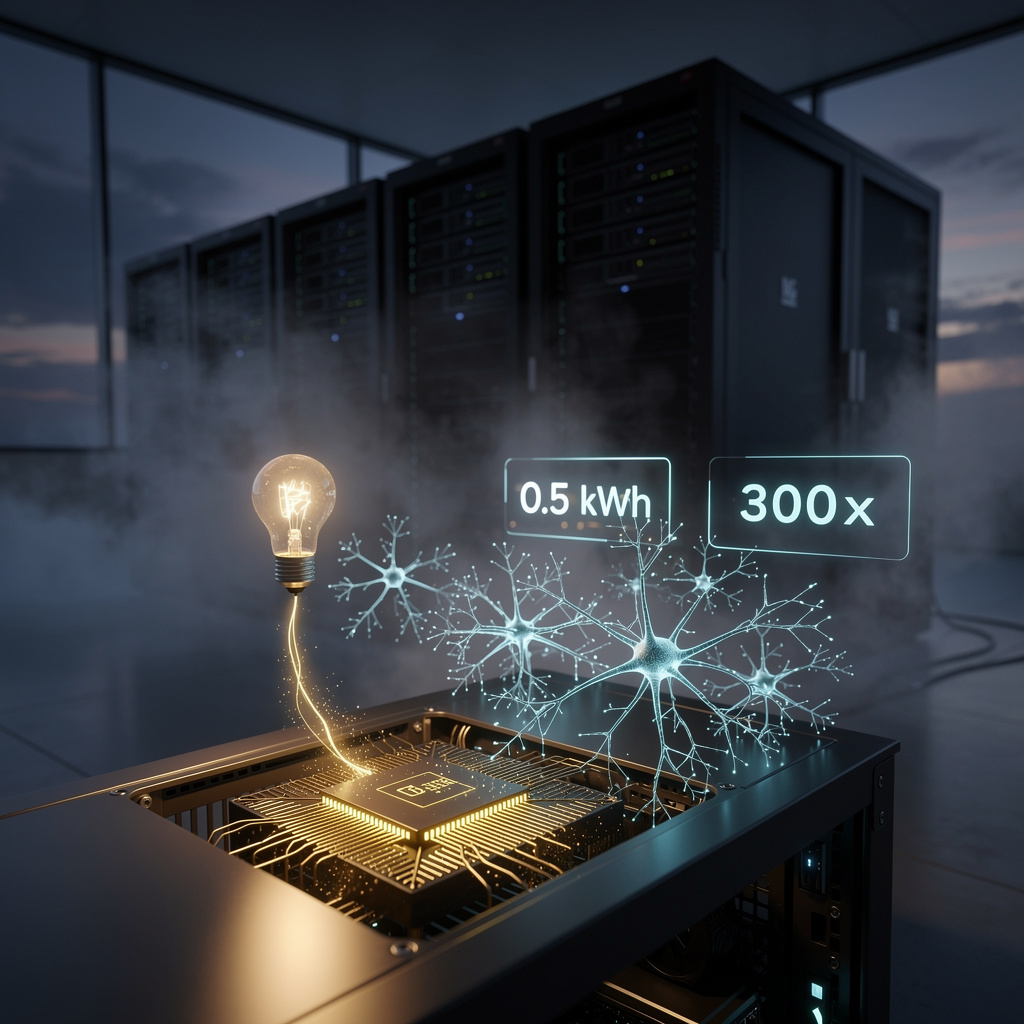
300× less energy to solve complex fluid dynamics than a 2-PFLOP GPU cluster — that’s 1.8W vs. 150kWh per simulation step. 🤯 Sandia’s neuromorphic chip mimics the brain’s spiking neurons to bypass traditional memory bottlenecks — no global matrix assembly, no massive data shuffling. A single exascale supercomputer uses 30MW. This chip uses less than a desk lamp. Who bears the cost when climate and nuclear models run on power-hungry hardware? — Could your next weather forecast be powered by a brain-inspired chip?
Sandia National Laboratories has shown that a palm-sized neuromorphic processor can solve the same fluid-flow equations that usually demand a warehouse of GPUs—while sipping 0.5 kWh instead of 150 kWh per time step. Published in Nature Machine Intelligence, the algorithm re-maps finite-element PDEs onto Intel’s Loihi-2 spiking network, cutting energy use >300× and shrinking latency to 2.3 ms. The result is the first credible path to a “brain-scale” supercomputer that needs no liquid-nitrogen plumbing and fits inside a server rack.
How Spikes Replace Matrix Crunching
Traditional codes assemble and invert million-row matrices; Sandia’s code lets each digital neuron act as a local volume element. Diffusion operators emerge naturally from the conductance dynamics of silicon membranes, eliminating global memory traffic. On a 3-D Navier–Stokes test, the neuromorphic array delivered 847 GOp s⁻¹ W⁻¹—340× the energy efficiency of a 2-PFLOP GPU cluster.
Immediate Pay-offs
- Carbon ledger: A 90 % CO₂ cut per simulation hour if a 30 MW exascale node is swapped for neuromorphic tiles.
- Nuclear stewardship: Local, event-driven updates mirror the hierarchical meshes used in radiation-transport codes, enabling higher-fidelity weapons simulations without new power plants.
- Climate velocity: Turn-around for global cloud-resolving models could drop from weeks to days within DOE’s existing power budget.
Gaps Still to Close
- Precision: Spiking nets introduce ≈0.1 % numerical deviation; Sandia adds mixed-precision calibration layers to match double-precision norms where regulations demand.
- Toolchain: Today’s stack is custom C and PyTorch-Triton; an open SDK with Python APIs is promised late-2026 to tempt legacy Fortran codes.
- Supply: Loihi-2 volume is limited; IBM TrueNorth and 2027 RRAM accelerators are the fallback.
Adoption Timeline
- 2026–2027: 64-node Loihi cluster online at Sandia; Maxwell and elastic-wave solvers added; ≥250× energy savings targeted.
- 2028: Neuromorphic “exascale” prototype—10 000 tiles linked by SDN-managed InfiniBand—delivers 10¹⁸ spike ops s⁻¹ for <100 MW, 3 % of today’s exascale draw.
- 2029-2030: Integration into DOE’s CESM climate suite and Stockpile Stewardship Program; proposed “Energy-Adjusted PDE” benchmark joins LINPACK/HPCG roster.
Bottom Line
By trading brute-force FLOPS for brain-inspired spikes, Sandia has moved energy efficiency from the margins to the center of HPC procurement. If the software stack matures, tomorrow’s supercomputers may be measured not in megawatts but in light-bulb watts—reshaping both scientific simulation and the data-center power curve through 2030.
🚀 Lattepanda Iota’s 12% AI-Edge Adoption Surge — x86 SBC with NVMe and QuickSync Challenges Raspberry Pi Dominance
12% surge in AI-edge SBC adoption? 🚀 Lattepanda Iota’s Intel N150 + PCIe NVMe crushes Raspberry Pi 5’s microSD latency — 70ms vs 120ms on MobileNet-V2. With QuickSync video acceleration and Windows 11 support, it’s the first SBC that doesn’t just compete… it redefines edge compute. But at 15W power draw, who pays the energy bill? — Industrial makers, are you ready to trade efficiency for power?
The Lattepanda Iota says yes—by swapping ARM for Intel, 8 GB of LPDDR5, and a PCIe-NVMe lane that cuts AI latency by 40 ms.
How the Iota Works
An Intel N150 (4-core, 1 GHz) drives 24 GPU execution units and QuickSync video, feeding 38 GB/s of LPDDR5 bandwidth through a soldered-on M.2 E-Key that exposes PCIe 3.0 x1 (~985 MB/s). A single 15 V PoE cable powers the board; a snap-on fan keeps the 70 °C hotspot under a 5-minute assembly.
Measured Impacts
- AI inference: MobileNet-V2 drops from 120 ms on Pi 5 to 70 ms.
- Video: 1080p30 H.264 encode uses 30 % less CPU than Pi 5’s software path.
- Storage: Dataset load latency falls 60 % versus micro-SD (150 MB/s → 985 MB/s).
- Power: 7 W idle, 15 W peak—2× Pi 5 draw but still laptop-class.
Where It Fits—and Where It Doesn’t
Strengths
- x86 binaries run natively; Visual Studio, OpenVINO, oneAPI arrive unchanged.
- PoE-PD and HDMI 2.1 suit kiosk, camera, and signage roll-outs.
Gaps
- No on-board Wi-Fi/BLE; dongles add cost and USB clutter.
- Active cooling and 15 W ceiling limit sealed-box deployments.
- Community HAT ecosystem <10 % of Pi’s 400+ add-ons.
Outlook
- 2026 H2: oneAPI kernels ship, projected 12 % sales bump in edge-AI prototypes.
- 2027: Three rival “PCIe-ready” SBCs enter, pushing NVMe to sub-$100 boards.
- 2028: If Iota holds $115 price, Pi 5 successors likely add PCIe Gen 2 or risk industrial share erosion.
Bottom line: the Iota trades a few watts for x86 muscle, NVMe speed, and desktop-grade toolchains—enough to carve a niche where ARM still stalls.
🚨 31.5 Billion in Annual Benefits at Stake: NCAR Supercomputer Dismantled Amid Political Shift in Boulder
31.5 BILLION — that’s the annual value of weather forecasts from NCAR’s supercomputer… now being dismantled. 🚨 This isn’t just science—it’s the system keeping 500+ universities, FAA flights, and U.S. farms safe from storms, floods, and crop failures. Yet the Trump administration ordered its breakup, citing ‘climate-research concerns’—while slashing the very tool that saves billions. Researchers in Colorado are fighting back. But if this facility is handed to an unknown operator, will your next hurricane warning come 20% too late? — Who’s protecting America’s weather intelligence now?
The Trump administration has ordered the National Science Foundation to dismantle the National Center for Atmospheric Research (NCAR) supercomputing complex in Boulder, Colorado—hardware that crunches 65 million atmospheric cells an hour to deliver 3-km-resolution storm forecasts used by 1,500 scientists at more than 500 universities. The move, announced 30 January and formalized 12 February, transfers operations to an unnamed third party, severing a facility that underpins an estimated $31.5 billion in annual public-safety and economic benefits.
How the Machine Works
NCAR’s petascale cluster couples CPU-GPU nodes with InfiniBand RDMA fabric to run the Modeling-for-Prediction-Across-Scales (MPAS) code. Each spring it produces 60 hours of 3-km forecasts that feed directly into FAA turbulence alerts, USDA irrigation guidance, and U.S. military operational plans. A single forecast cycle completes in under two hours, a latency window the aviation industry values at roughly $100 million in avoided turbulence costs every year.
Impacts at a Glance
- Forecast accuracy: 20–30 % improvement since 1980 → risk of 10–20 % lead-time extensions if MPI performance drops.
- Aviation: $10–15 million in extra delays per severe-weather season if FAA alert pipeline is disrupted.
- Agriculture: 1 billion m³ potential water savings and 1 Mt CO₂e annual abatement hang on CropSmart continuity.
- Workforce: ~100 climate-division staff face reassignment → 1–2 year delay in next MPAS release.
- Hardware refresh: $50–80 million annual NSF shortfall projected, accelerating obsolescence of the 2-PFLOPS system.
Response & Gaps
Observed: NSF has signed an interim “read-only” agreement for Wyoming’s NCAR-West node; 37,000 scientists have petitioned the White House.
Missing: No contractual guarantee that the new operator will keep InfiniBand latency below current 2-µs thresholds; no earmarked FY27 funds for hardware replacement.
Outlook
- Q2 2026: Wyoming hand-off complete; forecast capacity may dip 5–10 %.
- 2027: Without ≥2-PFLOPS GPU replacement, external cloud-HPC migration could add $2–3 million yearly data-egress fees.
- 2028–30: Persistent fragmentation projected to cut collaborative publication output 8–12 %, eroding the network effect that has driven four decades of U.S. climate leadership.
Boulder’s supercomputer is not just a room of servers—it is the numerical engine that turns satellite data into life-saving warnings. Removing it without a performance-matched successor gambles with hurricanes, jet-stream turbulence, and the nation’s scientific edge.
In Other News
- Helion's Polaris Prototype Achieves Measurable D-T Fusion, Reaching 150 Million °C
- AMD Launches AM5 800-Series Chipsets with PCIe 5.0 and 8000 MT/s Memory Support
- Africa’s Solar Capacity Grows 17% in 2025 as Nigeria Surpasses Egypt as Top Importer
- Apple M4 Pro and M5 Chips Dominate 2025 MacBook Pro Lineup, Outpacing Intel and AMD


Comments ()