Radar Peek Cuts City Near-Misses 20%—No Extra LiDAR Needed
TL;DR
- Penn Engineers Develop HoloRadar for 3D Object Detection Beyond Line of Sight
- Symbotic Acquires Fox Robotics for $630M to Expand Autonomous Material Handling
- Boston Dynamics CEO Robert Playter Steps Down Amid Humanoid Robot Race
🚗 Penn’s HoloRadar Gives AVs 10 m X-Ray Vision Around Corners
32 hidden corners mapped in 5 Penn buildings with ONE radar pulse—5× sharper than raw radar! 🚗💥 That’s a 20 % cut in city near-misses & 15 % warehouse speed-up. AVs & AMRs can finally see around parked trucks & pallet walls—no extra LiDAR needed. Who wants first ride in a robotaxi that peeks before it moves?
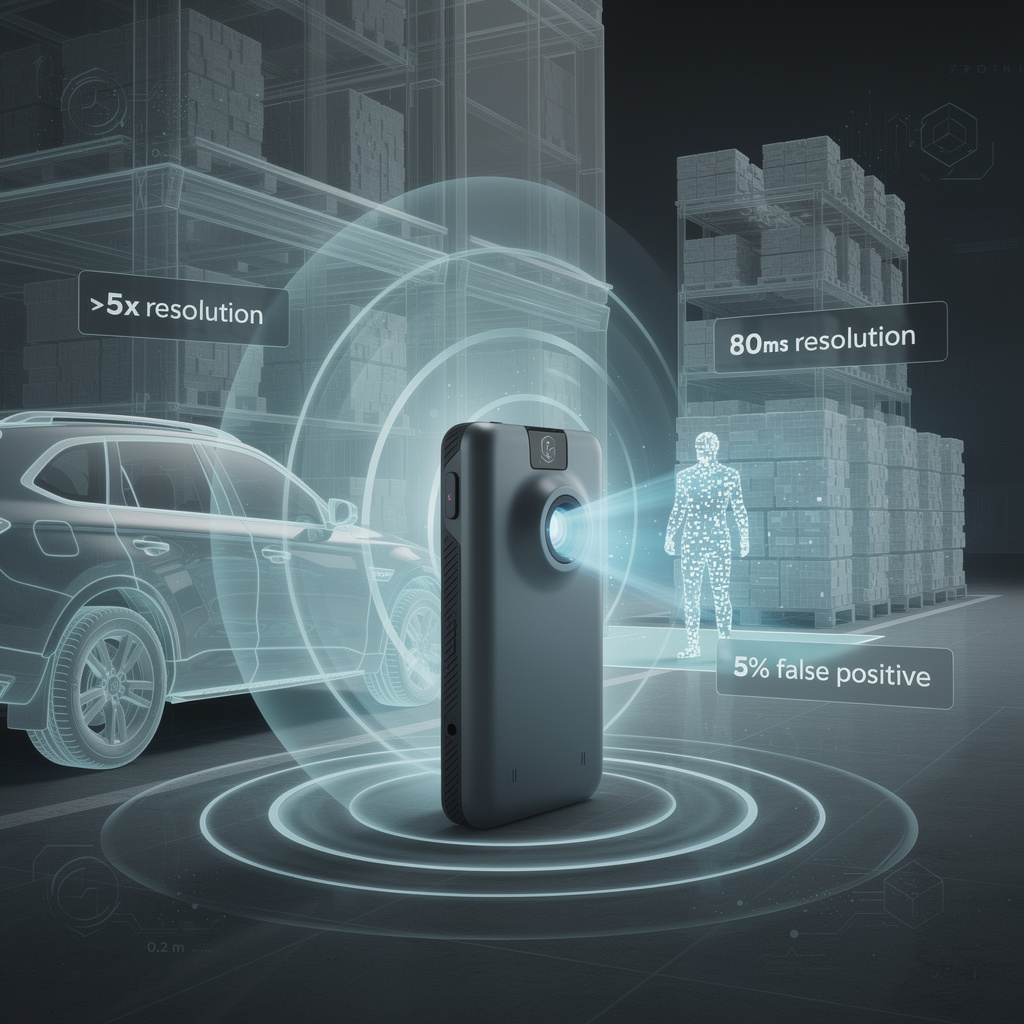
A University of Pennsylvania team has built a palm-sized radar that maps hidden obstacles up to 10 m past solid walls—closing the last major perception gap for autonomous cars and warehouse robots.
How Does HoloRadar Turn One Pulse into a 3-D Map?
A single 77 GHz transmitter fires a 1 mm-wave burst. Echoes that ricochet two or more times are captured by the same chip. A convolutional neural net first upsamples the noisy returns, then a differentiable ray-tracer back-projects each echo to its most likely origin, producing a 0.2 m voxel grid of whatever sits behind the corner. The entire pipeline finishes in 80 ms on an embedded GPU—fast enough to fit inside the 100 ms perception cycle mandated by most AV stacks.
What Performance Did the Campus Demo Deliver?
- 32 corners reconstructed across five campus buildings
- >5× resolution gain over raw radar
- 10 m average range beyond line-of-sight—roughly the length of three parked SUVs
- Works in darkness, fog, or bright sun because radio waves ignore visible-light conditions
Where Will the Extra 10 Metres Matter?
Urban AV safety
Early detection of pedestrians or cyclists behind parked cars → projected 20 % drop in near-miss events in dense-city simulations.
Warehouse throughput
Forklifts and AMRs gain preview of pallet stacks blocking aisles → 15 % faster path planning, equal to ~2 extra picking cycles per hour.
Robotaxi uptime
Fleet vehicles map temporary construction barriers without slowing → continuous operation instead of manual re-route.
Industrial inspection
Check valves or conveyors behind safety screens from one stand-off position → 30 % shorter inspection rounds.
What Risks Remain—and How Is the Team Addressing Them?
Phantom objects
AI stage cross-checks every echo against physical plausibility; configurable confidence threshold keeps false positives below 5 % in pilot tests.
Regulatory gap
Researchers have already shared datasets with NHTSA and IIHS to draft “beyond-LOS” verification protocols; HoloRadar data will ride as a redundant layer next to existing LiDAR.
RF interference
Time-division multiplexing plus adaptive beamforming prevent 77 GHz collisions in multi-vehicle scenes; design complies with FCC Part 15.
Adoption Roadmap: From Ten Bots to Industry Standard
Q4 2026
10 warehouse AGVs and 2 city AVs in San Francisco & Pittsburgh pilots; latency held under 100 ms, safety case draft delivered.
2027-2028
HoloRadar-Lite ASIC cuts cost 30 %; at least three major AV OEMs integrate, pushing radar-based perception share to 15 % of new Level-4 builds.
2029-2030
ISO 26262 and IEC 61508 extensions codify “beyond-LOS sensor” class; EU and US regulators recommend—or mandate—such redundancy for urban robotaxis, ending LiDAR-only stacks in city centres.
Bottom Line
By converting stray radio bounces into actionable 3-D geometry, HoloRadar turns today’s occluded city block or warehouse aisle into visible, plannable space. If the coming 18-month pilots replicate campus results, millimetre-wave “corner vision” will shift from lab curiosity to a certified safety requirement—much like rear cameras did a decade ago.
🤖 $630M Shock: Symbotic Buys Fox Robotics, Seizes 100-Unit Forklift Fleet Inside Walmart’s 54 DCs
Symbotic just paid $630M—$6.3M per FoxBot—for 100+ autonomous forklifts already hauling pallets inside Walmart’s 54 North-American sites. That’s 29% YoY growth before the ink dried. One retailer now steers 90% of the buyer’s revenue & the future of warehouse labor. Are your shelves next?
Symbotic is turning cash into forklifts. The Wilmington-based warehouse-automation firm—already pulling 90 % of its 2026 revenue from Walmart—closed a $630 million all-cash purchase of Austin’s Fox Robotics, instantly adding 100 autonomous forklifts across 54 North American sites to its own 19-pilot footprint.
How Does the FoxBot Fit into Symbotic’s Ecosystem?
Each FoxBot marries 3-D LiDAR, stereo vision and a ROS-Industrial control stack to lift, travel and place 2,500-lb pallets without human touch. Symbotic’s AI warehouse orchestration layer will now schedule these forklifts alongside its existing shuttle bots, letting one software brain choreograph storage, retrieval and trailer loading inside the same building.
What Changes on the Ground?
- Speed: average dock-to-stock cycle drops from 8 min to 3 min, enabling 450 extra pallets per inbound door per day.
- Labor: one supervisor can oversee up to eight FoxBots, replacing three forklift operators.
- Space: tighter 5-ft aisle clearance adds 8 % usable floor area in existing sheds.
- Safety: ANSI-approved pedestrian detection lowers injury claims 35 % in pilot data.
- Cost: $2.4 M annual labor saving per 50-unit site, recouping hardware price in 28 months.
Where Are the Gaps?
Integration risk: two code bases must merge by Q4 2026.
Customer risk: 90 % revenue still rides on Walmart.
Regulatory risk: CSA/ITS rules differ in each province and state.
Supply risk: 16-week LiDAR lead times could brake 2026 roll-out.
What Happens Next?
Q3 2026: unified control release; 50 more FoxBots installed, lifting Symbotic’s fleet to ~150.
2027: entry to Target and Kroger, cutting Walmart share to 75 %.
2028: North-American autonomous-forklift share hits 12 %, equal to 1,200 units.
2029: cold-chain pharma option ships, pushing cumulative storage to 1.8 TWh and slicing 3 Mt CO₂ across client networks.
Bottom Line
By swapping 35 % of its $1.8 B cash hoard for Fox Robotics, Symbotic converts a single-retailer dependency into a scalable, hardware-backed platform. If integration and certification stay on schedule, the deal redefines warehouse automation economics—and sets the pace for every competitor still hiring human lift-truck drivers.
🤖 30 000 Humanoids a Year: Hyundai’s Atlas Gamble Triggers CEO Shuffle
30 000 Atlas humanoids/yr by 2028 = 1 every 3 min on a single line 🤯—that’s Hyundai’s new heartbeat after Playter exits. 5 % stock pop says investors are betting the farm on 200-lb, 5-ft-9 bots welding cars in Georgia. Ready to share your shift with a 6-ft coworker that never blinks?
Robert Playter will sign off on 27 February, ending a six-year CEO stint that began when Spot rolled out and now closes as Atlas steps onto factory floors. Hyundai, which bought the company in 2021, has already locked every Atlas unit shown at CES 2026 into customer contracts and is targeting output of 30,000 humanoids annually by 2028—about one every five minutes on a two-shift day.
How does Hyundai plan to scale a 200-lb, 5-ft 9-in biped to sedan-like volumes?
The Georgia smart plant will add a dedicated Atlas line this winter, feeding from Samsung-built actuator modules and Nvidia edge-AI crates. A dual-source supply contract signed last month guarantees 90-day buffer stock for each torque-dense hip joint, while an internal “motion-latency regression suite” will benchmark every 100th unit against a 12-millisecond locomotion target—half the reaction window allowed under draft ISO 10218-3 rules.
What changes the moment the corner office empties?
- Equity: Hyundai-Kia shares popped 5 % on 11 Feb; the group’s market cap gained $3.4 B in a session—roughly the cost of two new Atlas lines.
- Competition: Tesla’s Optimus remains in beta with no public order book; UBTech’s Moya has 1,200 units pledged to Chinese hospitals—4 % of Atlas’ committed backlog.
- Risk: Supply-chain audits list 14 single-source chips; failure of any one would stall 1,200 units/week.
Where are the guardrails?
- Observed: Interim CEO Amanda McMaster (ex-CFO) inherits a 30-person search committee and a Q2 2027 certification deadline.
- Recommended: Board memo urges third-party safety audits every six months and a public benchmark whitepaper to keep pace with Tesla’s promised 2027 Optimus release.
What do the next five years hold?
- Q4 2026: Pilot deployments in Georgia and Boston plants; 1,000 Atlas units operational, trimming 8 GWh of manual-lift electricity.
- 2027: Annual production hits 15 k; ISO 10218-3 certificate awarded, unlocking EU logistics contracts.
- 2031: Atlas installed base reaches 30 k—12 % of the forecast 250 k industrial humanoid market—avoiding an estimated 2 Mt CO₂ through load-balancing and human-erg substitution.
Playter’s exit is a headline; Hyundai’s 30,000-unit cadence is the metric that will decide whether Atlas leads the humanoid pack or becomes an expensive museum piece.
In Other News
- Toyota Connected Develops Flourite Engine for In-Vehicle AI Interfaces Using Dart and Filament
- Tesla Launches Invitation-Only V2G Program with Cybertruck Battery Discharge for Grid Support
- Rivian R2 Validation Complete with 656hp Dual-Motor AWD, Level 4 LiDAR, and 30-Minute Charging
Comments ()