Billion-iPhone Backdoor: One Image File Hijacks Every iOS Device Ever Sold
TL;DR
- Apple Patch CVE-2026-20700 to Fix Memory Corruption Zero-Day Exploited Since December 2025
- Lazarus Group Poisons npm and PyPI with Malicious Packages Targeting Blockchain Exchanges
🍏 CVE-2026-20700: Apple’s dyld 0-day left 58% of U.S. iPhones open for 2-month spy fest
42% of iPhones patched in 24h—wow, Apple fans move faster than a caffeinated squirrel on Black Friday 🐿️ But 58% still naked to nation-state peeping-toms for TWO months while dyld got pwned. Update or keep handing your nudes to spyware vendors—your call, US. When will we stop treating 0-days like surprise drop culture?
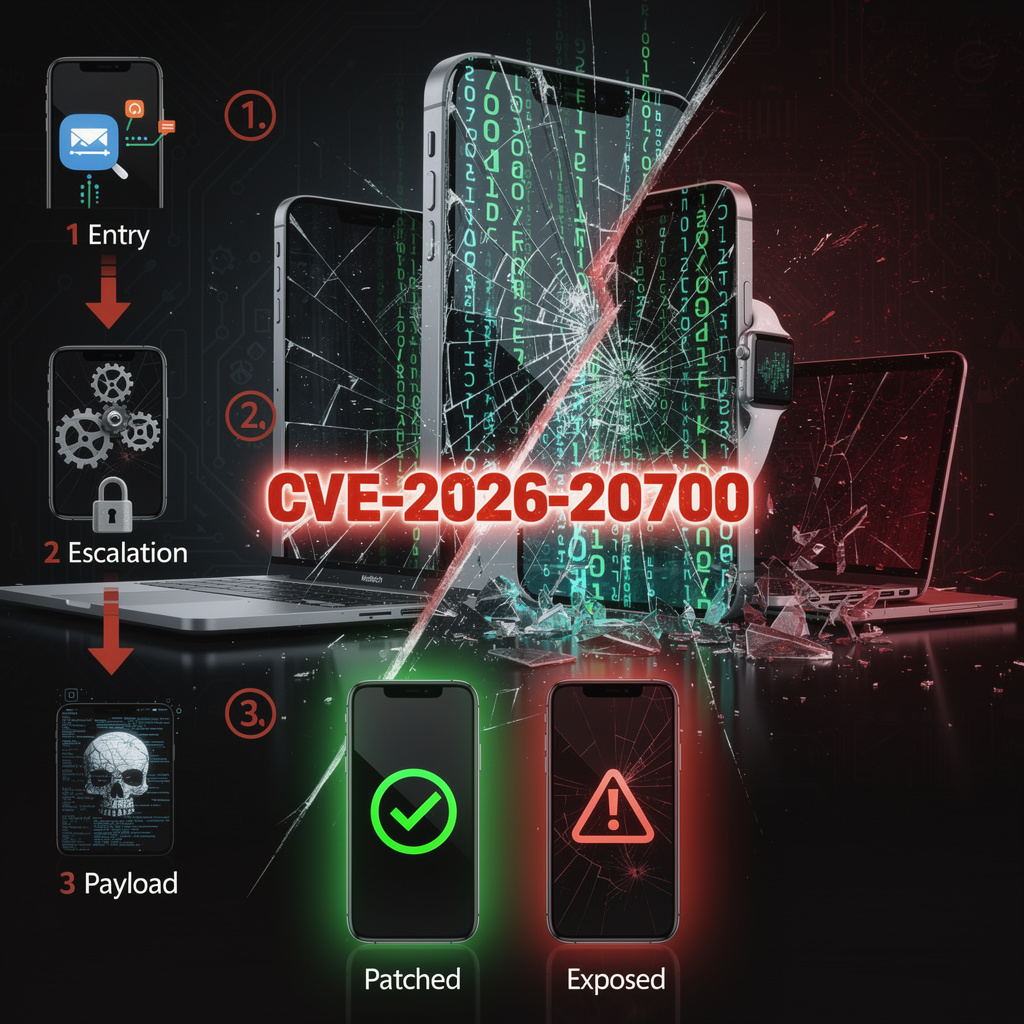
For two straight months, nation-state crews and commercial spyware peddlers treated Apple’s core dynamic-link editor, dyld, like their personal sandbox. CVE-2026-20700—an unchecked memory-write flaw—let them scribble whatever code they wanted onto iPhones 11-and-newer, current iPads, Macs on macOS Tahoe 26.x, Vision Pro, Apple Watch 6+, and even the living-room Apple TV. Google’s Threat Analysis Group finally rang the bell on 12 Feb 2026; Apple shipped an emergency patch the same day. Telemetry shows 42 % of iPhones updated within 24 hours, but only 18 % of Macs have bothered so far, leaving millions of endpoints still holding the door open.
How did the attack work?
- Entry: malicious app or web content triggers dyld with a rigged memory-write primitive
- Escalation: dyld trusts the input, copies attacker code into a privileged region, then executes it
- Payload: spyware implants, credential harvesters, and persistence tools ride in without a password prompt
What it already cost us
- Espionage: targeted individuals in the U.S. and Taiwan report unexplained credential leaks since December
- Enterprise risk: unmanaged macOS fleets remain 82 % exposed, turning “Bring-Your-Own-Device” into “Bring-Your-Own-Backdoor”
- Reputation: Apple’s first in-the-wild zero-day of 2026 arrives just seven weeks into the year, matching 2025’s full count of seven patched zero-days
Institutional response & gaps
Observed
- Apple compressed patch build-to-release to 48 hours, pushing updates across six operating systems simultaneously
Still missing
- No public indicator-of-compromise list; defenders must reverse the fix themselves
- Delayed detection: Google saw exploits in December, Apple learned in February—a two-month gift to intruders
Outlook
- Next 90 days: expect C2 traffic spikes as bot herders cash in on stragglers; SOC teams will scramble for dyld crash-log signatures
- 2027 and beyond: Apple is expected to wrap dyld in pointer-authentication and hardened allocators; NIST draft publications will likely add “dynamic-loader hardening” to incoming AI-Sec and IoT guidelines
Patch today, log dyld crashes tonight, or keep handing your users’ data to whoever can buy a $2 million exploit chain before breakfast.
💥 12 000 npm Installs: Lazarus Fake-Recruiter Poison Pipelines Globally
12k devs got punked by a fake LinkedIn recruiter & a "math" package—npm install just cost exchanges $5M in API keys 💥 That’s 3 RATs for the price of one job interview. Your CI pipeline still trusts strangers?
North Korea’s Lazarus Group just smuggled three Trojan horses—written in JavaScript, Python, and good-old VBScript—into npm and PyPI under the alias “graphalgo.” The bait: fake recruiter coding tests. The prize: API keys and wallet seeds from crypto exchanges. More than 12,000 installs later, two mid-size trading shops have already coughed up credentials, setting the stage for eight-figure fraud.
How Does the Poison Flow?
- Victim lands a “job interview” on LinkedIn or Reddit.
- Interviewer says, “Install bigmathutils and duer-js, then solve this algo.”
- One
npm installorpip installdrops an 85-130 kB obfuscated loader. - Loader phones home via token-rotating HTTPS, fetches RSA-2048-encrypted RAT.
- RAT scrapes ~/.ssh, env vars, browser storage; opens reverse shell; ships out secrets.
Impact Scorecard
- Confidentiality: Exchange API keys + wallet seeds exposed → unauthorized trades or straight wallet drain.
- Integrity: Live order books and price feeds now forgeable → market manipulation risk.
- Availability: RAT can kill trading nodes → halts matching engine, customer outrage.
- Business: Prior breaches of this size cost $1-5 M in hot-wallet losses + legal fallout.
- Regulatory: GDPR/CCPA breach notices, plus SEC/FINRA cyber exams if U.S. customers hit.
What Got Done—And What’s Still Missing
Observed
- GitHub, JFrog yanked the packages within 24 h of disclosure.
- Major mirrors flipped on SHA-256 signature checks.
- Red-team rules now flag “npm install” during HR Zoom calls.
Still Missing
- No mandatory sigstore signing for new uploads.
- No isolated sandbox for candidate code tests.
- No outbound TLS token monitoring in most SOCs.
Timeline: From Now to “Oh No, Again?”
- Next 3 months: Blacklists harden; CI pipelines reject unsigned deps; SOC alerts spike.
- 2026 Q4: First copy-cat campaign targeting GitHub Actions (probability >70%).
- 2027: Container-base-layer poisoning overtakes package registries as Lazarus’ favorite lane—unless reproducible builds and SBOM checks become default.
Bottom line: Lazarus proved that “just run this quick install” is now a $5 million question. Until every dependency arrives signed, sandboxed, and provenance-checked, your next coding interview might double as a bank heist.
In Other News
- FBI Investigates Chinese Spies for Starlink Data Interception in France
- OpenAI Faces Potential California Fines for GPT-5.3-Codex Safety Violations
Comments ()