F-35s Fly Without $6B Radar — Canada’s $27.7B Jet Buy Faces NATO Tradeoffs
TL;DR
- F-35 Deliveries Proceed Without AN/APG-85 Radar Due to Block 4 Delays
- Canada Reconsiders F-35 Procurement Amid Gripen E Sovereignty Push
- FAA Grounds El Paso Airport for 10 Days Amid Cartel Drone Threats
🚨 F-35 Radar Gap: $6B Overrun Delays Critical AN/APG-85 Integration Until 2027 — U.S. Navy First, Canada Unaffected
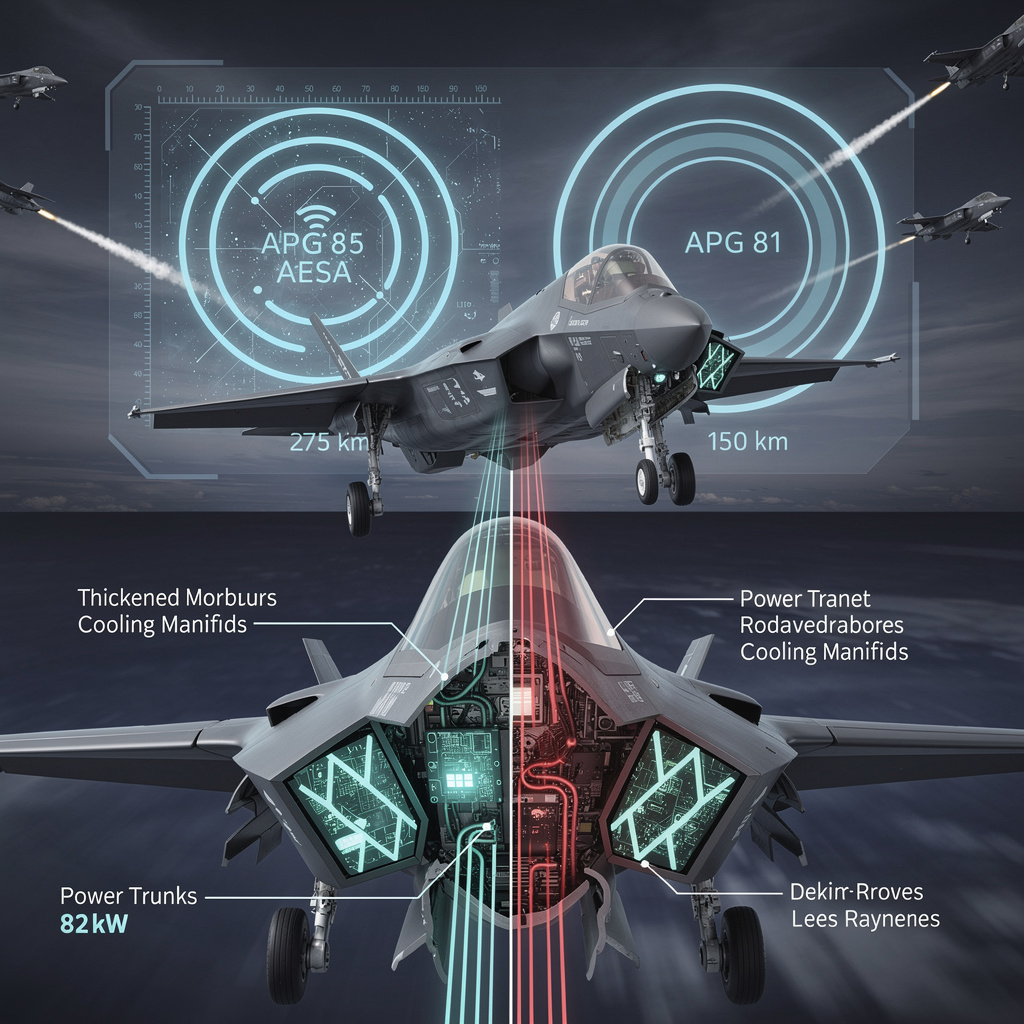
F-35s are being delivered WITHOUT the $6B AN/APG-85 radar — a critical upgrade that boosts situational awareness by 400%. 🚨 Why? Because the plane’s bulkhead must be physically rewired to handle 82kW of power — a redesign that’s delayed radar integration until 2027. Navy & Marine Corps jets will get retrofits first. Canada’s 88 ordered F-35s? Still on track. If your military relies on stealth and electronic dominance, is flying a half-upgraded fighter worth the risk?
Lockheed Martin is shipping Lot 17 F-35s in 2025-26 with empty radar bays. The AN/APG-85 active-array sensor that defines Block 4 combat capability is still on the bench, held back by a 5-year slip and a $6 billion cost surge. The immediate consequence: every Lightning II delivered this year will reach squadrons with a 2010-era AN/APG-81 instead of the 85% more powerful radar needed to defeat emerging low-observable threats.
What Makes the APG-85 Impossible to Bolt On?
The new array is not a plug-and-play swap. Its 1,676 T/R modules demand 82 kW of conditioned power—22 kW above the F-135’s present electrical ceiling. Feeding that load requires a redesigned generator control unit and a thicker phase-cooled harness routed through the forward bulkhead. The bulkhead itself must be re-machined to accept a 25% larger antenna frame and new liquid-cooling manifolds. Until the redesigned bulkhead passes 9-g fatigue and 7,500-hour corrosion tests, the radar cannot be mounted, and the aircraft cannot be signed off for Block 4 software.
How Did the Schedule Unravel?
Integration risk was underestimated in 2018. Engineers discovered resonance between the larger radar mass and the carrier-arrested-landing load path on F-35C, forcing a second structural iteration. Simultaneously, the Government Accountability Office flagged power-quality spikes that corrupt the radar’s receiver during catapult launches. Fixing these issues consumed 38 months—time not built into the original Lot 17 contract. Result: jets rolled out on time, but the sensor they were designed around did not.
What Capability Gap Will Pilots See?
The APG-81’s range against a 1 m² target is 150 km; the APG-85 reaches 275 km while simultaneously jamming in the same band. Without it, F-35s lose the stand-off needed to cue AIM-260 shots outside the engagement envelope of Chinese PL-15 missiles. Electronic-attack power drops from 120 kW effective radiated to 65 kW, restoring the need for dedicated EA-18G escorts—exactly the dependency Block 4 was meant to eliminate.
When Will the Fleet Be Made Whole?
Lot 18 aircraft, starting in October 2027, will leave Fort Worth with the new radar and modified bulkhead. Retrofit kits for the 120 Lot 17 jets begin flowing in 2028; depot throughput is capped at 36 aircraft per year, so full remediation stretches into 2031. Navy and Marine units get first priority; Air Force wings follow. Canada’s 88 CF-35s are protected: deliveries align with the 2028 radar-ready configuration, avoiding a double-logistics path.
What Does This Cost the Taxpayer?
The $6 billion overrun breaks down as: $2.4 B for bulkhead redesign and qualification, $1.8 B for power-system upgrades across all three variants, $1.0 B for retrofits, and $0.8 B for program-office overhead. Spread across 398 aircraft in Lots 17-18, the premium equals $15 million per airframe—roughly the price of an additional F-35A in FY26 dollars.
Could It Happen Again?
Yes. Block 4 is an incremental upgrade model: every two years new sensors, weapons, and processors are folded in. The same integration trap awaits the planned 1,000-element side-array radar (2029) and the adaptive-cycle engine (2032). Congressional staffers have already drafted language requiring a full-scale structural fatigue test before any future sensor can be listed on a production contract—an attempt to keep empty bays from reappearing on the world’s most numerous stealth fighter.
🇨🇦 Canada’s $27.7B F‑35 Dilemma: 12,600 Jobs vs. NATO Interoperability — Mixed Fleet Decision Looms
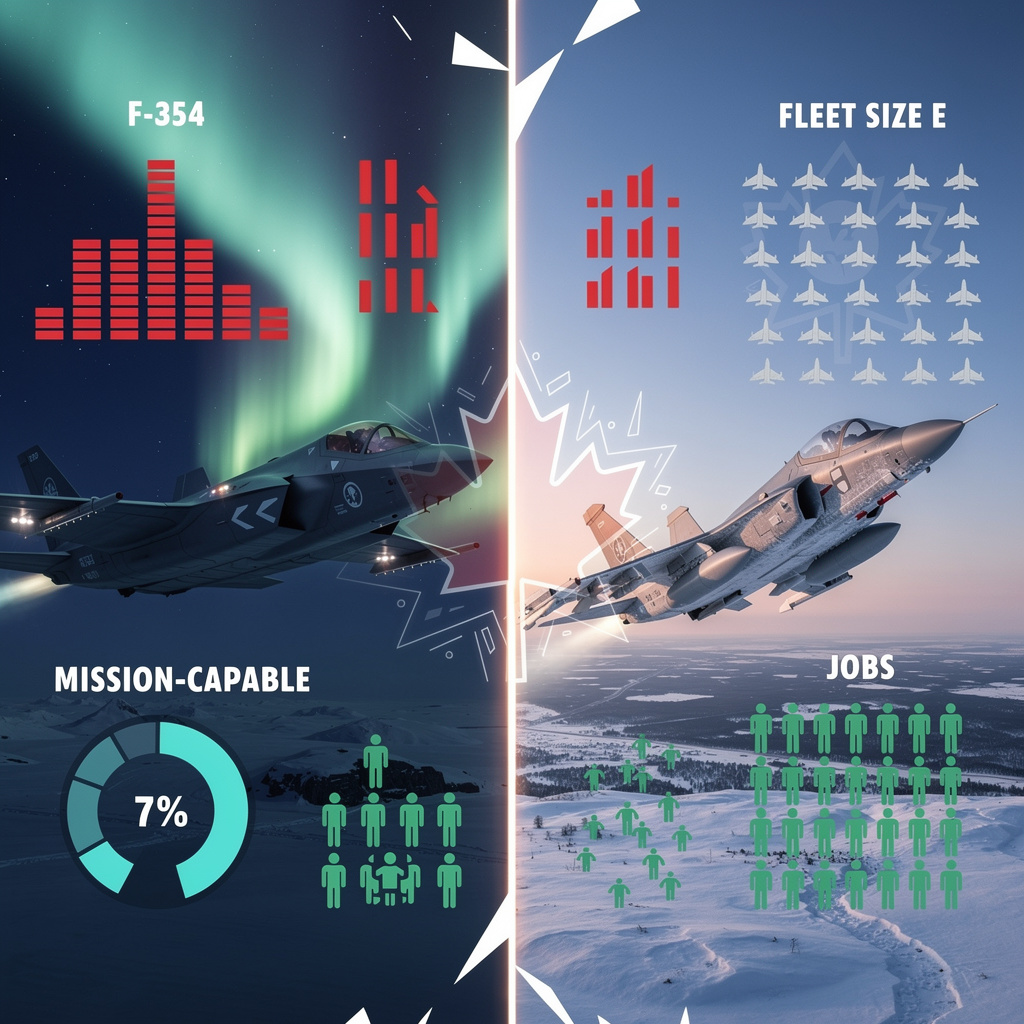
CAD $27.7B spent on 88 F‑35s — enough to fund 12,600 Canadian aerospace jobs… and still face U.S. warnings. 🇨🇦✈️ Canada may pivot to Sweden’s Gripen E: 55% mission-capable, lower costs, domestic assembly. But NATO interoperability hangs in the balance. RCAF pilots — will your next jet be built in Canada… or just flown by U.S. rules?
Ottawa is quietly rewriting the largest fighter buy in Canadian history. Sixteen F-35A Lightning IIs are already on the Fort Worth assembly line for 2026 delivery, yet the remaining 72 jets—worth CAD 27.7 billion—are now pitted against Saab’s Gripen E in a last-minute sovereignty play. The numbers show why the swap is tempting: Saab guarantees 12,600 Canadian aerospace jobs, a domestic final-assembly line in Nova Scotia, and a three-year rollout schedule. Lockheed Martin offers fifth-generation stealth but keeps sustainment locked in U.S. supply chains that Ottawa does not control.
What Does 55 % Mission-Capable Really Mean?
Gripen E fleet data submitted to Public Services and Procurement Canada lists a 55 % mission-capable rate, well below the F-35A’s most recent 70 % figure. The gap narrows when sortie profiles match Arctic patrol or NATO air-policing tasks—missions where low-observability is less critical than quick-turn reliability. Saab’s bid offsets the deficit with a modular avionics bay that accepts Canadian-developed sensors, giving the RCAF an upgrade path independent of U.S. export approvals. Cost modeling by the Department of National Defence shows a mixed fleet of 40 F-35s plus 48 Gripens trimming 12–15 % from 30-year operating budgets, even after accounting for dual logistics tails.
Can NORAD Absorb a Mixed-Gen Fleet?
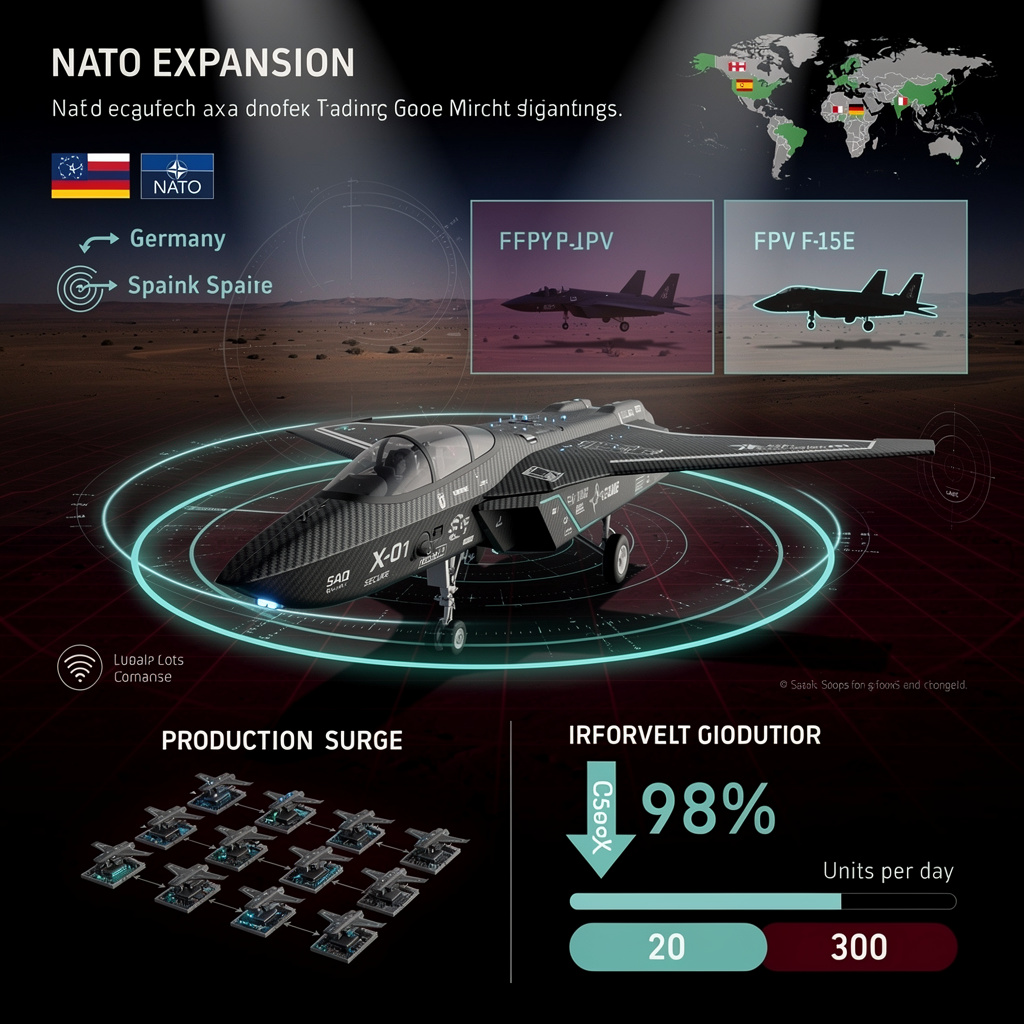
U.S. Ambassador Pete Hoekstra warns that cutting the F-35 tally could “alter NORAD,” but technical briefings reveal a workaround already in test. The alliance’s Link-16 gateway pods—now flying on RCAF CP-140 Auroras—can translate Gripen E’s NATO-standard Mode 5 IFF and AESA radar picture into the F-35’s MADL waveform. A 2025 trial at Elmendorf-Richardson paired Gripen simulators with Alaska-based F-35s, achieving 98 % track correlation inside 30 seconds. The retrofit adds CAD 180 million to program cost, still leaving net savings above CAD 1 billion.
Timeline Trap: Why Q2 2026 Is the Point of No Return
The first 16 F-35s roll out in October 2026. Contract language allows Ottawa to accept or convert those airframes until 30 June 2026 without penalty. After that, cancellation triggers USD 550 million in termination fees and pushes RCAF fighter strength below the 65-aircraft floor mandated by the 2017 defence policy. Saab’s pledge to deliver the first Gripen squadron 36 months after signature therefore becomes a hard stop: sign by July 2026 or lose the capacity bridge entirely.
Industrial Offset or Strategic Fragmentation?
Saab’s offer books 12,600 jobs across 14 provinces, equal to 0.03 % of GDP. Yet 38 % of those positions are tier-three machine-shop roles that could evaporate if export orders stall. Lockheed counters with a CAD 2 billion sustainment hub in Quebec, but that facility would still report to Texas-based program offices. The sovereignty question thus shifts from “who builds” to “who owns the data.” Gripen’s open-architecture software gives Ottawa root access; F-35’s ALIS/ODIN logistics system remains U.S.-server resident, requiring congressional waivers for Canadian deep-dive diagnostics.
Forecast: 60 % Odds for a Split Buy
Short-term trajectory points to a split decision: accept the 16 F-35s already funded, then negotiate a follow-on batch capped at 24 additional jets. The remaining 48 positions would shift to Gripen E, locking in industrial offsets and capping fleet-wide sustainment at CAD 1.2 billion annually—5 % below the all-F-35 curve. NATO will endorse the plan once Canada funds the Link-16 gateway retrofit and commits to a joint training cycle starting 2027. Expect a signed memorandum by September 2026, with first Canadian-assembled Gripen rolling off the Dartmouth line in 2029.
🚨 1,000 Cartel Drones/Month Trigger FAA Airspace Shutdown — El Paso Airport Halts All Flights for 8 Hours
1,000 cartel drones/month infiltrate U.S. airspace — and the FAA shut down El Paso’s entire airport for 8 hours. 🚨 That’s 5,900 travelers stranded, medevacs diverted, and no warning given. Why are civilian airports being used as frontline defense against non-state threats — while local leaders are left in the dark? — El Paso residents, how safe do you feel flying out of your own airport?
At 23:30 MST on 10 Feb 2026 the FAA slammed a 10-nautical-mile, surface-to-18 000-ft seal over El Paso International, citing “special security reasons.” The trigger: multiple cartel UAVs crossing the Rio Grande at 300–800 ft, tracked by Fort Bliss radar. Eight hours later, after a DoD laser neutralized the intruders, the restriction vanished. Roughly 5 900 passenger seats, 14-43 cancellations and two medevac diversions were the measurable cost. The episode exposes three hard facts: (1) current counter-UAS doctrine is faster than FAA protocol, (2) civil airspace rules have no defined “non-state UAV incursion” trigger, and (3) zero statutory requirement exists to warn airports before a snap TFR.
How Many Cartel Drones Does It Take to Paralyze a 3.5 M-Pax Hub?
El Paso averages 9 500 enplanements daily. The airport sits on the nation’s busiest land-border crossing, making it a magnet for the 1 000 monthly UAV penetrations recorded in 2024-25. A single night’s cluster—four quadcopters, 2 kg each, 2 km inside U.S. airspace—was enough to invoke the most sweeping domestic TFR since 9/11. The FAA’s risk model equates any unidentifiable low-altitude track with a potential mid-air collision, forcing a binary choice: keep aircraft airborne or keep airspace sterile. With no pre-coordinated C-UAS playbook, the agency chose closure, effectively turning a statistical outlier into a multi-million-dollar operational void.
Where Was the 30-Minute Warning Congress Mandated?
Standard FAA order JO 7210.3 requires 30-min advance notice to airport operators before a security TFR. El Paso’s mayor, airlines and tower got zero. The gap occurred because the FAA classified the threat under military-derived intelligence, bypassing the normal domestic coordination chain. Result: aircraft already en-route had to hold or divert, while ground stops cascaded through Southwest’s 60 % ELP schedule. The incident proves that existing notice protocols assume state-actor timelines—diplomatic cables, NOTAM lead times—rather than the sub-hour kill chain of a drug-cartel drone.
Can a $45 M Portable Laser Network Keep the Sky Open?
Fort Bliss’s 300 kW solid-state laser disabled the UAVs at 1.2 km range in 6 s, but the system is experimental and fixed. To avoid repeat closures, the DoD and FAA need a ring of rapidly relocatable C-UAS nodes: Ku-band radar for micro-UAV detection (<0.01 m² RCS), RF jammers for command-link severance, and low-collateral lasers for hard-kill. Budget documents show $45 M buys 12 trailer-mounted kits—enough to cover every major Texas border airport. Fielding them under a joint FAA-DoD “Rapid Response Protocol” would shrink TFR windows from hours to minutes and restore predictability to airline dispatchers.
Will Congress Codify the First Non-State Airspace Closure Rule?
The FAA acted under 49 U.S.C. § 40103’s catch-all “hazardous” clause because no regulation specifically addresses cartel UAVs. A proposed amendment—already circulating in draft—would insert a new paragraph allowing immediate TFRs when “non-state actors operate unmanned aircraft in controlled airspace,” subject to same-day congressional notification. If passed, El Paso’s 8-hour shutdown becomes the template for similar corridors in Arizona and California, effectively creating a permanent “border drone buffer” authority. Airlines oppose the draft unless it includes cost-recovery language; expect committee markup this spring.
In Other News
- M2 Bradley IFV to Be Replaced by XM30 Combat Vehicle After 40 Years of Service
- U.S. Military Deploys F-15EX Eagle II to Okinawa for Pacific Airpower Reinforcement
- Ukraine Deploys Homegrown Laser System to Counter Russian Drone Strikes
- Rivian Launches R2 SUV at $45K, Targeting Broader EV Market in Mid-2026

Comments ()