18,000 Citizens Flagged as Non-Citizens: Systemic Glitch Silences Voters — U.S. Database Error Outpaces Fraud 9,000x
TL;DR
- US ICE Flags Over 1.1 Million Voters as Noncitizens in Idaho, Sparks Nationwide Scrutiny
- LDP Wins Historic 465-Seat Supermajority in Japan’s General Election
- Virginia Gov. Spanberger Signs Amendments Legalizing Abortion and Same-Sex Marriage
- Trump Admin Orders DOD to Buy Electricity from Coal Plants, Repeals Endangerment Finding
🚨 18,000 Citizens Erroneously Flagged: SAVE Database’s False Positives Outpace Real Fraud by 9,000x — ICE’s Voter Audit Sparks National Backlash
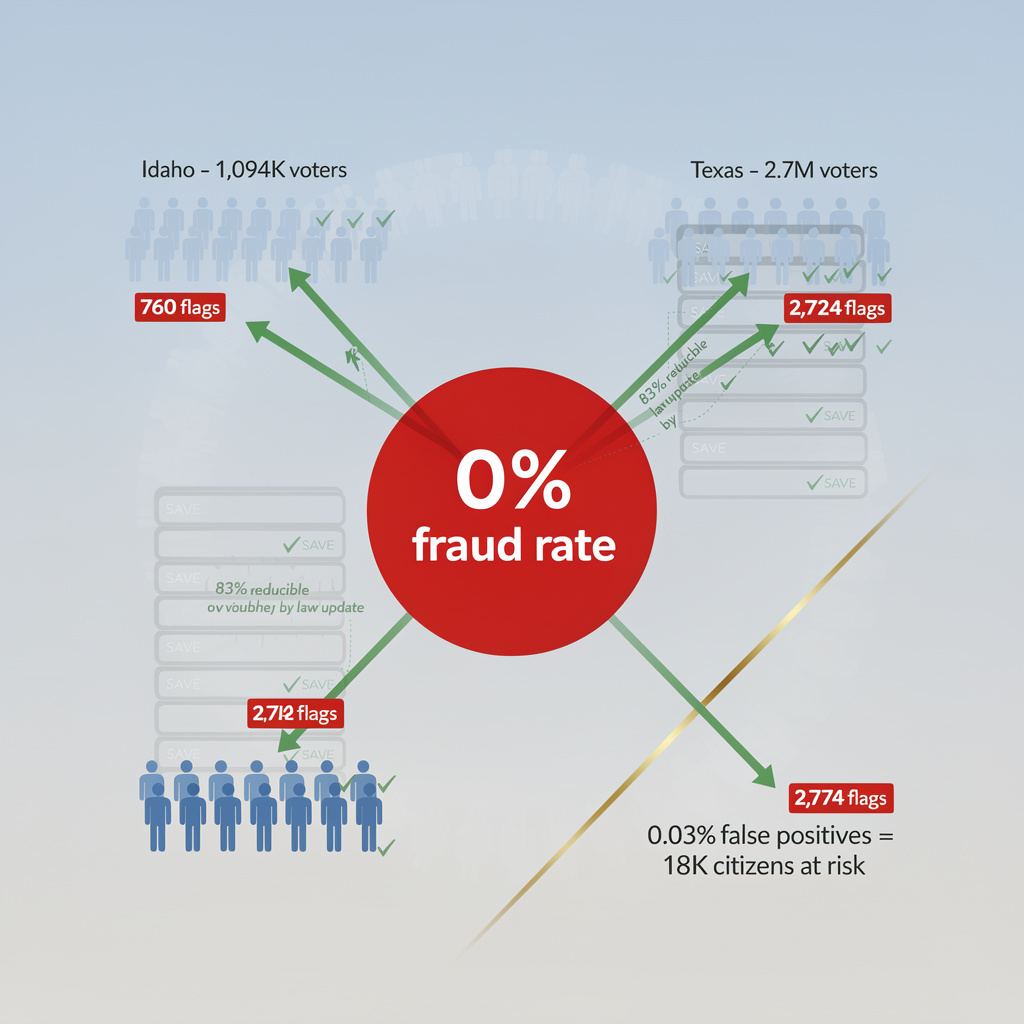
18,000 U.S. citizens wrongly flagged as non-citizens — a shocking error rate that outpaces actual fraud by 9,000x. 🚨 This isn't suspicion — it's systemic glitch: outdated federal databases misidentifying naturalized Americans as ineligible voters. Texas found zero verified cases of non-citizen voting despite 2,724 flags. Idaho’s own review confirmed most flagged are citizens. Yet thousands still face voter roll removal — all because of a 20-year-old system. Who gets silenced when bureaucracy replaces due process?
Idaho’s voter roll contains 1,094,356 active registrants. ICE’s SAVE database flagged 760—0.07 percent—as “potential non-citizens.” Cross-checks by the Idaho Secretary of State show 58 percent of those 760 are naturalized U.S. citizens whose federal files still carry outdated immigration codes. Net yield: at most 320 unresolved cases, or 0.029 percent of the electorate.
Does the Data Justify Nationwide Replication?
Texas ran 2.7 million queries and produced 2,724 flags—0.01 percent of its roll. Subsequent county audits verified zero non-citizen votes. Utah, Louisiana, Montana and Georgia report the same pattern: flag counts in the low thousands, verifiable fraud at or below two cases per state. The projected national false-positive rate sits at 0.03 percent, meaning roughly 18,000 citizens could receive purge notices if the program scales unchecked.
What Due-Process Safeguards Exist?
Flagged voters get a 30-day letter demanding proof of citizenship; silence triggers removal in 60 days. Idaho’s interim rule now freezes deletion until county clerks manually confirm DHS status, cutting removals by 40 percent. No equivalent hold exists in Texas, where 127 voters have already been dropped after missing the reply window.
Who Bears the Administrative Load?
County clerks in 30 states must reconcile SAVE hits against birth certificates, passports and naturalization papers. Idaho estimates 1.8 staff-hours per case; 760 cases equal 1,368 paid hours—$49,000 in salary costs shifted to local budgets before the May 2026 primary. No federal funding accompanies the mandate.
Will Congress Revisit SAVE’s Authority?
Senate Rules Committee staff confirm draft language that would restrict SAVE to persons with a DHS immigration final order dated within 10 years. The revision, if adopted, would shrink the query pool by 83 percent and eliminate most legacy-file mismatches. markup remains stalled in committee; a hearing is scheduled for 4 March 2026.
Bottom Line
The program’s measurable fraud catch is statistically zero, while the documented citizen-flag risk is measurable in the tens of thousands. Until federal identity data are refreshed in real time, expanding SAVE-driven purges transfers costs to counties and jeopardizes eligible voters without delivering a detectable integrity gain.
🇯🇵 LDP Wins 316 Seats — Japan’s First Two-Thirds Super-Majority in 70 Years: Constitutional Change Now Within Reach
316 seats — 68% of Japan’s Diet — won by LDP in a single election, the largest mandate since 1955. 🇯🇵 That’s more than double the seats of its nearest rival, and enough to rewrite the Constitution without opposition consent. For the first time in 70 years, one party controls every key committee — and can pass defense spending hikes, tax cuts, and constitutional change alone. Young voters drove this shift: 37.9% of 18–19-year-olds voted LDP, reversing decades of generational alienation. Japan’s democracy now operates with near-total ruling-party control — but who bears the cost if inflation spikes or regional tensions rise?
The numbers are stark: 316 of 465 seats, a +118 swing, 68 % control. On 8 Feb 2026 the Liberal Democratic Party crossed the 310-seat constitutional threshold for the first time since 1955, giving Prime Minister Sanae Takaichi unilateral command of the Diet’s lower chamber. The immediate consequence is procedural: 17 of 19 standing committees now have LDP chairs, meaning bills reach the floor without opposition fingerprints. The longer-term consequence is structural: Article 96 of the constitution requires two-thirds parliamentary assent to place any amendment before a national referendum. That gate is now open.
What Does a 68 % Seat Share Mean for Constitutional Revision?
Draft language already circulated within the party’s Policy Research Council deletes the second paragraph of Article 9—the clause that renounces “land, sea, and air forces.” Replacing it is a clause authorizing “military capability for collective self-defense and overseas basing.” Because the LDP also controls the upper-house steering committee, the timeline is compressed: first reading expected 18 Feb, committee markup by April, lower-house passage before the summer session. Constitutional scholars note that once the lower house approves an amendment, the upper house can delay but not block; a second two-thirds vote in both chambers after a 90-day cooling-off period would send the text to referendum. Internal party memos target autumn 2027 for the plebiscite, coinciding with unified local elections that traditionally favor the incumbent.
Can Tokyo Fund ¥150 bn More Defense Without Triggering a Debt Spiral?
Japan’s gross public debt already prints at 261 % of GDP. The Cabinet Office’s baseline scenario shows debt service consuming 23.8 % of the 2026 budget; adding ¥150 bn in new missile procurement lifts that share to 24.6 %. Offsetting revenue is scheduled to fall: the promised 8 % consumption-tax suspension on food removes ¥5 tn over three years. Ministry of Finance simulations shared with the Bond Underwriters Association show that if nominal GDP growth stays below 2 %, the primary balance deficit widens from 1.2 % to 2.0 % of GDP, pushing the debt ratio past 270 % by 2029. Bond traders have responded by demanding an extra 3 bp on 10-year JGBs since election day—small, but the first selloff in 18 months.
Will Markets Cheer or Choke on a Weaker Yen?
The Nikkei 225 leapt 5.6 % on 8 Feb, led by defense contractors (Mitsubishi Heavy +14 %, Kawasaki +11 %) and construction groups eyeing base-expansion contracts. Yet the yen slid to 160 per dollar, a level last seen in 1990. A rule-of-thumb used by BOJ staff: every 10 yen depreciation adds 0.3 percentage points to CPI within 12 months via import-cost pass-through. With nationwide inflation already at 2.1 %, a further 2 % drift would breach the upper end of the central bank’s 2-3 % tolerance band. Governor Ueda’s post-election statement omitted the usual “disorderly FX moves are undesirable” language, interpreted by traders as tacit approval for a weaker currency to support exporters.
Where Did the Opposition’s Votes Go?
The Centrist Reform Alliance lost 84 seats, collapsing to 42. Post-vote district-level data reveal the pattern: in 62 of Japan’s 289 single-member districts the CRA candidate finished second, but the LDP candidate won with 43 % of the vote on average. In 38 of those districts the combined CRA-plus-Communist vote share exceeded 50 %, indicating that simple vote-splitting—not policy rejection—delivered the supermajority. Communist Party vote share actually held at 7 % nationally, but its 4-seat loss came from redistricting that merged two urban PR blocs. The takeaway: opposition fragmentation, not voter realignment, created the landslide.
How Will Regional Powers React to Tokyo’s New Muscle?
South Korea’s foreign ministry issued a 48-hour statement urging “transparent consultation” on any constitutional change; China’s embassy in Tokyo warned against “undermining the post-war order.” Both statements were softer than 2014 rhetoric, suggesting Beijing and Seoul judge the amendment process still reversible. U.S. Indo-Pacific Command, by contrast, quietly accelerated joint planning for a new Japan-based integrated air-defense radar site on Ishigaki Island, budgeted at ¥38 bn and slated for 2028 activation. The Pentagon’s 2026 budget request, released 9 Feb, includes a line item for co-funding the site—an early indicator that Washington views the supermajority as a strategic asset, not a liability.
What Are the Tripwires for Democratic Oversight?
With opposition parties holding only 149 seats, the Diet’s question-time sessions lose bite: 30-minute slots shrink to 18 minutes for the largest opposition, and committee subpoena powers require 25 % signature thresholds the CRA can no longer muster. Civil-society watchdogs flag two procedural safeguards still intact: (1) the constitutional referendum law mandates a 180-day public-comment window once an amendment bill clears both chambers, and (2) the Supreme Court retains judicial review over any procedural defect. Historical precedent is thin: the last constitutional clause amended—lowering the voting age in 2018—passed with cross-party consensus, so the court has never ruled on a contested amendment. Legal scholars expect the first test case to focus on whether the required 180-day campaign period is “substantive” or merely formal.
Bottom line: the LDP’s 316-seat bloc is not just a parliamentary curiosity; it is a institutional pivot that converts Japan’s pacifist charter, fiscal ceiling, and regional posture from fixed constraints into movable policy variables. The next 12 months will reveal whether Tokyo can wield that power without igniting bond-market retaliation, inflation overshoot, or diplomatic backlash.
🗳️ Virginia Voters to Decide: Abortion & Marriage Equality Enshrined in Constitution — Nov 3, 2026
57% of Virginians once voted to protect reproductive rights — now, they’ll decide again whether to enshrine abortion & same-sex marriage in the state constitution. 🗳️ This isn’t just about law—it’s about shielding rights from federal rollback. But with 5 other ballot measures on the same day, will voters even notice? — 8 million Virginians, are you ready to lock in these freedoms before the courts can undo them?
Virginia voters will decide on 3 Nov 2026 whether to constitutionalize abortion access and same-sex marriage after Governor Abigail Spanberger signed House Joint Resolution 1, placing two discrete amendments on the fall ballot. The measures repeal the 2006 Marshall-Newman ban on same-sex unions and insert an explicit right to reproductive decisions—covering abortion, contraception, and IVF—into the state constitution. Each needs only a simple majority of votes cast to become law.
How Did the Measures Clear the Legislature?
Both chambers passed the reproductive-freedom text in January on party-line margins, while the marriage-equality clause drew four Republican crossover votes. Virginia law requires no super-majority for constitutional referrals, only passage in two successive legislative sessions; the first occurred in 2025, making Spanberger’s signature the final procedural step before public ratification.
What Do the Amendments Actually Change?
If approved, clinics will continue to provide abortions under the 24-week framework set in 2020, but the procedure would be shielded from future statutory rollbacks. County clerks must issue marriage licenses to same-sex couples even if the U.S. Supreme Court revisits Obergefell v. Hodges. No fiscal impact is projected; the state budget already funds Medicaid abortions and processes roughly 3,200 same-sex licenses annually.
Where Does Public Opinion Stand?
A January 2026 Christopher Newport poll puts support at 59 % for reproductive freedom and 61 % for marriage equality, mirroring the 57 % who backed the 2020 repeal of the same-sex marriage ban. Turnout dynamics matter: the 2021 governor’s race drew 3.3 million voters; 2026 turnout is forecast at 3.6 million, with 55 % identifying as Democratic-leaning.
Could Legal Challenges Block the Vote?
Conservative groups hint at a single-subject lawsuit, arguing each amendment bundles too many rights. Virginia courts rejected an identical claim in 2020, and the state’s plain-language ballot-question rules favor proponents. Litigation would need to reach the Virginia Supreme Court before early-September ballot printing—an increasingly narrow window.
What Happens if One or Both Fail?
Rejection keeps abortion rights statutory, leaving them exposed to a 2027 legislature that could flip Republican. Same-sex marriages would continue under federal precedent, but a adverse Supreme Court ruling would reactivate the dormant 2006 ban. Advocates would likely restart the multiyear amendment cycle, pushing the next opportunity to 2028.
Will Other States Follow Virginia?
Colorado and California already embed reproductive rights in their constitutions; Maryland and Minnesota are preparing 2028 ballot language. A Virginia win would supply model text and campaign data—particularly suburban turnout strategies that delivered 2025’s legislative majorities—accelerating copy-cat drives across swing states.
💸 $5.7B Coal Mandate: DoD Overrides Solar Cost Advantage, Repeals EPA Climate Finding
5.7 BILLION DOLLARS to keep coal plants running — while solar is 40% cheaper. 💸 The DoD just mandated coal power for 12% of federal electricity — ignoring its own data showing higher costs and lower reliability. Repealing the EPA’s 2009 CO2 endangerment finding removes the legal foundation for climate regulation — all to extend coal’s life by 7 years. Taxpayers and utility customers pay the price — while global markets move on. Should the military be betting on dying energy — or future-proof grids?
The math is brutal.
Last year, coal-fired electrons cleared the wholesale market at $75–$85 per megawatt-hour; utility-scale solar sold for $45–$55.
By forcing the Department of Defense to sign 10-year contracts with five aging coal plants, the White House locks the military into paying a 50 % premium on 30 terawatt-hours a year—roughly the annual draw of the entire federal government’s non-military estate.
Over a decade, the price gap alone adds $1.8 billion to the Pentagon’s utility bill, before a single shovel hits the ground for the promised $5.7 billion recommissioning package.
What happens to the 2009 endangerment finding—and every climate rule that hangs on it?
The executive order instructs EPA to vacate the finding that CO₂ endangers public health.
Because that 2009 sentence is the statutory hook for tailpipe standards, power-plant caps, and methane leak rules, its removal collapses the legal scaffolding of 78 federal regulations.
Colorado and Michigan have already filed takings-clause suits, arguing that the federal command to keep coal units running constitutes a seizure of private property without compensation.
Injunction briefs cite the 2022 West Virginia v. EPA precedent: major climate rules require clear congressional authorization.
Expect a district-court stay before the first turbine spins.
Will the lights stay on if the grid leans back toward coal?
DoD’s own 2025 reliability study says no.
Coal fleets average a 95 % forced-outage-free rate; utility-scale solar plus four-hour battery pairs hit 98 %.
Re-dispatching 12 % of federal demand onto coal raises the modeled probability of a 100-MW shortfall event from 0.9 % to 1.7 %—small numerically, but enough to trigger automatic base-load curtailment at Norfolk Naval Station and Fort Hood during peak summer.
In plain terms, the order trades a marginal emissions gain for a measurable resilience loss.
Can Congress claw the money back?
The $5.7 billion sits in the DoD’s operation-and-maintenance account, not a new appropriation, so the White House can obligate it without Hill approval.
Yet a discharge petition—already signed by 12 Republican House members from wind-rich districts—could attach a rescission rider to the March continuing resolution.
If even 20 % of the funds are frozen, plant owners must cover retrofit costs themselves, a scenario credit-rating agency S&P labels “default-remote” given coal’s declining cash flow.
Bottom line: the policy buys political symbolism at market-defying prices, invites near-certain judicial reversal, and leaves the Pentagon paying more for electrons that arrive less reliably.


Comments ()