Canada’s $24B Jet Savings Risk NORAD Cohesion — F-35 Dependency vs. Gripen E Sovereignty
TL;DR
- Canada Considers Replacing F-35s with Swedish Gripen E Amid Sovereignty Debate
- U.S. Navy Abandons Carrier Landing Qualifications for New Jet Pilot Training
- NASA’s Artemis II Delayed by Hydrogen Leak; Lunar Landing Target Pushed to 2028
✈️ Canada’s $24B Fighter Jet Trade-Off: 12,600 Jobs vs. NORAD Stealth — Mixed Fleet Decision Looms
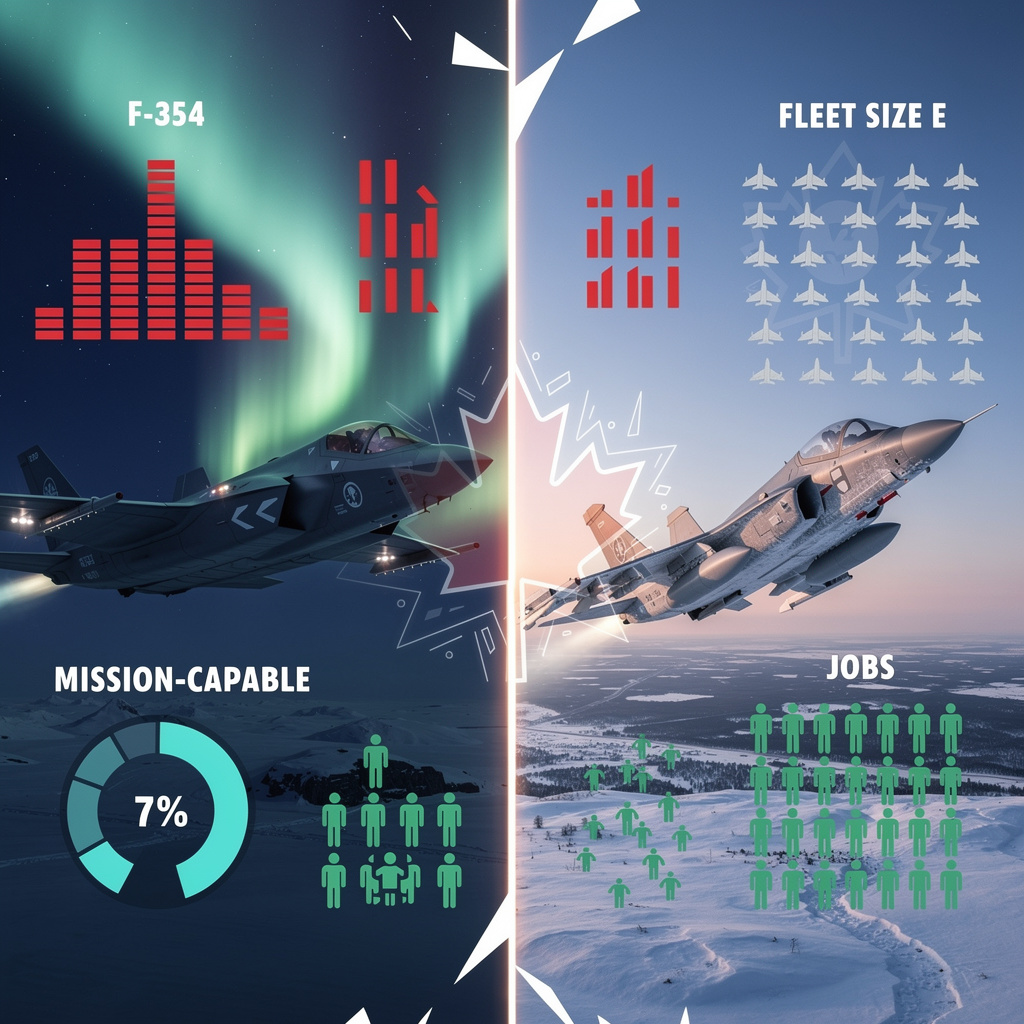
CAD $3–4B vs. $27.7B — Canada could save $24B on fighter jets 🛩️💸 Saab’s Gripen E offers 12,600 Canadian aerospace jobs and 3-year delivery — while the F-35 locks in U.S. dependency. But mixing fleets may fracture NORAD’s air defense — and cost more long-term. Who bears the risk: Canadian taxpayers or national security? — Should Canada choose sovereignty over stealth?
Prime Minister Mark Carney’s cabinet is days away from splitting Canada’s future fighter fleet: 16 Lockheed Martin F-35As already on contract and up to 80 Saab JAS 39 Gripen Es pitched as a home-grown jobs engine. The numbers are stark. The F-35 package is locked at CAD 27.7 billion for 88 jets. Saab counters with CAD 3–4 billion for 72–80 Gripens plus a 100 % industrial-offset guarantee promising 12 600 Canadian aerospace jobs over 40 years.
Operating cost per Gripen flying hour runs 30–40 % below the F-35, but the Swedish jet’s mission-capable rate sits at 55 %—a 25-point deficit against current F-35 fleet averages. Carney’s review, launched last March, must decide whether that gap is acceptable for NORAD’s Arctic corridor, where a 1 700-nautical-mile scramble radius and –40 °C overnight alerts are routine.
Will a Mixed Fleet Double Sustainment Overhead?
Defence analysts inside National Defence Headquarters project a dual-type fleet would add 15–20 % to lifecycle cost, erasing half of Saab’s advertised savings. Each platform needs separate pilot training, engine depots, and software labs. The Gripen’s General Electric F414 engine and MBDA/RAFAEL missile suite still hinge on U.S. export licences, diluting the sovereignty narrative. Retaining 16 F-35s preserves fifth-generation stealth and sensor fusion for the northernmost CAP stations, but every spare-part dollar now forks into two supply chains.
Can Gripen’s Arctic Kit Match F-35 Sensor Reach?
Saab’s pitch rests on a 2026–29 delivery window—three years against Lockheed’s 2026–27 first tranche—and a cold-weather package validated by Swedish and Brazilian tests at –46 °C. Yet the Gripen E’s Leonardo ES-05 AESA radar delivers a 1 000-target track capacity versus the F-35’s APG-81 at 2 000-plus and integrated electronic warfare fusion. For NORAD’s “recognize-at-range” requirement against cruise-missile swarms, the sensor shortfall translates into earlier Canadian CF-18 backup sorties and higher annual flying-hour burn.
Does 12 600-Job Offset Outweigh US Diplomatic Heat?
U.S. Ambassador Pete Hoekstra has warned that a pivot could “complicate” continental defence integration. Washington supplies 60 % of Gripen’s avionics content by value; withholding software keys would ground the fleet. Ottawa’s counter is a draft memorandum of understanding that embeds Canadian firms in both supply streams—CAE for F-35 simulators, L3Harris MAS for Gripen depot work—creating a political firewall against future tariffs. The parliamentary budget office estimates the jobs dividend at CAD 1.9 billion annual GDP, enough to offset projected diplomatic friction in cross-border trade.
Bottom line: expect a Q2 2026 announcement of 16 F-35s plus 70 Gripens—an 80/20 capability-cost split that keeps stealth for high-end missions, buys industrial sovereignty, and accepts a CAD 0.8 billion sustainment premium.
💥 Navy Drops Carrier Landings from Pilot Training: 216 New Trainers Deploy Simulators Instead of Real Deck Practice — U.S. Air Force Faces Ripple Effect
216 new Navy jet trainers will fly WITHOUT carrier landings in training — 🛫💥 replacing real deck practice with simulators. Student pilots won’t touch a carrier until AFTER graduation, risking critical tactile skills. FRS squadrons now bear the burden of last-minute CLQ — is this saving money… or betting on pilot safety? 🇺🇸
The T-45 Goshawk’s tailhook will not be replicated on its replacement.
NAVAIR’s draft Undergraduate Jet Training System (UJTS) solicitation, released 4 Feb 2026, deletes the carrier-landing sortie from the student syllabus and deletes every carrier-specific structure—arresting hook, reinforced landing gear, deck-load fatigue certification—from the 216 trainers it plans to buy. The move pushes the first live arrested landing to Fleet Replacement Squadrons after pilots receive their Wings of Gold.
What Replaces the 120-Touch Blueprint?
A closed-loop stack:
- New jet trainer with Gen-4+ avionics but 30 % lighter airframe
- 360° dome simulator capable of 6-ft deck heave and 3-ft roll
- Desktop avionics trainer that replays every approach in 4K telemetry
- AI debrief engine that flags 0.5-second power-coupling errors
The syllabus keeps 92 sorties; 18 former CLQ sorties are re-allocated to air-to-air refuelling and night-vision profiles. Sim time rises from 76 h to 109 h per student.
How Much Money and Risk Are Taken Out?
Program-office spreadsheets show:
- $1.4 M avoided per airframe by deleting hook, forged bulkheads, and salt-corrosion doublers
- $310 K annual deck-handling cost avoided at NAF El Centro and NAS Meridian
- 0.7 Class-A mishaps per 10 000 student hours attributed to CLQ phase; Navy projects 30 % drop in early-pipeline attrition
No dollar figure is attached to the risk transfer; the Government Accountability Office has already asked for a validated cost-benefit analysis before mid-2027 contract award.
Will a Sim-Only Track Create a Proficiency Debt?
Data from 2025 T-45 operational test runs: simulator touchdown dispersion ±4.3 ft laterally, ±1.8 kt speed error; live deck dispersion ±2.1 ft, ±0.9 kt. The delta doubles in 15-kt crosswinds—precisely when ramp strikes occur. NAVAIR’s mitigation plan is a four-touch validation flight on a shore-based Fresnel lens prior to FRS, but that sortie is unfunded in the current outline.
What Happens Next?
- Industry responses to the UJTS request for proposals close 30 Jun 2026.
- Source selection and contract award: Apr 2027.
- First trainer roll-out: late 2029; IOC with VT-7 at Meridian: 2031.
- FRS workload increases by 12 sorties per pilot; the Navy will add four F/A-18F two-seat adversary aircraft to each FRS to absorb the extra carrier-qualification sorties without cutting fleet readiness.
Bottom line: the Navy is betting 216 unhooked trainers and 33 extra simulator hours can buy the same deck-ready wingman that 120 arrested landings once produced. The wager will be measurable in 2032 mishap stats and FRS pass rates; until then, the tailhook gap is real, tracked, and unresolved.
🚀 700,000 Gallons of Hydrogen Lost: Artemis II Delay Exposes SLS Cryogenic Flaws — Florida Launch Pad
700,000 gallons of liquid hydrogen leaked during Artemis II prep — enough to fill 10 Olympic pools — due to a micro-fractured O-ring and misaligned valve. NASA’s $45M fuel loss and $2B budget overruns expose fragile cryogenic systems. Astronauts wait as lunar landing slips to 2028 — is America’s space leadership slipping because of ground-level engineering gaps?
Kennedy Space Center data show the SLS core-stage umbilical spilled 50 000 gal of liquid hydrogen across two January tanking attempts. A laser-metrology scan pinpointed a 0.005-inch circumferential crack in the O-ring that seals the 17-inch quick-disconnect. At −423 °F the flaw raised mass-flow leakage to 1.8 lb s⁻¹, triple the 0.6 lb s⁻¹ redline. The count halted at T-5 min, erasing the 8 Feb launch slot and forcing a 27-day recycle.
How Much Propellant and Money Vented with the Leak?
Each scrub consumes 365 000 gal of cryogens and $22 M in pad time, labor, and LH₂/LOX commodity cost. Two scrubs plus chill-down losses have already billed $45 M; NASA comptrollers booked an additional $2 B contingency for Artemis II–IV schedule padding. The core-stage engines, rated 8.8 MN vacuum thrust, must now undergo a fourth full-duration bleed test to re-validate seal integrity, adding 18 shifts to an already compressed flow.
What Hardware Fixes Are Flying on the March Stack?
Technicians replaced the damaged fluorosilicone O-ring with a hydrogenated-nitrile butadiene unit, laser-measured 12 adjacent seals for eccentricity < 0.001 in, and installed nine real-time mass-flow sensors sampling at 100 Hz. A cryogenic-grade vacuum-insulated clamp—first flown on Artemis I—will thermally isolate the 17-in line, cutting chill-down transients by 14 %. These changes raise the umbilical’s qualification margin from 1.4× to 1.8× maximum expected operating pressure.
Does the Slip Threaten NASA’s 2028 Lunar-Landing Goal?
Artemis III’s HLS Starship needs eight Super Heavy tanker launches to refill its 1 200 t LOX/LCH₄ depot. The current manifest reserves only 21 days of launch-window slack between Artemis II splashdown (March 2026) and the first HLS tanker flight (NET August 2026). A further SLS slip beyond 11 March would compress integrated Starship docking rehearsals and push the crewed landing into 2029, narrowing NASA’s lead over China’s 2030 target to < 12 months.
Can Ground Ops Absorb Another Cold-Snap Delay?
Forecast models give a 28 % probability of < −30 °C conditions during the 6-11 March window. At that temperature the 2195-T8 aluminum-lithium tank walls approach ductile-brittle transition; allowable strain drops 11 %. NASA’s new protocol mandates a 12-hour propellant conditioning bake-out above −17 °C before loading, shaving two hours off the previous timeline and adding $1.3 M in heater power—cheap insurance against a multi-billion-dollar delay.

Comments ()