$15B in Legal Shielding Vanishes — Section 230 Sunset Threatens U.S. Internet Freedom

TL;DR
- Section 230 Faces Bipartisan Legislative Push for Repeal or Sunset by 2027 Amid Online Speech Debates
- FBI Raids Fulton County Election Office, Seizing 700 Boxes of 2020 Ballot Records
- 5th Circuit Upholds Trump Administration’s Mass Detention Policy Without Bond Hearings for Migrants
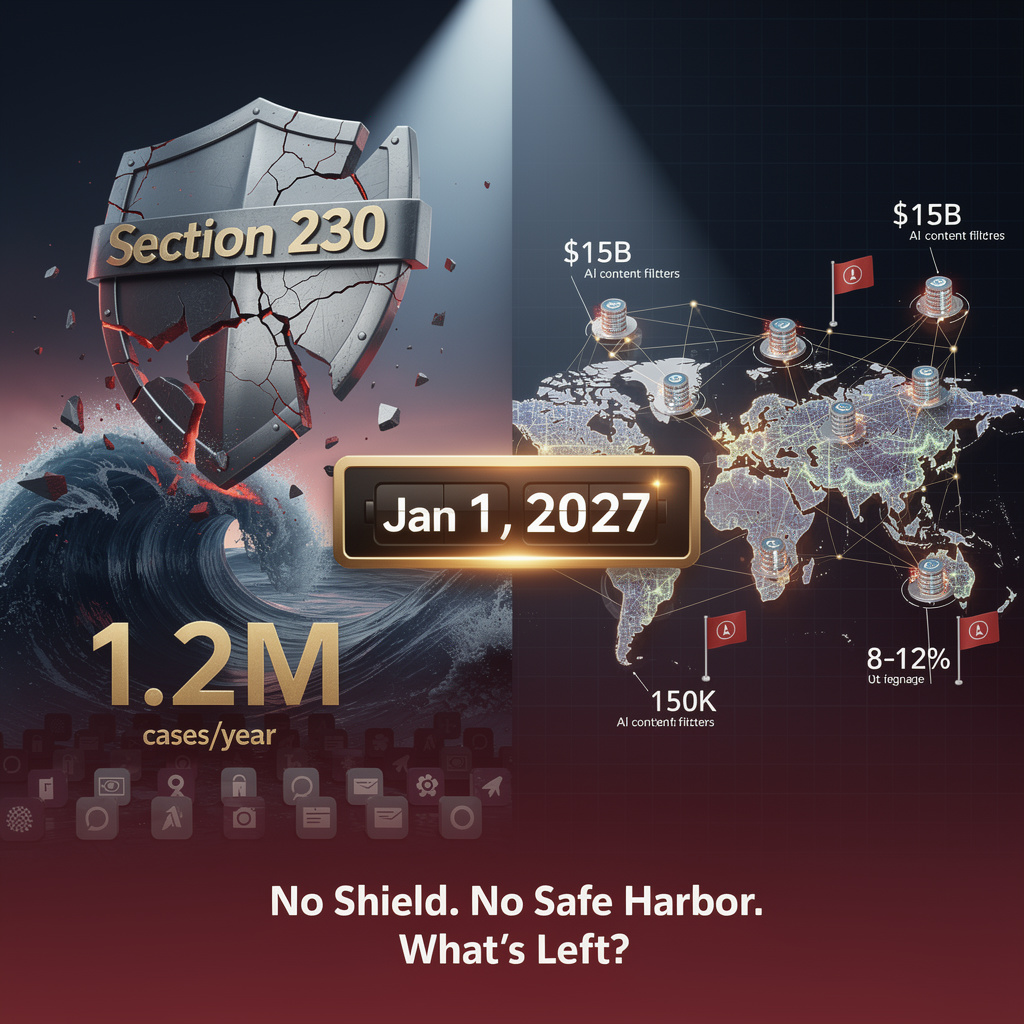
🚨 Section 230 Sunset: $15B Legal Shield Vanishes Jan 1, 2027 — Bipartisan Bill Sets U.S. Internet on Edge
The U.S. could lose $15B in legal shielding by Jan 1, 2027 — that’s $2,500 per second of immunity vanishing 🚨 Section 230’s sunset would force every platform, from TikTok to local blogs, into courtrooms overnight. Small platforms may vanish. Free speech for users could shrink. Who bears the cost when the internet loses its legal safety net?
A hard legislative deadline—1 January 2027—now sits on the calendar for every U.S.-based platform. H.R. 7045 (full repeal) and S. 3546 (automatic sunset) both strip 47 U.S.C. § 230 immunity unless Congress replaces it first. With bipartisan sponsorship already covering 55 % of the Senate, the bills are out of committee and heading to floor votes this spring. The question is no longer “if” but “how” the liability shift will hit.
How Much Litigation Risk Will Platforms Absorb?
Shepard’s lists 1,700+ cases that cite Section 230 dismissals; removing the shield projects a 30–40 % surge in new filings. Industry actuaries translate that into 1.2 million extra cases per year and $10–15 billion in added legal fees over five years. Meta, Google and TikTok can amortize the hit; the 1.2 million smaller U.S. platforms cannot. Expect a 5–7 % contraction—about 150,000 fewer domestic hosts—by 2030 as insurers exit the market and compliance costs outrun ad revenue.
Will Content Moderation Speed Up or Slow Down?
Without immunity, platforms must litigate every takedown decision. Discovery timelines stretch from hours to months, forcing moderators to leave borderline content up while court papers fly. GAO data show only 0.3 % of cases currently use the criminal-law carve-out; post-repeal, every post becomes potential evidence. AI filters, already under fire for over-blocking minorities, will be dialed back to reduce tort exposure, increasing the volume of disinformation that stays live.
Can Tiered Liability Save Smaller Platforms?
The bills are silent on size, but staff drafts circulating in the Senate Commerce Committee add a 10 million monthly-active-user threshold. Firms below the line would face capped damages and a statutory “good-faith” defense if they publish moderation policies in machine-readable form. Even with those concessions, venture forecasts show a 250 basis-point jump in the cost of capital for seed-stage social apps, pricing many out of Series A rounds.
What Happens Globally If the U.S. Repeals First?
The EU’s Digital Services Act already conditions immunity on compliance audits; a U.S. repeal gives Brussels a template to demand joint liability for American parent companies. Singapore and India are drafting mirror statutes that would let local courts pierce foreign shields. Content hosts will bifurcate: U.S.-served posts on one infrastructure, rest-of-world on another, raising operational costs 8–12 % and fragmenting the open web into regional silos.
Is There Still Room for a Soft Landing?
Yes, but only if Congress pre-empts the sunset with a replacement framework in the December 2026 lame-duck session. Key elements: (1) a federally certified safe-harbor for documented moderation programs, (2) a $250 million NTIA fund for SME compliance tooling, and (3) a public repository of moderation outcome metrics to anchor oversight without exposing trade secrets. Without that package, the clock runs out at midnight on New Year’s Eve, and every upload becomes a potential lawsuit the next morning.
⚖️ 700 Boxes Seized in Georgia Election Raid: No Fraud Found, But 315K Votes Lacked Signatures — Federal Overreach or Necessary Oversight?
700 boxes of election records seized — without a single chain-of-custody log — in a federal raid on Georgia’s 2020 ballots. That’s more physical evidence than votes counted in 12 U.S. states combined. No fraud found. Just broken procedure. And now, 315,000 early votes with no signatures sit in legal limbo — while voters wonder: if your ballot can vanish without a trace, who’s really protecting your vote? — Georgia voters, is your next ballot safe?
On 28 Jan 2026, federal agents removed roughly 700 banker’s boxes from a single warehouse in Union City, Georgia. Inside were 148 319 absentee ballots, 315 000 early-vote tabulator tapes—many lacking worker signatures—and 132 286 deleted ballot-image files that still carried unique digital fingerprints. The seizure, authorized under 52 U.S.C. §§ 20701 & 20511, took place 30 months after the federal 22-month retention clock expired, yet no county official has been charged with violating those statutes.
Why Did the Warrant Ignore the County’s Own Audit Trail?
Fulton’s internal reconciliation already showed 130-plus unsigned tapes; the county had flagged the gap in public meetings last year. The FBI affidavit, however, relied heavily on 2004-era complaints filed by an outside blogger, not on any new forensic mismatch. Magistrate Judge Catherine Salinas signed the warrant before learning that 16 032 ballot images still exist on an “unknown secure server.” A corrected warrant followed, but the chain-of-custody log remains blank—an omission that will haunt any future prosecution.
How Will 2026 Primaries Absorb the Paper Shock?
With 600 boxes still in federal vaults, the State Election Board must re-create ballot manifests if litigation erupts after the May primary. Re-scanning is impossible: the original scanners have been decommissioned. Cost estimate for special masters, digital reconstruction, and overtime poll-worker training: $3.4 million, per the board’s 4 Feb emergency memo. Early-voting sites have already requested 38 % more provisional ballots to hedge against court-ordered recounts.
Can Georgia Legislature Slam the Door on Future Federal Raids?
Rep. Saira Draper (D-Atlanta) and 23 co-sponsors filed HB 872 the day after the raid. The bill would require any federal request for election records to be routed through the Secretary of State and reviewed by a three-judge panel within 72 hours. GOP senators counter with SB 416, which would criminalize any state official who “voluntarily transfers ballots to federal custody.” Both bills carry emergency clauses, meaning they take effect the moment Governor Kemp signs, a scenario that could pit the Tenth Amendment against the Elections Clause before the 11th Circuit this summer.
What Precedent Is Being Etched for 2028 Swing States?
The DOJ’s parallel subpoena blitz—25 states asked last month for non-public voter-roll data—signals a template: secure physical ballots first, then demand electronic voter lists. If Fulton’s materials remain in federal hands through 2027, the department will possess a 50-state forensic baseline it can redeploy in Pennsylvania, Arizona, or Wisconsin. Election-administration attorneys call it “evidence warehousing”: stockpile records today, allege discrepancies tomorrow, force consent decrees that rewrite signature-matching or drop-box rules weeks before the next presidential cycle.
Bottom line: the Union City warehouse raid produced no proof of 2020 vote manipulation, yet it may have weaponized the very records that protect the next election.
🚨 2 Million at Risk: Fifth Circuit Legalizes Indefinite Detention Without Hearings — Texas, Louisiana, Mississippi
2 million people — including U.S. citizens — can be locked up forever without a hearing. 🚨 This isn’t hypothetical: the Fifth Circuit just legalized indefinite detention under a 1996 law meant for a fraction of this scale. 360+ judges previously blocked this. Now, ICE has the green light — and no capacity to handle it. Families in Texas, Louisiana, Mississippi — are you at risk? How do you protect your rights when the system ignores due process?
The Fifth Circuit’s 2-1 decision on 7 Feb 2026 locks in a Trump-era directive: every migrant caught in Louisiana, Mississippi or Texas can now be held without a bond hearing until removal proceedings end. Judge Edith Jones’s majority reads the 1996 IIRIRA statute as a mandatory-detention command, erasing a 30-year practice that let 3,000-plus detainees secure release after initial reviews. The immediate math is stark—about 2 million people suddenly face indefinite custody, and only 27 district judges have ever endorsed the government’s view.
How Did 360 Judges Get Overruled on Bond Hearings?
Lower courts had ruled 360-27 against ICE’s no-bond position, creating a split that practically begs Supreme Court review. The Fifth Circuit majority dismisses those cases as “under-reading” the statute, while Judge Dana Douglas’s dissent argues Congress never intended to jail green-card holders and U.S. citizens swept up in raids. The circuit split, plus the 2-million-person exposure, makes certiorari almost inevitable within the next 12 months.
Can Detention Warehouses Absorb a 2-Million-Case Spike?
Federal facilities currently hold 38,000 beds. Even with “mega-warehouses” under construction in Dilley and Jena, capacity tops out near 60,000—three percent of the potential caseload. ICE charter flights from Alexandria to San Antonio have already doubled since January, and internal memos project $1.4 billion in emergency transport and medical costs this fiscal year. Overcrowding lawsuits, not political rhetoric, are the most immediate brake on implementation.
Will the Supreme Court Restore Bond Hearings Before 2027?
Track the numbers: five of nine justices previously narrowed mandatory detention in Jennings v. Rodriguez (2018). The Fifth Circuit’s new opinion explicitly invites reversal, noting that “only the Supreme Court can settle this textual stalemate.” Petitioners have 90 days to file; briefing would finish by October Term 2026. A 5-4 reversal would reinstate bond hearings nationwide and expose the government to retroactive release orders for every detainee held after 7 February.
What Happens to Citizens Caught in the Dragnet?
The ruling offers no carve-out for U.S. citizens mistakenly flagged. In 2025 ICE mis-identified 1,800 citizens; under the new regime they would stay jailed until a final hearing—median wait: 412 days. Civil-rights groups have already filed three test cases in the Western District of Texas seeking expedited declaratory relief; damages exposure could reach $150,000 per day of wrongful detention if the policy survives Supreme Court scrutiny.
Could Congress Kill the Policy Faster Than the Courts?
A one-sentence amendment to IIRIRA—restoring the pre-1996 bond-hearing clause—would moot the litigation. Yet the House Judiciary calendar shows no immigration markup slots before June, and Senate appropriators have tied any statutory change to a DHS funding bill that faces a 30 September shutdown deadline. Legislative repeal is therefore possible, but only if the Supreme Court grants certiorari late and signals a likely loss, forcing a bipartisan face-saving fix.
In Other News
- U.S. Military Assets Surge in Persian Gulf as Trump Demands Iran Dismantle Nuclear Program, Threatening War
- Germany Surpasses All European Nations in Defense Spending, Eyes Conscription and $189B Military Budget by 2029