300 FPV Drones Per Day — 98% Cost Cut in Air Training — U.S. Military Shifts to AI-Driven Threat Simulation
TL;DR
- Saab to Deploy FPV Drones for Pilot Training and Air Defense Simulation, DSCA Investigates
- TSA Deploys 15 New CT Scanners at Major U.S. Airports by End of 2026
✈️ 300 FPV Drones/Day — 98% Cost Cut in Air Defense Training — DSCA Investigates Saab’s Rapid Scale-Up in U.S. and Europe
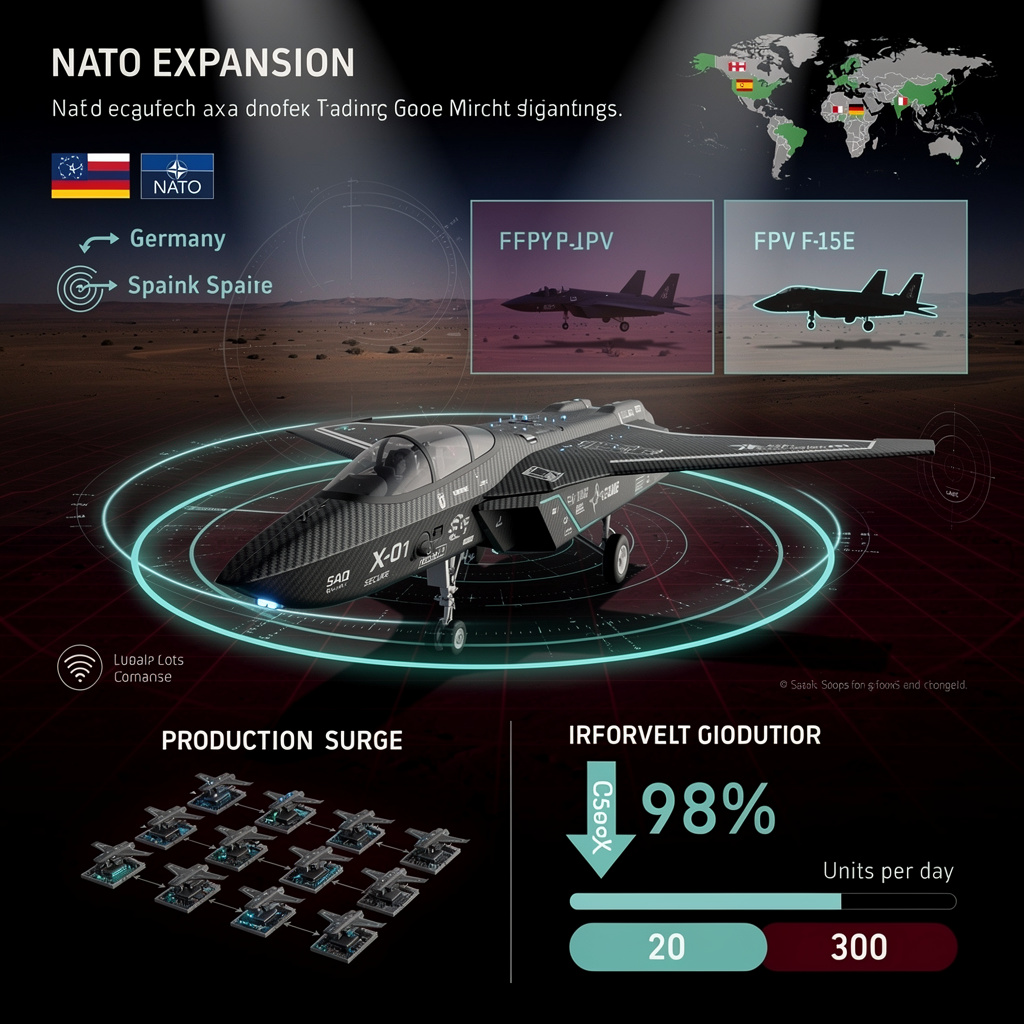
300 FPV DRONES PER DAY — 98% CHEAPER THAN MANNED TRAINING SORTIES. That’s 1 drone every 2.9 seconds, replacing $200K F-15 sorties with $4K drones that mimic enemy threats in real-time. U.S. Air Force and Marine Corps are now training 120+ hours per pilot using these autonomous simulators — no live jets needed. But DSCA just launched a probe: is this rapid scaling safe? — Who’s flying the future of air defense: you, your nation, or the algorithm?
Saab’s FPV drones replicate the radar and infrared signature of an F-15E, letting ground-based air-defense crews lock, track, and “fire” without burning flight hours on a manned jet. One 30-minute drone mission costs 98 percent less than a live Blue-on-Red training sortie and can be repeated six times in a morning.
Why is DSCA auditing a Swedish firm inside U.S. ranges?
The Defense Security Cooperation Agency licenses every foreign article that enters American military pipelines. Saab ramped output from 20 to 300 airframes a day in six months; DSCA wants proof that each carbon-fiber hull, flight controller and encryption chip is export-controlled, ITAR-classified and traceable down to the 3-D-printed nozzle.
Can 300 drones a day stay airworthy under live fire?
Quantico and Camp Pendleton already recorded near-misses with Marine Neros Archer drones during 2025 exercises. Saab now embeds dual-redundant C2 links and GPS geofences; a safety audit due in March will decide whether the line can stay above 250 units daily. Failure would freeze deliveries slated for Alaska’s winter air-defense rotation.
What happens after the U.S. signs off?
Germany and Spain have submitted FMS requests for 1,200 drones each. If DSCA issues a limited production license this spring, Saab’s Trollhättan plant will add a second shift, pushing annual output past 100,000—enough to standardize NATO’s entire short-range air-defense training catalog by 2027.
🛫 3.5% More Threats Detected: AI-Powered CT Scanners Roll Out Nationwide by April 2026 — TSA Mandates End of Legacy X-Ray Systems
3.5% MORE THREATS DETECTED — U.S. AIRPORTS NOW SCAN BAGS IN 3D WITH AI. THAT’S LIKE FINDING 1 EXTRA BOMB IN EVERY 28 CARRY-ONS. 🛫
Despite 10.4M travelers screened last weekend, wait times didn’t rise — thanks to AI that flags threats in under 1 second. Legacy 2D X-rays missed non-metallic explosives. Now, they’re being phased out by April 2026 — nationwide.
Travelers: Are you ready for AI to decide what’s dangerous in your bag?
No. TSA’s first 15 AI-driven computed-tomography (CT) units—eight at John F. Kennedy International and seven at Washington-Dulles—reconstruct 720 frames per 360° rotation, delivering a full volumetric view of every carry-on in under one second. Field data from Las Vegas and Baltimore show median lane times hold at 4 min 50 s, identical to legacy 2-D X-ray lanes, because the algorithm flags threats faster than a human screener can open a bag.
What Can the New Scanners See That Old Machines Miss?
Non-metallic explosives, sheet explosives, and deeply stacked lithium batteries. Legacy dual-view X-ray loses contrast after 8 cm of luggage depth; CT retains 0.2 mm voxel resolution through 35 cm, pushing detection probability for non-metallic threats up 30-40 %. A 5 % drop in false-positive “sunscreen bag pulls” saves an estimated 2.3 labor-hours per lane per day.
How Fast Must TSA Roll Out the Remaining 400-Plus Units?
April 2026 statutory deadline leaves 14 months to equip ~430 commercial airports. Procurement pace must average 1.4 scanners per airport—roughly 30 installations per week—starting this summer. $1 B in cumulative federal funding since 2001 covers hardware; a $45 ConfirmID security fee offsets operator training and maintenance.
Could AI Bias Let a Threat Slip Through?
TSA’s current model is trained on 2.8 million domestic threat signatures. Adversarial red-team tests every 90 days inject novel concealment methods; missed-item rate target is <0.3 %. If drift appears, cloud-based model updates push overnight without lane downtime.
Will Travelers Notice Any Change at the Checkpoint?
Electronics and liquids stay inside the bag, so bin demand falls 15 %. Belt speed remains 0.2 m s⁻¹; only the image viewer changes. At LAS Trial Gate D3, passenger satisfaction rose 8 % once signage explained the “leave it in” rule.
Are Smaller Airports Getting Left Behind?
No. Secondary hubs—Boise, Spokane, Manchester—are scheduled for Q3-Q4 2026 deliveries under the same procurement contract, ensuring a uniform 3-D baseline nationwide before the 2027 summer travel surge.
In Other News
- Ukraine Recovers and Reuses Russian Shahed Drone Engines Amid Sustained Drone Warfare
- US Air Force Extends F-16 Fighting Falcon Service Life to 2040 with SLEP
- Blue Origin Halts New Shepard Flights Amid Strategic Shift to Lunar and Space Industry Focus
- U.S. Navy Deploys Hypersonic CPS System on USS Zumwalt, Replacing Guns with Global Strike Capability
- U.S. Navy’s HELIOS laser system successfully shoots down four drones in combat test


Comments ()