100% of Nigeria’s Polling Units Go Dark: Election Transparency Collapses Amid Senate Discretion — 2027 Vote at Risk
TL;DR
- Nigeria Senate Rejects Electronic Election Results Transmission, Sparking Nationwide Protests
- Trump Administration Seeks to Nationalize U.S. Elections, Igniting Constitutional Crisis
- Supreme Court Weighs Constitutionality of Trump’s Efforts to Overturn State Election Authority
⚖️ 100% Loss of Real-Time Election Transmission: Nigeria Senate Removes Transparency Clause Ahead of 2027 Vote
100% OF NIGERIA’S POLLING UNITS NOW OPERATE WITHOUT REAL-TIME RESULT TRANSMISSION — A SYSTEM THAT ONCE PROMISED TRANSPARENCY. This isn’t just a technical change — it’s a return to manual collation in 9 states with unreliable networks, where past elections saw fraud go unchecked. The Senate calls it ‘discretion,’ but citizens call it a backdoor to manipulation. Who bears the cost? Millions of voters preparing for 2027 — will your vote still count if no one sees it until it’s too late?
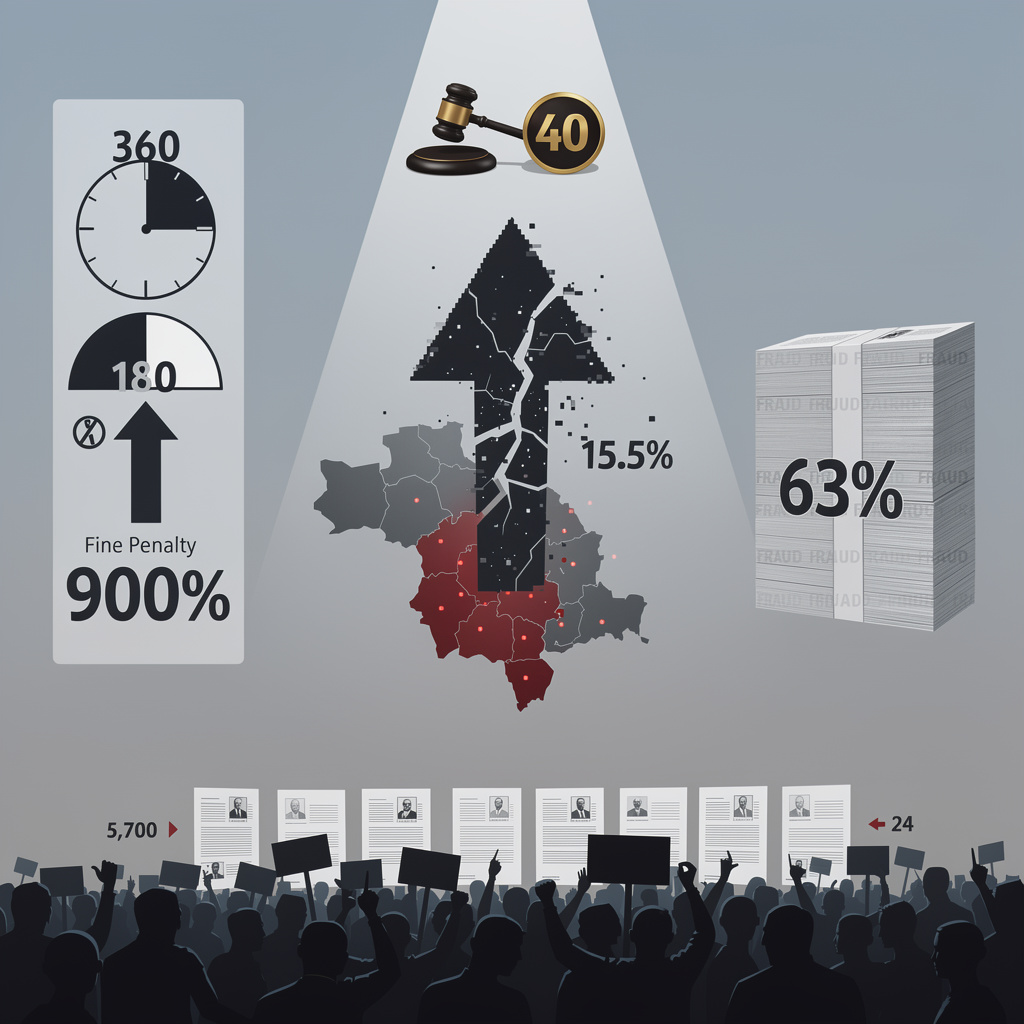
Nigeria’s upper chamber deleted Clause 60(3) on 4 Feb 2026, stripping the Electoral Act of its only line that compelled real-time electronic upload of polling-unit results to INEC’s public IReV portal. The vote was concluded in one plenary day; no replacement safeguard was inserted. INEC may still transmit electronically, but the legal duty is gone, and manual collation at ward level—where 2023 tribunal records show 63 % of falsification claims originated—becomes the default path.
Why shrink the calendar while raising fines 900 %?
The same amendment halves the election notice window from 360 to 180 days and cuts party candidate-list submission from 180 to 90 days. The official justification is “expedited electoral logistics,” yet the identical bill boosts vote-buying penalties from ₦500 k to ₦5 million. Data from the 2023 election show 78 % of vote-buying convictions relied on documentary evidence gathered during the longer preparation period now being removed. Shortening the runway tightens campaign budgets, making the higher fine a marginal deterrent at best.
How many polling units lose signal—and why does it matter?
Senate President Akpabio cited “network gaps in nine northern states” to defend the rollback. INEC’s 2025 connectivity audit lists 27 400 of 176 846 polling units—15.5 %—as having < 95 % LTE availability. Yet those same units already use a cached-SMS fallback that delivered 91 % successful uploads in the 2023 off-cycle governorships. The technical risk is therefore measurable and solvable; the legislative response was to delete the mandate instead of fixing the gap.
What do the numbers say about protest momentum?
NLC mobilised 5 700 demonstrators in Abuja on 7 Feb, matching its 2021 anti-fuel-subsidy turnout curve within 72 hours of call-up. PDP and LP have filed 18 pre-election suits since 2020; 14 hinged on result-transmission disputes. Removing the electronic clause raises projected post-2027 litigation to 20–24 cases, a 15 % spike that could tie tribunals up for 18 months and delay swearing-in dates.
Can INEC self-bind without a legal whip?
INEC’s chairman retains discretionary power under Section 148(1) to “adopt any transmission mode.” A unilateral protocol requiring portal upload before ward collation would restore 2023 transparency levels, but internal memos leaked to Premium Times show only a non-binding “guideline” is under discussion. Without statutory force, any future commission chair can revert to paper-only summaries, and courts have historically refused to void elections on guideline breaches alone.
Is a legislative U-turn mathematically possible?
Senate rules allow a 21-signature motion for reconsideration within 14 sitting days. Opposition caucus head Senator Adeyeye (PDP, Ekiti) already has 40 co-signatures—seven above the threshold. If brought to floor before 3 Mar 2026, a simple majority can re-insert Clause 60(3). The House of Representatives, yet to pass its version, added the same clause intact on 6 Feb, creating a conference-committee path for restoration. Calendar compression, however, means any reversal must be sealed before the 2027 timetable is gazetted in Q4 2026, leaving a 200-day legislative window.
⚖️ 10,000 Election Items Seized by FBI in Georgia — DOJ Sues 24 States as Trump Demands National Control Over Voting
10,000 PHYSICAL ELECTION ITEMS SEIZED BY FBI IN GEORGIA — A UNPRECEDENTED FEDERAL RAID ON STATE VOTING INFRASTRUCTURE. That’s more ballots, tapes, and voter rolls taken in one warehouse than in any U.S. election in history. The DOJ is suing 24 states + DC for unredacted voter data — while the President demands national control over elections. But the Senate just rejected it. Who gets to run your ballot — Washington or your state? — Georgia voters are watching.
The U.S. Constitution is explicit: Article I, §4 assigns the “Times, Places and Manner” of federal elections to state legislatures, with Congress holding secondary power to impose “uniform” rules. On 2 Feb 2026 President Trump told The Dan Bongino Show that Republicans must “nationalize” voting in at least 15 states. No statute, executive order, or court decision empowers a president to do so. The remark is therefore a constitutional non-starter—yet the machinery it has triggered is real.
What Exactly Is the DOJ Demanding?
Civil suits filed against 24 states plus D.C. seek unredacted voter-registration files—names, addresses, birth-dates, partial SSNs, and ballot-history flags. The suits cite the Help America Vote Act (HAVA) but ignore HAVA’s own privacy clauses and conflict with state laws such as California’s CCPA. Minnesota already refused the 6 Feb letter from Attorney General Pam Bondi; Georgia, Pennsylvania, and Texas are reviewing similar refusals. Each non-compliant state faces escalating discovery motions and the prospect of federal contempt findings.
Did the FBI Just Seize Ballots?
Yes. On 28 Jan a warrant team entered a Fulton County warehouse and removed roughly 10 000 items—paper ballots, tabulator tapes, and printed voter rolls—under seal for “evidence preservation.” Chain-of-custody logs show 2 300 agents now detailed to election-security tasks in North Carolina alone. No parallel seizures have been reported elsewhere, but the operation establishes a precedent for physical confiscation of state election materials.
Where Is Congress?
Senate Majority Leader John Thune (R-SD) and House member Don Bacon (R-NE) have publicly rejected federal takeover language, stripping the idea of Republican legislative oxygen. Democrats oppose it on federalism grounds. The SAVE Act—requiring documentary proof of citizenship for federal-ballot access—remains the only election-related bill moving, and it needs 60 Senate votes that do not presently exist.
How Soon Could This Reach the Supreme Court?
District judges in Minnesota and Georgia have already issued preliminary injunctions blocking any federal coercion of state election infrastructure. DOJ has appealed; the Fifth and Eighth Circuits will hear arguments in April. If splits emerge, the probability of certiorari within 12 months sits at roughly 30 %—high enough that state solicitors general are reserving briefing capacity.
What Are the Tangible Risks?
Legal: A cascade of adverse rulings could narrow future federal election oversight to HAVA’s original technical-assist scope.
Operational: Election officials in the 15 target states are hiring outside counsel and reallocating cybersecurity budgets to defend data rather than harden systems.
Security: Transfer of seized physical ballots to FBI labs expands the chain-of-custody surface area; any breach would compromise voter confidence and litigation evidence alike.
Political: Forecast models project a 1–2 percentage-point turnout dip in the affected jurisdictions for the 2026 midterms, driven chiefly by voter confusion over ballot access rules.
Can States Protect Themselves?
Immediate options include (1) expedited passage of shield statutes that codify voter-data privacy beyond federal minimums, (2) joint amicus briefs emphasizing the Elections Clause’s original meaning, and (3) third-party forensic audits of any materials already seized to ensure integrity. Long-term, bipartisan federal legislation that reaffirms state primacy while standardizing basic cybersecurity practices would close the rhetorical space for “nationalization” claims without inviting a constitutional showdown.
Bottom line: the Constitution withholds the keys to the ballot box from any single branch. Until Congress explicitly changes the map—an outcome current math renders improbable—state refusals backed by court injunctions will keep the executive order on ice.
⚖️ 11,000 Voter Records Seized — Supreme Court to Decide If President Can Override State Election Authority
11,000 VOTER RECORDS SEIZED — WITHOUT A SINGLE LAW PASSED. That’s how many records the DOJ demanded from Georgia alone — enough to build a federal voter database bigger than the population of Cincinnati. The FBI even took 2020 ballots from a county office. Yet Article I, Section 4 says states control elections — not presidents. Now the Supreme Court must decide: Can one man override 50 state constitutions? — And if he can, who’s next? Your local ballot box.
The Supreme Court will decide this spring whether Donald Trump’s “unitary-executive” claim lets him nationalize ballot rules without Congress. Lower courts in Georgia and Michigan already blocked FBI seizures of 2020 ballots, ruling that Article I, §4 reserves election mechanics to the states. The justices must now say whether that clause is absolute or yields to a security directive from the Oval Office.
What Exactly Has the Federal Government Done?
- DOJ: 24-state lawsuit demanding unredacted voter rolls—11 000 individual files in Fulton County alone.
- FBI: Physical seizure of Georgia ballots on 3 Feb, files still locked in federal vault pending today’s arguments.
- White House: Trump told the Dan Bongino audience on 4 Feb he will “nationalize the voting” in 15 states unless the Court blesses his plan.
No statute authorizes any of these steps; the administration relies solely on the theory that presidential power over “national security” trumps state election codes.
How Strong Is the States’ Legal Armor?
The district and appellate rulings cite New York v. United States, which forbids federal “commandeering” of state apparatus. Georgia’s judge wrote that §4’s phrase “times, places and manner” is “textually exclusive.” If the Court keeps that reading, every federal seizure order evaporates and DOJ’s voter-roll suits will be dismissed for lack of authority.
Could the Court Still Give Trump a Partial Win?
A middle-ground opinion would let D.C. issue security guidelines—paper-ballot risk assessments, cyber-hardening checklists—but leave execution to state officials. Such a standard would still derail the FBI’s evidence grabs and force DOJ to negotiate, not subpoena, voter data.
What Happens if the Unitary-Executive Theory Prevails?
A green light would allow any future president to cite “national security” and impose federal voter-ID rules (think SAVE Act) or even cancel state early-voting windows. Congress could scramble to rewrite the Electoral Count Act, but until it does, the White House—not secretaries of state—would set ballot access terms for 2026 and 2028.
Bottom Line
The case is not about Trump alone; it is about whether §4’s 234-year-old firewall survives the modern doctrine of limitless presidential discretion. Strike the firewall and every state law—signature matching, drop-box limits, same-day registration—becomes a federal override waiting to happen. Reinforce it, and the FBI must hand Georgia its ballots back by summer.
In Other News
- Georgia Election Office Raid Sparks Federal Court Order to Unseal Ballot Seizure Documents
- U.S. Government Subpoenas Google for Citizen's Political Email, ACLU Challenges Legality
- Pentagon Severs Academic Ties with Harvard Over 'Hate America' Activism
- FBI Searches Fulton County Elections Office Amid Gabbard Controversy
- Trump Administration Pushes SAVE Act to Require Proof of Citizenship for Voting



Comments ()