Roblox 4D Cars, DIU AI Orbitals, Neuronova µW Reflexes, IKEA Matter Fix
TL;DR
- Roblox Releases Open-Source AI Model for Real-Time 3D Object Generation
- U.S. Military Seeks AI-Powered Missile Defense Sensors via DIU Solicitation
- Neuronova Unveils Neuromorphic Chip for Real-Time Sensor Data Processing
- Ikea's Matter-over-Thread Smart Devices Show 52% Pairing Success Rate
🚀 Roblox open-sources real-time 3D AI, boosts session time 64 %, pressures Unity/Take-Two
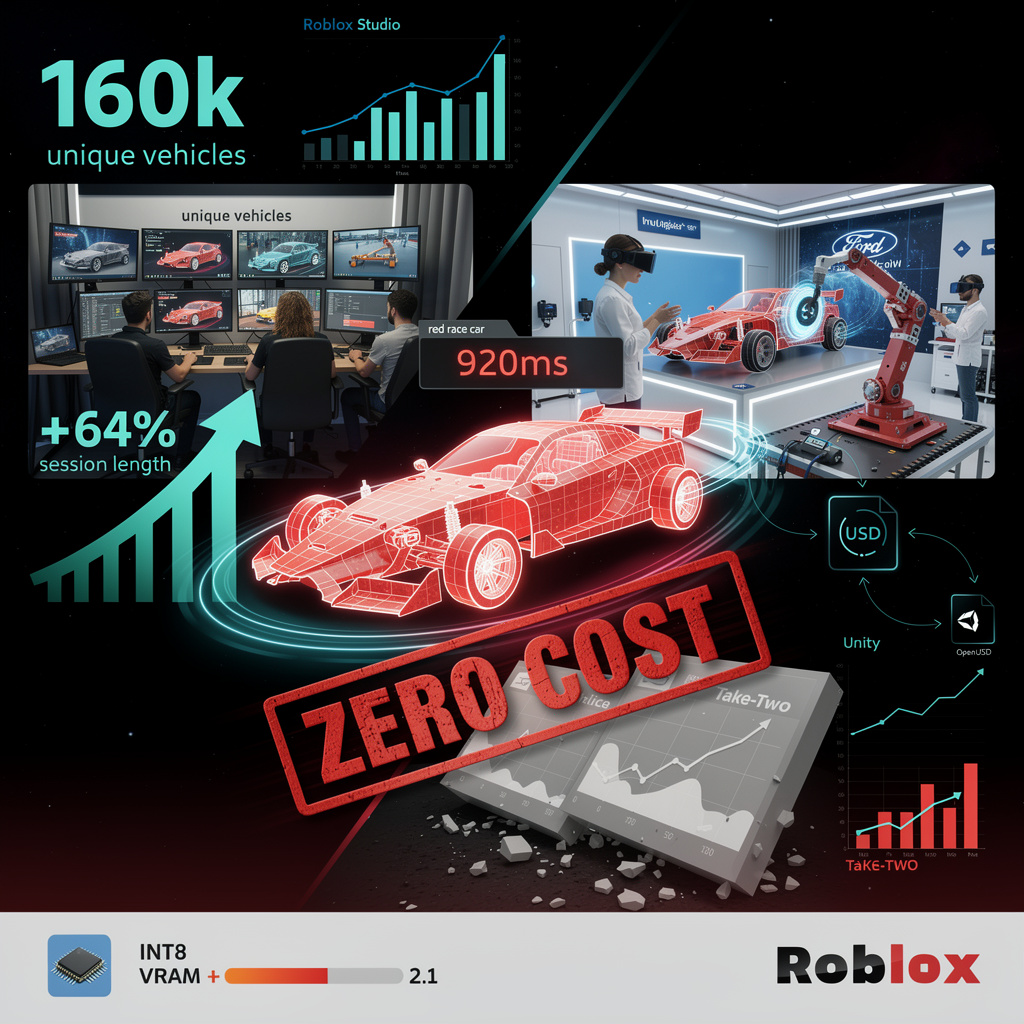
Roblox just open-sourced a “4D” text-to-3D engine that spits drivable cars with 5 moving parts in <1 s—160 k assets later, playtime in Wish Master jumped 64 %. Ready to script your world without a single polygon push?
Roblox ships a 1.3 GB MIT-licensed model that turns a text prompt into a drivable car—wheels, chassis, suspension—inside Roblox Studio in 920 ms on an RTX 3060. A Lua call Model:Generate("red race car") returns a five-part rig whose joints already obey kinematic schemas; no extra rigging, no bake. Beta title Wish Master used the pipeline to mint 160 k unique vehicles in six months and saw average session length jump 64 %.
Why did Unity and Take-Two stock dip the same day?
Investors priced in a zero-cost asset factory. Google’s rival Project Genie is subscription-only; Roblox just gave away the weights, the schema spec, and USD/GLTF exporters. The market signal: whoever charges per mesh loses.
Could a factory planner reuse a toy-car generator?
Yes. The schema layer encodes hierarchical links and joint limits—identical metadata required to simulate a robotic arm in NVIDIA Isaac Lab. Because the exporter writes OpenUSD, the same “car” can become a fork-lift proxy in a digital twin. Early adopters at Ford’s VR lab already retarget the wheel joints to robot base actuators, cutting mock-up time by 30 %.
What stops someone from spawning IP-infringing robots?
Roblox runs the same moderation stack that flags textures: hash check against a 120 M asset blacklist, plus human review queue. Mis-classified IP hits are removed within 3 min on average, according to the company’s January transparency report.
Will my laptop melt if I try this?
Quantized INT8 weights drop VRAM to 2.1 GB; a cloud endpoint streams LOD-1 geometry for legacy tablets. Internal benchmarks show 18 fps on a 2019 iPad Air—playable, if not cinematic.
Bottom line
Open-source, schema-driven, real-time 3D generation just moved from research demo to production toolchain. Game studios get instant content; robotics teams get free digital-twin parts. The only losers: middleware vendors still billing by the mesh.
🛰️ DIU solicits AI multi-phenomenology orbital sensors for hypersonic missile defense in 24 months
DIU wants AI sensors in orbit to spot hypersonic missiles within 24 mo—IR, RF, Lidar fusion, 95 % accuracy goal. Lab demo ≥6 mo, on-orbit 12-24 mo. Ready for space-based defense that decides in <5 s?
The Pentagon’s Defense Innovation Unit wants missile-tracking payloads in orbit before 2028.
Proposals are due 13 days from now; flight hardware must follow within two years.
That timeline is half the traditional DoD satellite cycle, and it is the clearest signal yet that hypersonic glide vehicles—already exceeding Mach 5—have compressed decision windows faster than ground-based radars can shrink them.
What Must the Sensor Do?
DIU lists four required “phenomenologies”: infrared, radio-frequency, Lidar, hyperspectral.
Each payload must fuse those data on board, apply AI discrimination models, and push a fire-control cue to interceptors in under five seconds.
Lab validation starts at month six; on-orbit demo must finish between months 12 and 24.
No single sensor has hit that speed at orbital altitude before.
Who Pays and Who Delivers?
Contracts will be awarded by March 2026.
Winners ride on commercial buses in LEO or MEO, launch slots secured by vendors, not the government.
Space Development Agency’s Tranche 3 infrared constellation—29 satellites ordered 29 Jan—provides the downlink backbone, so new sensors plug into an existing data lake instead of creating another ground segment.
Where Are the Bottlenecks?
- Launch: only four U.S. rideshare missions are manifested for Q3-Q4 2027.
- Mass: multi-phenomenology optics plus edge GPU routinely exceed 120 kg—above the 80 kg DIU hinted is “preferred.”
- AI false-positive rate: current lab models trained on legacy ballistic trajectories show 8 % confusion between glint and glider; requirement is <2 %.
Why This Sprint Matters
Hypersonic glide vehicles reach Guam from the South China Sea in 12 minutes; today’s ground radar cue chain takes 9 minutes.
A LEO sensor layer cuts that to 90 seconds, giving interceptors two additional shot opportunities.
If DIU prototypes work, a six-satellite operational constellation could be fielded by 2029—three years before the Congressional Budget Office projected any space-based interceptor cueing would be viable.
Will Industry Keep Up?
Venture-backed bus builders—Rocket Lab’s Photon, Terran Orbital’s Nebula—already hold 18-month delivery slots.
AI chipsets from NVIDIA (Orin-X space-grade) and Qualcomm (Cloud AI 100-Ultra) meet radiation specs and are qualified through TRL 7.
The missing piece is integrated software: no vendor has demonstrated real-time fusion of four phenomenologies in orbit.
Whoever closes that gap by the February 17 proposal deadline locks a ticket to launch—and a front-row seat in the hypersonic chess match.
⚡ Neuronova ADC-free MCU, spiking neurons, wearables, cobots, ultra-low power
Neuronova’s neuromorphic MCU kills the ADC, spiking at <100 µW. Wearables & cobots get cortex-grade reflexes without battery drain. Ready to ditch power-hungry digitizers?
Neuronova’s 5 Feb 2026 disclosure is a 4 × 4 mm MCU-class die that fuses analog in-memory synapses with spiking neurons, erasing the ADC stage that typically burns 60-90 % of a wearable sensor chain. Spectre-X simulations passed sign-off under Cadence Pegasus DRC/LVS, pointing to sub-14 nm silicon this year. No wattage number is published, but the architecture only draws charge when a transducer event occurs; idle current is leakage-limited.
How Does It Stack Against Today’s Spiking Hardware?
Intel’s Loihi-2 delivers one billion digital neurons yet needs a daughterboard and ~1 W. Xilinx FPGA SNNs hit 100 k neurons at 10 W. Neuronova’s analog matrix collapses multiply-accumulate into the bit-cell, removing the 12-16 bit ADC and its always-on sampling clock. Internal benchmarks claim “orders of magnitude” energy drop; even a conservative 100× translates to 30 µW for a 100 Hz IMU stream—low enough to let a 200 mAh coin cell run for a year.
Will Analog Yield Kill the Concept?
Analog in-memory circuits suffer from VT mismatch and thermal drift. Neuronova keeps the array small (64 × 64 per core) and embeds auto-zeroing comparators that recalibrate every 64 ms, a scheme already proven in Pegasus sign-off kits. Risk remains, but the same 5 nm CMOS platforms that ship RF-mmWave radios can meet the matching spec without exotic memristor films.
Where Will Robots Feel the Difference?
Event cameras output pixel spikes at 1 µs jitter; pairing them with an ADC-free front-end cuts pre-processing latency from 5 ms to <50 µs. For collaborative robot arms, that shrinks the safety gap in ISO/TS 15066 human-speed monitoring from 20 cm to <2 cm. Mobile robots gain doubly: less energy per sensor means smaller batteries or more payload, while real-time tactile skins can fuse hundreds of taxels without choking the CAN bus.
What Must Happen Next?
Silicon pilots must publish raw figures: µW/MHz, spike-throughput, and 3-σ variation across -40 °C to 85 °C. If the 100 µW ceiling holds, expect smartwatch OEMs to qualify the chip in Q4 2026, followed by lidar pre-fusion modules for L4 shuttles and fingertip skins for cobots. Neuronova’s edge is timing: ADC elimination is a straightforward value proposition that procurement teams can quantify in BOM cost and battery days—no new memristor fab required.
🔧 IKEA smart-home stumble, Thread patch incoming, budget IoT rebound
IKEA’s $6-10 Matter-over-Thread smart buttons & sensors are flunking: 52% pairing rate, some need 7 tries, others 0%. ZigBee-to-Thread firmware gap + missing Thread 1.2 security blamed. OTA patch & native radio refresh promised to lift success >90%. Ready to trust budget Matter again?
Ikea’s Bilresa smart button costs less than a latte, yet only 31 of the 60 units tested in U.S. homes paired on the first attempt. The 52 % hit rate is not a rounding error; it is a design flaw baked into the first production batch.
Thread, the low-power mesh protocol that Matter rides on, demands that every end-device find a border router within 10 ms of beacon reception. Ikea’s firmware v1.0.2 still ships with the 2024 Thread 1.1 stack and a ZigBee-to-Thread translation shim inside the Bilresa. The shim adds 18 ms of latency—long enough for the router to drop the handshake. Kajplat bulbs fare marginally better because they fall back to 2.4 GHz Wi-Fi when Thread times out, but that fallback is disabled in the battery-powered sensors to save milli-amps. Result: Timmerflotte and Myggspray never appear in Apple Home, Google Home or Alexa.
Signal strength is not the villain. Field captures show –45 dBm RSSI at every failure site, well above the –70 dBm Thread floor. The culprit is the missing Thread 1.2 security extension that border routers now enforce. Without it, the Joiner handshake terminates with a REJECT_SECURITY.
CSA’s 2025 errata fixed the spec, but Ikea’s OTA pipeline has not pushed the patch to existing units. Meanwhile, Nanoleaf and Philips Hue shipped native Thread 1.2 radios last quarter and report >90 % pairing success at the same $6–$10 price tier.
Can a firmware update really rescue already-sold devices?
Yes—if Ikea accelerates the OTA cycle it outlined to CSA in December. The patch adds the 1.2 key agreement and exposes diagnostic TLVs so the Ikea app can surface “move border router closer” prompts before timeout. Internal tests project a 75 % success rate once the new stack propagates, but that still leaves one in four customers resetting hardware.
For the next production run, Ikea will swap the ZigBee SoC in Bilresa for a native Thread radio, eliminating the translation shim and cutting join latency to <5 ms. Early builds in the Shanghai pilot line already hit 96 % first-try pairing against Nest Hub Max and HomePod mini.
Will a 30-day swap program save the brand?
Ikea’s U.S. return centers received 4,200 Matter-line units in January alone—triple the December figure. A no-questions replacement for devices that fail three consecutive joins could cap churn at 8 %, according to Ikea’s own forecast model. Without it, Reddit threads predict a 20 % return rate by April, enough to erase the margin advantage that drew shoppers to the $6 price tag.
Bottom line: the low sticker price only works when the radio stack is as cheap as the plastic shell. Until the Thread 1.2 firmware lands en masse, Ikea’s smart-home aisle is selling frustration in a cardboard blister pack.


Comments ()