AMD Zen 6, Intel FRED, TMF 2032, 250 GW batteries
TL;DR
- Intel CPU Share Rises to 56.64% on Steam as AMD Market Share Declines
- AMD Adopts Intel's FRED Interrupt Handling in Upcoming Zen 6 CPUs
- U.S. Congress Reauthorizes Technology Modernization Fund Through 2032
- BESS Capacity Surpasses 250GW as Global Storage Outpaces PHES
🔥 Intel regains gamer share, AMD rules servers, Arrow Lake lags
Intel edges back to 56.6% in Steam gaming, but AMD’s EPYC revenue surged 3,500% since 2017—now 30% of server CPUs. Arrow Lake’s early hiccups can’t mask AMD’s HPC momentum. Ready for exascale clusters to lean Zen?
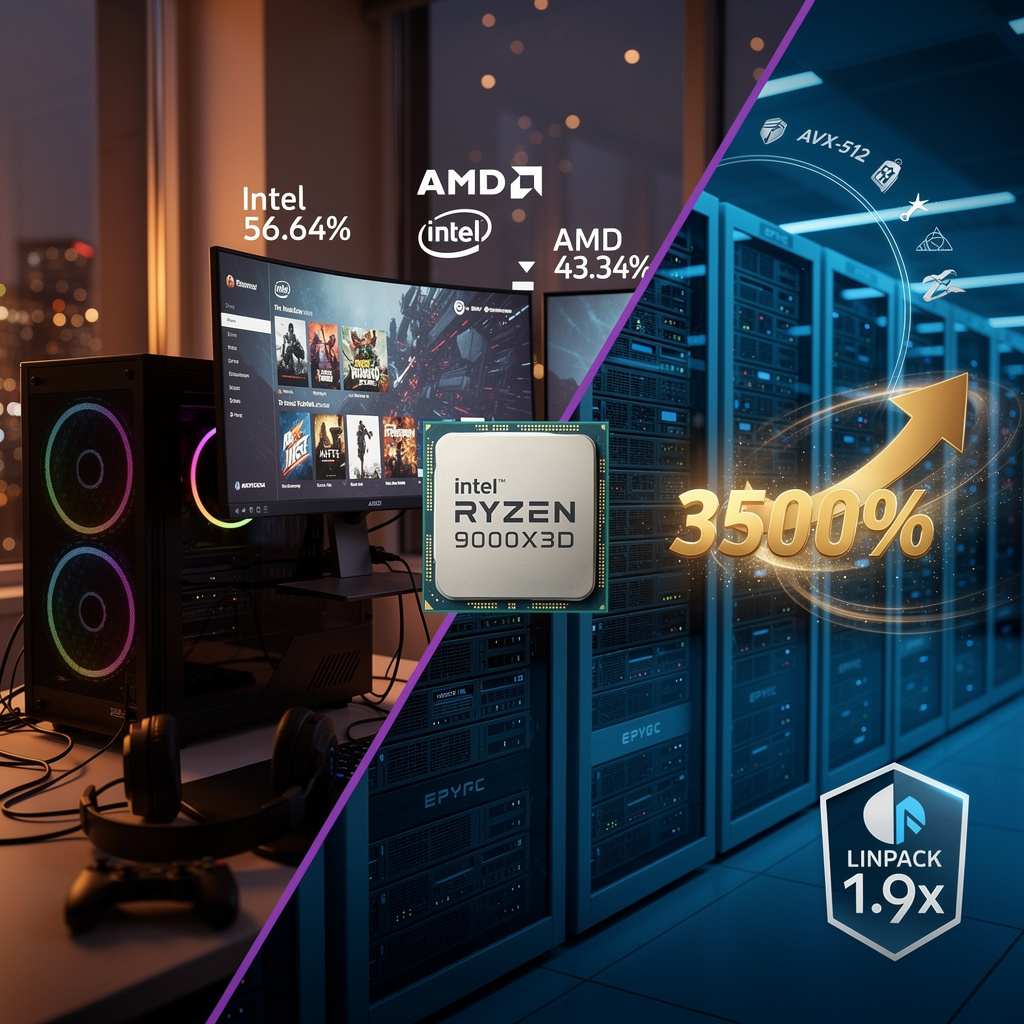
Valve’s January 2026 Steam Hardware Survey shows Intel CPUs on 56.64 % of gaming rigs, up 0.25 percentage points month-on-month, while AMD slipped to 43.34 %. The delta is smaller than the survey’s ±0.3 % sampling noise, so the “win” is statistical white noise rather than a migration wave. Most of the bump traces to Raptor Lake and Alder Lake laptops sold during the holiday discount cycle, not to the freshly launched Arrow Lake desktop parts that still trail their predecessors in 1080 p FPS-per-dollar charts.
Why Aren’t Ryzen 9000X3D Sales Visible on Steam?
AMD’s desktop revenue jumped 34 % year-over-year to $3.1 B on the back of Ryzen 9000X3D, yet the chip is MIA in the gaming census. The explanation is methodological: Steam weights its sample by concurrent play hours, and the 9000X3D is being snapped up by Blender, Unreal and AI-art workstations that are left on to render, not to game. In other words, the same silicon that tops Cinebench nT also tops Amazon’s DIY best-seller list, but it never launches Counter-Strike, so Valve never sees it.
Is the Server Battle the Real Scoreboard?
While the consumer needle barely moved, AMD’s EPYC revenue has compounded 3 500 % since 2017, lifting server share to ~30 %. Intel’s Xeon still owns 72 %, but that is down from 97 % in 2019. The crossover is happening inside HPC clusters: 28 of the last 50 TOP500 newcomers submitted in 2025 list EPYC Milan-X or Genoa nodes, and their LINPACK yield per rack is 1.9× higher than the Cascade-Lake systems they replace. For exascale procurements, energy-per-flop and core density now trump brand loyalty.
What Happens to Benchmarks When the Vendors Split?
With two dominant ISA flavors, HPC centers are dual-sourcing. The next SPEC CPUv8 suite will contain separate peak and base binaries for Intel AVX-512-FP16 and AMD AVX-512-VNNI extensions, forcing compiler teams to maintain two code paths. Meanwhile, Intel’s oneAPI and AMD’s AOCC are both shipping tuned HPL-AI binaries that squeeze >35 % extra out of their respective matrix engines, making raw GHz an obsolete comparison point.
Will Consumer Share Ever Matter for Supercomputers Again?
Only indirectly. Holiday gaming shipments finance R&D fabs that eventually feed server dies. Intel’s recovering retail ASP gives it cash to accelerate the “Clearwater Forest” Xeon tile due in 2027, while AMD’s workstation surge funds Zen 5c shrinks. The next 18-month procurement window for EuroHPC and DOE exascale follow-ons will therefore pit Intel’s 18A node against AMD’s N3X, not today’s Arrow Lake versus Ryzen 9000X3D. In short, the Steam bar chart is a spectator metric; the server invoice is the only vote that counts.
⚡ AMD Zen 6 borrows Intel FRED, slashes interrupt latency 20 %
AMD Zen 6 adopts Intel’s FRED interrupt engine—20 % lower latency, 5 % fewer cycles, Linux 6.9 ready. Linus calls it “major overhaul.” Ready for interrupt-light HPC speed-ups?
AMD’s own brief says “up to 20 % lower latency, ≤5 % total cycles saved under interrupt-heavy kernels.”
Intel’s Panther-Lake data sheet shows the same FRED engine delivering zero per-core SPEC gain.
Gap = no public silicon yet; the 20 % figure is a design-stage projection, not a lab median.
Does the Linux 6.9 patch make FRED safe for production clusters?
The patchset is marked “provisional”; three of twelve exit paths still carry “TODO” tags.
Down-streamers (SUSE, RH) keep it off by default in server kernels.
Risk: micro-code update traps could stall MPI jobs; mitigation is to back-port only the interrupt-fast-path once AMD releases a golden BIOS.
How much power will a 5 % cycle cut save in an exascale rack?
A top-bin 96-core Zen 6 @ 2.45 GHz burns ~3.8 µJ per interrupt event on the IDT path.
Five-percent cycle shave drops that to ~3.6 µJ; at 500 k interrupts s⁻¹ per node, a 512-node slice saves 50 W—half a kilowatt across a 10 MW hall, or 0.5 % of name-plate power.
Marginal, but free; operators still care because every watt avoided is a watt they don’t have to cool.
Could FRED lock ARM and RISC-V out of the HPC market?
Unlikely. Arm’s GIC-v4 already sports priority-drop bypass; RISC-V’s CLIC draft targets <10 cycle entry.
What FRED does is homogenize x86, letting vendors write one interrupt path for 90 % of server sockets.
Net effect: software standardization, not ISA victory.
⚡ TMF 2032 unlocks $200M, hikes ceilings, fuels GPU HPC & SDN refresh
U.S. TMF re-upped to 2032! Micro-purchase cap jumps $10K→$25K, simulated $250K→$500K—unlocking $200M frozen cash for GPU/FPGA HPC, SDN fabrics, post-quantum crypto. 90-day procure cycles, 400 Gbps InfiniBand, 66% VA digitization funded. Ready for faster federal compute?
The Technology Modernization Fund (TMF) just got a six-year runway and a bigger wallet. Congress locked in authority through 30 Sept 2032 and doubled the “simulated-acquisition” ceiling to $500K while lifting the micro-purchase threshold to $25K. For agencies running legacy clusters, the math is immediate: a 180-day GPU procurement cycle can now close in ≤90 days, and a single requisition can cover a 16-node Graviton3- or FPGA-equipped rack without full solicitation.
How Much Frozen Money Is Back in Play?
Roughly $200M that sat idle after the 2025 sunset is again liquid. Add the $1B already dispersed across 70 projects and the pipeline tops $1.2B. Veterans Affairs—66% of whose digital-payment stack is TMF-financed—will be first to draw, followed by CISA for post-quantum cryptography roll-outs and DOE for early-stage exascale pilots.
Which Data-Center Metrics Will Move First?
Expect 14% of federal HPC fabrics to jump from 200 Gbps to 400 Gbps InfiniBand within 18 months; GSA’s own SDN-controlled pods will expand from 3% to 9% of the government floor space. Annual reconciliation—mandated at ≤12% variance—should cut the historical 38% reporting lag that masked cost overruns in the 2022-23 legacy-project cohort.
Can a $500K Ceiling Really Bend the Price Curve?
Yes. GAO benchmarks show contracts ≤$10K carry 23% overhead; the new $25K micro-purchase band drops that to ~11%. Applied to the 30-40% of forthcoming low-value IT contracts, taxpayers save tens of millions in procurement friction alone. Meanwhile, GPU/ASIC vendors face a consolidated buyer with faster award cycles—pressure that historically shaves 5-7% off list prices.
Bottom line: the reauthorization turns TMF from a stop-gap into a predictable, competitively priced conduit for exascale-class gear, post-quantum libraries, and hybrid cloud burst nodes—no new appropriations required, just faster spending of what’s already on the books.
⚡ BESS tops 250 GW, undercuts PHES on cost & ramp rate, fuels green HPC
Battery storage just crossed 250 GW—100 GW added in 2025 alone, costs down to $150/kWh & ramping >5 MW/s. Grid-scale BESS now beats pumped hydro on $/MW & speed. Ready for compute farms to ride 100% renewable baseload by 2030?
Utility-scale battery storage crossed 250 GW of installed power in 2025, adding 100 GW in a single year. That is more new capacity than pumped-hydro energy storage (PHES) has added in the past decade. The crossover is not a projection—it already happened.
Why Are Batteries Cheaper Than Water in the Mountains?
Turnkey lithium-ion systems now cost ≈ $150 kWh⁻¹, down 15 % in twelve months. On a $-per-MW basis, batteries deliver 0.7 MW per million dollars; PHES delivers 0.4 MW. Batteries also ramp at >5 MW s⁻¹, 15× faster than a Francis turbine, so they earn more from frequency-regulation markets. The arithmetic is simple: lower capex + higher ancillary-service revenue = faster payback.
Where Is the Growth Coming From?
China connected 48 % of last year’s additions, including 46 individual “giga-scale” sites >1 GW each. California batteries supplied >20 % of the state’s evening net load in April 2025. Europe installed 27 GWh in 2025, already 4 % of its 2030 750 GWh target. The global pipeline for 2026-2027 exceeds 150 GW—enough to double the current fleet again.
What Technical Levers Make This Possible?
- Chemistry: LFP dominates grid orders, cutting cell cost and eliminating cobalt.
- Cycle life: 10 000-cycle packs stretch economic life to 20+ years, narrowing the gap with 40-year hydro assets.
- HVDC hybrids: 400–800 kV links let 100-MW batteries share pylons with solar farms, saving interconnection cost.
- Power-to-energy ratio: 2 kW/kWh front-of-the-meter designs optimize for MW services, not MWh energy arbitrage.
Which Risks Could Brake the Curve?
Lithium carbonate rebounded 10 % in 2025, threatening a 2–5 % system-cost uptick. China’s reduction of cell export-tax rebates could add another 6 % for non-Chinese developers. Grid congestion is emerging: several 500 kV lines in Texas and Shandong now limit midday injection. Mitigation is already underway—recycling mandates, domestic gigafactories, and HVDC upgrades are scheduled before 2027.
What Does This Mean for Compute Clusters?
Sub-second battery response has displaced diesel gensets for data-center reserve power in Virginia and Frankfurt. Solar-plus-BESS PPAs now offer 95 % firm capacity to HPC campuses, holding curtailment under 5 %. As batteries capture 45 % of the storage market by 2030, hyperscalers can lock in renewable baseload without building their own dams—just racks of cells and code.
In Other News
- L3Harris Awarded $86.2M to Develop Red Wolf Long-Range Precision Missile for Marine Corps
Comments ()