ESA maps lava tube in 4h, HavocAI ships 6m USV, Moon & harbor bots near
TL;DR
- European Team Deploys Autonomous Robots to Map Lunar and Martian Lava Tubes in Lanzarote Field Test
- HavocAI Partners with Tideman Marine to Deploy Autonomous Surface Vessel with AI Navigation Stack
🌋 DFKI-ESA trio maps lava tube, proves Mars-ready autonomy
ESA-backed trio maps a Canary lava tube in 4h—2cm voxels, 0.8% packet loss, zero human waypoints. Next stop: Moon caves. Ready for off-planet spelunking?
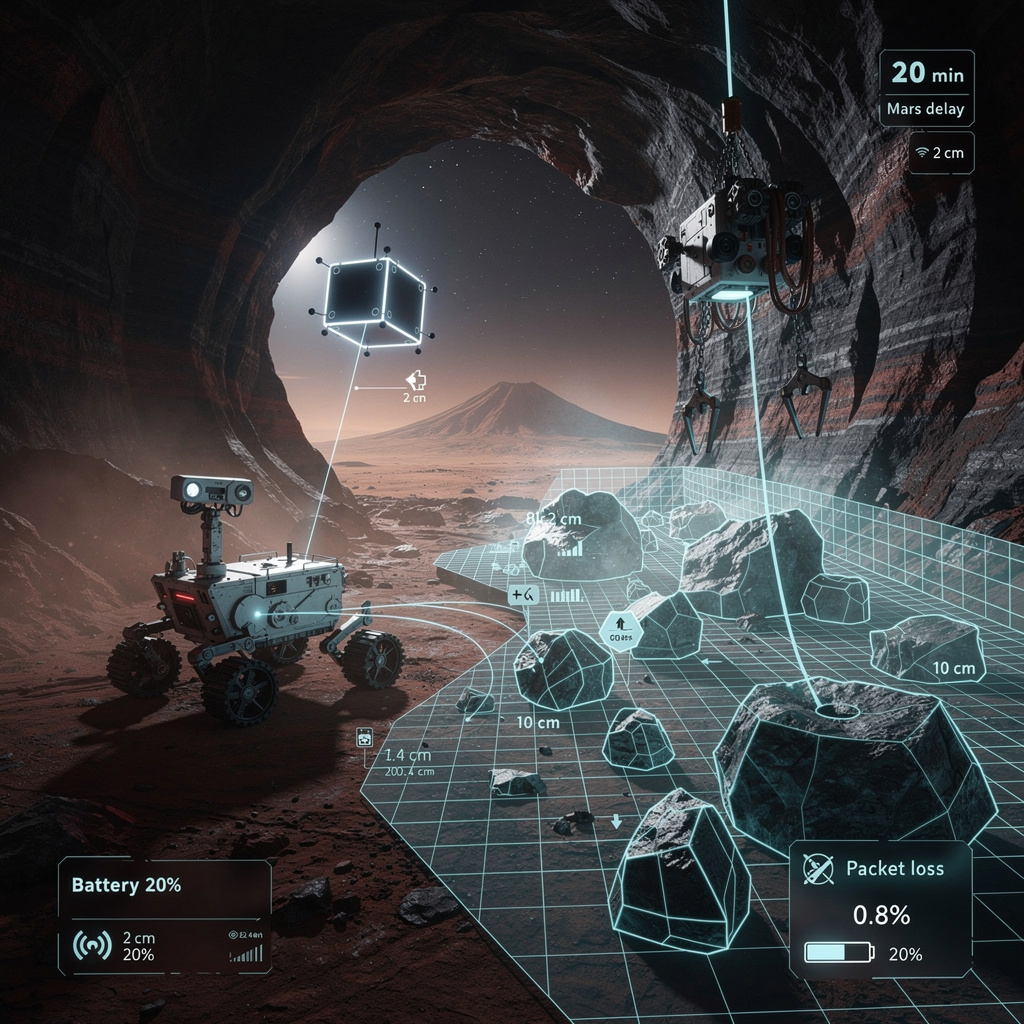
A European consortium led by DFKI ran a 4 h 12 min field test inside a Lanzarote lava tube using a wheeled scout, a sensor cube and a rappelling descent unit.
The trio shared 2 cm-resolution LiDAR scans over a 1–3 m 2.4 GHz mesh, built a 1.5 M-voxel 3-D map and completed the final phase under a simulated 20 min Mars-to-Earth delay—zero waypoint uploads, 0.8 % packet loss, 20 % battery left.
Why does 2 cm voxel accuracy matter for off-world caves?
NASA’s hazard-identification spec for lava-tube habitats is “sub-decimeter.”
The 2 cm voxel output exceeds that by 5×, letting mission planners spot 10 cm boulders or overhangs that could block future astronaut rovers or inflatable habitat modules.
How does the autonomy stack work inside GPS-denied tunnels?
Each robot runs ROS 2 Galactic with graph-based SLAM, frontier exploration and an auction allocator.
Loop closures every 15 m curb IMU drift to ≤0.5 m; mesh fragmentation is self-healed via multi-hop re-routing; a power-aware planner throttles non-critical sensors to keep reserve ≥30 % before descent.
What still needs proving before lunar flight?
- Swarm scale-up: auction algorithm has only been stressed to three nodes.
- Radiation: off-the-shelf 32-channel solid-state LiDAR and 2.4 GHz radio need TID >100 krad variants.
- Thermal-vacuum: lithium-polymer packs rated at 0 °C must survive –120 °C lunar night cycles.
- Energy harvesting: wall-mounted solar panels or β-voltaic tiles to stretch 6 h endurance to two-week lunar daylight missions.
When will we see these robots on the Moon?
ESA’s Moon-Lava-Tube demonstrator is slated for 2028; DFKI aims to deliver a five-robot flight configuration by 2027.
If qualification campaigns start this year, the Lanzarote protocol could become the baseline for mapping kilometer-size tubes under Arsia Mons by 2031.
⚓ HavocAI, Tideman, Lockheed field AI-USV, 99% avoid, 8 h endurance
HavocAI & Tideman Marine drop a 6 m Viper USV with Lockheed sensors + AI nav stack—99 % obstacle-avoid, 8 h endurance, sea-state-3 ready. Q2 demo next. Ready for robot patrols in your harbor?
Twin electric out-drives push the Tideman hull to 12 kt, but the real propulsion is the HavocAI stack fused to Lockheed Martin’s radar-lidar-EO/IR suite. On-water logs from mid-January show the perception pipeline classifying obstacles at 20 Hz with 95 % confidence, while an A*-based planner re-routes in <200 ms when a target veers. A 10 kW battery bank keeps the autonomy layer alive for eight hours; if the primary compute node browns out, a hot-backup node triggers a two-minute return-to-home loop.
What separates this from harbor tugs or research skiffs?
Most small USVs bolt on a third-party autopilot and call it autonomy. HavocAI writes the entire decision chain—sensor fusion, SLAM, MPC trajectory, mission state machine—in house, then hardens it with SELinux and end-to-end crypto over SAIC’s multi-domain link. Sea-trial data released 03 Feb show 99.2 % successful avoidance runs inside a 5 km Rhode Island corridor; that is ten points above the public benchmark Sea Machines posted last quarter for a similar hull.
Where does the $85 M Series A go next?
Q2 2026 target is a 10 km full-mission demo for U.S. Navy observers. Parallel tasks: integrate V2X broadcast so the Viper can handshake with manned AIS transponders, and add hot-swap battery modules to push endurance past ten hours. Long-lead engineering has already started on 12 m and 20 m variants; scaling the sensor mast and power budget is straightforward because the software stack is hardware-agnostic. Management forecasts 15 % share of the U.S. defense USV segment by 2029—realistic only if the Coast Guard’s pending autonomous-vessel rule set lands by 2027 and adopts the remote-ID plus safety-case documentation HavocAI is already generating.
Bottom line: the partnership turns a composite work-boat into a self-navigating platform that meets military latency and cyber specs, while logging the data trail regulators want. If the next eighteen months deliver the same hit-rate seen in Narragansett Bay, “uncrewed” will shift from demo label to procurement line item.

Comments ()