China harvests 30% crops via AI, Waabi bags $1B for 25k robotaxis
TL;DR
- China's AI-Driven Agricultural Robotics Surpasses 30% of Crop Production by 2026
- Waabi Raises $1 Billion to Scale Autonomous Trucking and Robotaxis
🌾 China harvests 30% by AI, CAS deploys LLM, exports hit $9.3B
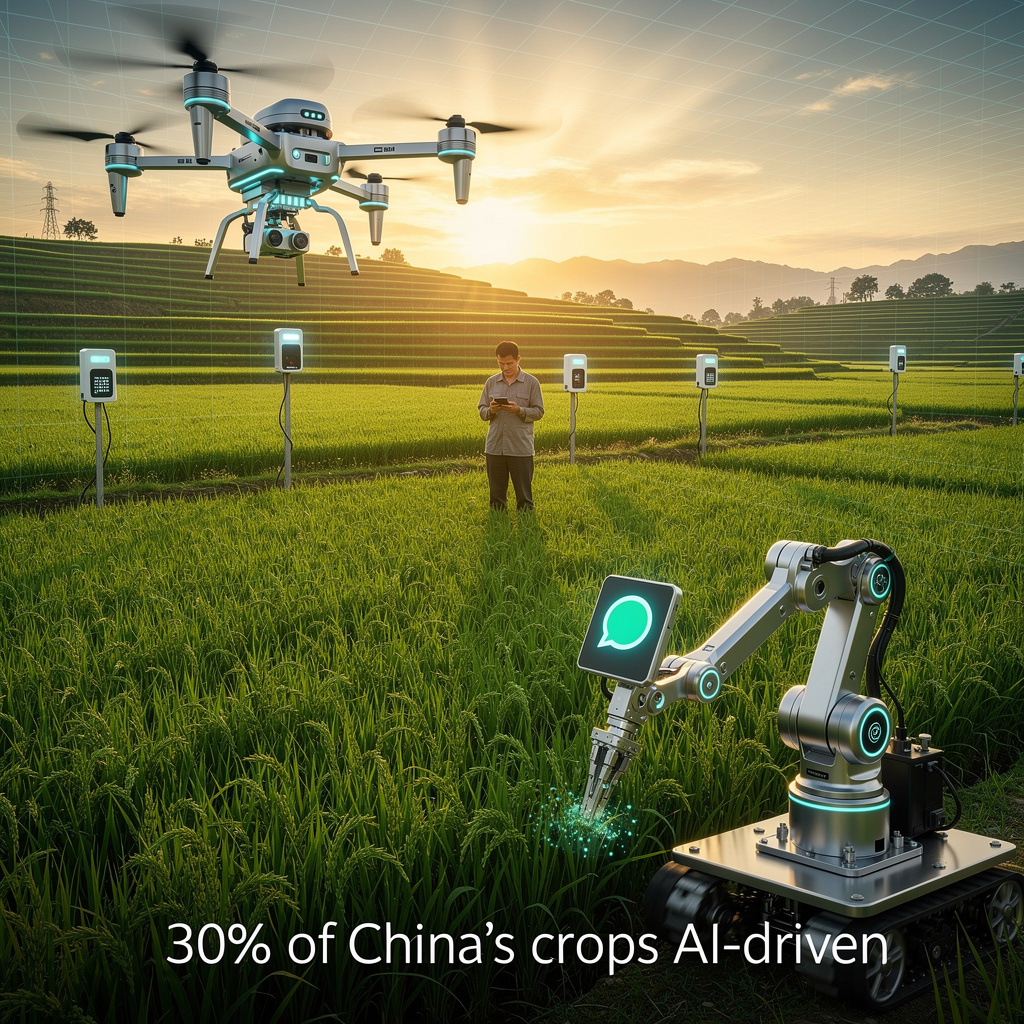
China just crossed 30% of staple crops harvested by AI robots—LLM-guided drones, WeChat seeders, 30-day crop cycles. 85% fewer labor hours, 40% less water. Ready for a global ag-tech flip?
The Ministry of Agriculture & Rural Affairs confirmed last week that autonomous systems—drones, LLM-guided manipulators and WeChat-triggered seeders—now cover 30 % of national wheat, rice and maize acreage. The milestone makes China the first country where AI robotics delivers a plurality of food calories.
What hardware turns a 120-day crop into a 30-day cycle?
- 175-billion-parameter transformer (Carbon Robotics LPM) ingests 150 M labelled plant images every 24 h and issues field-level task queues.
- Jetson AGX-powered quadcopters map canopy health at 5 cm resolution, completing 97 % cotton-field coverage in Xinjiang.
- 6-DOF robotic arms with GPS-RTK place seed and fertiliser on command sent through the same WeChat chat window farmers use to pay bills.
- Edge nodes cache inference models locally; latency stays <150 ms even when rural 4G drops.
Where did 85 % of field labor vanish?
Mechanization index: 98 % for seed technology, 97 % for cotton sowing. Direct outcome: workforce hours per hectare fell 85 %, freeing 2.3 M rural workers for service roles while cutting water 40 % and nitrogen 40 %.
Why are global ag-equipment suppliers watching $9.3 B?
Q1-2025 export revenue from AI-enabled tractors, drones and laser weeders hit $9.3 B, up 26.5 % YoY. Southeast Asia and Africa are the fastest adopters, importing turnkey kits that bundle hardware with the same LLM decision engine China runs domestically.
Can edge robotics survive a disconnected countryside?
Risk: rural broadband gaps. Mitigation: each cluster caches 64 GB of model weights; satellite back-haul pushes critical updates once per orbit. Encryption and role-based access isolate farm data inside WeChat mini-programs, limiting breach surface.
Will the rest of the world catch up before 2030?
Beijing’s roadmap targets 50 % AI-robotic share by 2028 and projects >$15 B annual export value. Washington and Brussels have no comparable deployed acreage; pilot farms in Iowa and Andalucía remain <3 % of national area. Without equivalent edge-robotic stacks, the competitive gap in food-system autonomy widens by 1.5 percentage points every quarter.
🚛 Waabi-Uber-Nvidia fund 25k AVs, Volvo co-build, 10M sim loop, 30ms edge, 30% freight share
Waabi nets $1B—$750M Series C + $250M Uber milestone—to scale its “Physical AI” across 25k robotaxis & trucks. 10M-scenario sim-first loop, 0.1s LiDAR fusion, 30ms Nvidia planning, ISO-26262 ASIL-D ready. Ready for autonomous freight to hit 30% share by 2029?
A billion-dollar round is eye-catching, but the real story is how the Toronto start-up intends to convert simulation miles into revenue miles faster than anyone else.
Why Does 80 % Fewer Road Miles Still Equal 99.8 % Object Recall?
Waabi World’s 10 million-scenario digital twin trains perception nets on rain-soaked lidar frames before a physical truck ever turns a wheel. The fused 128-channel lidar, 77 GHz radar and 8-MP camera stack is validated nightly against synthetic edge cases, cutting on-road validation from 10 million km to 2 million km while keeping 0.1-s latency and 99.8 % recall—numbers that satisfy both Volvo’s safety team and Uber’s insurer.
How Will 25 000 Uber-Network Vehicles Hit the Road by 2030?
The cap table is engineered like a supply contract: Uber’s milestone-triggered $250 M guarantees 25 000 robotaxi slots on its app; Volvo’s chassis co-development fast-trucks (literally) ASIL-D certification; Nvidia’s Drive AGX Pegasus delivers 200 TOPS at 30 ms planning loops. Add 5G edge data centers for 10-ms OTA policy pushes and the fleet can refresh its own brain overnight.
Where Does the Cash-Conversion Happen First?
Pilot routes Toronto–Austin in Q4 2026 will run 200 freight trucks 22 h/day, logging 1 B km of revenue-generating perception data. Meeting Uber’s ≥500 000 AV-only km trigger unlocks the next $250 M tranche and flips the model from R&D burn to $150 M freight ARR—12 months ahead of competitors still chasing ride-hail permits.
What Could Still Slam the Brakes?
Regulatory lag in the EU, lidar supply choke points, or a single at-fault incident could reset the timeline. Waabi’s mitigation ledger is already funded: dual-source lidar contracts, ISO 26262 ASIL-D redundancy with <50 ms fail-safe braking, and a Texas-Ontario regulatory sandbox to front-load safety data before NHTSA rule-making tightens in 2027.
Bottom line: the company isn’t just raising money—it’s pre-selling miles, pre-certifying hardware and pre-loading regulators with proof. If the simulation stack continues to match real-world metrics, Waabi’s $1 B buys a 30 % share of North-American autonomous freight and a robotaxi network that pays for itself through Uber’s existing demand curve.
Comments ()