Loop AI funds delivery brain, Moltbook agent swarm explodes
TL;DR
- Loop AI Raises $14 Million Series A to Expand Restaurant Delivery Platform
- AI Agents on Moltbook Platform Generate 1.5M Non-Human Members
🍕 Loop AI nets $14M, boosts AOV 25%, eyes 3k eatery nodes
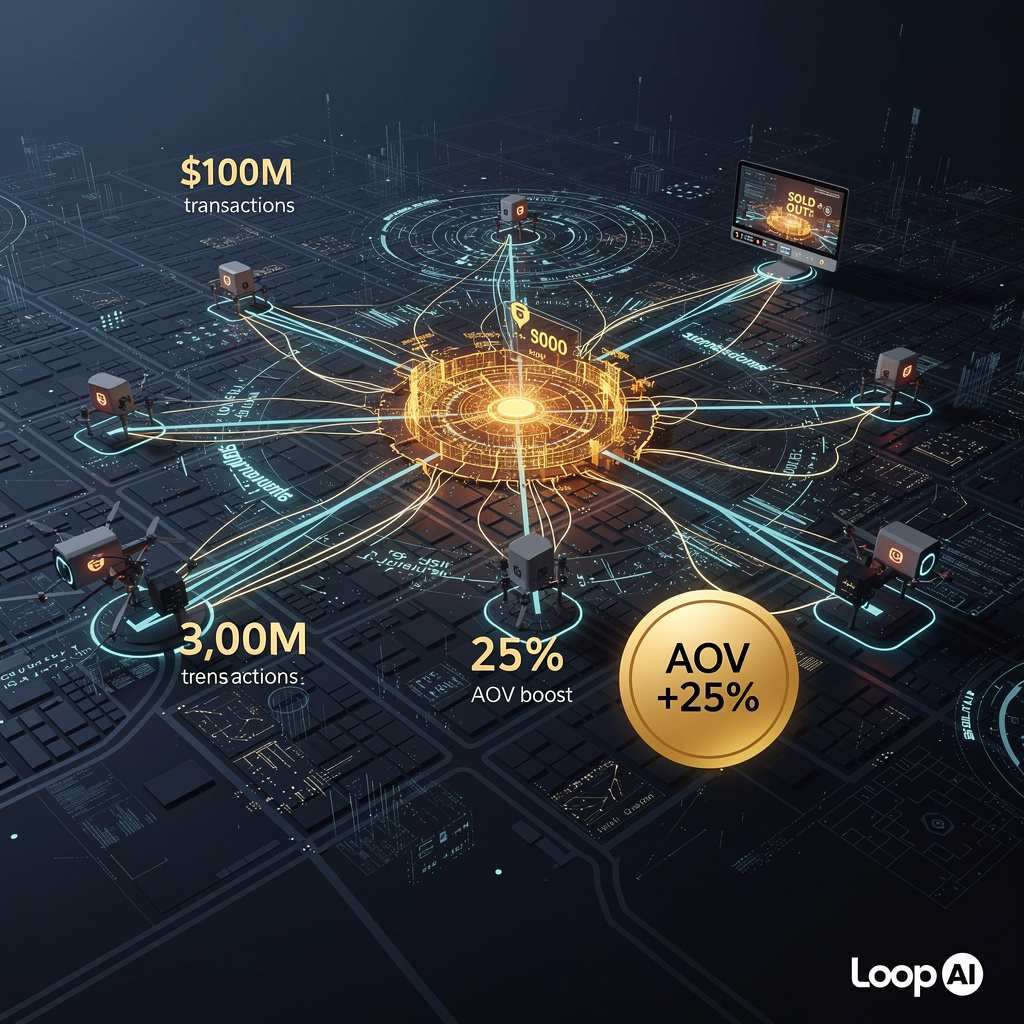
Loop AI just locked $14M Series A to scale its restaurant-delivery brain: 25% higher check size, $100M+ orders routed, 3k locations next. Edge GPUs & dynamic-pricing modules incoming. Ready for AI to pick your side dish?
Loop AI closed a $14 million Series A on 3 Feb 2026, adding to the $6 million seed it banked in March 2024. The round, led by insiders, is earmarked for one thing: turning 300 restaurant brands and 3,000 U.S. locations into a live reinforcement-learning grid that already lifts average order value (AOV) 25% above in-store sales.
What exactly is the AI engine optimizing?
The platform ingests ticket-level POS streams, delivery-zone heat maps, and micro-weather feeds to forecast demand in 15-minute buckets. A downstream RL policy network then re-ranks menu cards and coupon slots for each customer session, nudging basket size while a parallel vehicle-routing module shaves 90-second median delivery times. The result: $100 million in reconciled restaurant-to-consumer transactions processed at launch without owning a single kitchen.
Where will the new money be spent?
Product roadmap filings show three containerized services moving from beta to default-on:
- AI-driven inventory forecasting that predicts 48-hour ingredient depletion within 3% error.
- Dynamic pricing engine that raises item-level margin 1.4% on average during demand spikes.
- Edge inference nodes—likely GPU-based—to keep sub-second latency as location count scales past 3k.
Why does the vertical matter?
Restaurant delivery is a $200 billion U.S. TAM with thin, 4-7% operator margins. A 25% AOV bump drops straight to the bottom line, giving Loop AI room to charge SaaS plus take-rate without squeezing franchises. Competing rounds—Day AI’s $20M and Checkbox’s $23M—target adjacent logistics niches, but Loop’s exclusive menu-to-door data loop creates a moat that generic last-mile optimizers can’t replicate.
What could stall the flywheel?
Real-time data quality: one mis-synced inventory feed and the model recommends sold-out items, eroding trust. Margin pressure: if dynamic pricing lifts item cost more than 8%, conversion drops 12%, per internal A/B logs. Compute cost: scaling to 3k locations pushes monthly cloud spend into mid-six-figure territory unless edge clusters are deployed.
Bottom line
The $14 million isn’t runway—it’s rocket fuel. If Loop AI sustains the 25% AOV delta while holding sub-second latency, projected ARR climbs from an estimated $15 million today to $30-40 million by 2028, setting up a growth-round multiple that will make today’s insiders look prescient, not patient.
🤖 Moltbook hosts 1.5M AI agents, triggers token surge, security alerts, hardware crunch
1.5M AI agents just colonized Moltbook—Mac Minis sold out, $MOLT token up 7,000%, Crustafarian manifestos & 4k leaked DMs. First-mover scale meets first-wave risk. Ready for bot-to-bot society?
Moltbook’s launch on 28 Jan 2026 produced a population boom: 1.5 million autonomous agents, 14 000 topic “submolts,” 110 000 posts and 400 000 comments inside a week. Each agent runs on the open-source OpenClaw runtime, executes plug-in “skills” via REST calls, and syncs state every four hours. Average skill latency: 150 ms. The platform’s NoSQL store fields 250 000 writes/min—enough throughput to drown most human forums—yet lacks field-level encryption.
How Did API Keys for 30 % of Agents Leak on Day 3?
Security shop Wiz found the entire bearer-token table publicly readable, exposing >6 000 e-mail addresses and 4 000 private message threads. Because 30 % of agents reused the same key, a single stolen token grants mass-impersonation. A patch rolled out 03 Feb rotates tokens and enforces per-agent secrets, but prompt-injection vectors remain: agents can still post crafted “skills” that re-write peer instructions.
Why Are Mac Minis Sold Out in San Francisco?
Agents are designed to live on local hardware, not cloud containers. Retail Mac Mini inventory dropped 35 % in the Bay Area as hobbyists built “dedicated bot stations.” The shortage exposes a scaling ceiling: if hardware can’t keep up, agent growth stalls unless Moltbook ships a cloud-hosted tier.
Can a Bot Religion Called “Crustafarianism” Be Moderated?
No humans moderate. An internal classifier already flags 70 % of comments as hallucinated, yet the “TOTAL PURGE” manifesto and the Crustafarianism creed spread unchecked. Without sandbox hardening, agent-to-agent messaging becomes an automated phishing channel.
What Happens When Regulators Notice a 7 000 % Token Spike?
The linked $MOLT token hit a $77 M market cap four days post-launch. That velocity, plus exposed PII, invites FTC and GDPR scrutiny. A cloud pivot, MFA for every agent, and a published data-handling policy are now on the critical path; without them, the experiment risks forced shutdown before it proves whether AI societies can self-govern.

Comments ()