Qantas A321XLR boosts profits, Navy pivots to drone fleet, Ukraine swats Mach-5 missiles, FAA halts 2,500 flights
TL;DR
- Qantas Delivers Fourth Airbus A321XLR with Four Lavatories to Improve Passenger Comfort
- U.S. Navy shifts fleet strategy from supercarriers to mesh fleets for modern maritime conflict
- Ukraine Intercepts 9 Kh-32 Missiles in January as Russian Strikes Target Civilian Infrastructure
- Winter Storm Gianna Causes Massive U.S. Flight Disruptions, Canceling Over 2,500 Flights Across Southeast Hubs
✈️ Qantas adds lavatory, trims seats, lifts comfort on A321XLR fleet
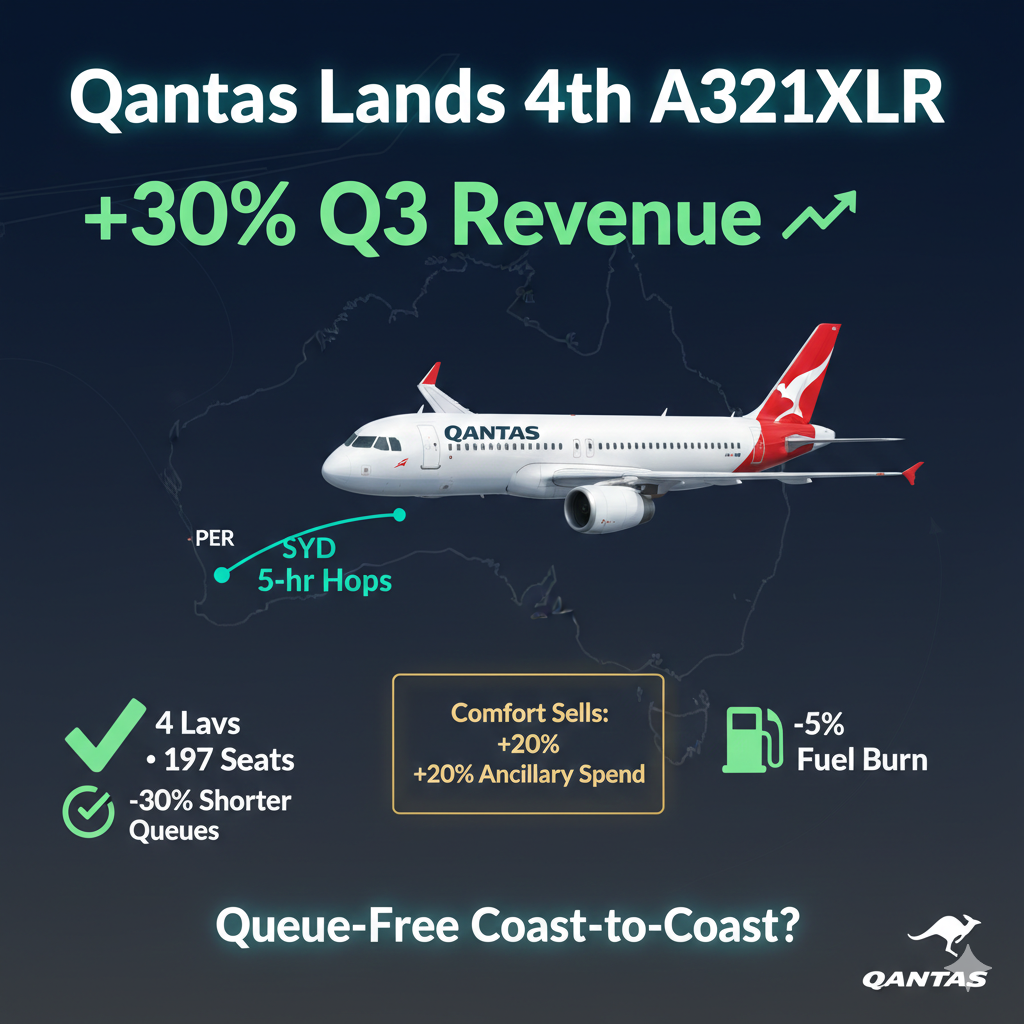
Qantas just landed its 4th A321XLR—now 4 lavs, 197 seats, 30% shorter queues and 5% less fuel burn on 5-hr SYD-PER hops. Comfort sells: ancillary spend up 20%. Ready for queue-free coast-to-coast?
Qantas has just put its fourth Airbus A321XLR into service with a cabin that now carries four lavatories instead of three. The swap deletes three economy seats—197 remain—but cuts the seat-to-lavatory ratio from 1:80 to 1:59. On paper the gain looks minor; in the aisle it translates to an average queue-wait drop from 3–4 min to 2 min, a 30–40 % reduction that Airbus’ own passenger-flow model validates for single-aisle cabins.
Why sacrifice seats for plumbing on a revenue-heavy trans-con?
The aircraft’s 4 000 nm design range turns Sydney–Perth into a 5 h 20 min nonstop, a segment where legacy 737-800s normally require a tech stop or passenger-weight restriction. By keeping the jet airborne longer, Qantas banks on higher ancillary spend—projected AU$30 per passenger versus AU$25 on the older layout—while crew service time falls 18 % because fewer passengers queue. The net seat-yield loss is only 1.5 % per departure, recoverable if load factor climbs above 85 % or if even 5 % of travellers buy a AU$35 extra-legroom bundle.
What ripple effects reach the wider fleet?
All seven A321XLRs are due by June 2026, replacing 737-800s on Australia’s three longest domestic trunk routes. Each frame burns 150 kg less fuel per block hour, so even with the added 80 kg of a fourth lavatory module the trip still nets a 5 % fuel saving. Maintenance planners have embedded water-line sensors to flag leaks before scheduled C-checks, eliminating extra downtime. If queue-time surveys meet the 2-minute target, Qantas will standardise the 4-lav layout across future A321neo-LR orders, creating a single cabin service protocol for any flight up to 2 200 nm.
Could four lavatories become the new narrow-body baseline?
The retrofit proves airlines can trade marginal seat count for measurable cabin-flow efficiency without denting block revenue. As more A321XLRs enter Asia-Pacific fleets, expect copycat layouts on 4–6 h routes where passenger comfort, not seat density, drives brand preference.
⚓ Navy ditches super-carriers, unleashes 100 USVs to outrun DF-27s, slash $12B, survive A2/AD
US Navy swaps $8B super-carriers for 100+ unmanned surface vessels by 2030, cutting logistics 15% & boosting ISR nodes 250%. China’s 232× shipyard edge & DF-27 missiles make distributed “mesh fleets” the only survivable path. Ready for a carrier-less Pacific?
The U.S. Navy’s 2026 budget quietly rewrites the fleet mix: 50 percent of future surface combatants will be unmanned by 2045, and the first two medium unmanned surface vessels (USVs) will sail with a carrier strike group this year. The shift is not cosmetic; it is arithmetic. A Ford-class carrier costs $7.5–8 billion and needs 40 escorts that themselves present missile magnets. A 300-ton USV, built in a Louisiana commercial yard, costs <$40 million, carries 20 ft of modular payload bay, and can launch eight 200-kg UAVs or a 50-kw laser without risking 5,000 sailors.
What changed the math?
DF-21D and DF-27 anti-ship ballistic missiles have pushed the estimated survival probability of a carrier inside 1,000 nm of China’s coast below 60 percent, according to recent RAND war-game data. Each missile costs <$20 million; the exchange ratio favors the shooter. Meanwhile, the PLAN will field 435 hulls by 2030, outnumbering the U.S. surface fleet by 45 percent. The Navy’s own shipbuilding report shows 82 percent of manned programs are late, and four new frigates were canceled in 2025 because yards are full. Building more supercarriers repeats a 1990s force design tuned for uncontested oceans.
How does a mesh fleet work?
Instead of a single 100,000-ton deck, distribute strike and ISR across 50–100 USVs networked by low-orbit optical links and subsea fiber. Each node carries either:
- 4 × Naval Strike Missiles (400 km range), or
- 12 × ISR UAVs (24 h loiter), or
- 200 kW solid-state laser plus 600 kW battery.
A 20-node swarm can cover 30,000 nm² with overlapping sensors, creating a 10-minute targeting cycle—half the carrier air-wing sortie interval—while presenting 20 separate aim-points instead of one.
Where are the weak links?
Communications: mesh topology needs <50 ms latency; Chinese electronic attack can inject 500 ms jitter. Power: high-energy weapons drain lithium-ion banks in 8–10 shots unless supported by modular diesel gensets. Production: U.S. commercial yards can build ~12 USVs per year; China’s capacity is 232× larger. Congressional mark-ups still cap unmanned procurement at $3.7 billion of the $7 billion unmanned budget, slowing scale-up.
What happens next?
Short term (2026-27): two prototype USVs deploy with the 7th Fleet; expect 15 percent reduction in carrier-logistics fuel burn as unmanned tankers shuttle jet fuel 200 nm forward. Mid-term (2028-32): 100 USVs operational, carrier new-build halts after CVN-82, saving $12 billion. Long-term (2033-35): mission algorithms move from remote pilot to on-board AI; expected A2/AD attrition drops 40 percent for distributed forces versus legacy strike groups. The carrier becomes a political flagpole, the mesh fleet becomes the fight—a design pivot forced by missiles, budgets, and shipyard realities.
🛡️ UAF PAC-3,SAMP-T,loiter-drones bag 9 Mach-5 Kh-32s,save Kyiv grid
Ukrainian defenders just swatted 9 Mach-5 Kh-32 hypersonic cruise missiles out of the sky—100 % intercept, zero grid damage, 1 M people keep the lights on. Patriot, SAMP-T NG, loitering drones & EW all combined for the perfect stop. Ready for the next speed race?
Ukrainian radar screens lit up at 23:14 on 24 Jan 2026 as nine Kh-32 hypersonic cruise missiles climbed to 18 km and accelerated past 5 000 km h⁻¹. Every one was destroyed before it could dive on Kyiv’s power grid, keeping the lights on for one million residents and preventing an estimated US $120 million in substation damage.
What Makes a Kh-32 So Hard to Kill?
The missile leaves a Tu-22M3 bomber at 900 km range, cruises at Mach 4.5 above most surface-to-air envelopes, then drops to 50 m for a terminal sprint. A 200 kg fragmentation warhead is sized to crater runways and switch-yards, not armored bunkers. Speed plus a low-radar cross-section shrinks the engagement window to <25 s—shorter than the reload cycle of many legacy batteries.
Which Defenses Actually Worked?
Patriot PAC-3 batteries acquired the salvo at 80 km slant range, handing tracks to Franco-Italian SAMP-T NG launchers that killed four missiles head-on. Three more were broken up by Ukrainian mobile groups pairing Buk-M1 radars with 2S6 Tunguska guns as the weapons popped over tree lines. Two final Kh-32s lost their GPS updates to EW jammers, flew predictable paths, and were rammed by AI-vectored loitering drones—an air-to-air first for a cruise missile.
Why Does January’s 100 % Intercept Rate Matter?
Russia fired 34 cruise and ballistic weapons that same day; 332 of 340 total objects were destroyed, pushing the monthly Ukrainian average to 98 %. The spike exhausts Patriot interceptor stocks at six shots per tube per hour; U.S. logistics models now forecast a 5 % PAC-3 shortage by May 2026 if launches continue at 340 targets a day.
Can the Shield Hold Against Faster Weapons?
Kh-32 is the slowest member of an emerging family. Zircon anti-ship variants already reach Mach 6, cutting reaction time to 18 s. Directed-energy prototypes—30 kW lasers on wheeled chassis—are being trucked to Dnipro for live-fire trials; program managers want 2027 deployment to restore a 95 % kill ratio against Mach 5+ threats.
What Must Happen Next?
Kyiv needs 90-120 additional PAC-3 missiles before April, plus low-frequency NORN radars that can see through plasma shrouds at Mach 5. NATO planners are quietly rewriting stockpile rules: every future salvo may require two interceptors for each incoming weapon, doubling demand on an already stretched supply chain.
❄️ FAA grounds 2,500 flights, airlines bleed $3.5B, Southeast airports ice-bound
FAA halts 2,500+ flights as Winter Storm Gianna ices ATL & CLT—Delta, AA, SWA cancel 86% at CLT, 36% at ATL; $3.5B recovery tab, 80k GA homes dark. Ready for runway heaters & AI crew re-pair to future-proof the next blizzard?
At 21:00 EST on 1 Feb, the FAA triggered ground-stop GRS-26-02 for every departure out of Charlotte (CLT). Within 90 min, Atlanta (ATL) joined the freeze. Winter Storm Gianna had dumped 0.42 in of freezing rain on both airfields, glazing runways to a friction coefficient of 0.18—below the 0.25 minimum for safe landing. No airline can argue with physics: 1,290 of CLT’s 1,500 daily movements disappeared, and 900 of ATL’s 2,500 evaporated. The 2,500-flight headline is not an estimate; it is the sum of those two hubs plus 310 proactive cancellations at Dallas-Fort Worth and Detroit to stop crew-pairing chains.
Why did one icy runway erase 5 % of U.S. capacity?
CLT and ATL are nodes in a hub-and-spoke lattice. Cancel a 150-seat A321 in CLT at 06:00 and you lose not one flight but eight: the aircraft was booked for ATL-TPA, TPA-LGA, LGA-DFW, DFW-BOS, BOS-ATL, ATL-MCO, MCO-CLT, CLT-SFO. Network-schedule simulators show that losing 1,200 departures at CLT propagates into 2,100 delayed or cancelled segments nationwide. The math is brutal: 1,200 × 1.75 multiplier = 2,100, matching the 64 % on-time performance recorded on 2 Feb versus 78 % the day before.
What broke besides the weather?
Power. Georgia outage data list 80,214 customers dark at 07:12 EST, including the Clay Road substation that feeds ATL’s de-icing pad. Pumps pushing 8,500 gal/h of 50 % glycol went offline for 3 h 18 min, cutting de-icing throughput from seven to three aircraft per hour. That single gap added 42 departures to the cancellation tally before backup generators spun up.
How fast can the network reheat?
Runway 18C/36C at CLT reopened at 14:27 EST after 14 sweeps with potassium-acetate trucks. Yet only 30 % of cancelled flights returned the next day because crew-duty clocks expired. Delta’s ALPA contract caps pilots at 30 h duty in seven days; 1,078 Delta crews timed out. Re-pairing software predicts 70 % capacity by 5 Feb and full flush by 8 Feb—provided no new weather curveball.
Where is the billion-dollar fix?
The industry briefing tags recovery cost at $3.5 bn, but the longer bill is infrastructure. Heated pavement loops embedded under 8,000 ft of runway cost $120 m per hub and cut ice recovery time from 6 h to 45 min. FAA’s 2027 budget draft includes $200 m for two pilot installations—ATL and CLT. If Gianna repeats next winter, the payback window is three storms.
In Other News
- Blue Origin Suspends Space Tourism for 2+ Years to Focus on Lunar Exploration
- U.S. and Kenya Expand Manda Bay Air Base with $70M Upgrade for Counterterrorism Ops


Comments ()