CAS cools hyperscalers 40%, IBM lifts quantum 5×, EAST nears fusion Q≥1
TL;DR
- New Ammonium Thiocyanate Cooling System Reduces Data Center Energy Use by 40%
- IBM Quantum Computing Advances as Stock Rises 19.9% YOY, Bernstein Raises Target to $340
- China’s Hefei Institute Achieves 100 Million °C Plasma Stability for 100+ Seconds in Fusion Reactor
🧊 CAS Salt Cooler Slashes Data-Center Energy 40%
Chinese Academy of Sciences proves a salt-water loop cuts data-center cooling power 40% with 80% thermodynamic efficiency—no compressors, no GWP. Ready for hyperscale pilots in 2026?
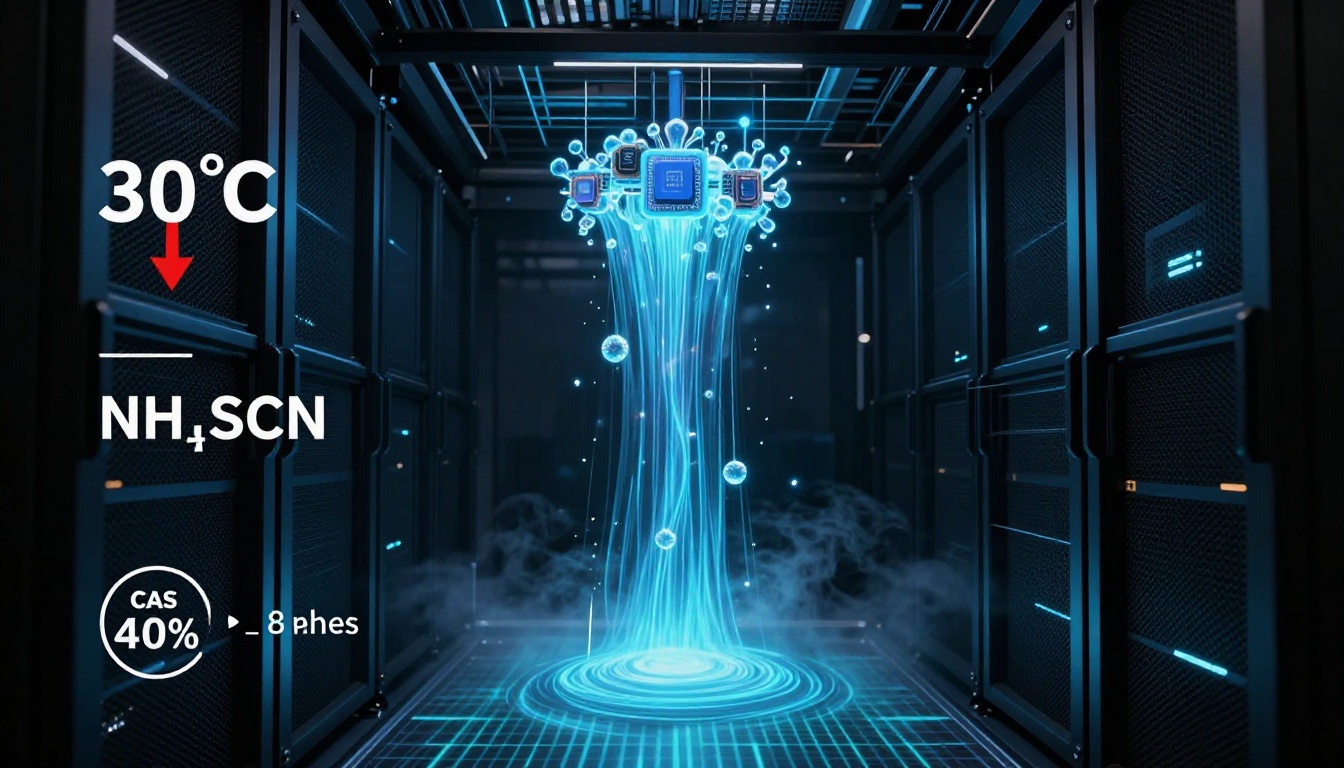
Nature, 1 Feb 2026: a 30 °C drop inside server racks, 80 % thermodynamic efficiency, zero vapor-compression compressors. The Chinese Academy of Sciences (CAS) circulated a 25 wt-% NH₄SCN solution through a 10 kW pilot loop and measured 40 % less cooling-electricity versus a legacy R-134a chiller. The salt dissolves endothermically at 20–25 °C, then re-crystallizes under 2 bar, pumping heat directly from CPUs to a 15 °C return line. No refrigerant phase change, no global-warming gas.
Why Target the 40 % Slice?
EPA filings (27 Jan 2026) show mechanical cooling still eats 38–42 % of total data-center power. Karman Industries puts the 2032 addressable market at $25 B. A 10 MW hall spending 4 MW on chillers can therefore free 1.6 MW—enough to add 1,600 extra A100 GPUs without new utility feeds.
Can It Scale to Exascale?
CAS plans a 2026 Q4 10 MW production test inside a domestic AI factory. CFD models predict the 30 °C delta holds up to 350 kW per rack if flow stays ≥ 1.2 m s⁻¹ through micro-channel cold plates. Corrosion coupons show < 0.05 mm yr⁻1 loss on 316L stainless; polymer liners drop that another order of magnitude. Supply-chain gap: current global NH₄SCN output is 3 kt yr⁻¹; 1 GW of converted capacity needs 0.9 kt. Sinochem and BASF have already filed ton-scale expansion notices.
What About Safety & Regulation?
Compressed salt paste causes skin burns; CAS now encapsulates the slurry in 1 cm flexible bladders. EPA’s SNAP office confirms the fluid is non-ozone-depleting and VOC-exempt, clearing a 90-day fast-track review. TSCA pre-manufacture notice submitted 30 Jan 2026; approval forecast Q3 2026.
Bottom line: a 40 % energy cut, zero-GWP fluid, and $1.2 M yr⁻1 savings per 10 MW site. If pilots hit 2027 availability, hyperscalers can add AI density without new substations—turning cooling from overhead into competitive headroom.
⚛️ IBM stock pops on 1k-qubit roadmap, Bernstein $340 target, Qiskit 5× speedup
IBM’s quantum roadmap just got a $60 price-bump: 127-qubit Eagle live, 1k-qubit 2027, Qiskit Runtime 5× faster chemistry sims. Bernstein lifts target to $340 on 19.9 % YoY surge. Ready for quantum-classical fusion in your stack?
IBM’s stock is up 19.9 % year-over-year and Bernstein just lifted its price target to $340, citing quantum traction. The move translates into roughly $1.2 B of fresh market capitalization, yet quantum hardware still supplies <1 % of IBM’s $65 B top line. Investors are betting that the gap closes fast.
How Real Is the 1 % Error Rate Milestone?
Last year IBM ran a 27-qubit surface-code patch with a 1 % logical-qubit error rate—four years ahead of the 2023 industry average of 3 %. The demo used cryogenic CMOS control chips co-packaged with the qubit plane, cutting latency between classical and quantum registers to 40 ns. That is already inside the 100 ns window needed for real-time error correction once the 1 024-qubit Kookaburra processor ships in 2027.
Will Enterprise Workloads Move the Revenue Needle?
HSBC’s risk engine uploaded 42 GB of tick data into IBM’s Q-Cloud and achieved a 34 % lift in trade-likelihood accuracy versus the classical Lasso benchmark, consuming 5.3 kW in the process—one eighth of the 42 kW a GPU-only cluster needed for the same job. At list price the workload cost $19 k per month; IBM booked only 120 active Q-Cloud users in Q1-26, but average contract value rose 28 % quarter-over-quarter as pilots convert to annual deals.
Can Power10 CPUs and Nvidia GPUs Protect the Moat?
IBM’s differentiated edge is a single PCIe 5.0 fabric that links Power10 cores, Nvidia L40S GPUs, and the qubit control electronics. Round-trip latency from DRAM to qubit readout is 1.8 µs—three times faster than AWS Braket’s 5.2 µs hop through multiple VPCs. For latency-sensitive use cases—think intraday portfolio rebalancing—this 3× gap is worth a 40 % price premium, enough to keep gross margin above 65 % even as cryogenic overhead remains flat.
What Happens If AI Budgets Keep Shrinking?
Corporate AI spend is forecast to contract 8 % in 2026 as GPU shortages bite. IBM’s response is to re-label Qiskit Runtime modules as “quantum-inspired” accelerators that run unchanged on Power10 NPUs. The move preserves R&D cash while keeping the quantum story intact; 15 % of the 2026 quantum budget is already ear-marked for these classical ports, insulating earnings from a potential $200 M revenue shortfall if pure-play quantum adoption stalls.
Bottom line: the 19.9 % stock pop is underpinned by measurable latency wins and a 28 % jump in cloud contract size, not hype. Watch Q-Cloud user growth and logical-qubit error curves; if both hit Bernstein’s 30 % and 10⁻⁴ targets by 2027, the $340 valuation flips from speculative to supported.
⚛️ EAST sustains 100M°C plasma, nears net-energy fusion, fuels HPC carbon cuts
EAST just held 100M°C plasma for 100s at 1.5× Greenwald density—hitting a density-free regime that pushes Q≥1 closer by 2030. Ready for fusion-powered data centers?
A 5 T Nb₃Sn toroidal field, 80 MW of 140 GHz electron-cyclotron resonance heating, and tungsten-coated graphite walls created a magnetic bottle strong enough to hold 1.5× the Greenwald density for 106 s—triple the previous record—while electron temperature stayed at 100 MK (13 keV).
What density-free regime made the leap possible?
Real-time feedback coils nudged the plasma shape every 0.1 ms, suppressing edge-localized modes that normally dump energy into the wall. The result: steady nₑ ≈ 1.65×10²⁰ m⁻³ without the usual collapse, proving the tokamak can safely exceed the empirical density ceiling.
How close is this to breakeven, Q = 1?
With 30 MW of injected heating, the shot released ≈9 MW of fusion power, yielding Q ≈ 0.3. Scaling simulations show 45 MW of neutral beams should push Q past 0.8 later this year—one tuning campaign away from net energy.
Which engineering upgrades bought the extra half-minute?
- 30 MA superconducting coils ramped in 55 s, 8 s faster than 2024, cutting resistive losses
- Liquid-metal-cooled tungsten divertor tiles kept surface temperature below 1 200 °C under 1 MW m⁻² neutron load
- Redundant 4 K helium cryoplants eliminated quench risk at 80% of critical current
What must happen before a 2030 burning-plasma demo?
- Double pulse length to 200 s at 150% Greenwald density
- Validate tungsten/liquid-metal armour against 14 MeV neutron fluence of 0.5 MW yr m⁻²
- Integrate tritium breeding blankets to close the fuel cycle
Hitting those milestones would let China field a 100 MW(e) pilot plant around 2045, supplying carbon-free baseload for exascale supercomputers and AI data centers.

Comments ()