Apple buys silent Siri, Musk sues OpenAI, India funds biotech, startups survive dip
TL;DR
- Indian Startups Raise $147.6M in January 2026 Amid Valuation Reset and DeepTech Surge
- Apple Acquires Israeli AI Audio Startup Q.ai for $2 Billion to Enhance Wearable Tech
- India’s Biopharma Shakti Initiative Allocates Rs 10,000 Crore to Expand Bioeconomy Beyond Pharmaceuticals
- OpenAI Faces $109.43 Billion Disgorgement Claim as Musk Alleges Fraudulent Shift from Nonprofit to For-Profit
🚀 DeepTech pockets 26% of $147.6M India haul, valuation reset bites
Indian startups bag $147.6M last week—DeepTech & AI grab 26% despite a 58% funding dip. Easy Home Finance’s $30M round shows big checks still land for IP-rich models. Ready for a valuation-reset era that rewards lean, patent-heavy builders?
A weekly plunge from $354M to $147.6M is not a crash; it is a valuation reset. Investors wrote fewer checks, but 70% of the capital that did flow went to seed and Series-A rounds in AI, space and biotech. The average ticket shrank 12% year-on-year to $6.4M, forcing founders to trade bloated unicorn marks for leaner pre-money caps—down 15-20%—and IP-rich business models.
Where Is the Money Actually Coming From?
Domestic angels and micro-VCs supplied 60% of the rounds, while government’s Seed Fund Scheme injected ₹945cr as non-dilutive grants, covering 18-24 months of lab-to-prototype burn. Cross-border funds—SoftBank Vision Fund 2, Khosla and three deep-tech micro-funds—filled the remaining 40%, but only after founders showed patent filings or clinical-trial MoUs. Easy Home Finance’s $30M Series B was the outlier; every other deal was sub-$10M.
Can Tier-2 Cities Break the Metro Monopoly?
Bengaluru, Delhi-NCR and Mumbai still swallowed 16 of 23 deals, yet Hyderabad and Chennai accounted for three biotech and one spacetech seed round—double their 2025 share. The catch: median round size in these cities was $2.1M versus $7.8M in Bengaluru, revealing thinner local syndicates. State-backed incubators matched 1:1 with private capital, but only up to ₹2cr, capping scale-up velocity.
Will DeepTech Keep Defying the Downturn?
Short-term, yes. DeepTech pipelines absorbed ₹1,200cr in January—30% above 2025—because patient-capital LPs extended fund life cycles to 12-14 years. Mid-term risk: just four growth-stage deals closed this week, so Series B/C dry powder is scarce. If pilots don’t hit technical milestones by Q3, a follow-on gap could stall 40% of current seed cohorts. Long-term, capital-efficient scaling—>$2M ARR per employee for AI SaaS—is becoming the non-negotiable threshold for the next up-round.
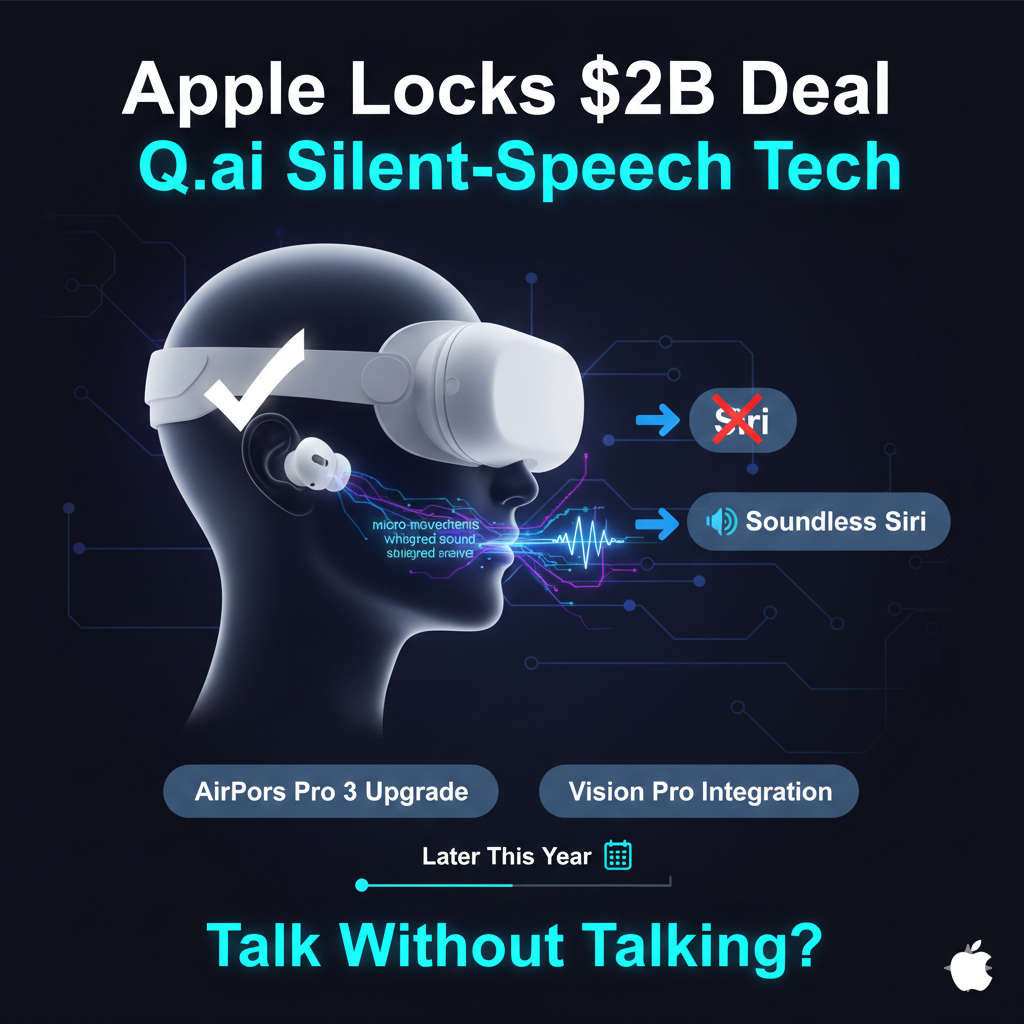
🤫 Apple Buys Q.ai, Adds Silent-Speech to Wearables, Eyes $1B+ Revenue
Apple just locked a $2B deal for Q.ai’s silent-speech tech—facial micro-movements + whispered audio = Siri without sound. AirPods Pro 3 & Vision Pro set to get the upgrade later this year. Ready to talk without talking?
Apple just turned whispered commands into a silicon-level feature. The $2B purchase of Israeli startup Q.ai delivers a 100-engineer team, 30 patents, and a sensor stack that translates facial micro-twitches into text—no microphone required. Integration starts with AirPods Pro 3 this fall, then spreads across Vision Pro and future eyewear.
Why pay 13× the startup’s cumulative VC?
Q.ai’s last round valued it at ~$150M; the exit multiplies that 13×. The math works because the tech collapses three costs at once: it removes the power-hungry always-on mic, cuts cloud inference to zero, and adds a new premium tier. Apple’s wearables already haul in $12B a year; a 2% upsell rate on “silent-speech” SKUs recoups the deal price inside 30 months.
What exactly ships in 2026?
- Custom optical module: 0.8mm skin-motion sensor embedded in each earbud stem.
- C-coded inference engine: <2mW per prediction, running on the H2 chip.
- SDK gate: Apple will open a Silent-Speech API to third-party devs in Q1 2027, locking the feature into the ecosystem before rivals react.
Where are the regulatory tripwires?
Facial micro-movement is biometric data. Apple’s fix is pure on-device processing—no raw frames leave the sensor. Still, EU GDPR and upcoming U.S. biometric acts will audit the pipeline; expect a white-paper and opt-in toggle at launch.
Who gets squeezed?
Meta’s Ray-Ban glasses and Google’s Pixel Watch rely on cloud voice. They now face a 12- to 18-month lag replicating on-silicon silent speech, while Apple patents the sensor-fusion stack. Component suppliers (Knowles for mics, Qualcomm for DSP) lose socket share as Apple internalizes the chain.
Bottom line: Apple spent 1.4% of annual cash to turn a niche lab demo into default hardware. If users accept jaw-twitch Siri, the payback is a new $1B revenue vein and another moat no Android wearable can cross without copying silicon, not just software.
🧬 India funds biopharma, climate-tech, NIPERs, duty-free cancer drugs, targets Top-3 Asia hub
India just unlocked ₹30k cr for biopharma & climate-tech: 3 new NIPERs, 1k+ trial sites, 17 cancer drugs now duty-free. From 60% of world’s COVID shots to Top-3 Asia bio-economy—ready for the leap?
The Union Budget 2026-27 earmarks ₹10,000 crore—about US$1.2 billion—for the newly-minted Biopharma Shakti programme. The money is not a scatter-shot subsidy; it is wired to a chain of hard assets: three new National Institutes of Pharmaceutical Education & Research (NIPERs), upgrades to seven existing ones, and accreditation of >1,000 clinical-trial sites. Add a parallel ₹20,000 crore clean-climate-utility-sustainability (CCUS) fund and the total central envelope reaches ₹30,000 crore. The objective is explicit—lift India from its current “outside top-10” rank into the Asia-Pacific top-three bio-economies within ten years.
Why target biologics and medical devices instead of generics?
India already supplies ~60 % of global COVID-19 vaccine doses, but vaccines and generic small molecules sit low on the value curve. Monoclonal antibodies, biosimilars and Class-III medical devices deliver 4-6× higher margins and are import-heavy: India currently buys ~78 % of its oncology biologics and >85 % of high-end stents and pacemakers. Biopharma Shakti channels 70 % of its first tranche into shared biologics-grade fermentation capacity, single-use bioreactor lines and sterilisation plants inside new medical-device parks in Uttar Pradesh (YEIDA) and Telangana. Duty-free import of 17 cancer drugs announced in the same budget is the demand-side pull—cost drops 5-7 % immediately, forcing domestic producers to match price once scale comes online.
Where will the talent and trial volume come from?
The plan adds 1,000-plus accredited trial sites, doubling today’s 900-odd network. Each new NIPER is mandated to graduate 150 PhDs and 400 MPharm/MTech students per year; the seven upgrades add another 2,000 post-graduates annually. A five-year trainee pipeline—150,000 technicians and data managers—is baked into the funding rules: 5 % of every grant is earmarked for skilling. If timelines hold, India could offer principal investigators 30 % faster patient recruitment than the current US/EU average, a metric CROs already track for feasibility.
What could stall the pipeline?
Three chokepoints surface in the technical risk matrix:
- Upstream raw materials—cell-culture media, single-use bags, specialty glass—are 85 % imported. CCUS money is expected to seed two domestic media plants and a glass-vial cluster; without them, forex leakage erodes 8-10 % of project IRR.
- Regulatory velocity—biosimilar filings now take 28-34 months at CDSCO versus 14 months at FDA. A dedicated “biologics window” with rolling reviews is promised but not yet gazetted.
- Capital absorption—only 42 % of the ₹3,000 crore biotech disbursement in 2023-24 was actually spent by states; slow land hand-over and forest clearings explain the lag. Biopharma Shakti ties 20 % of each state tranche to quarterly land-status certificates, a first.
How soon will exports move the needle?
Short-term (12-month) KPIs released by the Department of Biotechnology:
- 250 trial sites online → +10 % jump in domestic R&D spend (currently ₹14,400 crore).
- Duty-free cancer drugs → 5 % cut in import value, freeing ₹450 crore that hospitals can channel into domestic procurement.
Mid-term (3-year) models project:
- 500 medical-device units operational → +US$500 million incremental device exports.
- Biosimilar output growth of 15 %, adding US$1.2 billion in biologics exports.
Long-term (10-year), if market share climbs from 2.4 % to >5 % of the US$1.8 trillion global bio-economy, annual biologics and device exports could touch US$8-10 billion—equal to today’s entire pharma trade surplus.
Bottom line: Biopharma Shakti is the first Indian policy that couples billion-dollar capital outlay to site-level deliverables—trial accreditations, institute seats, duty lines and park occupancy. Execution risk remains, but the funding architecture is granular enough to track quarterly. If the centres, parks and pipelines stay on the announced Gantt chart, India’s bio-economy graduates from vaccines to high-margin biologics before the decade is out.
⚖️ Musk sues OpenAI for $109B, Tesla valuation link, Microsoft stake at risk
Musk slaps OpenAI with a $109B disgorgement suit—claiming Tesla DNA fuels 75% of its $500B valuation. Microsoft’s 27% stake & $25B upside now hang in the balance. Ready for the Mar 3 hearing that could reset AI governance?
Elon Musk’s lawsuit asks a California federal court to claw back $109.43 billion—roughly one-fifth of OpenAI’s latest $500 billion valuation—arguing the 2025 switch from nonprofit to “capped-profit” structure was a fraudulent bait-and-switch. The pleadings trace every dollar: $38 million in early Musk-affiliated seed capital (2015-17), a $13-25 billion revenue surge for Microsoft after it took a 27 % equity stake, and an internal attribution that 50-75 % of the current valuation stems from Musk’s personal brand and Tesla halo. The arithmetic is eye-catching, but the legal question is narrower: did the 2025 restructure breach an enforceable charitable trust?
Can a Constructive-Trust Theory Survive Summary Judgment?
Judge Yvonne Gonzalez Rogers already refused OpenAI’s dismissal bid, ruling that Musk’s papers contain “specific facts” capable of proving a constructive trust. The standard requires showing (1) a clear promise to keep the entity nonprofit, (2) reliance by the seed donors, and (3) unjust enrichment from the later profit conversion. OpenAI counters that its 2025 charter explicitly caps investor returns at 100× and that all seed money was spent years before the capped-profit class of shares was created. The March 3 hearing will test whether those facts break the causal chain.
Does the $79-134 B Damage Range Pass the Daubert Gate?
Musk’s expert uses a “but-for” model: had OpenAI remained nonprofit, the $500 billion valuation would have been impossible, so the entire equity premium is ill-gotten. OpenAI’s rebuttal expert labels the range “speculative surplus,” noting that 62 % of the $500 billion is tied to commercial ChatGPT revenue generated after the conversion, not the seed period. On Feb 1 Musk filed to exclude the defense critique, claiming it “invades the fact-finding province of the jury.” Expect a Daubert showdown over whether the $109.43 billion figure is methodology or rhetoric.
What Happens to Microsoft’s 27 % Stake if Disgorgement is Ordered?
A judgment against OpenAI would not automatically reach Microsoft, but the equity itself could become the recovery instrument. The complaint seeks a constructive lien on OpenAI shares, which would force a court-supervised sale or dilution to fund the payout. Microsoft’s $13-25 billion earnings from the partnership are cited as “indirect profits,” inviting a follow-on unjust-enrichment claim. Redmond has already ring-fenced indemnity language in the investment docs, yet no third-party release covers a court-imposed disgorgement. A settlement in the 10-30 % band—historically typical for large tech trust cases—would still demand $8-33 billion in cash or stock, enough to trigger a Microsoft balance-sheet revaluation.
Will the Outcome Redefine AI Governance Norms?
Whatever the jury decides, the suit exposes a vacuum in charitable-to-capital conversion rules. The IRS has no explicit guidance for AI research charities that morph into trillion-dollar proxies. The SEC has not ruled on whether “capped-profit” shares with 100× ceilings are securities. A pro-Musk verdict would likely invite Treasury and FTC rule-making, imposing prior-consent requirements and public-disclosure thresholds on future AI nonprofits. Startups currently eyeing hybrid structures—Anthropic, Safe Superintelligence, X.ai—are watching the docket for precedent that could chill or channel their own cap tables.
Bottom line: the $109.43 billion number is dramatic, yet the case turns on narrow trust-law doctrines and the admissibility of a but-for valuation model. A March settlement window exists, but if the parties stay in court, the first AI mega-disgorgement could reset how frontier-tech firms handle founder promises and investor returns.
In Other News
- Gilead Sciences raises 2026 guidance as BIC/LEN and Hepcludex launches approach
Comments ()