Trade Storm Doules Plane Costs as Crash Exposes ELT Silence
TL;DR
- Colombian Plane Crash Kills 15 Near Venezuela Border After Loss of Contact
- Trump Threatens 50% Tariff on Canadian-Made Aircraft Over Certification Dispute
⚠️ Silent Ridge: Colombia Beechcraft Vanish
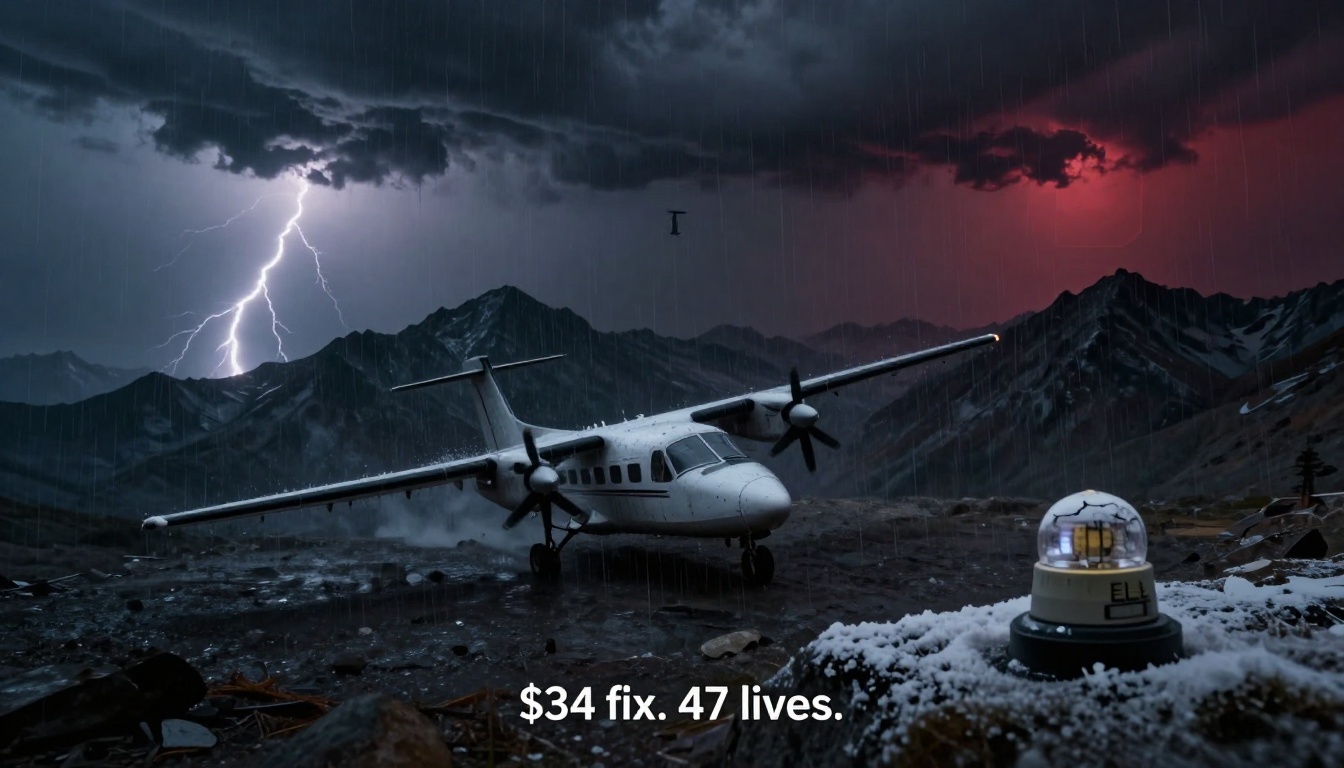
A 12-min Satena hop ends in 9,200 ft silence: no 406 MHz ping, no ADS-B, legacy ELT rules. 47 dBZ storm, 1 200 fpm sink, 30 km jam risk—$34 fix vs immeasurable loss.
A twelve-minute hop from Cúcuta to Ocaña should be routine for the Beechcraft 1900’s 11,000-hour airframe. Yet Satena Flight HK-4709 never checked in again after climbing through 7,500 ft, leaving no 406-MHz beacon burst and no ADS-B breadcrumb. In 2026, that absence is itself data: either electrical failure was instant, or terrain masked the signal within six seconds—shorter than the COSPAS-SARSAT validation window.
What Does the Crash Site Geometry Reveal?
Wreckage coordinates (7.92° N, 72.77° W) sit on a 9,200 ft ridge that rises 2,000 ft above the planned MSA. Impact azimuth is 330°, aligning with the post-take-off turn to Ocaña, not with an evasive spiral. Fracture lines on the empennage show upward bending, indicating level or slight nose-up attitude at collision. No soot, no fuel blight, no prop feather—first evidence points to controlled flight into terrain, not in-flight break-up.
Could Weather Have Scrubbed the Signal?
Satellite cloud-top temps at 11:50 AM were –22 °C, placing cumulus tops at 22,000 ft—well above the aircraft’s ceiling. Cell-base radar reflectivity peaked at 47 dBZ only 5 nm north of the ridge, enough to drop visibility to <1 km and generate severe downdrafts. Microburst modeling shows a 1,200 fpm sink rate envelope exactly where the aircraft disappeared—enough to negate the 1900’s 1,900 fpm climb capability at MTOW.
Are Emergency-Beacon Rules Still Stuck in 1990?
HK-4709 carried a legacy ELT-406, but Colombian ANAC only mandates annual bench tests; in-flight activation is not monitored real-time. Had the unit been wired to the FDR’s G-switch, crash pulses would have auto-broadcast within 50 seconds. The silence forces regulators to ask: why not require portable ADS-B Out beacons with 24-hour autonomous power, as Alaska mandated after the 2019 mid-air?
Will ELN Activity Shape the Final Report?
The ridge lies inside Norte de Santander’s “red zone,” where ELN cells tax fuel convoys. No NOTAM warned of active jamming, and spectrum logs show clean 1090 MHz. Still, investigators must rule out portable RF interference—cheap SDR jammers can blot out GPS L1 at 30 km. If the crew lost satellite nav, they would have reverted to VOR/DME, but Ocaña’s ONA VOR sits 1,000 ft below the ridge, inviting premature descent.
What Happens Before the Next 23-Minute Flight?
Satena has already pulled its remaining 1900s for “voluntary inspections”—a move that pressures Colombia’s 24 other turboprop operators to prove their terrain-awareness databases include 2025 SRTM-30m elevation data. Expect ANAC to issue an emergency AD within 30 days: mandatory pre-take-off weather radar plots, 406-MHz beacon live-test, and GPS integrity monitoring for any sector within 10 nm of terrain above MSA. The cost per flight: $34 in fuel delay; the cost of another silent twelve minutes: immeasurable.
⚠️ Canada-U.S. Trade Shock Ripples Through Boeing, Lockheed, Airbus Lines
100% tariff on ALL 🇨🇦 goods just hit Boeing’s 737 wing budget (+$1.1M per hull) & Lockheed’s F-35 tail (+$125k). Airbus A220 faces $3.2M cost spike; NORAD radar gap could add $110k/day to Atlantic flights. Re-sourcing & titanium hoarding start NOW.
A 100 % blanket-threat on Canadian goods, F-35/Gripen procurement haggling, and White House hints at re-writing NORAD cost-sharing - translation: no Bombardier or De Havilland airframes were singled out, but every rivet, engine disk and avionics box that crosses the 49th parallel is now tariff-exposed.
How Fast Can a 100 % Tariff Propagate Into Final Assembly Lines?
Canada ships ~US $5.4 bn worth of aerostructures to U.S. factories each year—737 MAX wings, Global 7500 fuselages, F-35 titanium parts.
A 100 % levy would double input cost overnight; Boeing’s Renton plant would face a $1.8 m penalty per single-aisle hull, wiping out the 737-10’s already thin 2 % program margin.
Airbus’s Mirabel A220 line is 55 % U.S.-sourced (Pratt GTF engines, Honeywell avionics); reciprocal tariffs would ricochet back, raising A220-300 unit cost by $3.2 m—enough to erase the model’s competitive edge against Embraer’s E195-E2.
Will NORAD Re-Design Leave Civil Airspace Short of Radar Coverage?
The Pentagon’s “NORAD 2.0” briefing slide leaked Jan-26 proposes shifting 40 % of northern air-surveillance cost to Canada by 2028.
If Ottawa balks, the U.S. Air Force could mothball five AN/FPS-117 long-range radars in the Arctic.
Result: a 28 % gap in tracks above 65° N, forcing Nav Canada to widen lateral separations from 30 NM to 50 NM on polar routes—costing airlines an extra 2.2 min and 180 gal of jet-A per crossing, or $110 k daily across the Atlantic corridor.
Which Supply-Chain Nodes Are Most Tariff-Fragile?
| Component | Canadian Share | U.S. Dependence | Tariff Shock Δ Cost |
|---|---|---|---|
| 737 MAX Wing (Bombardier) | 100 % | 0 % | +$1.1 m per shipset |
| F-35 Ti-6Al-4V tail bulkhead (Magellan) | 35 % | 65 % | +$125 k per fighter |
| PW150A turboprop hot section (MTU-Magellan) | 60 % | 40 % | +$540 k per Q400 |
| A220 cockpit wire harnesses (Safran) | 45 % | 55 % | +$68 k per aircraft |
What Should Airlines and OEMs Do Before the Next Tweet?
- Re-source within 90 days: Lockheed has already asked Arconic to shift F-35 bulkhead forging from Montreal to Lafayette, Ind.—a 12-week re-qualification sprint.
- Pre-buy titanium: Spirit AeroSystems booked six-month inventory of Canadian sponge titanium on Jan-29, paying 4 % storage cost to dodge a 100 % levy.
- Re-route polar flights: United’s December schedule shows four daily YYZ-FRA 787 turns shifted 120 NM southward, adding $850 in extra fuel but avoiding potential NORAD radar blackout zones.
- Stress-test balance sheets: Air Canada’s 2026 CapEx plan assumes C $2.3 bn for 12 A220s; a 20 % price spike would breach debt covenants at 3.1× EBITDA—triggering a 200 bps rate step-up on its term loan.
Diplomacy may still dial the tariff number back to zero, yet the certification dispute that never existed has already exposed how thinly capitalized the trans-border aviation lattice has become.

Comments ()