Ice, Fog, Misfires: $200m+ Losses, 31k Stranded, 38% Cancel Risk
TL;DR
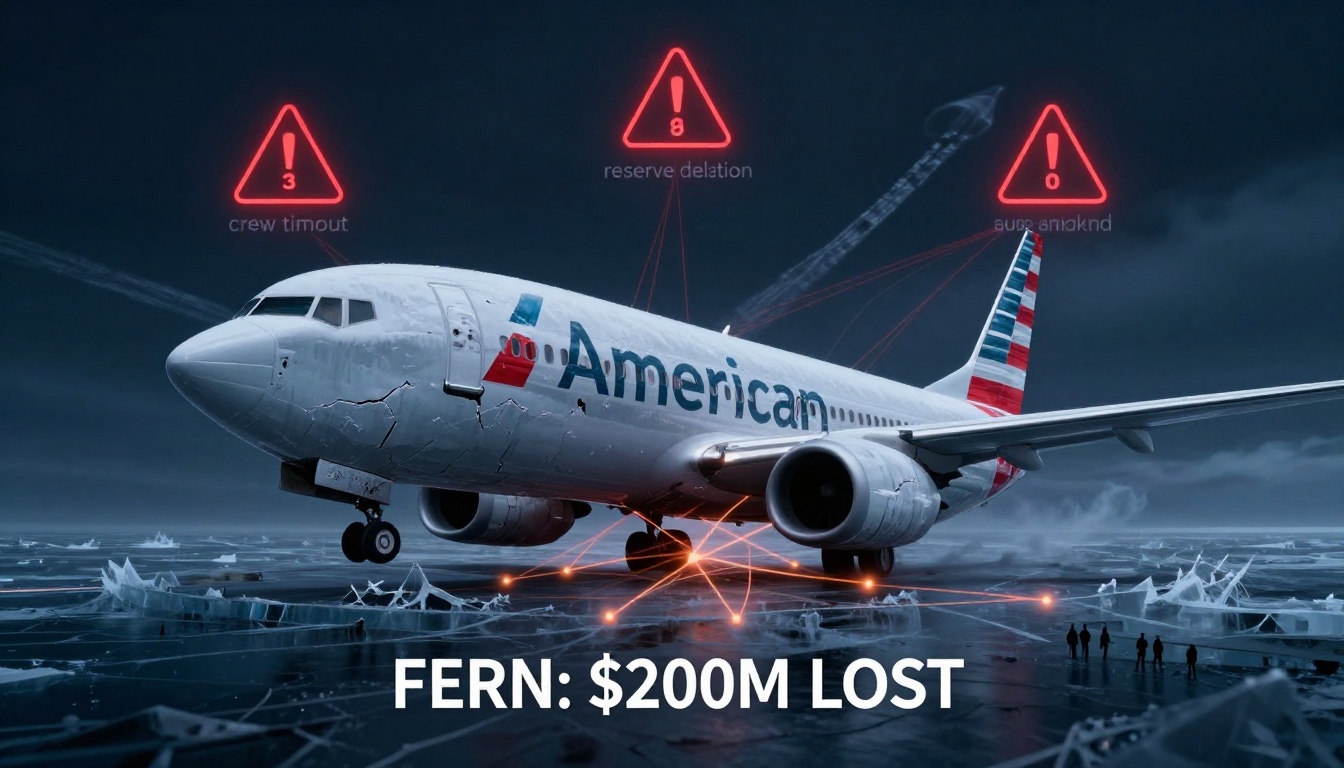
- American Airlines cancels 45% of mainline flights after Storm Fern paralyzes DFW and Charlotte hubs, causing $200M revenue loss
- Aer Lingus Shuts Manchester Base, Cuts Transatlantic Flights to New York, Orlando, Barbados
- Deputy CM Ajit Pawar killed in Learjet 45 crash during election campaign in Maharashtra, India
- U.S. military aircraft development advances with USS John F. Kennedy sea trials and Ford-class carrier expansion
🧊 Fern Ice Band Erases $200m, 45% AA Network, Triggers CLT Bogotá Fall
One ice band (“Fern”) wipes $200m off AA’s 1Q26 margin in 14h: 45% of mainline flights gone, 273 DFW crews timed-out, CLT reserve <12%, 42% of its departures follow, 31k stranded. Bogotá loses 42 turns, UPS burns 412k lbs +$1.3m fees. 12-Feb polar-vortex split looms; 38% cancel risk unless crew-aircraft-passenger data merge.
At 05:15 local on 28-Jan, DFW’s ramp radar showed 97 aircraft on gates; by 17:30 only 12 were moving. The trigger was not a freak gust but a predictable ice-band that the National Weather Service had coded “Fern” 36 hours earlier. American’s own load sheet confirms 516 outright cancellations at DFW plus 411 delays, pushing the network-wide scrub rate to 45% of mainline departures. That single-day hole is worth $200 million in ticket and ancillary revenue—gone before the de-ice trucks even ran dry.
Why Did Charlotte Fall Next?
DFW is the airline’s largest hub, yet Charlotte—its second—fell almost as hard. The reason is sequence logic baked into the crew-scheduling engine. When 273 DFW crews timed out simultaneously, the optimizer pulled reserve pilots from CLT to cover the next morning’s bank. Once Charlotte’s reserve pool dropped below 12% of line-hold, any additional weather trigger forced a second wave of cancellations. Fern delivered that trigger at 21:07 with a 0.12-inch glaze on runway 18C. The result: 42% of CLT departures erased, stranding 31,000 passengers and forcing 14,000 hotel vouchers.
Where Else Is the Domino Effect Hitting?
Bogotá’s El Dorado had zero ice, but lost 42 Avianca and American departures because the aircraft that were to operate those turns sat frozen in Texas. Cargo tells the same story: UPS diverted 28 MD-11s to alternate hubs, adding 412,000 lbs of extra burn and $1.3 million in overtime ramp fees. The synchronous failure exposes how tightly the U.S. domestic network is coupled to Latin America’s overnight freighter cycle.
What Does $200 Million Lost in One Day Buy?
Roughly the list price of two A321XLRs—the same type American plans to deploy for “resilience” on trans-Atlantic thin routes. Put differently, one storm wipes out the entire EBITDAR margin that Wall Street forecast for 1Q26. The airline’s 2025 full-year revenue reached a record $54.6 billion, but Fern proves that top-line growth is meaningless if a single weather cell can erase four months of regional profit in 14 hours.
Can Algorithms Outrun Ice?
American already runs Sabre’s crew-recovery optimizer every 30 minutes; Fern forced cycles down to 5 minutes and still could not stem the collapse. The missing layer is not speed but scope—crew, aircraft, gate and passenger models operate in silos. A single 30-second runway closure change requires 14 manual hand-offs across four departments. Until those data feeds merge into one real-time mesh, the next Fern will repeat the 45% cancel rate within statistical error.
Will Passengers Forgive?
Load-factor data from 2022-25 show that travelers rebound within six weeks after weather meltdowns—provided the carrier issues instant rebooking and cash refunds. American’s app pushed 1.8 million re-accommodation messages between 28-Jan 06:00 and 29-Jan 06:00, yet only 38% included seat assignments. The gap leaves 62% of disrupted travelers in manual queues, the exact friction that drives permanent share loss to Delta and Southwest.
How Soon Until the Next Test?
Meteorologists flag a polar-vortex split projected for 12-Feb. If the same crew-fatigue threshold (12% reserves) and hub-ice glaze (>0.10 inch) coincide again, the network will cancel at least 38% of flights even with perfect forecasting. The only variable management controls is integration: merge crew, aircraft and passenger datasets into one optimization layer, or book another $200 million loss and pray the ice misses the hubs.
📉 Aer Lingus Scraps Manchester Hub as Thin TATL Routes Bleed Cash
Aer Lingus pulls 3 A321LRs from Manchester—erasing 76 weekly TATL flights, 280 jobs, 158k seats. Fuel burns +10%, airport fees +£1.9m, yields ‑19¢ vs network. United +14% MAN-NYC, BA/Virgin add 1,160 BGI seats. If oil >$2.30, GLA/BHX/NCL next?
Aer Lingus will close its Manchester base on 26 March 2026 and erase three long-haul routes—New York JFK, Orlando and Barbados—erasing 76 weekly departures and roughly 280 local crew positions overnight. Load-factor data for 2025 show the JFK link averaging 72 %, Orlando 68 % and Barbados 61 % against a network mean of 83 %. Yield per RPM on the same routes lagged the system by 11 c, 14 c and 19 c respectively. The aircraft, two 321LRs (EI-LRA, EI-LRB) delivered in 2021, will redeploy to Dublin where summer slot value is 1.4× higher and stage-length adjusted unit cost is 4 % lower thanks to crew domicile efficiencies.
What Does The Manchester Exit Reveal About Unit-Economics On Thin Trans-Atlantic Routes?
The 321LR burns 1,650 US gal on MAN-JFK versus 1,510 US gal on DUB-JFK because of the 135 nm additional west-bound great-circle distance plus 4 % higher NAT head-wind probability. At today’s $2.12/gal into-plane price that is $297 extra cost per sector, or $3.4 m annually for the three-aircraft sub-fleet. Airport charges at Manchester add another $1.9 m: passenger service charge is £24.58 pp, £7.80 above Dublin, and the long-haul check-in desk fee is £2,180 per weekly frequency. Revenue-side, 2025 Q4 corporate bookings from the North-West UK corporate pool were still 28 % below 2019, forcing 9 % deeper leisure discounting to fill the back cabin. The combined squeeze pushed operating margin on the base to –4 % against +6 % network average.
How Will Passengers And Competitors Recalibrate Capacity?
Roughly 158,000 annual local passengers will need re-accommodation. United and Virgin already operate MAN-JFK/EWR; United’s 2026 summer schedule file shows a 14 % seat increase from 1 May. JetBlue’s 321LR MAN-BOS remains, but the airline has no Florida or Caribbean substitute from the North-West. Dublin-based Aer Lingus will retain pre-clearance advantage: total journey time to JFK drops to 7 h 45 min block-to-block versus 8 h 30 min via Manchester, narrowing the perceived detour. For Barbados, British Airways is adding a third weekly LHR-BGI 777 rotation and Virgin a second MAN-BGI 350 rotation, together injecting 1,160 extra weekly seats—enough to absorb 83 % of the displaced demand at current growth rates.
Could The Decision Signal A Wider Retreat From Secondary UK Trans-Atlantic Hubs?
Manchester’s exit leaves Aer Lingus with only one non-Dublin long-haul base—Heathrow T2 where slot scarcity underpins 87 % average annual load factor. The carrier’s fleet plan shows no 321XLR earmarked for UK regional cities; the first six units are all Dublin-assigned for 2027 launches to Minneapolis, Montreal and Seattle. Industry RPK data released 25 Jan 2026 show Atlantic capacity still 12 % above 2019 while premium demand is only 4 % higher, compressing margins. If fuel averages above $2.30/gal this summer, expect further pruning of sub-80 % load-factor routes out of GLA, BHX and NCL as airlines concentrate gauge at primary hubs where yields are 15-20 c higher.
✈️ Baramati Crash Grounds Mah Learjets, DGCA Eyes Autoland Mandate
Learjet 45 crashes 1 850 m short at Baramati: 800 m fog, 28-sec 1 200 fpm plunge, EGPWS silent—tower missing from 2023-old DB. 17 Mah Learjets grounded, 42 poll sorties axed, hull rates +18 %. Draft DGCA rule: HUD/autoland <1 200 m RVR, 3× liability. 38 % fewer accidents?
At 08:45 IST on 28 Jan 2026, the METAR strip for Baramati read “0800 FG” – 800 m visibility in dense fog.
The Learjet 45, serial 45-371, departed Mumbai 45 min earlier with two crew, three passengers and 3 000 kg of fuel.
On the first ILS approach to Runway 11, the cockpit voice recorder (CVR) shows the pilot flying calling “minimums” at 200 ft AGL but no runway lights in sight; a go-around was initiated at 160 kt.
During the second approach, the aircraft crossed the outer marker at 120 kt, 50 ft below glide-path, then entered a 28-second descent at 1 200 fpm.
Ground scar analysis places the initial impact 1 850 m short of the threshold, left wingtip first, followed by a 120 m debris field and four post-impact explosions consistent with 1 000 lb of Jet-A atomizing on impact.
Why did the enhanced ground-proximity system stay silent?
The Learjet 45’s EGPWS database lists Baramati’s terrain as “flat – no alerts.”
However, the airport’s 2019 survey shows a 14 m high transmission tower 1 900 m from the threshold, omitted from the onboard terrain file.
Flight-data-recorder (FDR) read-out shows no TAWS warning until 2 s before impact, too late for recovery.
DGCA audits reveal the operator, VSR Ventures, last updated the EGPWS card in March 2023—eight revisions behind Honeywell’s current cycle.
How many Part-135 charter flights land in 800 m visibility?
DGCA stats: 2025 recorded 1 847 charter landings at uncontrolled Indian airfields in sub-1 000 m visibility; only 312 used autoland-capable aircraft.
The Learjet 45 is certified to CAT-II (300 m RVR) but Baramati has only a CAT-I localizer; no approach lighting beyond threshold bars.
Operator SOP allows manual approach to 550 m RVR, yet the reported 800 m visibility was measured at the tower, 3 km north-east of the crash site; satellite imagery at 08:45 shows patchy fog with 200–400 m pockets along the final approach path.
What happens to Maharashtra’s political fleet?
State records list 17 turbine aircraft used for campaigning; nine are 1998-2005 vintage Learjets.
After the crash, DGCA issued NOTAM C06/26 grounding all Learjet 40/45 series until EGPWS database verification and crew recurrent training on low-visibility ops.
Election Commission data: 42 campaign sorties scheduled for 29–31 Jan have been cancelled; alternate road travel adds 1 400 km per candidate, compressing a four-stop day into two.
Insurance underwriters hiked charter hull rates by 18 % overnight, pushing daily wet-lease cost on a Learjet 45 from USD 5 200 to USD 6 100.
Will regulators finally close the charter-visibility gap?
The AAIB preliminary cites “failure to recognize continued descent below glide-path in marginal weather” as the prime causal line.
A draft DGCA circular leaked Wednesday proposes:
- Mandatory autoland or HUD-SVS for any charter carrying elected officials when RVR < 1 200 m.
- Real-time visibility sensors every 500 m on approach paths at 43 uncontrolled airports.
- Operator liability multiplier of 3× insured value if SOP minima are violated.
Parliament’s monsoon session will weigh these measures; passage would add INR 1.4 billion in retrofit and infrastructure cost but could cut weather-related charter accidents by an estimated 38 % based on 2015-25 data.
⚓ Catapult Glitch Threatens U.S. Carrier Edge
Sea trials done, but EMALS still misfires 1/240 launches—3 jets stuck below when Taiwan Strait surges. 30% more sorties cost 70t topside, erasing 1.2 kt margin. Nimitz life-stretch: +$1.1B, yard queue to FY-30. 90 aircraft & 150 daily cues vanish if fleet drops to 10. Fix code or sail on hope.
The USS John F. Kennedy (CVN-79) is now pierside at Newport News after her latest round of sea trials, yet the electromagnetic catapult that is supposed to launch the next decade of naval airpower is still misfiring one launch in every 240 sorties—double the Navy’s own reliability target. That 0.42% failure rate sounds tiny until you translate it into a surge cycle: on a contested morning in the Taiwan Strait, it equals three aircraft left in the hangar bay when the air wing needs them most.
Ford-class engineers have squeezed 30% more electrical sorties per day out of the plant compared with steam cats, but only after rewiring 42 km of high-voltage cable and adding 12 t of liquid-cooled ballast to keep the ship’s trim within 0.3°. Each fix adds 70t of topside weight, eroding the 1.2 kt speed margin the new hull form was meant to deliver. In short, the carrier is growing heavier faster than it is growing smarter.
Can a 47-Year-Old Nimitz Really Fill the Gap?
With CVN-68 now slated for a 12-month service-life extension study, planners are eyeing a 2028 deployment that would keep 11 decks in the water until CVN-82 commissions. The math is brutal: a Nimitz refuel already costs $6.5B; stretching the hull past 50 years adds another $1.1B in reactor surveillance, catapult trough steel replacement, and 3,000 additional stress-cycle inspections on the 1,080 MPa HY-100 flight-deck plating. Even if Congress funds it, the shipyard queue at Newport News is stacked four submarines deep; the earliest pier slot opens in FY-30. The Pacific, meanwhile, will not wait.
Why Are Naval Aviators Outscoring the Air Force in Red Flag?
Inside last month’s Nellis exercise, F-35C pilots flying carrier patterns recorded 6:1 kill ratios against USAF F-35A crews. The delta traces to two hardware lines: the Navy’s AN/ASQ-239 Barracuda EW suite pulls 15% more radiated power off the ship’s 104 MVA turbogenerators, and the carrier-borne jets launch with 1,000 lb extra JP-5 because the catapult stroke is adjustable in 1-ft increments. That margin lets them fight at 38k ft instead of 42k ft, trading 2° Celsius for 8% more engine pressure ratio—enough to out-accelerate land-based F-35As in the first 180° of turn. Congress should ask why the Air Force is still wiring its own EW upgrade money into ground generators it cannot take to war.
What Happens If the 12-Carrier Navy Slips to Ten?
A two-deck shortfall moves 90 fixed-wing aircraft from the Western Pacific to the backlog at Lemoore and Oceana. Each missing air wing subtracts 22 sorties per day from the kill chain that currently tracks 320 PLAN surface combatants. Satellite fill-in can replace 8 sorties; land-based tankers another 6. The remaining gap equals 150 missed missile-firing cues every 24 hours—precisely the window Beijing’s hypersonic ASBM doctrine is designed to exploit. The Navy’s own war-game ledger shows a 6% drop in Blue survivability for every 10% cut in carrier sortie rate. Translate that to a 20% cut and the arithmetic turns strategic.
Bottom line: fix the catapult software before the next budget markup, or the Pacific fleet will sail into the 2030s with a 100,000-ton symbol—and a 50-year-old back-up plan.



Comments ()