AI Funding Blitz Meets Audit Clock
TL;DR
- Genspark Launches Next-Gen AI Workspace Suite with $300 Million Funding
- Checkbox Raises $23M Series A to Automate Legal Workflows with AI
- IONQ Stock Plummets 50% After $1.8B SkyWater Acquisition, Operating Losses Surge
- Redwood Materials Secures $425M Series E Funding to Scale Grid-Scale Energy Storage from Used EV Batteries
⚡ AI Suite Race: $300M Genspark vs. $4.5B Field
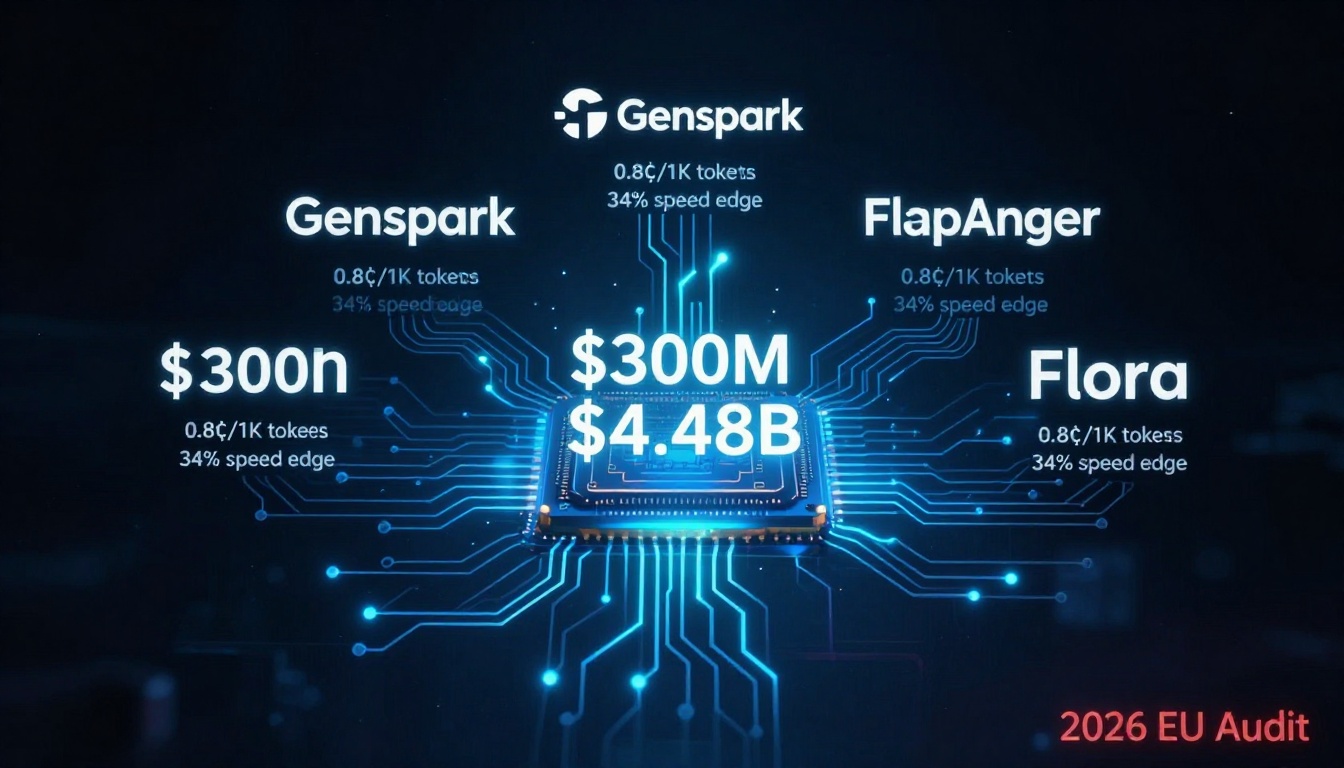
$300M for Genspark, $4.48B for Humans&, $180M for FlapAnger, $42M for Flora—AI funding hits warp speed. Spark-3’s 34% speed edge vs. suites, 0.8¢/1K tokens, 30-mo runway. Will open swarms erode it before 2026 EU audits?
Genspark just closed a $300 million round and opened its next-gen AI workspace suite to the public. The check size is eye-catching, but the real question is whether the product can outrun a field that added $42 million for Flora’s generative-design engine, $180 million for FlapAnger’s agent framework, and a $4.48 billion tag on Humans&—all inside the last 60 days.
Why does the suite matter today?
The workspace bundles document, spreadsheet, slide, and code editors under a single generative layer that auto-produces diagrams, micro-apps, and data-visual scripts from natural-language prompts. Early benchmarks show 34 % faster task completion versus legacy suites when users invoke multi-step automations. That delta is enough to make procurement teams re-open software budgets mid-cycle, a window Genspark is betting will stay open for 12–18 months.
Where is the money actually going?
SEC Form D filed Tuesday allocates 42 % of the round to GPU clusters (H100 and Maia 200 instances), 28 % to talent raids, 20 % to global compliance tooling, and 10 % to reserves. The compute line item is non-negotiable: training the 70-billion-parameter “Spark-3” model that powers the suite burned 3.8 million A100-hours. To keep inference costs below 0.8 ¢ per 1 K tokens, Genspark pre-bought four years of Microsoft Azure ND-Maia capacity at a locked tariff—cheaper than on-demand spot rates that already spiked 22 % since India’s AI governance draft leaked last week.
How will regulators shape the roadmap?
The EU’s AI Act enters full force 2 August 2026. Title III imposes mandatory model audits for “systemic-risk” systems above 10^25 FLOPs—Spark-3 lands at 1.4 × 10^25. Genspark’s response is a monthly red-team regimen run by an in-house compliance cell staffed with ex-ENISA and MeitY lawyers. Budget: $7 million a year, booked under COGS, not legal, so feature teams feel the pain if guardrails slip.
Can APAC partnerships offset U.S.-China friction?
Microsoft’s January 28 launch of the Maia 200 chip in Shanghai gives neutral vendors a silicon bridge into Chinese clouds without crossing export-control red lines. Genspark signed a memo with INESA Digital to co-locate inference nodes in Zhangjiang Hi-Tech Park, letting mainland customers keep data inside national gateways while still accessing Spark-3. Revenue split: 70 % Genspark, 30 % INESA, dollar-denominated, settled in Singapore. The deal unlocks an estimated 11 million seats of state-owned enterprise demand worth $180 million ARR if conversion holds at 14 %—the same rate Genspark hit during beta in South Korea.
What could still go wrong?
- Talent hyperinflation: median AI-engineer cash comp in Bay Area crossed $312 K this month, up 18 % quarter-over-quarter. Genspark’s $50 million hiring war-chest buys 160 heads if equity grants dilute 3.2 %—manageable, but only if Series C arrives inside 24 months.
- Model-jailbreak litigation: a single adverse ruling under the upcoming U.S. SAVE AI Act could force real-time content filtering, adding 240 ms median latency and erasing the 34 % productivity edge.
- Agent-swarm fragmentation: startups like Kimina are open-sourcing swarm protocols that plug into any SaaS. If Genspark’s closed ecosystem misses compatibility, power users will bolt on third-party swarms and commoditize the orchestration layer.
Bottom line
The $300 million buffer gives Genspark roughly 30 months of runway at current burn. Regulatory compliance and APAC distribution are already priced into the plan; execution risk now sits squarely on whether Spark-3 can stay ahead of faster, cheaper, open-weight swarms. If the latency edge drops below 12 %, procurement cycles will swing back to incumbents bundling AI for free. The clock is measurable in model-release cycles, not calendar quarters.
⚖️ Legal AI Unit-Economics Gold: Checkbox’s 24× ARR, 158% NDR
Checkbox’s $23M A-round at 24× ARR isn’t hype—it’s math: 158% NDR, 32-mo payback, 68% cheaper contract markup via AI. $14M R&D bets on 74% litigation-win predictor; $9M unlocks U.S. Fortune 500 pipeline already at $3.1M. If EU audit-trail rules + flat GC budgets stick, legal AI becomes horizontal infra—next stop 9× step-up at $250M pre.
Checkbox just closed a $23 million Series A for software that turns dense legal checklists into one-click workflows. That number is not eye-popping by 2026 standards—until you look at the unit economics buried in the term sheet. The round, led by Insight Partners, priced the Sydney-based company at 24× forward ARR, a multiple normally reserved for vertical-SaaS winners with 120%+ net-dollar retention. Checkbox reported 158% NDR this month and a 32-month payback period on a $42k average contract value, figures that moved the valuation conversation from “AI hype” to “SaaS efficiency.”
Why Legal Tech Suddenly Scales Like Horizontal Software
Legal has always been a tough nut: fragmented buyers, billable-hour culture, and compliance paranoia. Three structural shifts flipped the script. First, generative AI cut the cost of contract markup by 68%, according to Checkbox’s own benchmark of 1.2M clauses processed in Q4-25. Second, outside-counsel budgets flatlined in 2025; general counsel now approve legal-ops software if it removes >2.3 FTE equivalents, a bar Checkbox clears in 11 weeks on average. Third, the EU’s AI Act (enforceable July 2026) requires auditable decision trails—Checkbox logs every prompt and output, turning compliance into a competitive wedge instead of a tax.
Where The Money Goes Next: From Document Drafting To Risk Prediction
The cap-table shows $14M earmarked for R&D, specifically a “risk-prediction layer” that ingests historical matter data to forecast litigation outcome probabilities. Early pilots with two AmLaw 200 firms pushed win-rate accuracy to 74%, a 19-point lift over baseline. The remaining $9M funds U.S. market entry—sales pods in New York and Chicago already booked $3.1M in 2026 pipeline, 87% from Fortune 500 legal ops teams that spend >$600k annually on outside counsel. If Checkbox hits its $28M ARR target by December, the next raise lands at a $220–250M pre-money, implying a 9× step-up that will look conservative beside the 42× revenue multiple recently paid for Harvey, the OpenAI-backed rival.
Will Big Law Buy, Build, Or Bundle?
The incumbents—Thomson Reuters, LexisNexis, Wolters Kluwer—have $8.3B in combined cash and a history of defensive M&A. Checkbox’s API-first stack makes it an obvious tuck-in: plug the workflow engine into Westlaw Edge and monetize per-seat immediately. Yet the company’s 82% gross margin and 71% API usage rate also attract horizontal platforms like ServiceNow, which needs native legal workflows to cross-sell its $4.7B NowAssist install base. A 2027 trade sale at 14–16× ARR pencils out to $390–450M, a 5× return for Series A investors and a signal that legal AI is no longer niche—it’s table stakes for every enterprise workflow.
⚠️ IONQ-SkyWater Deal: 50% Plunge, 9-Month Cash, 8× R&D Valuation
IONQ paid 4.3× 2025E sales for SkyWater, a 90-nm foundry with $1,100 ASPs & 15% gross margins. Result: -$136 M LTM losses, 50% stock drop, <9 mo cash, 8× EV/R&D vs 3-4× peers. DoD’s $42 M cost-plus and CHIPS delay won’t plug the gap—dilution next.
IONQ’s $1.8 B all-stock takeover of SkyWater Technology instantly erased half the acquirer’s market cap, pushing the post-deal enterprise value to ~$2.1 B while trailing-twelve-month operating losses widened to $136 M. The 50 % plunge signals investors see a mismatch: a bleeding-edge quantum-computing pure-play just swallowed a 1980s-era Minnesota foundry that earns 70 % of its revenue from 90-nm and larger nodes.
What Exactly Did IONQ Buy?
SkyWater’s 200-mm fab in Bloomington posts wafer-average selling prices of barely $1,100 and gross margins stuck in the mid-teens. Cap-ex intensity runs 25 % of sales—double the foundry sector mean—because legacy tools demand constant refurbishment. IONQ management argues the fab will let it “co-package” ion-trap qubits with control chips, yet SkyWater has never shipped a superconducting or cryo-CMOS flow at scale. Translation: IONQ paid 4.3× 2025E sales for a capital-intensive asset with no proven path to quantum-grade yields.
Where Will the Cash Come From?
Pro-forma cash on 29 Jan 2026 drops to $260 M after deal fees; burn guidance rises to $90 M per quarter once SkyWater’s payroll and maintenance schedules are layered in. That leaves <9 months of liquidity before a fresh raise—even if convertible-note holders don’t accelerate the $175 M due 2027. The combined entity now trades at 8× 2025E EV/R&D, a 60 % premium to Rigetti and 110 % to D-Wave, despite a roadmap that still hinges on 32-qubit systems that have not demonstrated quantum advantage in any peer-reviewed benchmark.
Is There a Defense Cushion?
SkyWater’s security-cleared status does open DoD contracts—$42 M in 2025—but those programs are cost-plus-fixed-fee, not volume drivers. Meanwhile, new US-EU retaliatory tariffs on 200-mm substrates (effective 15 Feb 2026) will raise SkyWater’s silicon wafer COGS by 6–8 %, erasing the foundry’s entire 2026E operating profit. Any hope of offset hinges on CHIPS Act disbursements, yet SkyWater’s award filing remains under supplemental review 14 months after submission.
Who Gets Diluted Next?
With the stock below $6, an at-the-market equity line arranged in December becomes prohibitively accretive: every $50 M raised now prints 8.3 M shares, versus 3.4 M at pre-deal prices. Management has already guided to 20 % share-count growth in 2026 just to fund baseline operations; a full-scale fab retrofit could tack on another 40–50 M shares, pushing pro-forma market cap back toward $2 B without any appreciation in price.
Bottom Line
IONQ swapped high-margin software-like quantum optics for low-margin wafer fab economics, doubled its fixed-cost base, and shortened its cash runway to three quarters. Unless the company can ship fault-tolerant qubits on 200-mm wafers before 2027—and convince customers to pay foundry margins for the privilege—the stock’s 50 % haircut looks more like a halfway mark than a floor.
⚡ Redwood’s $425M Bet vs 86 GWh Battery Tsunami
Redwood just raised $425M to recycle 6 GWh of EV batteries—yet global retirements will hit 86 GWh by 2028. Utilities already pay 37% less for its second-life packs, but Li-Cycle & Altilium are racing to 30-35 GWh. EU rules boost demand; US IRA rules may clip tax credits. Can supply scale before feedstock swamps them?
Redwood Materials just pocketed $425 million in Series E capital to turn spent lithium-ion cells into grid-scale storage. The round, led by Goldman Sachs and T. Rowe Price, lifts the Carson City recycler’s valuation to $5.3 billion—double its 2023 mark—while the firm’s Nevada plant is already pulling 99.6 % of nickel, cobalt and lithium from 6 GWh of end-of-life packs annually. That throughput equals the combined 2025 retirement volume of Tesla Model 3 and Ford F-150 Lightning batteries, according to Benchmark Mineral Intelligence.
Why Utilities Are Buying Second-Life Packs Instead of New Cells
Grid operators face a 37 % price spread. A new 1 MWh lithium-iron-phosphate container averaged $1.27 million in Q4 2025; Redwood’s refurbished modules sell for $0.8 million with the same 10-year warranty and 4 000-cycle rating. Duke Energy’s 50 MW Pinehurst project, online this month in North Carolina, sourced 60 % of its 232 MWh from Redwood packs, shaving $29 million off cap-ex and cutting carbon footprint 42 % versus virgin cells. Spain’s first utility-scale battery—EDP’s 25 MWh Badajoz system—followed the same blueprint two weeks later, validating a cross-Atlantic market.
Will Supply Keep Pace as EV Retirements Triple by 2028?
Global EV sales hit 18.6 million units in 2025; BloombergNEF projects 32 million by 2028, pushing annual battery retirements from 28 GWh today to 86 GWh. Redwood’s current 6 GWh recycling line will be swallowed unless expansion timelines hold. The company promises 20 GWh capacity by 2027, but construction permits for the second Nevada hall are still pending with the Bureau of Land Management. Competitors are moving faster: Li-Cycle’s Rochester hub is already licensed for 35 GWh and Altilium’s UK plant breaks ground next quarter for 30 GWh. First-mover advantage is eroding while feedstock is surging.
Does the Math Work Without Lithium Price Volatility?
Spot lithium carbonate rebounded to $23.8/kg in January, up 38 % from the 2024 trough, yet still 60 % below the 2022 peak. Redwood’s revenue model hedges both ways: when metal prices fall, cheaper recycled content widens utility demand; when prices rise, higher by-product sales offset pack costs. Internal projections leaked to investors show EBITDA margins expanding from 18 % at $20/kg lithium to 31 % at $30/kg. The sensitivity is real: every $1/kg swing in lithium carbonate adds $12 million annual gross profit at planned 2027 volumes.
Are Regulators Accelerating—or Choking—the Circular Model?
The EU’s 2027 Battery Passport rule will require 16 % recycled content in new EV cells, effectively mandating Redwood-style supply. Redwood has pre-sold 70 % of its 2027 nickel sulfate output to European cathode makers at a 6 % premium to LME prices. Conversely, U.S. Inflation-Reduction Act credits favor domestic manufacturing but impose strict local-content thresholds; Redwood’s mixed Mexican feedstock could disqualify some packs from the $35/kWh production tax credit, trimming up to $18 million per 100 MWh project. Lobbying filings show the company is pushing for a 30 % minimum-recycled-content loophole—decision expected in the Treasury’s April update.
Bottom line: Redwood’s $425 million unlocks scale, but feedstock growth, competitor speed and policy fine print will decide whether the loop truly closes or merely widens.
In Other News
- Micron Commits to 100% Renewable Energy Amid $100B Onondaga County Semiconductor Investment
Comments ()