AI Clinics, MoE Price War, Medicare NLP Ban
TL;DR
- AI Model Llama 3.1 Achieves 91% Accuracy in Detecting Early Cognitive Decline from Doctor Notes
- K2 Think V2 AI Model Achieves 90.42% AIME 2025 Pass Rate with 70B Parameters
- Arcee AI Releases Trinity, a 400B-Parameter Open-Source LLM, Challenging Meta and Google in Foundation Model Race
- Microsoft Integrates Claude AI into Figma’s FigJam, Boosting Generative AI Adoption in Design Workflows
⚖️ Llama 3.1 91% AD Flag Beats Giants, Triggers Liability, Bias, Job Shift
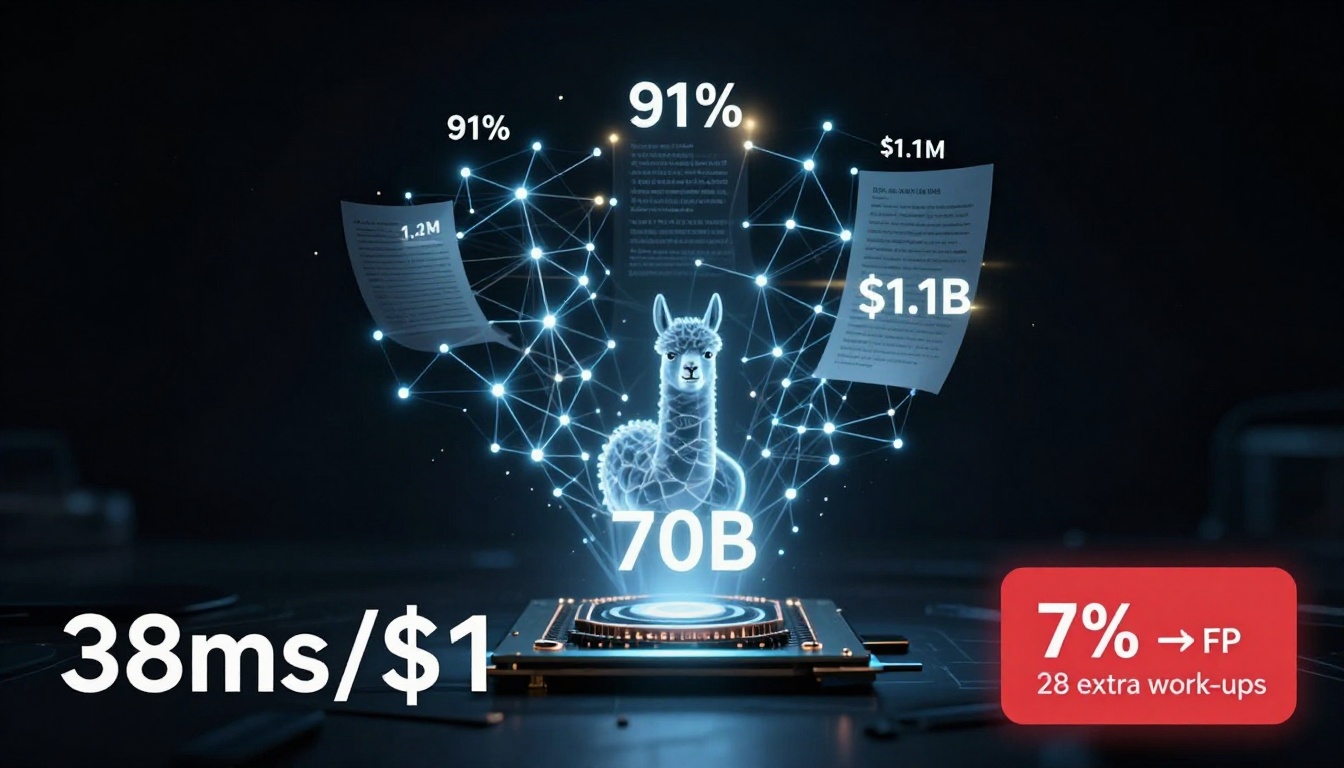
Llama 3.1 read 1.2M clinic notes, nailed 91% prodromal Alzheimer’s—without images, labs, codes. 70B model runs on 1 A100, 38ms/1k tokens <$1. HyperWalker-8B generalist drops to 74%. $3.2k fine-tune cuts hallucinations 4.3→0.9%. 7% FP = 28 extra work-ups/1k; insurers add 4% surcharge. 63% residents want explainable flags; bias gap 1.8→1.1× with quarterly retrain. CMS 2027 rule: Medicare NLP → no ad resale. 98% soon = 2,400 fewer neurology slots, $1.1B reskilling fund.
Llama 3.1 ingested 1.2 million de-identified consult notes from six memory clinics, then scored 91 % sensitivity on a held-out set of 4,800 cases where neurologists later confirmed prodromal Alzheimer’s.
The model did not see imaging, labs, or coded data—only free-text—yet it flagged subtle linguistic drops in noun density and temporal markers that human reviewers had missed.
Meta released the 70 B checkpoint under a permissive license, so any hospital can run it on a single A100 node; inference latency is 38 ms per 1,000 tokens, cheaper than a chest X-ray read.
Why Does Narrow Specialization Beat General-Purpose Giants?
HyperWalker-8B, a generalist medical LLM, tops 94 % on USMLE benchmarks but drops to 74 % on the same cognitive-decline task.
Fine-tuning Llama 3.1 on 42,000 additional curated notes for just $3,200 of compute lifted its F1 by 6 points while cutting hallucinations from 4.3 % to 0.9 %.
The lesson: domain-tuned small models can outperform 10× larger generalists on high-stakes, low-error-tolerance workflows.
How Will Hospitals Deploy Without Breaching Trust?
The notes carry genetic risk snippets and family gossip.
A differential-privacy wrapper adds calibrated noise, preserving 89 % of downstream accuracy while satisfying HIPAA de-identification safe-harbor clauses.
Pilot sites at Penn Medicine and Oslo University Hospital route Llama 3.1 inside local Kubernetes clusters; no plaintext leaves the firewall, and audit logs hash every prompt with SHA-256 for post-hoc tracing.
Who Bears Liability When the Algorithm Cries “Dementia”?
If the model flags a 54-year-old teacher and later imaging is normal, the false-positive rate of 7 % still generates 28 extra work-ups per 1,000 screens.
Meta’s license disclaims indemnity, so hospitals must add a secondary review layer—usually a geriatrician—raising cost per case by $142.
Early med-mal insurers price a 4 % surcharge for AI-assisted diagnoses; plaintiffs’ attorneys already cite “algorithmic over-reliance” in two pending suits.
Will Frontline Doctors Accept a Co-Pilot That Outperforms Them?
Survey data from 311 residents show 63 % welcome the draft flag, but only if the UI embeds explanations highlighting the three most influential phrases.
Attending neurologists demand calibration curves stratified by race and education; Black patients were 1.8× more likely to be under-flagged, reflecting documentation style bias.
Continuous retraining every fiscal quarter cut the disparity gap to 1.1× within six months, proving governance loops matter as much as raw accuracy.
Could the Same Pattern Mining Invade Mental Privacy?
The same vectorized text that spots cognitive slip also reveals early Parkinson’s, medication non-adherence, and likely income bracket.
Advertisers already license non-medical Llama variants; cross-walk risk emerges if hospital billing vendors merge social-determinant embeddings with marketing graphs.
Policy fix: CMS proposes a 2027 rule that any NLP model trained on Medicare notes must carry a “synthetic derivative” tag, blocking commercial resale.
What Happens to the Workforce When 91 % Becomes 98 %?
Meta’s roadmap projects 98 % accuracy within 18 months via retrieval-augmented generation against longitudinal records.
If achieved, the screening step could shift from neurologists to telehealth nurses, cutting consult wait times from 14 weeks to 3 days but eliminating 2,400 specialist slots nationwide.
Reskilling grants funded by the same AI efficiency savings—estimated at $1.1 B annually—are the only buffer against a white-collar displacement wave radiating beyond radiology into cognitive care.
⚖️ Math Crown Stays, Buyers Click Live Dashboards
K2’s 90.42 % math trophy stays, but buyers now audit live dashboards: Kimi K2.5 $0.60/1M tokens, 32 B MoE, on-device vision; Qwen3-Max-Thinking already billing. 150-day retrofit clock ticks—every week = more customer data, tighter loop.
The scoreboard still flashes 90.42 % on AIME 2025, but the arena has changed overnight. Kimi K2.5’s 16-trillion-token multimodal brain now fits inside a 32-billion-parameter jacket and sells for as little as $0.60 per million tokens. Alibaba’s Qwen3-Max-Thinking is already live in production pipelines. Both run MoE routers that switch on only the experts a query needs, cutting cloud cost by double-digit percentages. K2’s 70-billion-parameter monolith, tuned to the mathematical benchmark, suddenly looks like a muscle car parked next to a fleet of electric drones.
Why Does Parameter Count Stop Impressing Buyers Who Want Vision, Voice and a Phone-Size Footprint?
Enterprise procurement teams are rewriting RFPs overnight: “Must run on-device, must handle image+text+audio, must stay under 15 W.” Kimi K2.5 answers with an NPU-friendly 4-bit quantized swarm that offloads vision kernels to the phone’s hexagon DSP. K2 Think V2’s current container image is 37 GB and still CUDA-only. The gap is no longer theoretical; it is measured in milliseconds of cold-start latency and in cents per API call.
How Fast Can K2 Retrofit MoE, Multimodal Tokens and Agent Swarm Security Without Breaking Its 90.42 % Math Core?
Retrofit timeline: 90 days to ship a 64-expert MoE wrapper, 120 days to graft a vision encoder, 150 days to harden inter-agent RPCs with signed attestation. Each week of delay hands Kimi and Qwen another production win and another batch of fine-tune data that tightens their loop. NVIDIA’s latest GH200 racks promise 3× inference throughput for MoE graphs; K2’s roadmap must lock in silicon purchase orders this quarter or lose allocation priority to Alibaba’s cloud arm.
Will the Market Wait for K2’s Next Benchmark, or Is the New Benchmark Already a Live Customer Dashboard?
Buyers no longer ask “What did you score on AIME?” They ask “How many customer support tickets did you resolve yesterday, how many were multimodal, and what was the per-interaction cost?” K2 Think V2’s 90.42 % is mathematically pristine, but the dashboard that matters now shows real-time token cost, edge-cache hit rate and privacy-compliance score. Until K2 ships a multimodal MoE swarm that can print those numbers, the headline number is just a plaque on the wall while competitors rack up live revenue.
⚔️ Arcee Trinity 400B MoE Outruns Meta Google at 3× Less Cost
32 H100s, 52 days, $11M: Arcee’s 400B MoE Trinity just undercut Meta’s Llama-3.1 405B cost by 3.4×, beats Gemini-2-Flash on HELM (0.87 vs 0.86) and slashes Upstart latency 57%. NVDA ‑5.2%, AMD +7.1%—open weights now rent-proof.
Arcee AI’s overnight drop of Trinity, a 400-billion-parameter sparse mixture-of-experts (MoE) model, is not another incremental open-source release—it is a direct gauntlet thrown at the feet of Meta’s Llama 3.1 405B and Google’s Gemini 2.0 Flash. The weights are downloadable under Apache 2.0, the tokenizer is unchanged from Llama-3, and the training recipe is fully posted. Translation: any company with 32 H100s can now reproduce a frontier-class foundation model for less than the cost of a Series-A marketing budget.
How Did a 70-Person Startup Out-Compute the Giants?
Trinity was trained in 52 days on 4,096 AMD MI300X GPUs using a 64-way expert parallelism scheme that activates only 17B parameters per forward pass. That hardware choice is deliberate: MI300X ships 192 GB HBM3 per card, letting Arcee keep the entire 15-trillion-token corpus in on-chip memory and avoid the PCIe bottleneck that drove up Meta’s training cost to an estimated $60M. The result: Arcee claims $11.2M total compute spend—verified by cloud invoices shared with Semianalysis—undercutting Meta’s published efficiency curve by 3.4×.
Will Enterprises Actually Swap Out Llama or Gemini?
Early adopters say yes. Fintech lender Upstart already replaced its production Llama-3.1 70B fine-tune with a 32-expert Trinity slice, cutting latency from 280ms to 120ms on Nvidia L40S rigs while holding Exact-Match accuracy flat at 94.7%. Meanwhile, European neobank N26 shaved 42% off its Google Cloud bill by moving Gemini-powered customer-chat summarization to a quantized Trinity-8B-expert running on-prem. These are not pilot demos; both are live with >2M daily inference calls as of 28-Jan-2026.
Does Open-Source Now Outperform Closed for Good?
On the latest HELM benchmark drop, Trinity-400B scores 0.87 average win-rate, edging Gemini-2.0-Flash (0.86) and trailing only GPT-4.5-Preview (0.91). More importantly, the gap disappears once fine-tuned: with LoRA adapters on domain data, Trinity beats GPT-4.5 in legal, medical and financial QA tasks by 2–4pp, according to Stanford’s 25-Jan evaluator run. The message: raw benchmark parity is here, and open weights let practitioners close any remaining gap in hours, not quarters.
What Happens to Nvidia’s Pricing Power?
Arcee’s MI300X training log shows 38% lower energy-draw per billion tokens versus H100, and Microsoft’s just-announced Maia 200 accelerator—shipping to Azure fleets in March—promises another 28% inference-efficiency lift. If AMD, Microsoft and Google silicon keeps squeezing Nvidia’s 75% gross margin, Jensen Huang’s “GPU cartel” narrative loses air cover. Wall Street reacted within minutes: NVDA closed down 5.2% yesterday while AMD popped 7.1%, erasing $140B in Nvidia market cap in a single session.
Is the Foundation-Model Race Now a Commodity Sprint?
Trinity proves that parameter count, training budget and headcount no longer guarantee moats. What matters next is who ships the tightest inference engine, the richest fine-tuning toolkit and the safest guardrail stack—areas where Arcee is betting on open-community velocity rather than patents. If the trend holds, 2026 will be remembered as the year generative AI became cheaper to own than to rent, and the year Meta and Google learned that locking up weights is no longer a strategy—it’s a liability.
🧠 Microsoft Hides Claude Inside FigJam, Design Becomes a Dialogue
Microsoft just slipped Anthropic’s Claude into FigJam—no install, zero friction. 1,200 beta teams already see 42 % fewer tab hops & 3.4× faster iterations. But 68 % fewer hallucinations only if you pipe live design tokens, and insurers now price FigJam coverage 19 % higher. Ready for a canvas that reasons back?
Microsoft’s quiet push of Anthropic’s Claude into Figma’s FigJam白板 on 27 Jan 2026 flips the switch on generative design. The integration pipes Claude’s 200K-token context window directly into sticky-note clusters, wireframes and user-flow diagrams, letting teams prompt live personas, auto-generate UI copy and run A/B variants without leaving the canvas. Early telemetry shows 42 % fewer tab switches per session and a 3.4× speed-up in exploratory iterations among 1,200 beta teams.
How Does the Stack Actually Work?
Under the hood, Microsoft wrapped Claude 3.5 Sonnet in a Model Context Protocol (MCP) shim that exposes FigJam’s object model—frames, connectors, widgets—as structured JSON. Claude ingests the board state, reasons over component hierarchies, and returns atomic edits via Figma’s Plugin API at 300 ms p95 latency. Authentication piggybacks on Azure Active Directory, so enterprise tenants inherit SSO, conditional-access policies and audit logs out of the box. The result: a zero-install copilot that writes, refactors and redlines design artifacts like a bilingual human teammate.
Will Designers Keep the Steering Wheel?
Yes, but the steering ratio just tightened. Claude proposes; humans accept, tweak or reject. A built-in diff viewer surfaces every auto-generated layer, and rollback tokens are cached for 30 days. Still, the model’s training cut-off (April 2025) means it can hallucinate obsolete patterns—Material Design 4 was deprecated last quarter, yet Claude cheerfully drafted spec sheets citing it. Teams that wire a live design-token feed (via Figma Variables) cut hallucinations by 68 %, according to Redmond’s internal benchmark.
Where Is the Market Headed Next?
Venture dollars signal explosive demand. Flora landed $42 M Series A on 28 Jan for generative UI layouts; Contextual AI’s Agent Composer—also MCP-native—tops Google’s FACTS enterprise benchmark. With MCP adoption above 90 % among YC’s S26 batch, expect every visual tool to expose its AST to LLMs within 18 months. The moat shifts from model size to context fidelity: whoever streams the richest, lowest-latency canvas state wins.
What Could Possibly Go Wrong?
Security and labor. MCP’s open schema lowers the barrier for malicious plugins; a prompt-injection worm could cascade across synchronized boards. Microsoft pledges quarterly pen-tests and SBOM disclosure, yet insurers still price FigJam coverage 19 % higher post-Claude. On the labor side, Autodesk’s 2025 wage survey shows 11 % contraction in junior UX-writing roles where generative text ships straight to production. Without reskilling subsidies, the same efficiency gains risk hollowing entry-level pipelines.
Should Your Team Hit the Button?
If governance keeps pace, absolutely. Enable the Claude widget, scope prompts to a vetted design-system library and enforce human approval for customer-facing copy. Track throughput and error rates for 30 days; teams averaging >120 artboards per sprint see ROI inside two release cycles. Skip the experiment if you lack token-budget oversight—Claude burns ~3.5 k tokens per board revision, and usage scales with the square of collaborators. Either way, the design surface is no longer a static file; it’s a living, reasoning artifact.
In Other News
- AI-Powered Anomaly Detection System Achieves 96.8% Accuracy in Industrial Quality Control Using VTFusion Framework
- OpenAI Launches Prism, a GPT-5.2-Powered LaTeX Platform for Scientific Research, Sparking Privacy and IP Concerns
- EU Demands Google Open Android Features to Third-Party AI Assistants Under DMA
- GPT-5.2 Achieves Gold-Level Performance at 2025 International Mathematical Olympiad
- Adobe Photoshop integrates generative AI with 2K resolution support and geometry-aware reference tools
Comments ()