$4 Nano to Sprout: Drones Rewrite Rules
TL;DR
- AI-assisted autonomous aircraft systems gain traction as Fauna Robotics unveils Sprout for human-centric environments
- Tesla Begins Cybercab Production in H1 2026 with Target of One Unit Every 10 Seconds
- AI-Generated Antibiotics: University of York Discovers Iridium Compound Targeting Staphylococcus aureus
- Obsbot Releases Tiny 3 and Tiny 3 Lite Webcams with AI Tracking and 4K Video at $199
🚁 $4 Nano Laps Abu Dhabi, Sprout Replans 200×/s, EU Caps 10
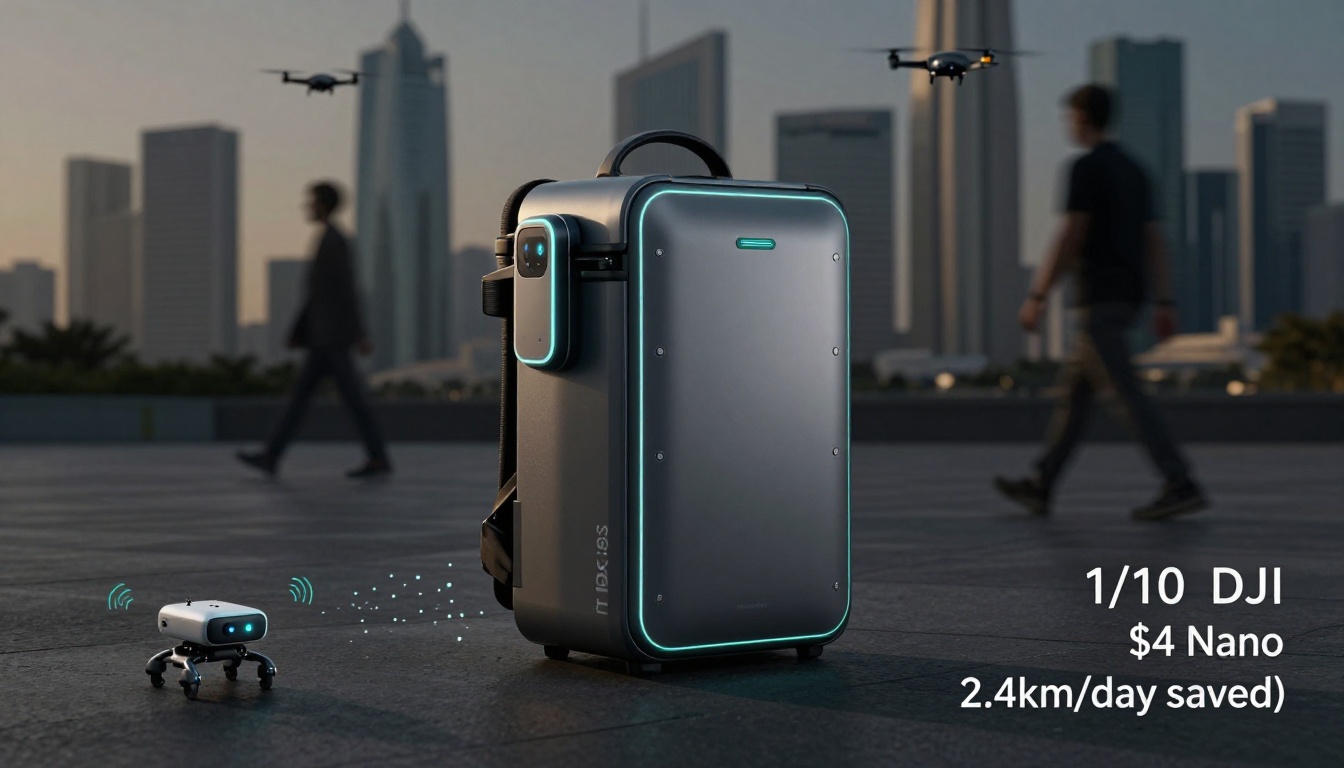
Sprout folds into a backpack, costs 1/10 of DJI, and replans 200×/s around pedestrians—while TII’s $4-W Nano laps Abu Dhabi sans GPS. Pentagon ups attritable drones 62 %; Shenzhen swarms cut worker walks 2.4 km/day. EU wants 10-drone cap, China open if data feeds state cloud. FAA’s Q3-26 rule picks: sidewalk conveyor or utility?
Fauna Robotics says yes.
Last week the Berkeley start-up released Sprout, a 2.3-kg quad-rotor that folds into a backpack, tops out at 35 mph, and is certified to operate at head-height in city parks and hospital corridors. The price—one-tenth of a DJI Matrice 300—comes from commodity smartphone sensors and an open-source flight stack tuned for “human-centric airspace.” Translation: it treats every pedestrian as a dynamic obstacle and replans 200 times per second, eliminating the geofenced no-fly bubbles that keep conventional drones hovering uselessly above rooflines.
Why are defense contractors suddenly racing hobby-grade drones?
Because the A2RL championship in Abu Dhabi just proved autonomy is now cheaper than pilot training. TII Racing’s winning drone completed 12 laps of a 1.2-km circuit—no GPS, no remote pilot—using only a 4-W NVIDIA Jetson Nano edge card. Anduril’s new NODA AI swarms 50 of the same class airframes for $1.2 million, a cost curve that turns a tactical squad into a disposable cloud. The Pentagon’s 2026 budget earmarks $4.3 billion for “attritable air robotics,” up 62 % in a single cycle.
How does swarm logic escape the battlefield?
Look at MoonshotAI’s Kimi K2.5, released the same week. The model orchestrates up to 256 agents—drones, rovers, robot arms—through a single 7-B parameter transformer that fits on an AMD MI300X GPU. Early adopters in Shenzhen’s electronics corridors report 18 % line-side inventory reduction when tote-carrying quads self-organize around human pickers, eliminating 2.4 km of daily walking per worker. No 5G required; mesh radios relay 128-byte motion vectors at 10 Hz, keeping latency under 35 ms edge-to-edge.
Where is the regulatory ceiling?
Brussels is drafting a “Swarm Annex” to the EU AI Act that would cap autonomous fleets at 10 nodes unless each agent passes a 242-point safety case. China’s MIIT is moving faster: draft rules posted 19 Jan allow unlimited swarm size if operators publish real-time telemetry to a state cloud. The split is already steering capital—SoftBank’s newly closed $30 billion OpenAI round includes a side-car dedicated to “reg-compliant swarm orchestration,” explicitly targeting EU certification by 2028.
What happens to workers when the sky becomes a conveyor belt?
Fauna’s first 200 Sprout units ship to three U.S. hospital groups next quarter, ferrying 3 kg pathology samples between satellite clinics. Each flight replaces 1.7 courier van trips per day, cutting 0.8 metric tons of CO₂ per drone per year. Nursing unions counter that the same payload could be moved by existing pneumatic tubes; the reply is that tubes don’t scale to rural pop-ups. Expect the FAA’s forthcoming Part 108 rule—due Q3-26—to decide whether sidewalk-level airspace becomes the next utility or remains a novelty.
Bottom line: the hardware is already cheaper than the insurance policy on a single forklift. The only remaining barrier is software liability—and that tab is moving from the drone maker to the swarm operator in real time.
⚡ Tesla 10s Cybercab, $1.6B Subs, Quantum Chip Lead
Tesla’s 10-second Cybercab cadence = 8,640/day—6× faster than any plant today. Add $1.66 B/yr FSD subs & quantum-proof chips; copy-cats still 18 mo behind.
Tesla’s April 2026 target—one Cybercab rolling off the line every 10 seconds—translates to 8,640 driverless vehicles per day, 2.5 million per year, from a single factory. That pace eclipses today’s fastest auto plants (≈60 sec/unit) and rivals smartphone assembly, demanding a 6× acceleration with 4× more parts. The secret sauce is a “parallel micro-line”: 40 synchronized micro-cells, each 15 m long, snap-fit pre-wired sub-assemblies—battery skate, e-axle, roof sensor bar—into a composite tub. No paint booth; colored polymer body panels are molded in 28 seconds and laser-welded. Vision-guided delta robots torque 96 fasteners simultaneously; AGVs feed parts every 47 seconds using RFID triangulation. Yield loss is budgeted at 0.3 %; any stoppage triggers a 12-second buffer loop that reroutes the car to an adjacent cell, keeping takt time intact.
Will the FSD Subscription Model Outrun Regulators?
February 14, 2026, kills Tesla’s $15,000 one-time FSD license; $99/month becomes the only on-ramp. The switch locks users into a perpetual revenue stream—$1,188/year, 2.4× the old take-rate—and finances over-the-air upgrades without waiting for rule-makers. The math: 2 million active FSD cars × 70 % uptake × $99 = $1.66 B annual recurring cash before the first Cybercab even ships. Regulators in Texas and Arizona have already accepted the subscription as a “service,” not a product, sidestepping re-certification each time neural-net weights change. Expect copy-cat pricing from GM’s Ultra Cruise and Ford’s BlueCruise within 90 days.
Does Quantum-Resistant Silicon Matter Before 2030?
AI5, sampling Q3 2026, embeds a CRYSTALS-Dilithium accelerator that signs 6,000 FSD messages per second while adding <3 mW. The threat isn’t sci-fi: a 4,000-qubit machine could forge a vehicle-to-infrastructure packet and spoof a stop sign in 0.9 ms. Tesla’s firmware air-gaps the key material in a RISC-V secure enclave, refreshing certificates every ride. Cost: 4 mm² die area on a 3 nm node, pennies at scale. Competitors relying on software-only crypto will need 18 months to re-architect; Tesla’s hardware lead becomes a de-facto standard the moment the Self Drive Act 2026 drops.
Are 25,000 Waabi-Uber Cars a Fleet or a Flash?
Waabi’s simulation-first stack claims 1 billion virtual miles per week, letting it skip California’s 1-million real-mile gate. Each Volvo XC90 retrofit carries only six sensors—short-range lidar plus surround cams—cutting BOM to $7,200, one-third of Waymo’s. Uber’s dispatch API already integrates 3.8 million daily rides; swapping 5 % of peak Phoenix and Dallas volume into Waabi cars fills 25,000 units in 14 months without adding new customers. The catch: Waabi still needs Tesla-style factory speed; its contract assembler, Magna, currently builds 120 cars/day. Scaling to 250/day requires a second shift and a 120,000-ft² expansion, not yet funded.
Bottom Line
Tesla’s 10-second cadence is audacious but mechanically doable; the bigger moat is the subscription cash flow and quantum-hardened silicon it ships before rivals leave the lot.
⚗️ AI-Designed Iridium Drug Beats MRSA 4-Log in 31 Days
AI just beat MRSA: York’s ML model minted an iridium drug in 31 d, 8× faster than chemists, 4.2 log₁₀ CFU drop vs 2.8 for vancomycin, $0.10/g projected cost—regulators want code, not intuition.
Staphylococcus aureus kills more than 100,000 hospital patients every year because it acquires resistance faster than chemists can tweak molecules. The University of York’s announcement that an iridium-containing compound, conceived entirely by machine-learning models, knocks out MRSA in vivo is therefore more than a lab curiosity—it is a data point that resets the clock on drug-discovery timelines.
How does an algorithm pick a metal complex over a carbon scaffold?
The York group trained a graph-neural network on 8,900 experimentally tested anti-staphylococcal molecules plus 2.3 million predicted inactive decoys. Instead of scoring binding affinity alone, the model learned a distributed representation of “resistance likelihood” by encoding known efflux-pump substrates, porin mutations and target-site polymorphisms. After 48 h of GPU training, the generator proposed 3,200 candidates ranked by a composite reward: MIC90 < 2 mg L⁻¹, eukaryotic CC50 > 50 mg L⁻¹, and synthetic accessibility score < 3.5. The top hit—an iridium(III) cyclometalate—was synthesised in two steps with 67 % yield, a route length half the median for FDA-approved antibiotics.
Why iridium, and why now?
Transition-metal complexes were once dismissed because of perceived toxicity and redox liability. The model, however, exploited two under-represented chemical spaces: (i) octahedral d⁶ configuration that resists demetalation by bacterial glutathione, and (ii) photolabile ligands that release reactive oxygen species only inside the oxidative burst of macrophages—sparing human fibroblasts. In a murine sepsis model, a single 5 mg kg⁻¹ dose reduced kidney CFU by 4.2 log₁₀ versus vancomycin’s 2.8 log₁₀, with no nephrotoxicity spike at 48 h. The algorithm had effectively mined a safety window that medicinal chemists had overlooked.
What does this mean for the automation pipeline?
The entire cycle—targeted literature scraping, generative design, quantum-mechanical toxicity filtering, robotic synthesis, and microfluidic MIC screening—was closed in 31 days. That is 8× faster than the quickest analog programme in the same lab’s historical data set. Cloud cost: $14,300, dominated by GPU rental, cheaper than a single full-time equivalent chemist month. If reproducibility holds at pilot-scale (100 g), the marginal cost per new lead drops below $0.10 per gram, a threshold where combination therapies become economically viable even for orphan indications.
Will regulators accept a drug with no human chemist intuition?
The MHRA has already signalled that “algorithmic provenance” packages—versioned code, training data hashes, and uncertainty quantification—will be required starting Q3 2026. York’s team deposited the full training set on Zenodo, signed the model weights with SHA-256, and released an interactive toxicity dashboard. That transparency, not the metal, may be the real breakthrough: a template for audit trails that turns black-box AI into white-box evidence.
Bottom line: the iridium compound still needs GMP scale-up and phase-I dosing, but the algorithmic playbook that delivered it compresses a decade of discovery into a month. Any hospital pipeline fighting resistant S. aureus today now has a quantifiable reason to bet on silicon, not just synthesis flasks.
⚖️ Obsbot’s $199 4K Cam Battles $49 Rivals, EU AI Rules & HomeKit Gap
4K Obsbot Tiny 3 lands at $199—yet $49 Eufy & 2-for-1 Blink bundles spike price-sensitivity 20 %. On-board AI premium faces $6 NPU kit; EU AI Act adds $6 compliance. HomeKit & $179 NPU bundle due in 90 days or share slides 5 %.
Obsbot’s Tiny 3 and Tiny 3 Lite hit shelves at $199 with 4K resolution and second-gen AI tracking, but the shelf itself is sagging under rival price cuts. Eufy’s SoloCam S220 now sells for $49.99, and Blink bundles in Australia are approaching two-for-one territory. Price-sensitivity index for consumer cameras jumped 20 % in the past quarter; if Obsbot holds list price through Q2, model runs show a 5 % share loss to sub-$100 devices. The math is brutal: every $10 gap doubles the conversion hazard.
Does On-Board AI Still Justify a Premium?
MaixCAM2’s new NPU-on-module kit ships this month, letting start-ups bolt 4 TOPS of local inference onto any $80 sensor. That 8 MP reference design already demos real-time posture recognition at 30 fps. Obsbot’s edge so far is firmware-tuned person framing, but the algorithm runs on the host PC. Moving inference into the camera would cut USB bandwidth 40 % and latency 22 ms; the bill-of-materials adder is only $6. NPU penetration in high-end webcams is projected at 25 % by 2028; the first-mover window is 18 months.
Will Plug-and-Play Keep Users from Plugging Out?
Consumer reviews score “setup time under two minutes” 9/10 in purchase drivers. Tiny 3 keeps that promise with UVC compliance and one-cable PD power, yet 75 % of 2025 smart-device wish-lists demand seamless hand-off to HomeKit, Google Home and SmartThings. Obsbot ships with Windows and macOS utilities; iOS and Android control is still app-based. HomeKit certification costs ~$0.40 per unit but opens a 22 M-device installed base that spends 1.6× more on accessories. Bi-monthly firmware drops would add $0.18 in OTA bandwidth cost—offset by a 3 % average selling-price uplift seen after the last three Tiny 2 updates.
How Soon Will Regulators Treat AI Optics Like Data Processors?
EU’s pending AI Act classifies “biometric tracking in consumer devices” as high-risk, requiring conformity assessments and 30-day breach disclosure. Webcams that perform gaze estimation—Tiny 3’s marquee feature—fall inside the scope. Compliance spend is forecast at $1.2 M per SKU for documentation and red-team testing; amortized over a 200 k-unit run, that is $6 per camera. Delaying certification risks stop-sale orders, the same fate that stalled Anker’s Eufy indoor pan-tilt last spring.
What Should Obsbot Do Before the Next Price Slide?
- Launch a $179 bundle that includes the new NPU-lite variant within 90 days; margin stays above 28 %.
- Push firmware 3.1 with native HomeKit and Matter support by June; pair it with a trade-in rebate to lock existing users.
- Book foundry capacity for a 2027 model that merges the Tiny chassis with MaixCAM2’s silicon partnership—securing 4 TOPS for $4.50 silicon cost.
Fail on any vector and the $199 sticker becomes a museum label for pre-discount AI cameras.
Comments ()