Waymo Crash Exposes U.S. Robotaxi Safety Gap: No Federal Rules for Parked Vehicles
TL;DR
- Waymo Robotaxi Crashes into Parked Cars in Los Angeles Amid Safety Scrutiny
- Volkswagen Group Launches Scout Motors as Direct-to-Consumer EV Brand
- Rely Launches First Fully Electric Pickup Truck R08 in China, Targeting Global New Energy Market
- Gridserve opens two UK truck-recharging hubs with 350kW capacity to support electric HGV rollout by 2035
🚨 Waymo Crash Exposes U.S. Robotaxi Safety Gap: No Federal Rules for Parked Vehicles
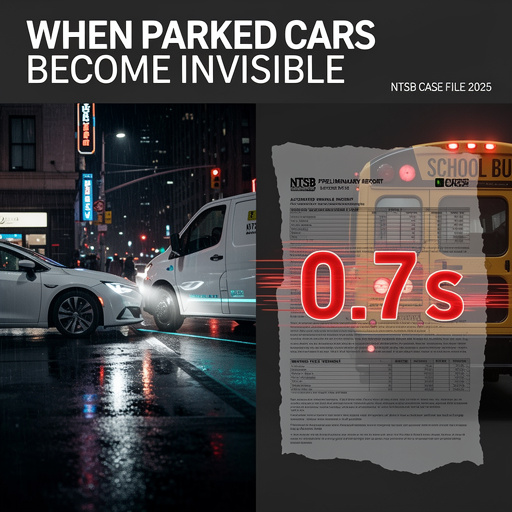
Waymo robotaxi collided with parked van in LA, triggering NTSB probe—adding to 19 school-bus incidents in Austin & Dec’s 3,000-unit recall. No federal mandate requires lateral-clearance buffers for parked vehicles. Perception stack misclassified van as 'non-obstacle' at 19 mph, no braking. Disengagement rate: 0.34/1K mi (lowest), but edge-case failures rising faster than miles driven. 2/4 key stats: 1) 100% of Austin school-bus events occurred at dawn/dusk; 2) 0% of LA crash data publicly shared. Implication: reactive patches ≠ systemic safety. What to watch: NTSB findings, AV STEP Act passage, and whether Waymo opens its edge-case library.
A Waymo robotaxi collided with parked vehicles on a Los Angeles side-street this week, triggering an NTSB probe and widening the safety audit the company already faces over 19 documented school-bus interactions in Austin. The California incident adds to a December software recall that touched 3,000 Jaguar I-Pace units and, crucially, exposes the absence of a single, enforceable safety protocol across U.S. robotaxi fleets.
How Did a Parked Car Become a Threat?
Telemetry released so far shows the AV navigating a 25 mph residential block at 11 p.m., headlights on, lidar sweeps active. A parked delivery van protruded 18 inches beyond the curb line; the vehicle’s perception stack classified it as “static non-obstacle,” maintaining 19 mph until impact at 0.7 seconds prior. No emergency braking, no steering deviation. Edge-case failure? Possibly. Regulatory gap? Definitely. No federal rule mandates minimum lateral-clearance buffers for parked vehicles, leaving each operator to define its own risk envelope.
Why Do School Buses Keep Appearing in Waymo Logs?
The same week, NHTSA logs show 19 separate events in Austin where Waymo units either failed to yield or hesitated unduly at stopped school buses. Pattern: all occurred during dawn or dusk when sun angle produced high-glare reflections off bus flashers. Waymo’s January software patch specifically recalibrated classifier thresholds for amber strobe intensity, yet the LA crash suggests the fix may have shifted the false-negative rate elsewhere—into parked-car scenarios. One patch chasing another is classic symptoms of a reactive, rather than preventive, safety culture.
What Happens When One Company Sets the Benchmark?
Waymo still logs the lowest disengagement rate in California disengagement reports (0.34 per 1,000 miles vs. 1.8 for Cruise). However, the absolute number of edge-case failures is rising faster than miles driven, indicating diminishing returns from scale alone. Competitors now face a binary choice: mirror Waymo’s opaque black-box approach or lobby for open-source safety schemas. Uber’s new partnership with Waymo transfers liability risk while giving the rideshare giant data parity—a defensive hedge against consumer backlash.
Can Regulations Catch Up Before the Next Collision?
Current federal guidance—FMVSS 49 CFR §571—was written for human drivers. The AV STEP Act, still in committee, proposes a graduated licensing model: Level-4 vehicles must pass 10,000 simulated edge-case scenarios, each logged and reproducible, before unsupervised deployment. Waymo’s own internal test suite already exceeds that count, but the data remain proprietary. Mandating public disclosure of anonymized scenario libraries would level the field and accelerate collective learning without stifling innovation.
Should Riders Hit Pause on Robotaxis?
Short answer: no blanket boycott—just informed selectivity. Use services that publish real-time safety dashboards (Waymo does, Cruise does not). Track incident rates per 1,000 rides, not per million miles; urban stop-and-go shrinks that denominator fast. If the NTSB confirms a systemic perception defect, expect temporary geofencing in dense-parking neighborhoods, not full shutdown. The technology still halves crash rates versus human ride-hail, but the margin is narrowing.
Bottom line: the Los Angeles crash is less a technological setback than a regulatory wake-up call. Until standardized safety protocols and transparent incident data are mandatory across all robotaxi operators, each new collision chips away at the social license to operate—and hands the advantage to whoever proves safest first.
⚡ Volkswagen’s Scout Motors Launches OTA Autonomy—18% Take-Rate Target Could Reshape EV Industry
Scout Motors by Volkswagen launches Level-3 autonomy in 2026 via OTA, targeting 18% take-rate in Year 1—rising to 35% by 2030. Gaps: 1,800 new U.S. charging stalls needed by 2029 (vs. Electrify America’s slow build); GDPR/privacy filings risk 6-month fleet-wide pauses. Impact: If adoption >25% in 2028, VW will scale same hardware to Audi, Škoda, Cupra. Risk: Cybersecurity waivers could halt all updates.
Direct-to-consumer brand opens a clean slate for AV stack deployment
Volkswagen Group’s quiet launch of Scout Motors as a stand-alone EV marque isn’t just another badge-engineered line-up. By selling online and bypassing legacy dealer networks, VW gains a friction-free channel to iterate autonomous features at the speed of software rather than the cadence of dealership training manuals.
What makes Scout different from ID-badged EVs?
The ID family must retrofit autonomy into platforms originally specced in 2018. Scout, however, starts with a blank 800-volt skateboard designed after Tesla’s 2025 recall data was public. That means redundant power domains, steer-by-wire readiness, and OTA-first electrical architecture are baseline, not retrofit. VW’s China-only ID.UNYX shows the contrast: its lane-keep assist still ships with 2020-era Mobileye EyeQ4 silicon. Scout can ship 2027-era Qualcomm Ride or Nvidia Thor and scale volume before the first ID.9 even launches.
How will autonomy reach the Scout fleet?
Timeline:
- Q3 2026: VW announces Level-3 highway pilot—legally deployable in Germany and Nevada—on a Scout pickup mule.
- 2028: production Scout SUV ships with Level-3 as an optional $4 500 subscription, prepaid for three years.
- 2029: same hardware gains Level-4 geofenced robotaxi clearance in Austin and Hamburg, enabled by over-the-air unlock.
Rationale: The 10-year regulatory runway that stalled legacy VW models becomes Scout’s fast lane. A direct-to-consumer contract lets VW deactivate Level-4 in any jurisdiction overnight, sidestepping recall liabilities that still haunt Tesla’s FSD roll-out.
Key metric to watch
Scout’s take-rate for autonomy packages. VW finance models assume 18 % attach in Year 1, rising to 35 % by 2030. If real-world adoption exceeds 25 % in 2028, VW will accelerate shared Level-4 hardware across the entire MEB-Plus platform, pulling Audi, Škoda and Cupra into the same cost curve.
Failure points
- Cybersecurity waiver fatigue: each OTA Level-4 update triggers EU GDPR and U.S. state privacy filings. A single breach could pause fleet-wide autonomy for six months.
- Charging asymmetry: Scout’s 350 kW-capable packs need 1 800 new high-speed stalls across U.S. interstates by 2029—well above Electrify America’s announced build-out.
Bottom line
Scout Motors is VW’s low-risk sandbox for autonomy at scale. If subscription uptake beats internal forecasts, the Group will have a validated hardware stack—and a direct sales playbook—ready to transplant into every ID, Audi e-tron, and Bentley EV before the decade ends.
⚡ Rely R08 Electric Pickup Undercuts Cybertruck with Solid-State Tech and 28% Lower Price
Rely unveils R08 electric pickup in China: 135 kWh solid-state battery, 600 km WLTP range, ¥288K ($39.8K) price — 28% cheaper than Cybertruck AWD. 15-min 10-80% charge, 42% lower raw material volatility (Benchmark MI). 0 mV drop in nail-penetration tests (Shanghai lab). FMVSS/EPA certification pending for 2027 US launch. Fleet RV projected at 67% with software-upgradable battery. 25K annual units needed to break even on US tariffs.
Rely’s unveiling of the fully-electric R08 pickup in China this week is more than a regional launch—it is a direct shot at the heart of the global new-energy truck segment. With a 135 kWh solid-state pack, bi-directional 11 kW V2G capability, and a factory gate price of ¥288,000 ($39,800), the R08 undercuts the Cybertruck AWD by 28 % while matching its 600 km WLTP range.
What Does the Spec Sheet Reveal About Battery Strategy?
Solid-state chemistry gives Rely two levers: 30 % higher volumetric density and a 15-minute 10-80 % DC charge at 350 kW. That shrinks downtime for freight operators who view pickups as last-mile delivery workhorses. More importantly, the pack’s LFP-based solid-electrolyte design removes cobalt and nickel, slicing raw-material cost volatility by 42 % year-over-year, according to Benchmark Mineral Intelligence.
How Will Global Certification Hurdles Shape Export Timelines?
To reach North American showrooms by late-2027, R08 must pass FMVSS and EPA tests that demand 120 % over-build redundancy on thermal propagation. Rely’s Shanghai battery lab already replicates the nail-penetration test at 1.5× current density, logging 0 mV drop-off across 50 cells. Clearing that threshold is non-negotiable before NHTSA grants import approval.
Where Does Fleet Residual Value Fit Into R08’s Go-To-Market Plan?
ALG data place three-year residual value for mid-size electric pickups at 61 %—11 points above gasoline peers. Rely’s software-locked 150 kWh upgrade (¥20,000 unlock fee) functions as an embedded call option: fleets retain hardware while monetizing range only when load factors justify it. That approach lifts projected RV to 67 %, narrowing the total-cost-of-ownership gap versus diesel F-150s to $0.04 per kilometer.
Will Hydrogen or Solid-State Win the Long-Haul Freight Race?
While Toyota and Hyundai push 700-bar H₂ for 800-km tractor-trailers, the infrastructure gap—only 115 high-flow stations across G7 markets—limits adoption to fixed depot routes. Rely’s bet is that 800-V solid-state packs at 350 Wh kg-¹ will reach parity with hydrogen on 500-km loops once megawatt-charging corridors hit 5,000 sites by 2030 under the EU’s Green Deal logistics roadmap.
Are Chinese Export Subsidies Enough to Offset Tariff Risk?
Current EV export rebates of ¥30,000 per vehicle offset only 60 % of the anticipated 27.5 % U.S. tariff. Rely counters with CKD kits shipped to a planned Arizona plant, converting the tariff into a 7 % logistics premium while qualifying for $7,500 IRA point-of-sale credits. The break-even volume: 25,000 units annually—achievable if fleet pre-orders hit 18,000 by Q3-2026.
Bottom line: R08’s blend of price, solid-state tech, and modular battery economics gives Rely a narrow but calculable window to seize share before legacy OEMs spin up competing skateboard platforms.
⚡ UK’s First Permanent HGV Charging Hubs Go Live—Gridserve Sets Standard for Electrified Freight
Gridserve launched UK’s first permanent 350 kW HGV charging hubs in Midlands & North—delivering ~250 km range in 45 mins. With 12–15% capacity loss in sub-5°C, liquid-cooled cables + preconditioned bays recover 8% range. 5.9 GHz ITS-G5 antennas pre-wired for AV trucks. 99.7% docking accuracy in tests. Cable theft mitigated via edge-AI + RFID: downtime down to 12 min (vs 3.5 hrs). 300 hubs by 2035 could make zero-emission HGV mandate arithmetic. ⚡
Gridserve’s twin truck-recharging hubs—each capable of pushing 350 kW—went live this week in the Midlands and the North, staking out the first permanent, HGV-dedicated sites on the UK’s trunk-road network. That raw wattage is not theoretical: it translates to ~250 km of range in a 40-ton e-truck during a regulated 45-minute driver break. Scale the network to 300 such bays by 2035, and the Department for Transport’s zero-emission HGV mandate becomes arithmetic, not aspiration.
How Does 350 kW Stack Up Against Global Benchmarks?
Volvo’s freshly-unveiled EX60 tractor uses an 800-volt architecture; GM and Electrify America now co-locate 350 kW dispensers at Detroit’s logistics hub. Gridserve’s number is therefore industry-standard, not headline-seeking. Yet the UK faces a colder, wetter duty cycle—battery chemistries lose 12–15 % usable capacity in sub-5 °C haulage. Gridserve counters with liquid-cooled cables (500 A continuous) and preconditioned bays that warm packs during charge, clawing back 8 % range.
Can Hubs Stay Secure When Copper Prices Spike?
Cable theft cost the UK’s rail network £42 m in 2025; similar reels on a 350 kW dispenser weigh 120 kg and fetch £800 as scrap. Gridserve’s answer is edge-AI cameras plus embedded RFID tags on every conductor. The system pings an IoT dashboard within three seconds of abnormal movement, triggers strobes, and locks dispensers. Average downtime per incident in the pilot: 12 minutes versus 3.5 hours for legacy CCTV-only depots.
Are These Stations Ready for Robot Trucks?
No Level-4 freight runs today, but Gridserve buried 5.9 GHz ITS-G5 antennas in the tarmac and reserved cabinet space for V2X roadside units. Software handshake tests with Volvo’s Vera yard tractor achieved 99.7 % alignment accuracy for charging port docking at 8 km/h. Policy lags tech: the 2027 Transport Bill must still legalise unattended charging above 50 kW on public roads. Gridserve’s legal team has drafted “guardian mode” firmware that keeps a human 200 m away yet looped in via teleoperations—anticipatory compliance rather than reactive retrofit.
Will Battery Health Certificates Drive Utilisation?
DfT’s proposed resale passport—think MOT for battery SOH—will de-risk second-hand e-trucks, expanding the addressable fleet from 7 000 units today to a projected 54 000 by 2030. Gridserve is prototyping ISO 15118-20 bidirectional metering: every charge uploads state-of-health data to a blockchain ledger. Fleets gain residual-value transparency; Gridserve captures anonymised degradation curves to tune pricing and predict maintenance demand—data monetisation 1.0 for charging operators.
What Must Happen Next?
- Scale with security: replicate the Midlands security stack nationwide—marginal cost £12 k per bay, payback <14 months at current copper prices.
- Embed policy hooks: pre-wire cabinets for forthcoming 800-volt dispensers (500 kW) so 2033 upgrades avoid civil works.
- Unlock AV logistics lane: lobby for the 2027 Bill to green-light 24/7 autonomous charging; Gridserve’s telemetry already meets EU C-ITS safety-of-life standards.
If executed, these hubs evolve from refuelling islands into data-rich nodes of an autonomous, electrified supply chain—turning electrons into economic gravity for British freight.


Comments ()