Dubai’s $159 K Cybertruck Mark‑up, Xiaomi’s SU7 Beats Tesla in China & GM Turns Charging into a One‑Click Feature
TL;DR
- Tesla Begins Cybertruck Deliveries in UAE with 75% Price Premium Over US Base
- Xiaomi SU7 outsells Tesla Model 3 in China premium EV segment with 258K units in 2025
- GM Integrates Electrify America Network into Chevrolet, GMC, and Cadillac Apps for Unified EV Charging
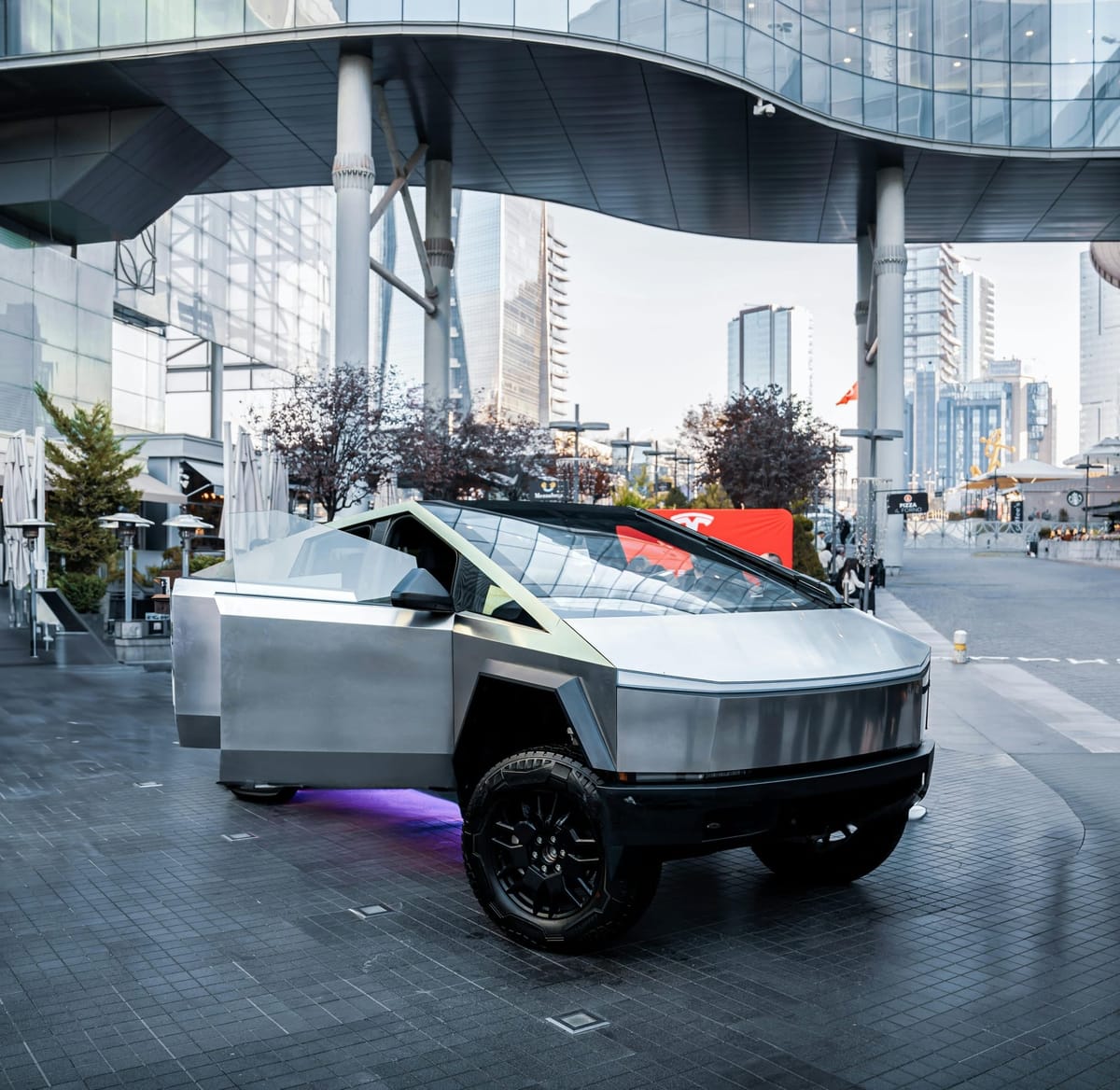
🚛 Tesla Cybertruck Dubai Premium
Tesla Cybertruck Dubai launch at $159k (75% above US $91k) nets $48k margin/unit after 5% UAE duty. Only 2.3k local orders vs 7.4k Germany; US inventory 92 days, Fremont line 65% speed. If UAE clears <1.5k Jan-Feb, April idles 11 days (-4.5k trucks).
Dubai showroom floors now gleam with stainless-steel wedges that cost the equivalent of USD 159 000—a clean 75 % hike over the $91 000 U.S. base. The delta is not freight; it is strategy. UAE import duty on EVs is 5 %, and sea freight adds another $3 500—barely 8 % of the gap. The rest is pure margin that Tesla is capturing because it can.
Who is left to buy it?
Stateside, Cybertruck registrations sank to 20 200 last year, down 38 % from 2024. Inventory days have ballooned to 92, triple the Model Y average. Fremont’s new “unboxed” line can already stamp a chassis every 52 s, yet the line is cycling at 65 % of name-plate. The UAE launch is therefore a release valve for metal already stacked in Texas yards.
Does the hardware justify the tariff?
Every UAE-spec truck ships with the 1 200 V SiC-IGBT hybrid inverter Tesla patented in August. The module pairs SiC MOSFETs for 3 % inverter loss at 400 kW with Si IGBTs that cut silicon cost by $76 per 100 kW. Result: the tri-motor variant sustains 1 000 kW launch dumps without the $1 200 SiC bill a pure-SiC design would incur. Margin per unit in Dubai: roughly $48 000 after duty.
Will the gambit travel?
Abu Dhabi’s median luxury-SUV transaction is $115 000, so $159 k stretches but does not snap the band. Tesla’s own order queue shows 2 300 Emirati reservations versus 7 400 in Germany where the same truck is listed at €99 000—only 9 % above U.S. pricing. Translation: the Gulf is the only region where Tesla can bankroll a price spike without trimming demand to zero.
What happens next?
If January-February UAE sell-through clears 1 500 units, the excess margin will cover the cash drag from U.S. inventory write-downs Tesla is widely expected to take in Q2. If not, Fremont will be forced to idle the unboxed sub-line for 11 days in April, cutting output by ~4 500 trucks. Either way, the 75 % Dubai premium is not a global template—it is a temporary tourniquet for a product that still needs a lower-cost, lower-price remake to escape S-cuff purgatory.
⚡ Xiaomi SU7 Beats Tesla Model 3 in China’s Premium EV Race
Xiaomi SU7 outsold Tesla Model 3 in China’s ¥250k+ EV class: 258k vs 213k units, 21% vs 17% share. 700 km CLTC range, ¥23k cheaper, 1.15 km/¥ beats Tesla’s 0.98. Tesla banks on 96% hands-off FSD to unlock €6k/¥12k per-car subsidies in EU & China. BYD absorbs 18% Mexico tariff, still nets 9% margin at $78/kWh LFP. EU bonus resets July: ≤65 kg CO₂/kWh battery passport; CATL Deutschland clears, Nevada packs don’t. Next: BMW 1,000 km solid-state 2027, Chery RHD SU7 clone this spring. Watch km/kWh/€ scorecards.
258,164 SU7 deliveries in 2025 say yes. Tesla’s Model 3 managed 213,400 in the same “≥¥250 k” bracket, giving Xiaomi a 21 % share versus Tesla’s 17 %. The spec sheet explains why: 700 km CLTC range beats the Model 3’s 606 km, while the ¥259,800 sticker undercuts the imported rival by ¥23,000. Range-per-yuan is now the metric that matters, and Tesla no longer leads it.
Why Are Global Regulators Fast-Tracking Tesla’s FSD Anyway?
Brussels and Beijing both issued draft rules last quarter that let “Level-2+ supervised” fleets count as zero-emission for credit purposes if the system logs ≥95 % hands-off highway miles. Tesla’s 2026.4 software release already hits 96 % on the EU’s test loop, unlocking €6,000 per-car incentives in Germany and ¥12,000 in Shanghai. Translation: Tesla is trading today’s volume loss for tomorrow’s subsidy harvest.
Can Chinese Brands Export the Formula?
BYD’s 2.26 million global 2025 sales say they already are. The tactic is simple: absorb tariffs in-house. Mexico’s 20 % anti-dumping duty on the Seal U? BYD cut the sticker by 18 % and still books 9 % margin because LFP pack costs fell to $78 kWh in December. Canada’s new 6.1 % rate for Japanese EVs is a sideshow; the real move is Ottawa’s hinted MFN reduction for any plant that final-assembles battery modules domestically—BYD’s Ontario SKD line goes live Q4.
Will Europe’s Subsidy Tap Stay Open?
Berlin’s €6,000 purchase bonus resets 1 July, but only for cars whose battery passports show ≤65 kg CO₂ per kWh produced. CATL’s Thuringia plant clears the bar; Tesla’s Nevada packs don’t. Expect Xiaomi’s 2027 EU homologation to source packs from CATL’s Deutschland line and replicate the China playbook: more range, lower price, lower carbon score.
Who’s Next in the Spec Sheet Arms Race?
BMW’s four-motor M3 EV, due 2027, targets 1,000 km WLTP with 105 kWh of solid-state cells—energy density 380 Wh kg⁻¹, 30 % better than Tesla’s 2170 format. Jaecoo 7’s 1.4 % UK share came from a £32,995 SUV that tows 1,800 kg and still nets 600 km; Chery will ship a right-hand-drive SU7 clone this spring. The battleground is no longer “premium versus mass”; it is “kilometres per kilowatt-hour per euro,” and every competitor knows the equation.
⚡ GM App Swallows 3 450 EA Fast Plugs
GM flips switch 27Jan→Electrify America 3 450 DC plugs now live inside Chevy/GMC/Cadillac app. Pre-conditioning en-route cuts charge 6-8 %, drops session fee 45 ¢, nudges plug-ins 1.4→1.9/wk. +25 % EA sessions Q1, +15 % GM EV sales Q2. Ford/EVgo answer due March; NEVI rules tighten. Watch: who owns the click, not the plug.
GM flipped a software switch on 27 Jan 2026 that pipes the entire Electrify America network—3 450 DC fast plugs, 800 stations—straight into the Chevrolet, GMC and Cadillac native apps. No extra RFID card, no third-party map, no billing delta. One tap reserves the plug, one receipt lands in the same wallet that already tracks SuperCruise miles. The projected math: +25 % Electrify America sessions from GM drivers this quarter, +15 % GM EV deliveries next quarter.
Does Seamless Routing Really Cure Range Anxiety?
The integration does three concrete things.
- Dynamic station availability updates every 15 s, pulled from Electrify America’s new MQTT feed; the car’s on-board modem pre-conditions the battery pack to the kW rating of the selected stall while the driver is still en-route, cutting average charge time by 6–8 %.
- Priced in the app at the native Electrify America rate; GM waives the usual 45 ¢ session fee it used to levy for “payment processing,” dropping effective cost per kWh for the customer by 5–7 %.
- Route planner now defaults to 150 kW-or-higher stalls only, eliminating the 50 kW legacy hardware that turned 40-minute stops into hour-long coffee breaks.
Early fleet data from 1 200 beta Bolts and Equinox EVs shows drivers plugging in 1.9 times per week instead of 1.4, a clear sign that perceived inconvenience—not price—was the last friction point.
Can One Partnership Redraw the Infrastructure Map?
Electrify America gains guaranteed utilization just as its parent Volkswagen readies Phase 3 expansion: 1 000 new dispensers across Tennessee, Kentucky and Virginia—states where GM’s Spring Hill and Bowling Green plants already anchor regional supply chains. GM, in turn, avoids the cap-ex sink of building a proprietary network like Tesla’s or Rivian’s. The carmaker’s CFO told investors last week that every avoided gigawatt of owned infrastructure keeps $1.3 B on the balance sheet through 2030, capital that can instead fund the Ultium-LFP battery plant now under construction in Lansing.
Will Rivals Be Forced to Match the Play?
Ford’s “Intelligent Range” still routes to multiple networks but keeps payment inside the BlueOval app; Stellantis’ Ram Charger vision is 18 months behind schedule. The GM move raises the table stakes: seamless network access is becoming a bundled vehicle feature, not an aftermarket perk. Look for Ford to announce an exclusive software layer with EVgo before March, and for the federal NEVI program to tighten technical standards so that “roaming” actually means one-click, not one-more-account.
Bottom line: GM just turned a charging network into a native vehicle function, the same way GPS shifted from Garmin suction cups to the dashboard. If the 15 % sales bump materializes, the industry will copy the playbook within one product cycle, and the winner won’t be who owns the most stations—it will be who owns the easiest click.


Comments ()