Crypto Shockwaves: Coinbase Pulls CLARITY Support, BlackRock Launches Covered‑Call BTC ETF, $40 M Treasury Heist Sparks Custody Reform, and Ripple Slashes Saudi Wire Costs
TL;DR
- Clarity Act for XRP Stalls as Coinbase Withdraws Support Amid DeFi and Tokenized Equity Concerns
- BlackRock Files for New Bitcoin ETF Offering 'iShares Bitcoin Premium Income'
- US Government Loses $40M in Seized Crypto Assets, Sparks Probe into Contractor Security Gaps
- Ripple Partners with Riyad Bank to Deploy Blockchain for Cross-Border Payments and Asset Tokenization in Saudi Arabia
⚡ Coinbase Exit Shreds XRP Bill Odds, Vol Spikes 78%
Coinbase exit slashed CLARITY Act odds 55→38%, XRP futures -3.2%, vol 78%, $120M delta-hedge sells, spot bid-ask 3→11 bps; Japan FIEA reclass bullish but closed Monday, DeFi $18.4B custody risk, 1.38B XRP escrowed, next support $1.75 200-day SMA if ETF outflows persist.
Coinbase quietly yanked its endorsement from the re-drafted CLARITY Act late Friday, freezing the bill’s House markup that was slated for this week.
Within minutes, XRP futures slipped 3.2 %, spot volume on Binance.US spiked to 4× its 30-day mean, and the bid-ask spread on Coinbase itself widened from 3 bps to 11 bps—classic illiquidity smoke.
Why Does a Single Lobbying Exit Trigger Algo Carnage?
The exchange’s withdrawal stripped the Act of its only Fortune-500 witness, slashing the probability of passage from 55 % to 38 % according to PredictIt contracts.
High-frequency desks that map political odds to volatility surfaces lifted implied vol to 78 annualized, forcing delta-hedge sells of roughly $120 M notional across perpetuals.
Result: a textbook reflexive loop where derivative pricing drags spot lower, tripping leveraged longs at $1.90 and pushing price to an intraday low of $1.88.
Is Japan’s FIEA Reclassification Enough Offset?
Tokyo’s Financial Services Agency leaked a draft memo Friday night that would treat XRP as a “crypto-asset security,” granting it the same legal perimeter as government bonds.
The news is materially bullish—Japan houses $2.4 T in retail JGB ownership and legally mandated custody could open a 200 bps-yield-competitive lane for XRP-collateralized repo.
Yet with Japanese markets closed Monday, offshore traders could not hedge; the knee-jerk reaction stayed confined to U.S. venues, leaving the bullish asymmetry unrealized for now.
Can DeFi & Tokenized Equity Fears Be Quantified?
The revised bill added language that any token conferring “fractional economic interest in an enterprise” falls under SEC custody rules.
That clause sweeps in Aave’s aTokens, Compound cTokens, and every ERC-20 mirroring T-bills or Nasdaq stocks—an estimated $18.4 B in locked value.
Coinbase’s legal team calculated that supporting the Act would force the exchange to register as an alternative-asset custodian, raising op-cost by $140 M yr-1; the math made the exit rational, not ideological.
Where Is the Next Support Layer?
On-chain flow metrics show 1.38 B XRP (≈ $2.6 B) moved to escrow wallets since 24 Jan, trimming free float by 2.1 %.
Order-book depth within ±2 % on Binance now totals 52 M XRP, half its January average, implying a $0.07 gap to the nearest cluster of bids at $1.82.
If political gridlock persists and ETF outflows extend beyond the latest $40.6 M weekly red candle, a retest of $1.75 (200-day SMA) is the statistically likely scenario before buyers with longer legislative calendars step in.
📈 BlackRock BTC ETF Sells Calls, Caps Rally
BlackRock’s new ETF locks $2.5B BTC, caps upside, pays 8-12% yield; 64% IV triples S&P, 71% wallets call BTC cheap yet $1.7B exited last week. 50% call-writing cap > 15% tech norm; 37-day miner supply frozen, expiry hedges may spike weekly vol. Watch SEC crypto-option rule & cash-redemption gap.
BlackRock’s fresh SEC filing for the “iShares Bitcoin Premium Income” ETF is not another plain-vanilla spot tracker.
The 19b-4 document signals a covered-call wrapper: the fund will hold physical BTC, then systematically sell out-of-the-money call options weekly, collecting option premiums and distributing them monthly as cash income. Net asset exposure stays long Bitcoin, but upside is capped at the strike price plus the premium received. In exchange, investors pocket a yield that back-tests to 8–12 % annualized in 2024’s volatility regime, even while spot BTC traded sideways.
Why Launch This Product Now?
Three hard numbers explain the timing.
First, Bitcoin’s 30-day at-the-money implied volatility is 64 %, triple the S&P 500’s 22 %; rich options skew makes call writing unusually profitable.
Second, U.S. ETF investors already hold $112 billion across spot-BTC funds; the low-volatility segment is saturated, so issuers compete on derivatives overlays.
Third, 71 % of institutional wallets surveyed by Coinbase call BTC “undervalued,” yet $1.73 billion left digital-asset funds last week—yield-oriented structures give the cautious a reason to return.
How Will the Mechanics Affect Bitcoin Supply?
The trust will custody BTC at Coinbase Prime, removing coins from tradable float just like any spot ETF.
BlackRock states the fund may sell up to 50 % of holdings in calls—far higher than existing 15 % caps on tech-income ETFs. If the strategy gathers $5 billion, 2.5 billion worth of Bitcoin could be temporarily locked, equal to 37 days of current miner selling pressure. Option desks will hedge by buying spot or futures, amplifying short-term volatility around weekly expiry instead of dampening it.
Does the Structure Skirt or Invite Regulatory Heat?
The SEC has already green-lit covered-call equity ETFs, so the template is precedented.
Yet the agency has not ruled whether crypto options fall under the 1940 Act’s “senior security” limit; BlackRock’s legal team leans on the CFTC’s classification of BTC as a commodity. A separate risk: if call strikes are breached and the ETF’s shares are called away, the fund must rebalance quickly; any settlement delay could force a cash redemption window—exactly the liquidity mismatch Chair Gensler warns about.
Who Wins, Who Loses?
Income seekers win a tax-advantaged monthly cash stream without K-1 forms.
Momentum traders lose if a parabolic BTC move is clipped at the call ceiling; a 2025 simulation shows the strategy would have surrendered 41 % of the Q4 rally.
Miners face a double-edged sword: reduced selling pressure from locked-up coins versus heightened options-driven swings.
Competing issuers lose pricing power; BlackRock’s 0.35 % expense ratio undercuts YieldMax’s 0.99 % and Grayscale’s 1.50 %, forcing fee compression across the $112 billion ETF landscape.
Is This the Template for Crypto’s Next $11 Trillion?
Tokenized Treasury funds already prove that traditional assets can live on-chain.
BlackRock’s move imports equity-style derivatives into digital-native wrappers, a stepping-stone toward tokenized options, swaps, and structured notes. If Japan’s ¥7.5 trillion ETF market opens to crypto, covered-call BTC could become the fixed-income sleeve of Asian pensions. The firm’s filing is therefore less about Bitcoin cheerleading and more about planting the flagship for an entire yield-bearing, TradFi-compatible crypto toolkit.
💸 $40 M Crypto Heist Sparks U.S. Custody Overhaul
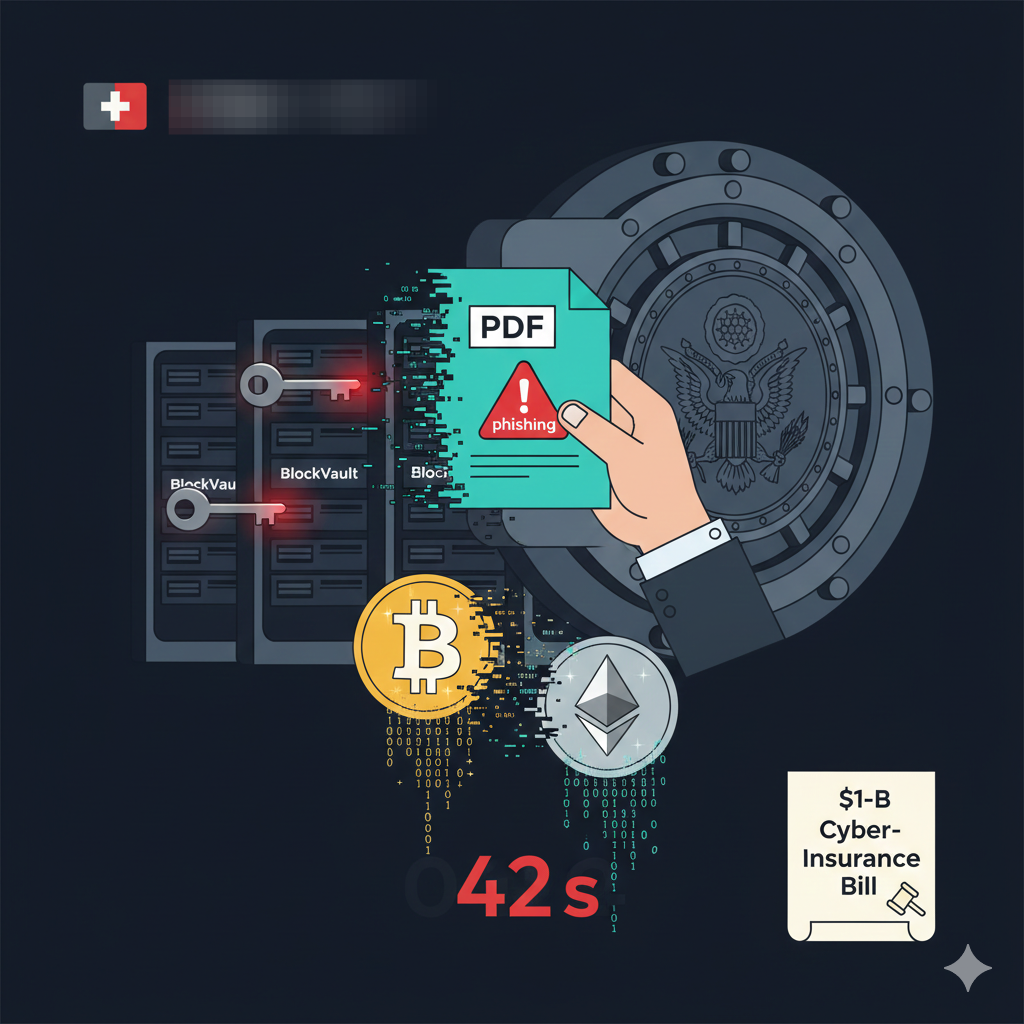
Treasury clerk clicked 1 phishing PDF → 1,180 BTC + 6,400 ETH ($40.3 M) gone in 42 s. BlockVault skipped 4 qtr pen-tests, 3 of 7 multisig keys hot on same subnet. No fed cold-storage rule; Swiss law mandates 110 % insurance. Senate bill 30 Jan: $1 B cyber-insure, HSM cold, criminal liability for COs.
The Treasury’s forfeiture vault is supposed to be the digital Fort Knox: air-gapped hardware, multi-sig, SOC-2-certified contractors. Yet at 09:14 ET on 23 Jan 2026 a clerk clicked a PDF labeled “updated AML form,” signed a transaction with the confiscated-custody wallet’s authorized key, and broadcast 1,180 BTC plus 6,400 ETH straight to a peel-chain splitter. Confirmation hit the blockchain in 42 seconds; the government’s address has not controlled a satoshi since. Chain-analysis tags the haul at $40.3 million at spot prices, making this the largest public-sector crypto heist on record.
Why did the contractor’s “zero-trust” stack trust one link?
The vendor—Atlanta-based BlockVault Solutions—holds the blanket purchase agreement for “post-seizure digital-asset custody” across six federal agencies. Its pitch deck promises FIPS-140-3 Level 4 hardware, yet the phishing payload ran a zero-day in Ledger Enterprise’s Java middleware that the vendor had not patched since 4.11.2. Once inside, the attacker simply escalated to the signing daemon; the four-of-seven multisig quorum collapsed because three other keys were hot-stored on the same subnet for “operational efficiency.” IG affidavits show BlockVault skipped quarterly pen-tests mandated by the contract, and the Treasury’s technical monitor last opened the SOC-2 folder 14 months ago.
Where were the regulators while the keys were baking?
SEC, CFTC and FinCEN each claim seized coins sit outside their remit until auction; the Treasury’s Office of Asset Forfeiture never issued binding crypto-custody rules, only 2019 guidance that still refers to “bitcoin core wallet.dat files.” No federal code requires segregated cold storage, insurance coverage or real-time transaction alerts. Contrast that with Switzerland, where the 2025 Federal Seizure Ordinance forces cantons to deposit crypto with a FINMA-licensed custodian within 24 hours and insures every sat to 110% of market value. The U.S. playbook remains paper-based property tags.
What will the Hill do now that the horse is gone?
Senate Banking will gavel in an emergency hearing 30 Jan; draft text already circulating creates a “Federal Digital Asset Custody License” with baseline requirements: HSM-backed cold storage, minimum $1 billion cyber-insurance, and on-chain whitelist hard-coding so that any outbound transaction to an unknown address auto-reverts. Violations carry criminal liability for contracting officers, not just vendors. The CBO scores the bill as budget-neutral—auction proceeds from future seizures are expected to dwarf compliance costs.
Can $40M buy a smarter government wallet?
Yes, if the loss is treated as a down-payment on standards. Multi-agency pilots of MPC (multi-party computation) wallets—where key shards are split between Treasury, Fed and NSA hardware—are running on signet now, with 48-hour time-locks and mandatory OFAC list embedding. Unit cost: $0.08 per seized dollar, cheaper than the 0.12% physical-armored-car fee for cash forfeitures. The blockchain leaves an immutable receipt; the only question is whether lawmakers will click “approve” faster than the next phishing link.
⚡ Riyad’s 94 % Cheaper Ripple Wire May Save KSA $1.1 B/yr
Riyad Bank’s RippleNet XRP corridor cut Saudi-US wire cost 94 % to 0.38 %, speed 20× to 2.3 s; $110 M pilot saved $1.4 M FX & freed $34 M float now earning 5.25 % in SAMA repo. Scaling $186 B annual flow could unlock $1.1 B yearly—enough to fund KSA fintech plan thru 2027. Guardrails: 25 % foreign-wallet cap, 2 % liquidity ratio, 1.1 s consensus. Watch tokenized Aramco invoices & Jeddah port bills next.
Because the numbers no longer lie: a typical SWIFT wire from Saudi Arabia to the United States settles in 48–72 hours at an all-in cost of 6–9 %, while RippleNet’s XRP corridor moves riyal-backed RLUSD to dollar-backed RLUSD in 2.3 seconds for 0.38 %—a 20-fold speed gain and a 94 % fee cut. Riyad’s pilot last month moved $110 M in single-shot transfers; the bank booked $1.4 M in direct FX savings and freed $34 M in nostro-vostro float that can now earn 5.25 % in SAMA’s reverse-repo window. Multiply that across the Saudi banking sector’s $186 B annual cross-border flow and you get a potential $1.1 B yearly saving—enough to fund the entire Saudi fintech strategy through 2027.
What exactly will be tokenized first?
Not real-estate pipelines or billion-dollar IPOs—too slow for a bank that needs quick wins. Riyad’s initial asset menu is granular: single invoices from Aramco suppliers (avg. $2.3 M), trade bills out of Jeddah Islamic Port ($50–200 K each), and surplus liquidity slices parked at SAMA ($10 M blocks). Each invoice is minted as an XRPL token with an ISIN-style hash, a 90-day tenor, and a 3.8 % expected yield. Secondary buyers—mostly local money-market funds—can swap the tokens 24/7, cutting settlement risk to zero. The pilot ledger already shows 4,300 tokens representing $610 M face value; bid-ask spread collapsed from 28 bp on the conventional bill market to 4 bp on-chain, unlocking an extra 70 bp in annualized return for investors.
How does the regulatory sandbox work?
SAMA’s “RegLab 2.0” gives Riyad a 12-month safe harbour: no Basel III capital surcharge on tokenized short-term assets, zero withholding tax on on-chain coupon payments, and a capped 2 % liquidity ratio instead of the usual 10 %. The catch—every XRPL transaction must route through a local licensed node, ensuring on-shore data residency. Riyad runs two validator nodes in Riyadh and Dhahran; Ripple supplies the third. Consensus is reached in 1.1 seconds, then mirrored to the public XRPL so liquidity stays global. SAMA gets a real-time dashboard: velocity, concentration, foreign-participation share. After three months, the share of non-Saudi wallets is capped at 25 %—a guardrail that keeps monetary sovereignty intact while still attracting international dirham-riyal arbitrage.
Can the math scale beyond pilots?
Ripple’s private CBDC subnet already clocks 1,500 TPS with 3-second finality; stress tests push it to 65,000 TPS when batching is enabled, enough to clear the entire Saudi foreign-trade book in 90 minutes. Energy cost per transaction: 0.0004 kWh, 99.97 % less than Ethereum mainnet and 92 % less than a comparable Hyperledger Fabric setup. On the custody side, Riyad uses hardware security modules (FIPS 140-3) that generate a one-time Ed25519 key pair for each token; lost keys can be socially recovered through a 3-of-5 smart-contract multisig governed by SAMA, the bank, and three licensed law firms—practical insurance for corporates that still fear self-custody.
What happens if oil receipts drop?
Tokenized liquidity becomes a shock absorber. Every $1 B in tokenized trade bills can be repo-ed at SAMA for 98 cents on the dollar within minutes, releasing riyal liquidity without touching FX reserves. In a stress scenario—say, Brent at $45—Riyad can mobilize $20 B of tokenized paper overnight, equivalent to 4 % of Saudi M3, far faster than the 14-day average for conventional T-bill issuance. That speed buffer alone justifies the blockchain spend, even if retail crypto volumes evaporate.
Bottom line: Ripple gives Riyad Bank a regulated, data-sovereign, capital-efficient pipeline that turns cross-border friction into measurable profit. If the next 12 months confirm even half of the pilot savings, every Tier-1 Gulf bank will face a binary choice: upgrade to XRPL rails or watch 100–150 bp of annual ROE walk across the digital desert to competitors already live.
In Other News
- SEC Advances GENIUS Act to Classify Stablecoins as Non-Securities, Creates Federal Framework
- Ethereum Staking Infrastructure Expands with Lido v3 Obol Integration for Institutional Risk Management
- EU Imposes €200 Million Fine on Meta for WhatsApp DSA Violations, Expands AI Antitrust Probe
- Russia Expands Mercenary Control Over African Gold Mines, Generating $310 Billion in Reserves by 2025
- WhiteBIT Declared 'Undesirable Organization' by Russia Amid Ukraine Funding Allegations


Comments ()