Jet Crash in Bangor, China’s AI Drone Test, Royal Navy’s Autonomous Helicopter, and Delhi’s Air Taxi Future
TL;DR
- Bangor International Airport jet crash kills 8 amid severe winter storm, FAA and NTSB launch joint probe into takeoff conditions
- China Tests Jiutian 'Mother Ship' Drone Capable of Launching 100 AI-Guided Kamikaze UAVs in Precision Strike Trial
- Royal Navy Successfully Tests First Autonomous Helicopter 'Proteus' in UK, Marking Major Leap in Maritime UAV Technology
- Skyportz Identifies Delhi as Critical Global Hub for Air Taxi Deployment, Projecting $2.5B Annual Revenue by 2045
❄️ Bangor Jet Crash: Winter Storm, Runway Risks, and Systemic Gaps
Bangor jet crash kills 8 during Winter Storm Fern: 14,800+ flights canceled, -40°C wind chills. De-icing delays, runway data gaps. Yet: real-time braking metrics, cockpit decisions, mechanical checks. Will FAA mandate sensor upgrades without another tragedy?
The Bangor International Airport jet crash on January 25, 2026, which killed eight, occurred amid Winter Storm Fern’s extreme conditions—wind chills below -40°C, heavy snowfall, and documented de-icing delays. The FAA and NTSB are now examining whether real-time runway braking action reports and updated surface condition assessments were used in the takeoff decision.
Were de-icing protocols overwhelmed by storm intensity?
Nationwide, 14,800 flights were canceled due to Fern, with 9,600 on January 25 alone. At Ronald Reagan Washington National, 97% of departures were scrapped. Bangor’s infrastructure, like Toronto’s during its January 16 snowstorm, faced de-icing bottlenecks—AC841 endured a 5-hour tarmac delay. Such delays increase the risk of ice reaccumulation, directly impacting aerodynamic performance.
Is current aircraft monitoring sufficient for extreme winter ops?
The investigation includes analysis of ice accretion on control surfaces and engine inlets, as well as mechanical integrity of critical components like landing gear. Precedents such as United Flight 2323’s nose gear failure highlight recurring vulnerabilities in cold-weather operations. No evidence yet confirms a mechanical fault in the Bangor incident, but cockpit voice and flight data recorders remain under review.
Will this trigger mandatory upgrades in winter safety systems?
Initial findings are expected in 30–60 days. Potential outcomes include revised FAA Advisory Circulars mandating automated runway condition sensors and enhanced crew training for low-visibility takeoffs. Investments in real-time weather integration and advanced de-icing fluids are likely, mirroring post-incident reforms seen after past runway excursions in Budapest and Toronto.
🚀 China's Jiutian Drone Launches 100 AI Kamikaze UAVs in Precision Test
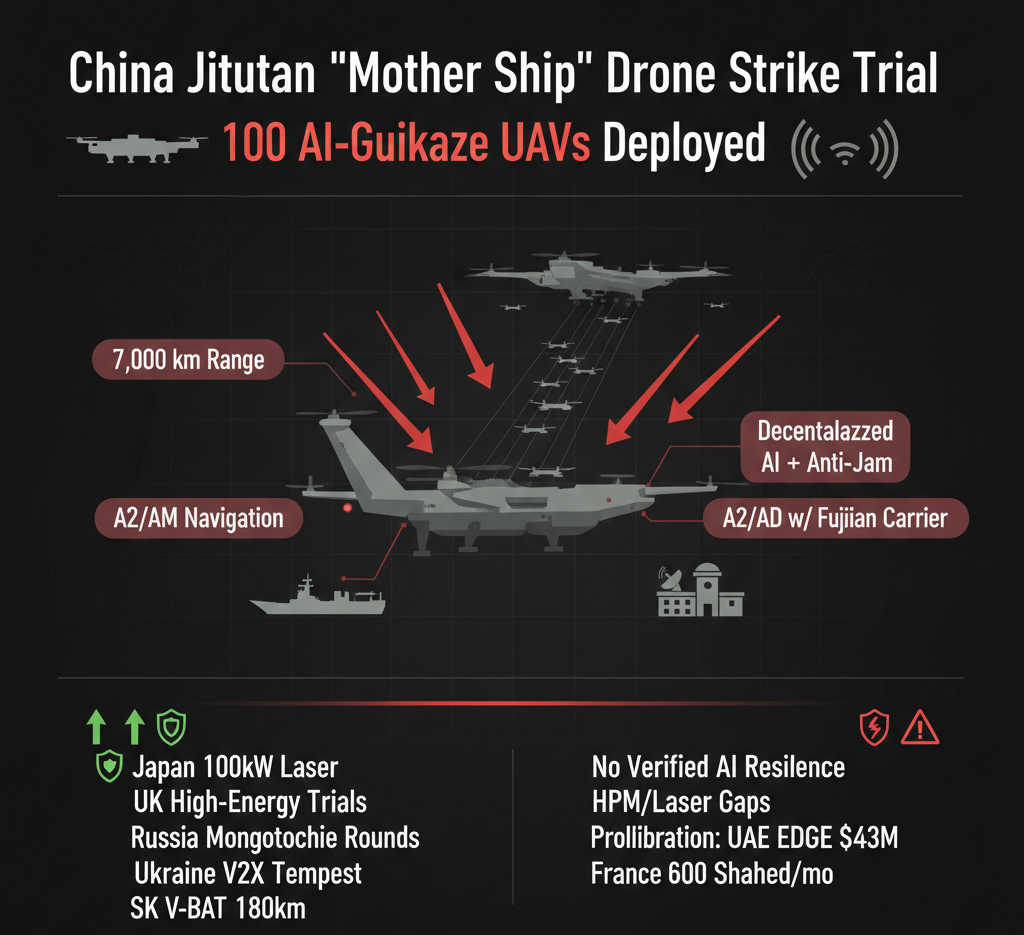
Jiutian 'Mother Ship' drone test (20 Jan 2026) launches 100 AI-guided kamikaze UAVs: swarm coordination achieved. Yet: laser, HPM, and kinetic counters lag—can defenses scale?
China’s Jiutian 'Mother Ship' drone successfully executed a precision strike trial on January 20, 2026, deploying 100 AI-guided kamikaze UAVs against simulated high-value targets, including naval vessels and command centers. The test validates China’s progress in autonomous swarm technology, with implications for regional deterrence in the South China Sea and toward Taiwan.
The Jiutian platform leverages decentralized AI coordination, likely incorporating anti-jamming protocols and GPS-independent navigation via SLAM-based visual-inertial systems. Its 7,000 km range enables integration with China’s Fujian (Type 003) aircraft carrier, reinforcing A2/AD strategies alongside YJ-12 and DF-26 systems.
Globally, counter-swarm technologies are advancing rapidly. Japan’s 100-kW laser weapon, Britain’s high-energy laser trials, and Russia’s Mnogotochie multi-fragment rounds demonstrate kinetic and non-kinetic responses. Ukraine’s V2X Tempest interceptors ($200,000 per shot) and NATO’s Crow system in Lithuania reflect operational urgency.
However, critical gaps remain. No verified data confirms Jiutian’s AI swarm algorithms or resilience to HPM attacks. Britain’s laser and China’s Hurricane 3000 HPM system lack real-world testing against AI-coordinated swarms.
South Korea’s V-BAT, armed with L-MDM missiles and satellite-linked targeting, has demonstrated 13-hour endurance and 180 km range in Ukraine. Meanwhile, UAE’s $403M EDGE contracts and France’s production of 600 Shahed-type drones monthly highlight rapid proliferation risks.
With PLA swarm tests now exceeding 200 drones and autonomous launch sequences of 48 fixed-wing UAVs, the operational threshold for massed drone warfare is rising. Yet, without proven defenses against coordinated, AI-driven swarms, the balance of deterrence may shift toward offensive autonomy.
🚁 Royal Navy's 'Proteus' Helicopter Test Signals UK's Autonomous Naval Ambition
Proteus test (26 Jan) achieves AI-driven ASW ops, 1-tonne payload, UK sea trials. Yet: EMP risks, certification gaps. Without hardened systems, scalability looms. How does it benchmark against V-BAT or PLA swarms?
The Royal Navy’s first successful test of the autonomous helicopter 'Proteus' in UK waters marks a pivotal advancement in naval UAV capabilities. The flight, launched from Predannack airfield in Cornwall, validated AI-driven navigation, dynamic route planning, and shipboard landing protocols under real maritime conditions.
Proteus demonstrated full autonomy in anti-submarine warfare (ASW) simulations, operating without continuous human input. With a payload exceeding 1 tonne, it supports modular mission configurations—surveillance, logistics, or combat roles. The £60 million RWUAS investment has already created 100 high-skilled jobs, centered at Leonardo’s Yeovil facility.
Is the UK building a coordinated unmanned warfare network?
Proteus is not standalone. It aligns with HII’s expanded Portchester facility—now 6,500 ft²—supporting ROMULUS USV and REMUS UUV development, with full production expected by Q3 2026. The Atlantic Bastion concept envisions Proteus operating alongside these systems in layered, networked maritime operations.
International collaboration is active: a joint exercise with the French Navy on Jan 17, 2026, tested uncrewed rotary-wing interoperability. Domestically, the MoD funded the UK’s first 'drone degree' at NMITE (£240,000), training 20 specialists annually.
How does Proteus compare globally?
China recently fielded 200-drone AI swarms controlled by one operator, while the U.S. is arming V-BAT UAVs with L-MDM missiles. Lockheed Martin’s 'Vectis' (2027) and Sikorsky’s 'Nomad' signal intense competition. Yet, U.S. SSN(X) submarine delays offer the UK strategic leverage.
France produces 600 Shahed-type drones monthly; Germany’s Rheinmetall acquired a Polish drone maker. Meanwhile, Singapore received U.S. approval for $2.3B in P-8A Poseidons.
What risks remain?
Key failure modes include reliability in electronic warfare environments, regulatory delays in autonomous certification, and vulnerability to EMP attacks on digital systems. Without hardened electronics, mission resilience could be compromised.
Near-term plans include coordinated trials with ROMULUS by mid-2026 and non-combat fleet deployment by 2027. Export potential is high in a global UAV market projected at $1.2 trillion by 2030.
✈️ Delhi’s $2.5B Air Taxi Ambition: Can Skyportz Overcome Regulatory and Infrastructure Gaps?
Skyportz locks Delhi as global air taxi hub, targets $2.5B revenue by 2045. Certification delays (FAA/DGCA) and vertiport gaps persist. Yet: Zipline’s 125M autonomous miles, Dubai’s 12-site rollout, 15% delivery growth. Can India scale by 2030—or will regulation stall flight?
Skyportz locks Delhi as a strategic node for urban air mobility, projecting $2.5B in annual revenue by 2045. This hinges on eVTOL certification timelines, particularly through FAA and DGCA alignment, with Vertical Aerospace targeting 2028 for Valo aircraft deployment. Global precedents exist: Dubai has completed 12 vertiports with 60% progress on airport-adjacent sites, while Zipline has flown 125M autonomous miles and completed 2M deliveries, proving system reliability.
What Are the Key Barriers to Scaling?
Certification—not infrastructure—is the primary bottleneck. UAE’s air taxi launch shifted from Q1 2026 to late 2024 despite vertiport readiness, signaling regulatory drag. Delhi currently lacks vertiports and UAM-specific air traffic protocols. India’s auto sector, growing at 6.8% YoY and contributing ₹3.56 lakh crore in FY26, offers manufacturing synergies, but 1,700 new aircraft orders are aimed at commercial aviation, not eVTOLs.
How Does Delhi Compare to Global Models?
Zipline’s $7.6B valuation and 15% weekly delivery growth reflect investor confidence in autonomous flight. Vertical Aerospace’s US tour with Bristow Group signals transnational scalability. Yet, India faces a gap: 54.5M passenger journeys may go unserved by 2035 due to capacity constraints. The 350-airport target by 2046 (from 164 today) provides runway for UAM integration, but $500M–$1B in vertiport investment—comparable to Dubai’s $150M+ spend—is uncommitted.
Is the 2045 Revenue Target Realistic?
$2.5B in annual revenue requires 30+ vertiports, harmonized DGCA-EASA regulations, and corporate adoption. Traffic costs in Delhi already hit $10B annually, creating demand. However, failure to establish a regulatory sandbox by 2027 or underinvest in charging infrastructure risks stalling deployment. Without policy acceleration, Delhi may miss the 2030–2035 pilot-to-scale window, leaving the 2045 target unachieved.


Comments ()