Rivian Leads in Satisfaction but Lags in Reliability; Waymo Recalls Robotaxis After Safety Incidents
TL;DR
- Rivian ranks last in new car reliability despite high owner satisfaction, highlighting persistent manufacturing and battery system challenges in its R1T and R1S models.
- Nio Confirms No Hardware Upgrades for L60/L90 EVs, Focuses on Software Optimization with Nio World Model
- Zenobē and Trans Group Electrify Copiague School Bus Fleet with 10 Zero-Emission Buses Under NYSERDA Funding
- Waymo Recalls 3,000 Robotaxis After School Bus Violations and Fatal Cat Incident in San Francisco
⚠️ Rivian’s Reliability Crisis: High Satisfaction, Low Durability
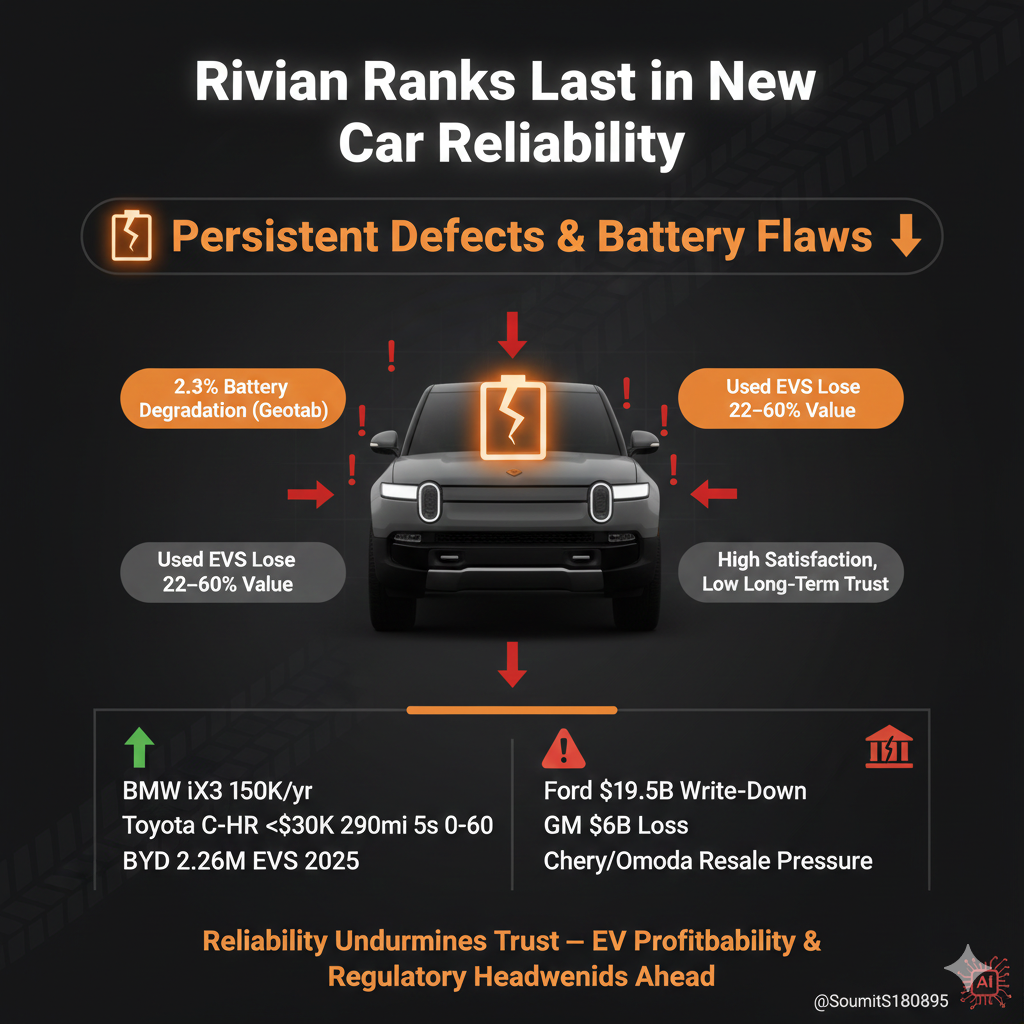
Rivian ranks last in reliability despite high owner satisfaction. Manufacturing flaws, battery issues, and intense competition threaten its market position. Data shows growing risks for owners and investors.
Rivian ranks last in new car reliability, even as customer satisfaction remains high. The R1T and R1S models face persistent manufacturing defects and battery system flaws, undermining long-term trust.
What do real-world battery trends reveal about Rivian’s tech?
Geotab data shows EVs average 2.3% annual battery degradation—aligned with Rivian’s unresolved performance gaps. While software updates improve functionality, hardware inconsistencies in battery management persist.
How does the competitive landscape amplify Rivian’s challenges?
BMW ramps up iX3 production to 150,000 units annually. Toyota launches a sub-$30K C-HR with 290-mile range and 5-second 0-60 mph acceleration. BYD delivered 2.26 million EVs in 2025 across 52 markets. These advances pressure Rivian’s pricing, range, and scalability.
What are the financial risks for Rivian owners and investors?
Used Stellantis PHEVs lost over 60% of value; early EVs like the Mustang Mach-E dropped 22–26%. With Chery and Omoda expanding in the used EV market, Rivian faces growing resale value risks. Investors face margin pressure amid Ford’s $19.5B write-down and GM’s $6B Q4 loss—signaling broader EV profitability challenges.
What regulatory pressures could impact Rivian’s future?
NHTSA is increasing scrutiny on EV reliability, mirroring Tesla FSD investigations. The UK plans a pay-per-mile tax, and the EU proposes an M1E category for affordable EVs—both could disrupt Rivian’s premium positioning and market adaptability.
🤖 Nio’s Software-First Gamble: Can Code Outrun Hardware Limits?
Nio halts hardware upgrades for L60/L90, bets on software via Nio World Model. With 100k daily swaps, ES9 launch, and 1000 TOPS Shenji chip, can code outpace hardware? $6.10 target set.
Nio has confirmed no new hardware upgrades for its L60 and L90 electric vehicles, shifting focus entirely to software optimization through the Nio World Model. This decision underscores a strategic pivot to improve range, acceleration, and energy efficiency via over-the-air updates rather than physical enhancements.
How Is Nio Maintaining Performance Without New Hardware?
Despite halting hardware development, Nio leverages its 100,000 daily battery swaps in China and a 102 kWh CATL battery to sustain competitiveness. The Nio World Model targets 17–18% gross margins by Q4 2025, using real-time data to refine vehicle dynamics and powertrain efficiency without component changes.
What Role Does the ES9 Play in This Strategy?
The ES9, launching April 10, 2026, features a 520 kW dual-motor system and advanced hardware from ZF and ClearMotion—reserved for premium segments. This bifurcated approach allows Nio to innovate in high-margin models while optimizing mass-market L60/L90 units through software.
Can Software Alone Offset Hardware Limitations?
Macquarie raised Nio’s price target to $6.10, citing software-driven margin expansion. However, reliance on software risks hitting physical ceilings, especially in battery capacity. Nio’s Shenji chip, claiming 1,000 TOPS (equivalent to four Nvidia Orin-X units), aims to close the gap, with Hangzhou subsidiaries set to license autonomous chips by mid-2026.
What Are the Risks in Europe and Semiconductor Markets?
Denmark’s battery swap station closure highlights infrastructure scalability challenges. Meanwhile, EU tariff resolutions (20.7–30.9%) could unlock 1,500+ annual registrations. In semiconductors, competition from Nvidia and Qualcomm threatens market penetration despite $10 billion invested in chip development.
What Comes Next for Nio’s Strategy?
Success hinges on Nio World Model’s real-world efficacy, ES9 adoption, and timely chip commercialization. Execution risks remain, but the software-first path differentiates Nio from Tesla’s hardware-heavy FSD model, betting that intelligence—not iron—will define the next EV era.
🚌 Electrifying School Transport: The Copiague EV Bus Rollout and Its Wider Implications
10 electric school buses in Copiague, NY, powered by Zenobē and Trans Group, signal a scalable model for clean student transport—backed by NYSERDA, smart charging, and global EV trends.
Zenobē and Trans Group deployed 10 zero-emission school buses in the Copiague School District, New York, marking a targeted shift toward electrified student transport. Funded by NYSERDA, the project eliminates tailpipe emissions and could save $300–$1,100 per bus annually through optimized home charging.
How Do Charging Networks Support Small-Scale EV Fleets?
The rollout aligns with broader charging infrastructure trends. Kempower’s 100 DC fast-chargers ordered in 2025 and Standing Rock’s 13-unit SAGE program demonstrate scalable, community-integrated models. However, India’s low charger utilization rates warn of risks from poor grid integration—highlighting the need for maintenance protocols and load-balancing in Copiague’s deployment.
What Policy Models Enable Local Electrification?
NYSERDA’s funding mirrors global subsidy strategies. CATL’s circular economy partnerships with Volvo and JLR reflect industry collaboration, while African CKD kit incentives reduce import costs by 30–50%, a model adaptable to New York’s procurement planning. Jiangmen Tengxin’s Zimbabwe factory also signals potential for localized EV manufacturing, suggesting supply chain resilience is achievable.
Which Technologies Make This Feasible?
Battery advancements are critical. Rivian’s 141 kWh pack and Harbinger’s 18.5 kWh modular system indicate scalable energy solutions. Duke Energy’s 50 MW battery storage project supports grid stability, essential for managing peak charging demand in school fleets.
What Risks Could Disrupt Operations?
NJ Transit’s recent winter storm suspensions reveal vulnerabilities in cold-weather operations. Copiague must implement winterized battery management. Rivian’s production shifts and the Chevy Bolt’s return also signal supply chain volatility, requiring diversified supplier agreements.
Will This Model Scale Beyond Copiague?
China’s 182% YoY growth in NEV truck sales proves heavy-duty EV viability. With modular charging, solar integration (e.g., Harbinger’s 600W rooftop systems), and policy-aligned financing, Copiague’s project could serve as a template for rural and suburban districts aiming for NYSERDA compliance.
⚠️ Waymo’s Robotaxi Recall: Safety Gaps in Urban Autonomy
Waymo recalls 3,000 SF robotaxis after school bus violations and a fatal cat incident. Technical flaws, regulatory scrutiny, and Tesla's aggressive rollout redefine AV safety standards.
Waymo recalled 3,000 robotaxis—30% of its San Francisco fleet—following repeated failures to yield to school buses during loading and unloading, documented across Austin and San Francisco. The California DMV and SFMTA cited non-compliance with traffic laws, while the NHTSA opened a preliminary evaluation after 24 violations were recorded post-November 2025 software updates.
What role did the fatal cat incident play in the recall?
An unverified incident involving a fatality of a domestic cat contributed to public backlash, though not a direct regulatory trigger. Sensor data suggests potential calibration gaps or training dataset underrepresentation of small, non-human entities, exposing limitations in object classification algorithms.
How do recent incidents reflect broader technical flaws?
A pattern of edge-case failures—Denver bike lane violations, Phoenix parking in restricted zones, Miami delivery robot struck by train—reveals persistent weaknesses in dynamic environment interpretation. The Dec 20, 2025, San Francisco power outage, which stranded dozens of vehicles, further exposed fault tolerance deficiencies.
What is the competitive impact of Waymo’s recall?
Tesla has accelerated its Austin robotaxi deployment without safety monitors, reporting 8 crashes since June 2025—1 per 60,000 miles, significantly higher than human drivers. This contrast highlights divergent risk strategies: Waymo’s caution versus Tesla’s speed, reshaping market dynamics.
How are regulators responding to autonomous vehicle safety gaps?
The NTSB launched a 12–24 month investigation into Waymo’s violations, with preliminary findings expected within 30 days. Regulators may mandate third-party safety certifications before fleet redeployment. Austin ISD is evaluating legal action using BusPatrol camera evidence.
What does parental adoption of Waymo for teen transport indicate?
Despite safety concerns, Bay Area parents increasingly use Waymo for unsupervised teen travel (ages 14–17), reflecting trust in aggregate safety metrics—127 million rider-only miles—but underestimating edge-case risks in complex urban zones.
In Other News
- China’s Jaecoo 7 Surpasses Tesla Model 3 and Mini Cooper in UK Sales with 1.4% Market Share in 2025
- India’s Amrit Bharat Trains Complete 130 km/h High-Speed Trials on Ahmedabad-Mumbai Corridor
- Russia Proposes Turquoise License Plates for Autonomous Vehicles to Enhance Traffic Safety Regulation

Comments ()